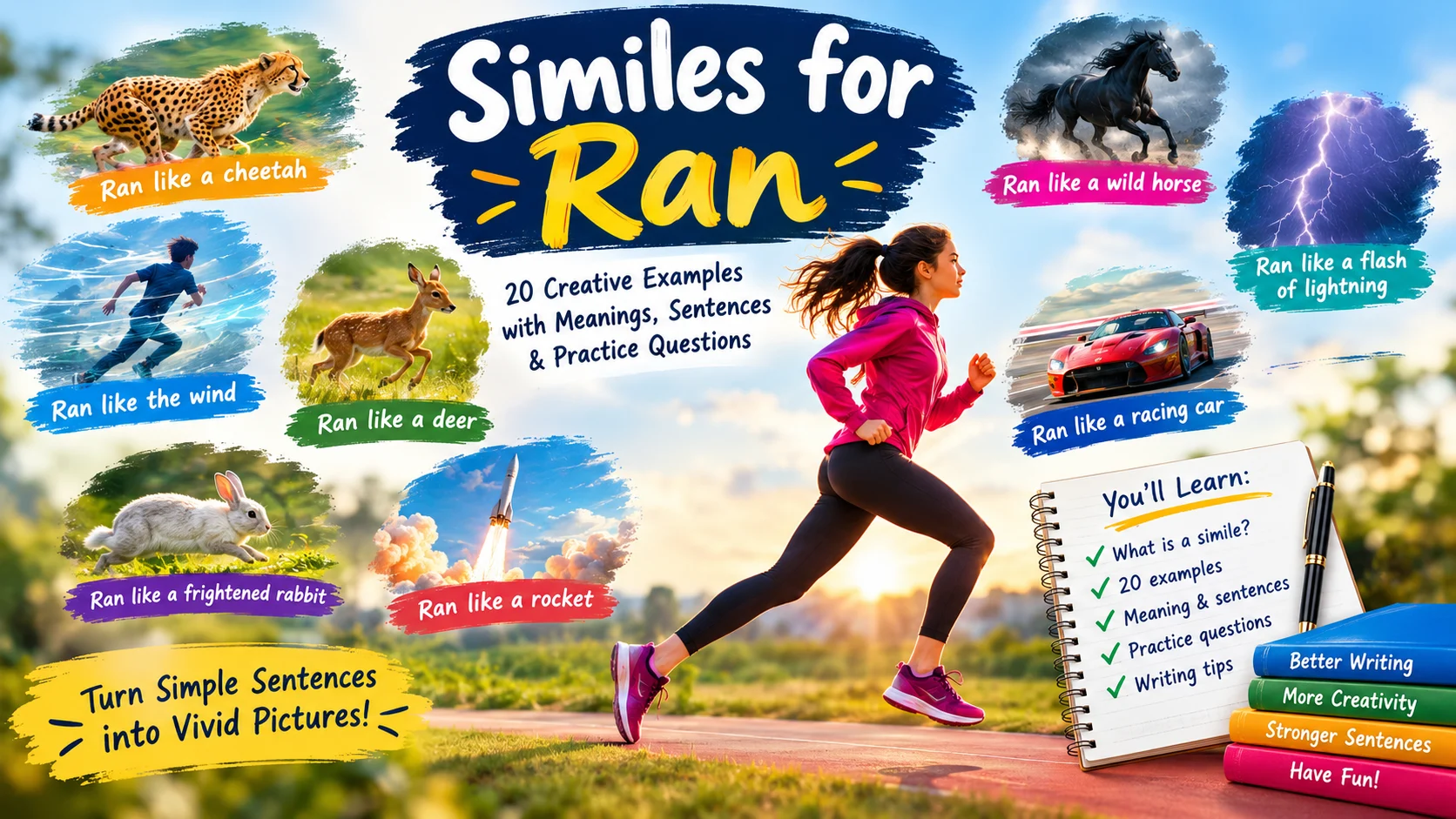
Have you ever wanted to describe how someone ran in a more exciting way? The word ran tells us what happened, but it does not always show us how fast, smoothly, or wildly someone moved. That is where similes can help!
Similes for ran compare running to something familiar. They often use the words like or as to help readers picture an action. For example, you might say, “He ran like a cheetah.” This tells us that he ran very fast.
Similes make stories more fun and help readers imagine what is happening. They can show speed, fear, excitement, effort, or even a funny moment. You can use them in school essays, short stories, poems, and everyday writing.
In this guide, we will explore 20 creative similes for running, explain what each one means, and show you how to use it in a sentence. You will also find a short practice exercise to help you learn how to create your own similes.
Let’s get started and make your writing more lively!
What Is a Simile for Ran?
A simile is a figure of speech that compares two different things using words such as like or as.
For example:
- He ran like the wind. This means he ran very fast.
- She ran as fast as a deer. This compares her speed to a quick animal.
- The boy ran like a frightened rabbit. This shows that he ran away because he was scared.
In simple terms, a simile helps readers picture an action instead of just reading about it.
20 Similes for Ran
Here are 20 creative writing similes for ran, each with its meaning and example sentences.
He Ran Like the Wind
Meaning: He ran very fast.
This simile compares a runner’s speed to the wind. It creates a picture of someone moving quickly.
Examples:
- He ran like the wind to catch the school bus.
- The young athlete ran like the wind across the field.
She Ran Like a Cheetah
Meaning: She ran extremely fast.
Cheetahs are known for their speed, making them a great comparison for a fast runner.
Examples:
- She ran like a cheetah to reach the finish line.
- My sister ran like a cheetah during the school race.
He Ran Like a Deer
Meaning: He ran quickly and gracefully.
This simile suggests that the person moved with speed and ease.
Examples:
- He ran like a deer through the green meadow.
- The boy ran like a deer when he heard his friends calling.
She Ran Like a Frightened Rabbit
Meaning: She ran away because she was scared.
This comparison helps readers imagine someone escaping from danger.
Examples:
- She ran like a frightened rabbit when the dog barked.
- The little girl ran like a frightened rabbit into her mother’s arms.
He Ran Like a Rocket
Meaning: He started running with great speed and energy.
A rocket launches quickly, so this simile suggests a sudden burst of speed.
Examples:
- He ran like a rocket when the race began.
- The player ran like a rocket toward the ball.
She Ran Like a Wild Horse
Meaning: She ran freely and powerfully.
This simile creates an image of strength, freedom, and energy.
Examples:
- She ran like a wild horse across the open field.
- The excited girl ran like a wild horse toward the playground.
He Ran Like a Machine
Meaning: He ran steadily and without slowing down.
This comparison suggests that the runner kept a regular pace and showed great endurance.
Examples:
- He ran like a machine throughout the long race.
- The athlete ran like a machine during his daily training.
She Ran Like a Flash of Lightning
Meaning: She ran extremely quickly.
Lightning appears in an instant, making it a strong image for sudden speed.
Examples:
- She ran like a flash of lightning to catch the train.
- The goalkeeper ran like a flash of lightning toward the ball.
He Ran Like a Rabbit Being Chased
Meaning: He ran away very quickly to escape something.
This simile suggests fear and urgency.
Examples:
- He ran like a rabbit being chased when the angry dog approached.
- The children ran like rabbits being chased when the rain began.
She Ran as Fast as an Arrow
Meaning: She moved quickly toward a target.
An arrow flies swiftly in one direction, creating an image of speed and purpose.
Examples:
- She ran as fast as an arrow toward the finish line.
- The girl ran as fast as an arrow to meet her father.
He Ran Like a Tornado
Meaning: He ran with wild energy and movement.
This simile suggests that the runner moved quickly and caused a lot of commotion.
Examples:
- He ran like a tornado through the busy playground.
- The excited puppy ran like a tornado around the living room.
She Ran Like a Fox
Meaning: She ran quickly and cleverly.
Foxes are often linked with cleverness and agility, so this simile can suggest quick, skillful movement.
Examples:
- She ran like a fox through the narrow path.
- The player ran like a fox past the defenders.
He Ran Like a Marathon Runner
Meaning: He ran with endurance and determination.
This simile focuses on stamina rather than just speed.
Examples:
- He ran like a marathon runner despite the hot weather.
- My brother ran like a marathon runner until he reached home.
She Ran Like a Flying Bird
Meaning: She ran lightly and freely.
This comparison gives the reader a sense of freedom and effortless movement.
Examples:
- She ran like a flying bird across the open grass.
- The little girl ran like a flying bird toward her friends.
He Ran Like a Racing Car
Meaning: He ran at a very high speed.
This simile compares a runner to a fast-moving car.
Examples:
- He ran like a racing car when the whistle blew.
- The young player ran like a racing car down the field.
She Ran Like a Shadow
Meaning: She moved quickly and quietly.
This simile suggests that someone moved so silently that others hardly noticed.
Examples:
- She ran like a shadow through the dark hallway.
- The spy ran like a shadow past the sleeping guard.
He Ran Like an Athlete in Training
Meaning: He ran with focus and discipline.
This simile suggests that the runner was serious about his goal.
Examples:
- He ran like an athlete in training during the morning race.
- The boy ran like an athlete in training around the school track.
She Ran Like a Storm
Meaning: She ran with great force and energy.
This comparison creates an image of powerful, unstoppable movement.
Examples:
- She ran like a storm toward the finish line.
- The excited player ran like a storm across the field.
He Ran Like a Clock Was Ticking
Meaning: He ran in a hurry because he had little time.
This simile suggests urgency and pressure.
Examples:
- He ran like a clock was ticking to reach his exam hall.
- She ran like a clock was ticking to catch her flight.
She Ran as Though Her Feet Had Wings
Meaning: She ran lightly and very quickly.
This imaginative simile makes it seem as if running takes almost no effort.
Examples:
- She ran as though her feet had wings across the playground.
- The happy child ran as though her feet had wings toward the ice cream truck.
How to Use Similes for Ran in Your Writing
You can use similes to make your sentences clearer and more interesting. The best comparison depends on what you want your reader to imagine.
- To show speed: He ran like the wind.
- To show fear: She ran like a frightened rabbit.
- To show strength: He ran like a wild horse.
- To show quiet movement: She ran like a shadow.
- To show urgency: He ran like a clock was ticking.
- To show freedom: She ran as though her feet had wings.
Try to choose a simile that fits the scene. If a character is scared, a rabbit comparison may work well. If a character is racing to win, a rocket or racing car may be a better choice.
Remember, you do not need a simile in every sentence. One clear, fitting comparison can make your writing much stronger.
Practice Exercise: Test Your Knowledge
Complete these 10 questions to practice identifying and creating similes.
Questions
Complete the simile:
- He ran like the ______ to catch the bus.
- She ran as fast as a ______.
- The frightened boy ran like a scared ______.
- He ran like a ______ launching into space.
- She ran like a shadow, moving quickly and ______.
Choose the best answer:
- – Which simile best shows fear?
- A. Ran like a frightened rabbit
- B. Ran like a machine
- C. Ran like a racing car
- – Which simile best shows steady effort?
- A. Ran like a tornado
- B. Ran like a machine
- C. Ran like lightning
– What does “ran like the wind” mean?
A. Ran very slowly
B. Ran very fast
C. Stopped running
Create your own simile:
- Complete this sentence: “The athlete ran like ______.”
- Write a simile that shows someone running because they are late.
Answers and Explanations
- The wind: This is a common comparison for running very fast.
- A cheetah: Cheetahs are famous for their speed.
- Rabbit: A frightened rabbit suggests someone escaping from danger.
- Rocket: A rocket suggests a sudden burst of speed.
- Quietly: A shadow suggests silent movement.
- A: A frightened rabbit is associated with fear and escape.
- B: A machine suggests steady, consistent effort.
- B: “Ran like the wind” means running very quickly.
- Example: The athlete ran like a racing car. This suggests great speed.
- Example: She ran like the wind to catch the train. This shows urgency and speed.
Your answers to the last two questions may be different. The goal is to create a comparison that clearly expresses the idea.
Conclusion
Similes for ran can turn a simple sentence into a lively picture. Instead of saying someone ran quickly, you can say they ran like the wind, like a cheetah, or as though their feet had wings. Each comparison creates a different feeling and helps readers imagine the action.
The key is to choose a simile that fits your meaning. Use comparisons for speed, fear, strength, excitement, or urgency when they make your writing clearer.
Now it is your turn! Try creating three original similes for running. Think about animals, weather, machines, or things you see every day. With practice, you will learn how to use similes naturally and make your stories more creative and fun to read.

I am Beau Thomas, the Administrator at SimilyHub. I enjoy making similes, metaphors, and idioms easy to understand through clear explanations, helpful examples, and engaging content for English learners and writers.