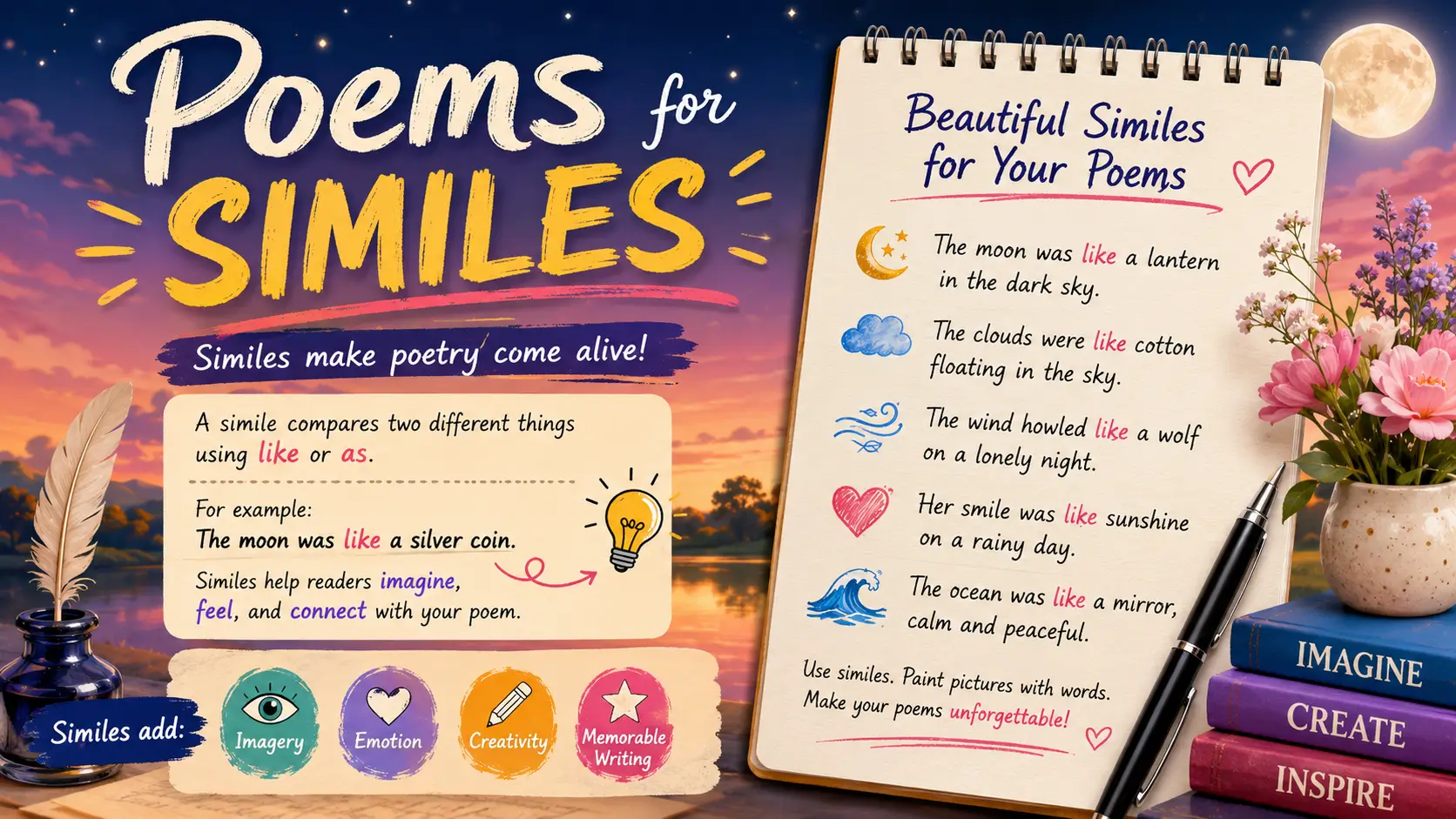
Have you ever read a poem and felt like you could see, hear, or feel every word? Similes often help make that happen. A simile compares two different things using words such as “like” or “as.” For example, “The moon was like a silver coin in the sky.” You know the moon is not really a coin, but the comparison helps you picture it.
Similes are especially useful in poems because they add color, emotion, and imagination. Instead of saying “The wind was strong,” a poet might say, “The wind roared like a wild animal.” Suddenly, the scene feels alive.
If you are learning creative writing, poems are a great place to practice similes. In simple terms, a good simile helps your reader imagine what you mean.
You may also see the phrase “strohl simile” in searches or learning materials. It is not a standard literary term. The main idea to focus on is simply understanding and using similes correctly.
Let’s explore some easy and creative poems for similes.
20 Similes for Poems
1. The Moon Was Like a Lantern
Simile: The moon was like a lantern in the dark sky.
Meaning: The moon looked bright and glowing.
What it conveys: This comparison creates a clear picture of the moon lighting up the night.
Example sentences:
- The moon was like a lantern above the quiet town.
- In the poem, the moon shone like a lantern.
2. Her Smile Was Like Sunshine
Simile: Her smile was like sunshine.
Meaning: Her smile was warm and cheerful.
What it conveys: It suggests that her smile made people feel happy.
Example sentences:
- Her smile was like sunshine on a cold morning.
- She smiled like sunshine breaking through the clouds.
3. The River Moved Like a Snake
Simile: The river moved like a snake through the valley.
Meaning: The river curved and twisted as it flowed.
What it conveys: The comparison helps readers picture the river’s winding path.
Example sentences:
- The river twisted like a snake between the hills.
- In the poem, the stream moved like a silver snake.
4. The Clouds Were Like Cotton
Simile: The clouds were like soft cotton in the sky.
Meaning: The clouds looked soft and fluffy.
What it conveys: This creates a gentle and peaceful image.
Example sentences:
- White clouds floated like cotton above us.
- The clouds looked like cotton pillows.
5. The Wind Howled Like a Wolf
Simile: The wind howled like a wolf.
Meaning: The wind made a loud, haunting sound.
What it conveys: This gives the poem a mysterious or scary feeling.
Example sentences:
- The winter wind howled like a lonely wolf.
- Outside the window, the wind cried like a wolf.
6. Her Voice Was Like Music
Simile: Her voice was like music to my ears.
Meaning: Her voice sounded beautiful and pleasant.
What it conveys: The comparison shows how much the speaker enjoyed hearing her.
Example sentences:
- Her voice was like music on a quiet evening.
- The singer’s voice sounded like music flowing through the room.
7. The Stars Shone Like Diamonds
Simile: The stars shone like diamonds.
Meaning: The stars looked bright and sparkling.
What it conveys: It makes the night sky seem beautiful and magical.
Example sentences:
- The stars glittered like diamonds above the sea.
- Tiny stars shone like diamonds in the dark.
8. His Heart Was Like a Drum
Simile: His heart beat like a drum.
Meaning: His heart was beating very fast or strongly.
What it conveys: The comparison helps readers feel excitement, fear, or nervousness.
Example sentences:
- Her heart beat like a drum before the performance.
- His heart pounded like a drum when he heard the news.
9. The Snow Was Like a Blanket
Simile: The snow covered the ground like a white blanket.
Meaning: Snow spread across the ground and covered it completely.
What it conveys: It creates a peaceful winter image.
Example sentences:
- Snow lay like a blanket over the sleeping village.
- The white snow covered the fields like a blanket.
10. The Sun Was Like a Golden Ball
Simile: The sun was like a golden ball in the morning sky.
Meaning: The sun looked round, bright, and golden.
What it conveys: This creates a warm and cheerful picture.
Example sentences:
- The sun rose like a golden ball.
- Above the hills, the sun looked like a golden ball.
11. The Rain Fell Like Tears
Simile: The rain fell like tears from the gray sky.
Meaning: The rain looked like falling tears.
What it conveys: It can create a sad or emotional mood.
Example sentences:
- Rain fell like tears on the empty street.
- The clouds wept like a child, and rain fell like tears.
12. The Leaves Danced Like Children
Simile: The leaves danced like children in the wind.
Meaning: The leaves moved quickly and playfully.
What it conveys: This gives the leaves a lively and joyful feeling.
Example sentences:
- Autumn leaves danced like children around my feet.
- The leaves moved like happy children in the breeze.
13. The Night Was Like Velvet
Simile: The night was like dark velvet.
Meaning: The night looked smooth, dark, and rich.
What it conveys: This creates a soft and beautiful picture of nighttime.
Example sentences:
- The sky was like velvet scattered with stars.
- The quiet night felt like dark velvet around us.
14. The Fire Was Like a Dragon
Simile: The fire roared like a dragon.
Meaning: The fire was loud, powerful, and fierce.
What it conveys: This makes the fire seem strong and almost alive.
Example sentences:
- The campfire roared like a dragon.
- Flames rose like a dragon from the burning wood.
15. His Words Were Like Arrows
Simile: His words were like arrows.
Meaning: His words were sharp and hurtful.
What it conveys: The comparison shows the emotional power of his speech.
Example sentences:
- Her cruel words struck like arrows.
- His words were like arrows aimed at my heart.
16. The Ocean Was Like a Mirror
Simile: The ocean was like a giant mirror.
Meaning: The water was calm and reflected the sky.
What it conveys: This gives the reader a peaceful picture of the sea.
Example sentences:
- The calm ocean looked like a giant mirror.
- At sunrise, the sea was like a shining mirror.
17. The Boy Ran Like the Wind
Simile: The boy ran like the wind.
Meaning: He ran very quickly.
What it conveys: The comparison emphasizes speed.
Example sentences:
- He ran like the wind toward the finish line.
- The young athlete moved like the wind.
18. Her Eyes Sparkled Like Stars
Simile: Her eyes sparkled like stars.
Meaning: Her eyes looked bright and shining.
What it conveys: This can suggest happiness, excitement, or beauty.
Example sentences:
- Her eyes sparkled like stars when she opened the gift.
- The child’s eyes shone like stars with excitement.
19. The Morning Was Like a Fresh Start
Simile: The morning was like a fresh start.
Meaning: The new day felt full of hope and possibility.
What it conveys: This simile gives the poem an optimistic feeling.
Example sentences:
- The quiet morning felt like a fresh start.
- Each sunrise was like a fresh start for her.
20. The Little Bird Sang Like a Singer
Simile: The little bird sang like a skilled singer.
Meaning: The bird made a beautiful sound.
What it conveys: The comparison highlights the beauty of the bird’s song.
Example sentences:
- The bird sang like a singer in the early morning.
- From the tree, the robin sang like a tiny singer.
How to Identify Similes in Poems
Finding a simile is easy once you know what to look for.
First, look for comparison words such as like and as.
For example:
The moon was like a silver plate.
The moon and a silver plate are different things, but the poet compares them because both can look round and bright.
You can also ask yourself:
- What two things are being compared?
- Does the sentence use like or as?
- What quality do the two things share?
- What picture does the comparison create?
- Does the simile make the poem more vivid?
Remember that not every use of “like” is a simile. In “I like poetry,” there is no comparison. A true simile compares one thing with another.
How to Use Similes in Your Own Poems
Writing a simile can be simple.
Start with an ordinary idea.
Ordinary sentence:
The rain was heavy.
Now ask, “What is heavy rain like?”
You might write:
The rain fell like a waterfall.
You can also start with an emotion.
Ordinary sentence:
I was nervous.
Turn it into a comparison:
My heart beat like a drum.
This is one of the easiest ways to create creative writing similes. Think about what something looks, sounds, feels, or moves like.
Practical Exercise: 10 Simile Questions
Try these questions before checking the answers.
1. Identify the simile
The moon was like a silver coin.
What two things are being compared?
2. Complete the simile
The stars sparkled like ________.
a) rocks
b) diamonds
c) mud
3. Identify the comparison
The boy ran like the wind.
What is being compared to the wind?
4. Complete the sentence
Her voice was as sweet as ________.
a) honey
b) stone
c) thunder
5. Is this a simile?
The clouds were fluffy like cotton.
Yes or no?
6. Find the simile
Which sentence contains a simile?
a) The bird flew away.
b) The bird flew like an arrow.
c) The bird sat on the branch.
7. Complete the simile
The snow covered the ground like a ________.
a) blanket
b) pencil
c) window
8. What does this simile mean?
His heart beat like a drum.
Does it mean:
a) His heart was beating strongly or quickly.
b) His heart stopped.
c) He was sleeping.
9. Create your own simile
Complete this sentence:
The sun was like __________.
10. Create a simile about happiness
Complete:
She was as happy as __________.
Answers and Explanations
1. Silver coin
Answer: The moon is compared to a silver coin.
The comparison helps readers imagine the moon as round and bright.
2. Diamonds
Answer: b) diamonds
Stars are often compared to diamonds because both can sparkle and shine.
3. The boy
Answer: The boy’s running is compared to the wind.
It shows that he was running very fast.
4. Honey
Answer: a) honey
Honey is sweet, so this comparison suggests that her voice sounded pleasant.
5. Yes
Answer: Yes.
The sentence compares clouds with cotton using the word like.
6. The bird flew like an arrow.
Answer: b) The bird flew like an arrow.
The comparison shows that the bird moved quickly and directly.
7. Blanket
Answer: a) blanket
The comparison shows how the snow covered the ground.
8. Strongly or quickly
Answer: a) His heart was beating strongly or quickly.
This simile can show fear, excitement, nervousness, or anticipation.
9. Many answers are possible.
For example:
The sun was like a golden ball.
The important thing is that your answer creates a clear comparison.
10. Many answers are possible.
For example:
She was as happy as a child on a holiday.
A good answer should compare happiness with something that clearly suggests joy.
Why Similes Matter in Poetry
Similes do more than make poems sound pretty. They help readers see, hear, feel, and imagine what the poet means.
Compare these two sentences:
Without a simile:
The ocean was calm.
With a simile:
The ocean was like a giant mirror.
The second sentence gives you a stronger mental picture. You can imagine the smooth water reflecting the sky.
That is why poets use similes so often. They turn simple ideas into memorable images.
Conclusion
Similes are powerful tools for poets and creative writers. They make ordinary ideas easier to picture and help readers connect with emotions, scenes, and experiences. A simple comparison can turn a plain sentence into something memorable.
As you read poems, look for comparisons using like and as. Ask yourself what is being compared and why the poet chose that image. Then try creating your own simile sentences.
Start with something simple. Compare the moon, rain, wind, stars, emotions, or even your favorite place to something familiar.
The more you practice, the easier it becomes to use similes naturally. So pick up a pencil, choose an idea, and write your own poetic comparison today.

I’m Evelyn Marie, an author passionate about similes, metaphors, and idioms. I enjoy explaining creative expressions simply, helping readers understand language and make their writing more engaging.