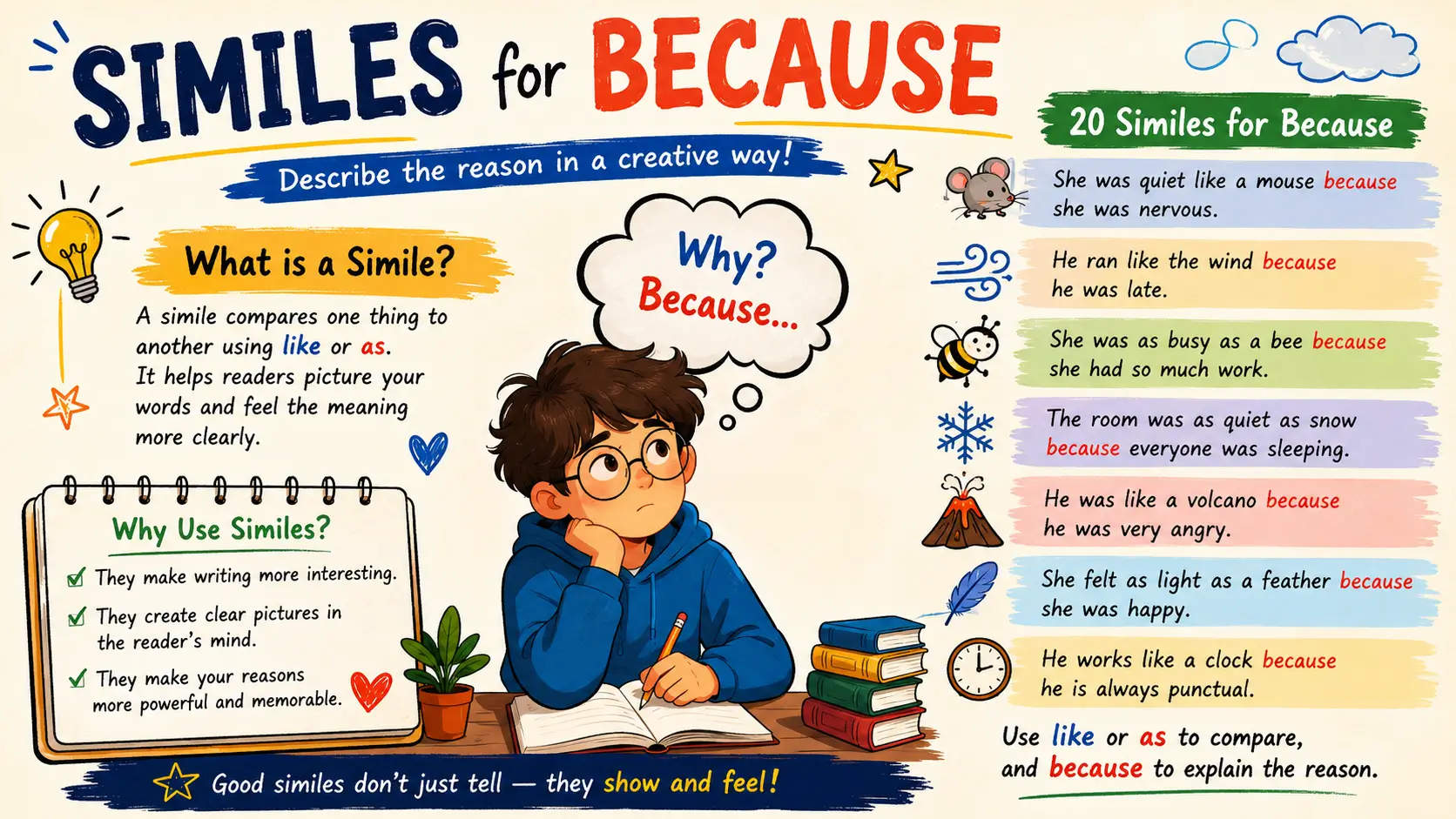
Have you ever wanted to explain why something happened in a more creative way? That is where similes can help. A simile compares one thing to another using words such as like or as. It makes an idea easier to picture and gives ordinary writing more life.
The keyword “similes for because” can be understood as looking for creative simile sentences that explain a reason, cause, or feeling. In simple terms, you can use a comparison to show why something happened in a vivid way.
For example, instead of saying, “She was quiet because she was nervous,” you might say, “She was quiet like a mouse because she was nervous.” The simile adds a clear picture to the sentence.
Let’s explore 20 creative writing similes that work naturally with because. You will also see their meanings, explanations, and examples. By the end, you will have a better idea of the meaning of similes, how to recognize them, and how to use similes in writing.
What Does “Similes for Because” Mean?
“Because” is not itself a type of simile. It is a word used to introduce a reason or cause.
A simile can appear in a sentence that contains “because.”
For example:
He ran like the wind because he was late.
The simile is “ran like the wind.” The word “because” explains the reason he ran.
You might say that similes help answer the question, “What was it like?”, while “because” helps answer “Why?”
Also, if you have seen the phrase “strohl simile,” it is not a standard literary term. You may be referring to simile, the common figure of speech that compares two different things using “like” or “as.”
20 Similes for Because
1. Like a Mouse Because She Was Nervous
Simile: She was quiet like a mouse because she was nervous.
Meaning: She became very quiet due to nervousness.
What it conveys: The comparison creates an image of someone being extremely quiet and careful.
Examples:
- She sat like a mouse because she was afraid to speak.
- He became quiet like a mouse because everyone was watching him.
2. Like the Wind Because He Was Late
Simile: He ran like the wind because he was late.
Meaning: He ran very quickly because he was behind schedule.
What it conveys: “Like the wind” gives a strong picture of great speed.
Examples:
- I ran like the wind because the bus was leaving.
- She hurried like the wind because she did not want to miss the train.
3. As Busy as a Bee Because of Work
Simile: She was as busy as a bee because she had three projects to finish.
Meaning: She was extremely busy.
What it conveys: The bee comparison suggests constant movement and activity.
Examples:
- Dad was as busy as a bee because guests were coming.
- The students were as busy as bees because exams were near.
4. Like a Statue Because He Was Shocked
Simile: He stood like a statue because he was shocked.
Meaning: He remained completely still after seeing something surprising.
What it conveys: The simile makes his stillness easy to imagine.
Examples:
- She stood like a statue because she could not believe the news.
- He froze like a statue because the loud noise startled him.
5. Like a Bear Because She Was Angry
Simile: She sounded like a bear because she was angry.
Meaning: Her voice sounded rough, loud, or frightening.
What it conveys: The bear comparison emphasizes her strong anger.
Examples:
- He growled like a bear because someone broke his favorite mug.
- She shouted like a bear because the children had made a huge mess.
6. Like Ice Because He Was Afraid
Simile: His hands felt like ice because he was afraid.
Meaning: His hands became very cold from fear.
What it conveys: The comparison gives a physical image of nervousness.
Examples:
- Her fingers were like ice because she was frightened.
- His hands felt like ice because he was waiting for the result.
7. Like a Rocket Because She Was Excited
Simile: She jumped like a rocket because she was excited.
Meaning: She moved suddenly and energetically.
What it conveys: A rocket suggests powerful, fast movement.
Examples:
- The children rushed like rockets because school was finally over.
- He jumped like a rocket because he heard the good news.
8. As Quiet as Snow Because Everyone Was Sleeping
Simile: The house was as quiet as snow because everyone was sleeping.
Meaning: The house was completely peaceful and silent.
What it conveys: Snow suggests calmness and silence.
Examples:
- The room was as quiet as snow because the baby was asleep.
- The street was as quiet as snow because it was very late.
9. Like a Thunderstorm Because He Was Furious
Simile: He was like a thunderstorm because he was furious.
Meaning: His anger was powerful and intense.
What it conveys: A thunderstorm suggests loudness, force, and sudden anger.
Examples:
- Dad looked like a thunderstorm because the car had been damaged.
- She entered like a thunderstorm because she was extremely upset.
10. Like a Bird Because She Felt Free
Simile: She danced like a bird because she felt free.
Meaning: She moved happily and freely.
What it conveys: The bird comparison suggests lightness, joy, and freedom.
Examples:
- He ran like a bird because he finally felt free.
- She moved like a bird because she was celebrating.
11. Like a Snail Because He Was Tired
Simile: He walked like a snail because he was tired.
Meaning: He moved very slowly.
What it conveys: A snail is commonly associated with slow movement.
Examples:
- I walked like a snail because I had been awake all night.
- She moved like a snail because she had no energy left.
12. Like a Lion Because She Was Brave
Simile: She spoke like a lion because she was brave.
Meaning: She spoke with courage and confidence.
What it conveys: The lion represents strength and bravery.
Examples:
- He stood like a lion because he wanted to defend his friend.
- She answered like a lion because she was not afraid.
13. Like a Broken Record Because He Was Worried
Simile: He repeated the question like a broken record because he was worried.
Meaning: He kept saying the same thing again and again.
What it conveys: The comparison shows repetition caused by concern.
Examples:
- Mom asked about my homework like a broken record because she was worried.
- He kept checking the door like a broken record because he expected someone.
14. As Red as a Tomato Because She Was Embarrassed
Simile: She was as red as a tomato because she was embarrassed.
Meaning: Her face became very red.
What it conveys: The tomato comparison makes her embarrassment easy to visualize.
Examples:
- He turned as red as a tomato because everyone laughed.
- Her face became as red as a tomato because she made a mistake.
15. Like a Shadow Because He Was Lonely
Simile: He followed his friend like a shadow because he was lonely.
Meaning: He stayed very close to his friend.
What it conveys: A shadow suggests someone who stays nearby.
Examples:
- The little boy followed his sister like a shadow because he felt lonely.
- She stayed beside her friend like a shadow because she did not want to be alone.
16. Like a Firecracker Because He Was Excited
Simile: He was like a firecracker because he was excited about the party.
Meaning: He was full of energy and excitement.
What it conveys: A firecracker suggests sudden energy and lively action.
Examples:
- The children were like firecrackers because the holiday had started.
- He jumped around like a firecracker because his team won.
17. Like a Deer Because She Was Surprised
Simile: She looked like a deer because she was surprised.
Meaning: She looked shocked, confused, or unsure of what to do.
What it conveys: The comparison creates an image of someone suddenly startled.
Examples:
- He stared like a deer because the magician disappeared.
- She looked like a deer because nobody had warned her about the surprise.
18. Like a Volcano Because He Was Angry
Simile: He was like a volcano because he was angry.
Meaning: His anger was building and ready to burst out.
What it conveys: A volcano represents powerful emotions that suddenly erupt.
Examples:
- Dad was like a volcano because the window had been broken.
- She looked like a volcano because she had been waiting for hours.
19. As Light as a Feather Because She Was Happy
Simile: She felt as light as a feather because she was happy.
Meaning: She felt carefree and joyful.
What it conveys: The feather suggests a feeling without worry or heaviness.
Examples:
- He felt as light as a feather because he had passed the test.
- She walked as lightly as a feather because her worries were gone.
20. Like a Clock Because He Was Punctual
Simile: He arrived like clockwork because he was always punctual.
Meaning: He arrived reliably and on time.
What it conveys: The comparison shows regularity and dependability.
Examples:
- She comes to class like clockwork because she values being on time.
- The train arrived like clockwork because the schedule was reliable.
How to Use Similes in Writing
Using similes does not have to be difficult. Start with the idea you want to describe. Then ask yourself:
“What does this remind me of?”
For example, suppose you want to describe someone who is very nervous.
You could write:
He was nervous.
That is clear, but it is plain.
Now add a simile:
He was as nervous as a rabbit because he had to speak in front of the class.
The second sentence creates a stronger picture.
Here are a few simple steps:
- Choose the feeling or action.
- Think of something that behaves in a similar way.
- Use “like” or “as.”
- Add “because” if you need to explain the reason.
- Read the sentence aloud.
- Make sure the comparison makes sense.
Remember, good creative writing similes should help the reader see, feel, or understand an idea.
Practical Exercise: 10 Simile Questions
Try these questions before checking the answers.
1. Complete the simile:
He ran like ______ because he was late.
2. Identify the simile:
“She was as quiet as a mouse because the baby was sleeping.”
3. Complete the sentence:
His face became as red as a ______ because he was embarrassed.
4. What does this simile mean?
“She moved like a snail because she was tired.”
5. Find the simile:
“He stood like a statue because he was shocked.”
6. Complete the simile:
She was as busy as a ______ because she had many tasks.
7. What does “like the wind” suggest?
“He ran like the wind because the bus was leaving.”
8. Create a simile for someone who is very angry.
Use because in your sentence.
9. Create a simile for someone who is very happy.
Use like or as.
10. Is this a simile?
“He was angry because his phone broke.”
Explain your answer.
Answers and Explanations
1. Answer: the wind
Sentence: He ran like the wind because he was late.
Explanation: “Like the wind” compares his speed to the fast movement of wind.
2. Answer: as quiet as a mouse
Explanation: This is the simile because it compares her quietness to a mouse using “as.”
3. Answer: tomato
Sentence: His face became as red as a tomato because he was embarrassed.
Explanation: The tomato comparison shows how red his face became.
4. Answer:
It means she moved very slowly because she was tired.
Explanation: A snail is known for slow movement.
5. Answer: like a statue
Explanation: This compares his stillness to a statue.
6. Answer: bee
Sentence: She was as busy as a bee because she had many tasks.
Explanation: Bees are associated with constant activity.
7. Answer:
“Like the wind” suggests that he ran very quickly.
Explanation: The wind creates an image of speed.
8. Example answer:
He was like a volcano because he was furious.
Explanation: A volcano suggests anger that can suddenly erupt.
9. Example answer:
She smiled like sunshine because she was happy.
Explanation: Sunshine suggests warmth, brightness, and joy.
10. Answer: No.
Explanation: “He was angry because his phone broke” contains a reason, but it does not contain a comparison. A simile would be:
He was like a volcano because his phone broke.
Common Mistakes to Avoid
When writing simile sentences, beginners sometimes make a few simple mistakes.
Using a comparison that does not fit
A simile should make sense to the reader. Avoid comparisons that confuse your audience.
Forgetting the comparison word
A traditional simile usually uses like or as.
For example:
- Simile: She is as fast as a cheetah.
- Not a simile: She is a cheetah.
The second sentence is a metaphor rather than a simile.
Adding too many similes
One strong comparison can be better than five weak ones. Let each simile do useful work.
Confusing “because” with a simile
“Because” explains why something happens. It does not create the comparison.
For example:
He cried because he was sad.
There is no simile.
But:
He cried like a baby because he was sad.
Now the sentence contains a simile.
Why Similes Make Writing Better
A simple sentence tells readers what happened. A strong simile can help them picture what happened.
Compare these:
The girl was nervous.
And:
The girl was as nervous as a rabbit because she had to speak on stage.
The second sentence gives the reader a clearer image.
This is why examples of similes are useful for students, bloggers, poets, storytellers, and anyone learning creative writing. Similes can make descriptions more memorable without making the writing difficult to understand.
They are especially helpful when describing:
- Feelings
- People
- Actions
- Nature
- Sounds
- Colors
- Speed
- Appearance
- Mood
- Everyday experiences
Conclusion
Similes are simple but powerful tools for creative writing. They help readers picture an action, feeling, or person by comparing one thing with another. When you add because, you can also explain the reason behind the action.
For example, “He ran like the wind because he was late” tells us both how he ran and why he ran.
The key is to keep your comparisons clear, natural, and useful. You do not need complicated words to write a good simile. Start with something familiar, use like or as, and connect it to the idea you want your reader to understand.
Now it is your turn. Pick an ordinary sentence and make it more vivid with a creative simile. You might be surprised by how much more interesting your writing becomes!

I am Beau Thomas, the Administrator at SimilyHub. I enjoy making similes, metaphors, and idioms easy to understand through clear explanations, helpful examples, and engaging content for English learners and writers.