Have you ever said, “I’m as busy as a bee” or “Her smile was like sunshine”? If so, you have already used a simile! Similes and metaphors are simple tools that make writing more colorful, clear, and fun.
When students learn about figurative language, they learn more than just definitions. They learn how to describe feelings, people, places, and ideas in creative ways. Good learning objectives for similes and metaphors help students know exactly what they should understand and be able to do.
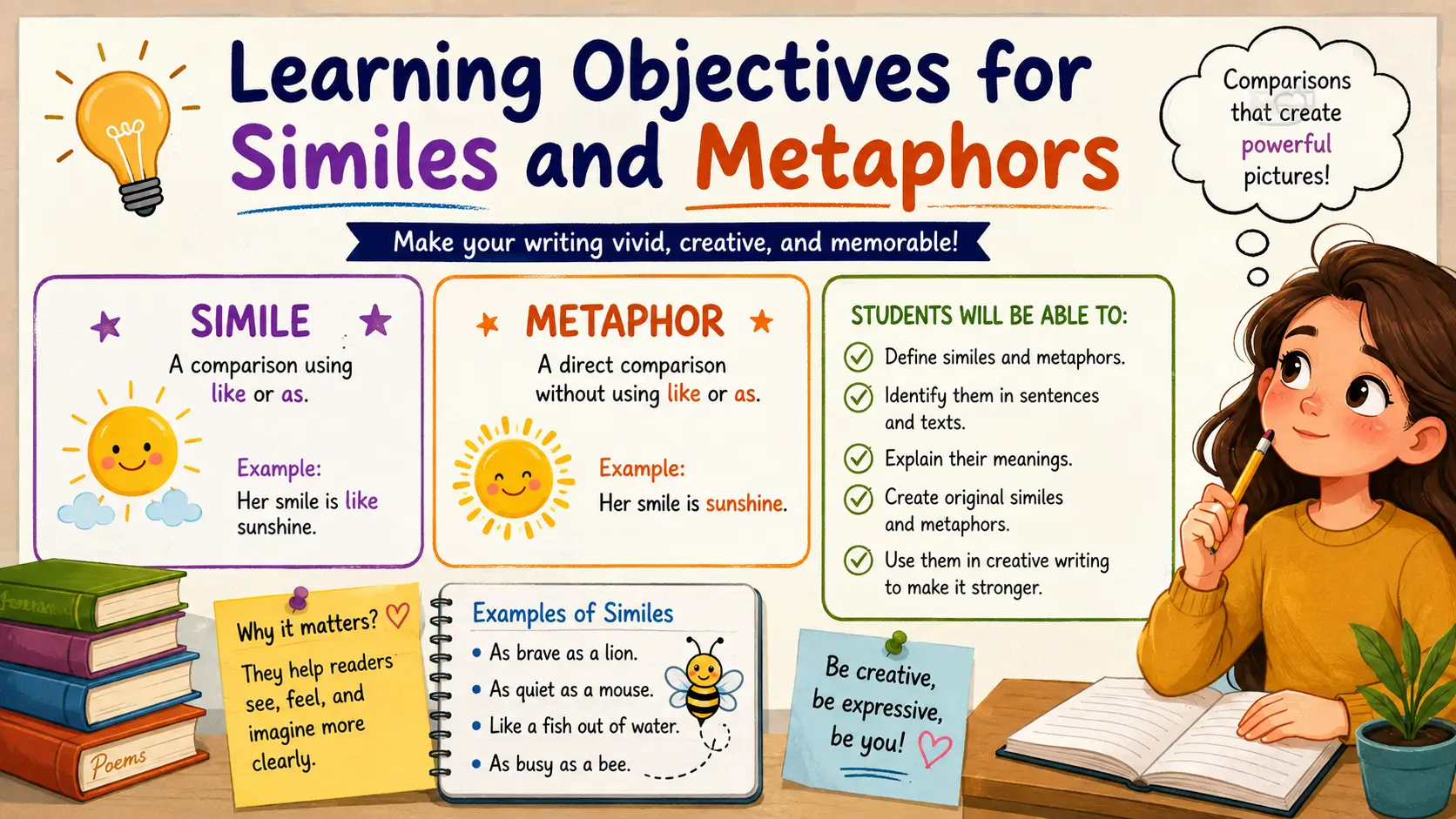
In simple terms, a simile compares two different things using “like” or “as.” A metaphor makes a direct comparison without using those words. For example, “The baby slept like a log” is a simile, while “The classroom was a zoo” is a metaphor.
Let’s explore useful learning objectives, examples of similes, and simple activities that can help you understand and use figurative language with confidence.
Learning Objectives for Similes and Metaphors
By the end of a lesson, students should be able to:
- Define a simile in their own words.
- Define a metaphor in their own words.
- Identify similes in sentences and short texts.
- Identify metaphors in sentences and short texts.
- Explain the meaning of similes.
- Explain what a metaphor compares.
- Recognize words such as like and as in similes.
- Create original similes.
- Create simple metaphors.
- Use figurative language in their own writing.
- Explain how comparisons make writing stronger.
- Replace plain descriptions with creative comparisons.
- Distinguish between literal and figurative language.
- Write effective simile sentences.
- Use sensory details when creating comparisons.
- Improve descriptive writing with figurative language.
- Find examples of similes and metaphors in stories or poems.
- Explain why a writer uses a particular comparison.
- Edit their own creative writing for stronger imagery.
- Use similes and metaphors naturally in creative writing.
These objectives give students a clear path from recognizing figurative language to creating it themselves.
20 Similes With Meanings and Examples
Here are 20 simple creative writing similes that students can study and use.
1. As busy as a bee
Simile: She was as busy as a bee before the school play.
Meaning: Very busy and active.
What it conveys: This comparison shows someone moving quickly and doing many tasks.
Examples:
- My mother was as busy as a bee getting ready for the party.
- The students were as busy as bees during art class.
2. As brave as a lion
Simile: The young girl was as brave as a lion.
Meaning: Very courageous.
What it conveys: A lion represents strength and courage.
Examples:
- He was as brave as a lion when he spoke in front of the class.
- The firefighter was as brave as a lion during the rescue.
3. As quiet as a mouse
Simile: The children were as quiet as mice during the test.
Meaning: Very quiet.
What it conveys: It creates a clear picture of complete silence.
Examples:
- Everyone became as quiet as a mouse when the teacher entered.
- The baby was as quiet as a mouse while sleeping.
4. As cold as ice
Simile: Her hands were as cold as ice.
Meaning: Extremely cold.
What it conveys: Ice gives the reader a strong feeling of coldness.
Examples:
- The water was as cold as ice.
- His fingers felt as cold as ice after playing outside.
5. As fast as lightning
Simile: The runner moved as fast as lightning.
Meaning: Extremely fast.
What it conveys: Lightning is sudden and very quick.
Examples:
- The rabbit ran as fast as lightning.
- She finished the race as fast as lightning.
6. As bright as the sun
Simile: Her yellow dress was as bright as the sun.
Meaning: Very bright or cheerful.
What it conveys: The comparison creates a strong image of brightness.
Examples:
- His smile was as bright as the sun.
- The room looked as bright as the sunlit sky.
7. Like a shining star
Simile: She stood on the stage like a shining star.
Meaning: She looked special, confident, or impressive.
What it conveys: A star suggests beauty, attention, and success.
Examples:
- The singer performed like a shining star.
- The student stood proudly like a shining star.
8. As gentle as a lamb
Simile: The nurse was as gentle as a lamb.
Meaning: Very gentle and kind.
What it conveys: A lamb is often associated with softness and gentleness.
Examples:
- He handled the tiny bird as gently as a lamb.
- The teacher spoke as gently as a lamb to the nervous child.
9. As strong as an ox
Simile: The farmer was as strong as an ox.
Meaning: Very strong.
What it conveys: The comparison highlights great physical strength.
Examples:
- My brother is as strong as an ox.
- The worker was as strong as an ox while carrying the boxes.
10. Like a fish out of water
Simile: I felt like a fish out of water at the new school.
Meaning: Feeling uncomfortable or out of place.
What it conveys: It shows that someone does not feel comfortable in a new situation.
Examples:
- He felt like a fish out of water at the formal dinner.
- I was like a fish out of water during my first dance lesson.
11. As light as a feather
Simile: The box was as light as a feather.
Meaning: Very light in weight.
What it conveys: A feather helps the reader imagine something extremely light.
Examples:
- The paper was as light as a feather.
- Her scarf felt as light as a feather.
12. As busy as an ant
Simile: The workers were as busy as ants.
Meaning: Very active and hardworking.
What it conveys: Ants are known for working together and staying active.
Examples:
- The students were as busy as ants before the exhibition.
- Everyone was as busy as ants preparing the classroom.
13. Like a roaring lion
Simile: The angry coach sounded like a roaring lion.
Meaning: Very loud and powerful.
What it conveys: The comparison makes the person’s voice seem strong and frightening.
Examples:
- Dad sounded like a roaring lion when he shouted.
- The speaker’s voice echoed like a roaring lion.
14. As smooth as silk
Simile: The fabric felt as smooth as silk.
Meaning: Very soft and smooth.
What it conveys: Silk gives the reader a clear sense of texture.
Examples:
- Her hair was as smooth as silk.
- The blanket felt as smooth as silk.
15. As hungry as a wolf
Simile: After the long hike, I was as hungry as a wolf.
Meaning: Extremely hungry.
What it conveys: The comparison emphasizes strong hunger.
Examples:
- I was as hungry as a wolf after football practice.
- The children were as hungry as wolves after swimming.
16. Like a rocket
Simile: The boy shot out of the classroom like a rocket.
Meaning: He moved away very quickly.
What it conveys: A rocket suggests sudden speed and energy.
Examples:
- She ran like a rocket toward the finish line.
- The dog raced like a rocket across the yard.
17. As sweet as honey
Simile: Her voice was as sweet as honey.
Meaning: Very pleasant and gentle.
What it conveys: Honey suggests sweetness and pleasure.
Examples:
- The singer’s voice was as sweet as honey.
- The child’s words were as sweet as honey.
18. Like a busy squirrel
Simile: He moved around like a busy squirrel.
Meaning: He was very active and energetic.
What it conveys: The comparison creates a playful picture of constant movement.
Examples:
- She ran around like a busy squirrel before the party.
- The children worked like busy squirrels to clean the room.
19. As clear as glass
Simile: The lake was as clear as glass.
Meaning: Extremely clear.
What it conveys: Glass gives the reader an image of something clean and easy to see through.
Examples:
- The water was as clear as glass.
- His explanation was as clear as glass.
20. Like a warm blanket
Simile: Her kind words felt like a warm blanket.
Meaning: Comforting and reassuring.
What it conveys: A warm blanket suggests safety, comfort, and peace.
Examples:
- His hug felt like a warm blanket on a cold night.
- Her friendly smile was like a warm blanket after a difficult day.
Similes and Metaphors: What’s the Difference?
The easiest way to remember the difference is this:
Simile = comparison using “like” or “as.”
Example:
The moon was like a silver coin.
Metaphor = direct comparison.
Example:
The moon was a silver coin in the dark sky.
Both forms create an image in the reader’s mind. The main difference is how the comparison is made.
What Does “Strohl Simile” Mean?
You may come across the phrase “strohl simile” when searching online. “Strohl simile” is not a standard literary term used in common English-language instruction.
If you meant “simile,” a simile is a figure of speech that compares two different things using words such as like or as.
For example:
The classroom was as quiet as a library.
So, if you are learning about similes for school or creative writing, focus on the standard definition and how comparisons work in sentences.
How to Use Similes in Writing
Using a simile is easy when you follow three steps.
Step 1: Choose what you want to describe
It could be a person, place, object, feeling, sound, or action.
Step 2: Think of something with a similar quality
For example, if something is very fast, think of lightning, a rocket, or a racing car.
Step 3: Connect the ideas
Use like or as.
For example:
Plain:
The boy ran quickly.
With a simile:
The boy ran like a rocket.
The second sentence gives the reader a stronger picture.
Practical Exercise: 10 Questions
Try these questions before looking at the answers.
1. Identify the simile
The baby slept like a log.
Question: What two things are being compared?
2. Complete the simile
The water was as cold as ________.
3. Identify the simile
Her smile was like sunshine.
Question: What word tells you this is a simile?
4. Complete the sentence
The boy was as fast as ________.
5. Is this a simile?
“The classroom was a zoo.”
6. Create your own simile
Complete this sentence:
“The snow was as white as ________.”
7. Identify the meaning
“He was as busy as a bee.”
What does this mean?
A. He was sleeping.
B. He was very busy.
C. He was angry.
8. Find the simile
Which sentence contains a simile?
A. The sun was bright.
B. The sun was a golden ball.
C. The sun was like a golden ball.
9. Make the sentence more creative
Change this plain sentence into a simile:
“The girl was very quiet.”
10. Write your own
Create a simile describing something that is very soft.
Answers and Explanations
1. Answer: Baby and a log
The sentence compares the baby’s deep, still sleep to a log.
2. Answer: Ice
“The water was as cold as ice.”
Ice is commonly associated with extreme cold.
3. Answer: “Like”
The word like connects the smile to sunshine.
4. Answer: Lightning
“The boy was as fast as lightning.”
Lightning represents great speed.
5. Answer: No
“The classroom was a zoo” is a metaphor because it directly compares the classroom to a zoo without using “like” or “as.”
6. Example answer: Snow
“The snow was as white as snow” is grammatically a simile, but it is not a strong comparison because it compares something to itself. A better answer is:
“The snow was as white as a sheet of paper.”
7. Answer: B — He was very busy.
The simile compares the person’s activity to a busy bee.
8. Answer: C
“The sun was like a golden ball” uses like, making it a simile.
9. Example answer:
“The girl was as quiet as a mouse.”
The comparison makes her quietness easier to imagine.
10. Example answer:
“The pillow was as soft as a cloud.”
This comparison helps the reader imagine a very soft pillow.
Why Learning Objectives Matter
Clear learning objectives help both teachers and students.
For students, objectives answer a simple question:
“What should I be able to do after this lesson?”
For teachers, they help shape activities, examples, discussions, and assessments.
A strong lesson might move through these stages:
Understand → Identify → Explain → Create → Use
For example, students first learn what a simile is. Then they identify similes in sentences. Next, they explain their meanings. Finally, they create their own simile sentences.
This approach makes figurative language easier to learn because students move from simple recognition to creative practice.
Conclusion
Similes and metaphors can turn ordinary writing into something memorable. They help readers see, feel, and imagine ideas more clearly. That is why strong learning objectives for similes and metaphors should include both understanding and practice.
Start by learning the basic difference: a simile usually uses like or as, while a metaphor makes a direct comparison. Then read examples, explain their meanings, and try creating your own.
Don’t worry about making every comparison perfect. Start with simple ideas from everyday life. You might say, “My backpack is as heavy as a rock” or “Her laugh was like music.”
The more you practice, the easier it becomes to use figurative language naturally and make your creative writing more vivid.

I am Beau Thomas, the Administrator at SimilyHub. I enjoy making similes, metaphors, and idioms easy to understand through clear explanations, helpful examples, and engaging content for English learners and writers.