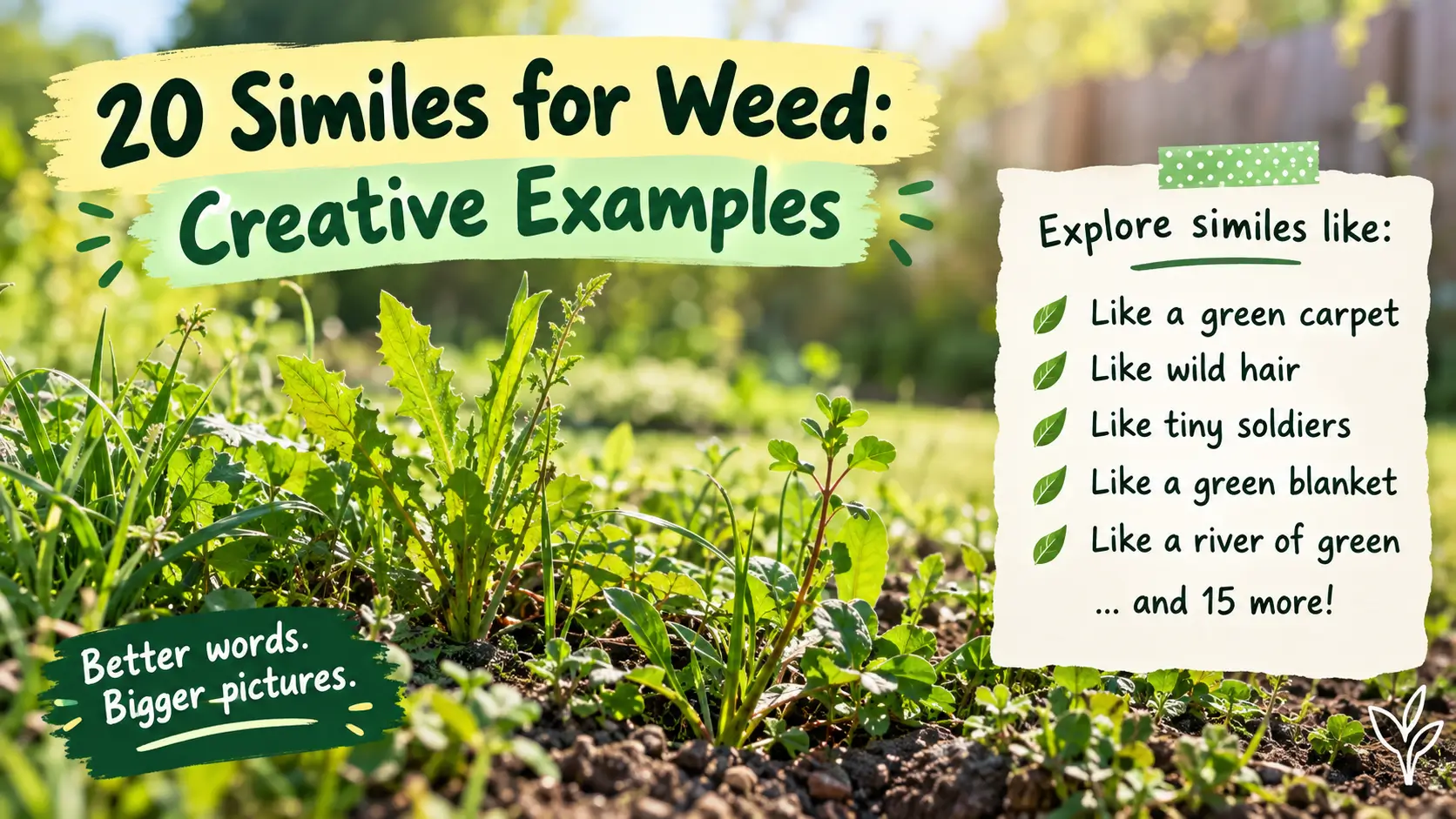
Similes make writing more vivid by comparing one thing to another using words such as like or as. When you are looking for similes for weed, you may be describing a plant growing in a garden, a patch of unwanted vegetation, or the way weeds spread across a space. A good comparison can help readers picture green leaves, tangled growth, quick spreading, or a stubborn plant that keeps returning. In creative writing, these comparisons can make an ordinary description feel more alive and memorable.
In this article, you’ll find 20 original and natural similes related to weed and weedy growth. Each example includes a simple meaning, what it conveys, and two simile sentences. You’ll also learn how to use similes in writing, understand the difference between a simile and a metaphor, and practice with ten questions. Whether you are writing a story, poem, school assignment, or descriptive paragraph, these examples can give you ideas for creating stronger figurative language.
20 Similes for Weed
1. Like a Green Carpet
Meaning: The weeds cover the ground in a thick, continuous layer.
What it conveys: This creates an image of an area almost completely covered with green growth.
Example sentences:
- The weeds spread across the empty yard like a green carpet.
- After the rain, the garden looked covered with weeds like a green carpet.
2. Like Wild Hair
Meaning: The weeds grow in a messy, untidy way.
What it conveys: This comparison emphasizes tangled and uncontrolled growth.
Example sentences:
- Weeds stuck out from the garden bed like wild hair.
- The neglected field was filled with weeds growing like wild hair.
3. Like Tiny Soldiers
Meaning: Many weeds stand upright and appear to fill an area together.
What it conveys: This gives the plants a playful image of strength and determination.
Example sentences:
- Tiny weeds stood across the garden like little soldiers.
- The new shoots appeared like tiny soldiers after the storm.
4. Like a Green Blanket
Meaning: Weeds cover the soil so thoroughly that they resemble a blanket.
What it conveys: The comparison highlights thick and widespread growth.
Example sentences:
- Weeds covered the empty ground like a green blanket.
- By summer, the field was hidden beneath weeds like a green blanket.
5. Like Threads Through Cloth
Meaning: Weeds appear in narrow lines or spread through other plants.
What it conveys: This suggests weeds are mixed into an area and difficult to separate.
Example sentences:
- The weeds curled through the flower bed like threads through cloth.
- Thin weeds ran between the vegetables like threads through cloth.
6. Like a Crowd at a Festival
Meaning: Many weeds grow closely together in one place.
What it conveys: This makes the area seem crowded and full of unwanted plants.
Example sentences:
- Weeds filled the garden like a crowd at a festival.
- Green shoots crowded the field like people at a busy festival.
7. Like Green Fingers Reaching Up
Meaning: Tall weeds grow upward with narrow stems that resemble fingers.
What it conveys: This creates a slightly mysterious and visual image.
Example sentences:
- The weeds rose from the soil like green fingers reaching for the sun.
- Strange plants poked through the cracks like green fingers.
8. Like Sparks After a Fire
Meaning: New weeds appear quickly in scattered places.
What it conveys: The comparison suggests sudden and widespread growth.
Example sentences:
- Weeds appeared across the yard like sparks after a fire.
- After the rain, green shoots popped up like sparks scattered across the ground.
9. Like a Vine of Green Lace
Meaning: Thin weeds spread in delicate-looking patterns.
What it conveys: This gives the plants a softer and more artistic appearance.
Example sentences:
- The thin weeds spread across the fence like green lace.
- Small leaves covered the wall like a vine of green lace.
10. Like a River of Green
Meaning: Weeds spread continuously through a large area.
What it conveys: This emphasizes movement, direction, and a large amount of vegetation.
Example sentences:
- Weeds flowed through the empty lot like a river of green.
- A river of green weeds seemed to stretch across the field.
11. Like a Jungle in Miniature
Meaning: A small patch of weeds looks dense and wild.
What it conveys: This makes a simple patch of vegetation seem much larger and more untamed.
Example sentences:
- The abandoned flower pot looked like a jungle in miniature.
- A few weeks of neglect turned the garden into something like a jungle in miniature.
12. Like Green Fire
Meaning: Weeds spread quickly and seem to take over an area.
What it conveys: This creates a dramatic image of fast, powerful growth.
Example sentences:
- The weeds spread across the yard like green fire.
- After several rainy days, green growth raced across the field like fire.
13. Like a Net Across the Ground
Meaning: Weeds spread outward and become tangled across the soil.
What it conveys: This suggests dense growth that covers and connects different areas.
Example sentences:
- The weeds formed a tangled layer like a net across the ground.
- Roots and stems stretched everywhere like a green net.
14. Like Unruly Children
Meaning: Weeds grow in random directions without seeming controlled.
What it conveys: This gives the plants a playful image of disorder.
Example sentences:
- The weeds grew around the flowers like unruly children.
- Green shoots popped up everywhere like unruly children refusing to sit still.
15. Like a Green Army
Meaning: Large numbers of weeds appear to advance across an area.
What it conveys: This creates a humorous image of weeds taking over the ground.
Example sentences:
- The weeds marched across the lawn like a green army.
- Every rainy week seemed to bring another green army into the garden.
16. Like Green Stars in the Soil
Meaning: Small weeds appear as separate points of green across the ground.
What it conveys: This creates a gentle and colorful picture of scattered plants.
Example sentences:
- Tiny weeds dotted the soil like green stars.
- After watering, new shoots appeared like little green stars across the garden.
17. Like a Blanket of Emeralds
Meaning: Thick green weeds cover an area and look rich in color.
What it conveys: This gives the scene a bright, colorful, almost magical quality.
Example sentences:
- The empty field looked like a blanket of emeralds after the rain.
- Green weeds covered the hillside like a blanket of emeralds.
18. Like a Secret Garden
Meaning: Wild growth makes an ordinary or neglected place look hidden and natural.
What it conveys: This comparison can make weeds seem mysterious or unexpectedly beautiful.
Example sentences:
- The overgrown corner looked like a secret garden.
- Behind the old wall, weeds grew like a secret garden untouched by people.
19. Like Needles Poking Through the Soil
Meaning: Young weeds emerge as thin, sharp-looking shoots.
What it conveys: This emphasizes their narrow shape and sudden appearance.
Example sentences:
- New weeds pushed through the soil like tiny needles.
- After the rain, green shoots rose like needles poking through the earth.
20. Like a Wave Rolling Across the Field
Meaning: Weeds spread over a large area in a continuous pattern.
What it conveys: This gives the growth a sense of movement and scale.
Example sentences:
- The weeds stretched across the field like a wave rolling toward the horizon.
- Green growth moved through the empty land like a slow wave.
How to Use Similes in Writing
Creating your own similes is easier when you follow a few simple steps.
Choose What You Want to Describe
First, decide what quality you want readers to notice. Is the weed:
- Thick?
- Fast-growing?
- Tangled?
- Bright green?
- Wild?
- Small?
- Difficult to remove?
For example, if you want to show tangled growth, you might write:
The weeds were like tangled string.
Find a Familiar Comparison
Think of something readers already understand.
For example:
- Thick weeds → like a carpet
- Tall weeds → like soldiers
- Tangled weeds → like a net
- Fast-spreading weeds → like a wave
Use “Like” or “As”
A clear simile often uses like or as.
The weeds spread like a green blanket.
You can also use an “as…as” structure:
The weeds were as thick as a carpet.
Make the Comparison Clear
The comparison should help readers see something specific.
Weak:
The weeds were like something interesting.
Stronger:
The weeds twisted around the fence like green ropes.
Avoid Clichés When Possible
Common comparisons can work, but fresh comparisons can make creative writing more memorable.
Instead of:
The weeds were like grass.
Try:
The weeds curled through the garden like green threads.
Match the Tone
A funny story might use:
The weeds marched across the yard like tiny soldiers.
A mysterious story might use:
The weeds crept through the cracks like silent fingers.
Add Sensory Details
Good descriptive writing often combines similes with details about sight, texture, sound, or movement.
For example:
The wet weeds shone like green glass after the rain.
That sentence gives the reader both an image and a sense of the scene.
What Is a Simile?
A simile is a type of figurative language that compares two different things to make a description clearer or more vivid. Writers commonly use words such as like or as to signal the comparison.
For example:
The weeds spread like a blanket.
The weeds are not literally a blanket. The writer is comparing their thick coverage to a blanket.
Another example is:
The leaves were as bright as emeralds.
This helps the reader imagine their rich green color.
Similes are useful because they turn simple descriptions into stronger mental pictures. Instead of saying, “The weeds covered the yard,” you could say, “The weeds covered the yard like a green carpet.”
The phrase “strohl simile” is not a standard literary term. If you encounter that wording, it may be a search phrase or a mistaken variation of another term. In ordinary literary study, a simile simply means a direct comparison between different things, usually using like or as.
Simile vs. Metaphor
Both similes and metaphors make comparisons, but they do it differently.
Simile: “The room smelled like rotten eggs.”
Metaphor: “The room was a rotten-egg factory.”
The simile uses like to make the comparison clear. The metaphor states the comparison more directly.
Here is another example:
Simile: “The weeds spread like a green blanket.”
Metaphor: “The weeds were a green blanket covering the yard.”
For beginners, an easy way to remember the difference is this:
- Simile: compares using words such as like or as.
- Metaphor: says one thing is another thing.
Both are useful forms of figurative language.
Practical Exercise: 10 Questions
- Fill in the blank: The weeds covered the ground like a ________.
- Identify the simile: Which sentence contains a simile?
A. The garden was quiet.
B. The weeds spread like a green carpet.
C. The flowers grew beside the wall. - Fill in the blank: The weeds rose from the soil like green ________ reaching toward the sun.
- Multiple choice: Which comparison best describes weeds growing in a tangled pattern?
A. Like polished glass
B. Like a tangled net
C. Like a single stone
D. Like a clear window - Identify the simile: Is this a simile? “The weeds were a green army.” Explain why or why not.
- Create your own: Write a simile describing weeds that are growing very quickly.
- Compare two sentences: Which sentence creates a stronger mental picture?
A. “The weeds covered the yard.”
B. “The weeds covered the yard like a thick green blanket.” - Multiple choice: Which word is commonly used to introduce a simile?
A. Because
B. Like
C. Therefore
D. Although - Create your own: Write a simile describing a small group of weeds growing between cracks in a sidewalk.
- Compare the forms: Turn this metaphor into a simile: “The weeds were a green carpet.”
Answers and Explanations
- Answer: “carpet” or “green carpet.”
Explanation: A carpet covers a surface, so it is a clear comparison for weeds covering the ground. - Answer: B. “The weeds spread like a green carpet.”
Explanation: This sentence uses like to compare weeds with a green carpet, making it a simile. - Answer: “fingers.”
Explanation: “Like green fingers” creates an image of narrow shoots reaching upward. - Answer: B. “Like a tangled net.”
Explanation: A net has connected strands, making it a useful comparison for tangled weeds. - Answer: No, it is a metaphor.
Explanation: The sentence directly says the weeds were an army. It does not use “like” or “as.” - Answer: One possible answer is: “The weeds spread like a fast-moving wave.”
Explanation: A wave suggests movement and helps show that the weeds are spreading quickly. Other creative answers can also be correct. - Answer: B. “The weeds covered the yard like a thick green blanket.”
Explanation: The second sentence gives readers a specific image, making the description more vivid. - Answer: B. “Like.”
Explanation: “Like” is one of the most common signal words used to form a simile. - Answer: One possible answer is: “The weeds poked through the sidewalk like tiny green fingers.”
Explanation: The comparison helps readers picture the small plants emerging from narrow spaces. - Answer: “The weeds were spread across the ground like a green carpet.”
Explanation: The metaphor has been changed into a simile by adding like and making the comparison explicit.
Conclusion
Similes can turn a simple description into a picture readers can easily imagine. The 20 similes for weed in this guide show different ways to describe spreading, tangled, colorful, small, or wild plant growth. You can use these ideas in stories, poems, school assignments, and other forms of descriptive writing.
The key is to choose a comparison that matches the exact image or feeling you want to create. A carpet can show coverage, a net can show tangled growth, and a wave can show spreading movement. Once you understand how these comparisons work, try creating your own. Look around you, choose something familiar, and connect it to what you want readers to see. A simple comparison can make your writing much more vivid and memorable.

I’m Evelyn Marie, an author passionate about similes, metaphors, and idioms. I enjoy explaining creative expressions simply, helping readers understand language and make their writing more engaging.