Have you ever wanted to show that something is so clear that nobody can miss it? That is where similes can help! Similes make your writing more vivid by comparing one thing to another using words such as “like” or “as.”
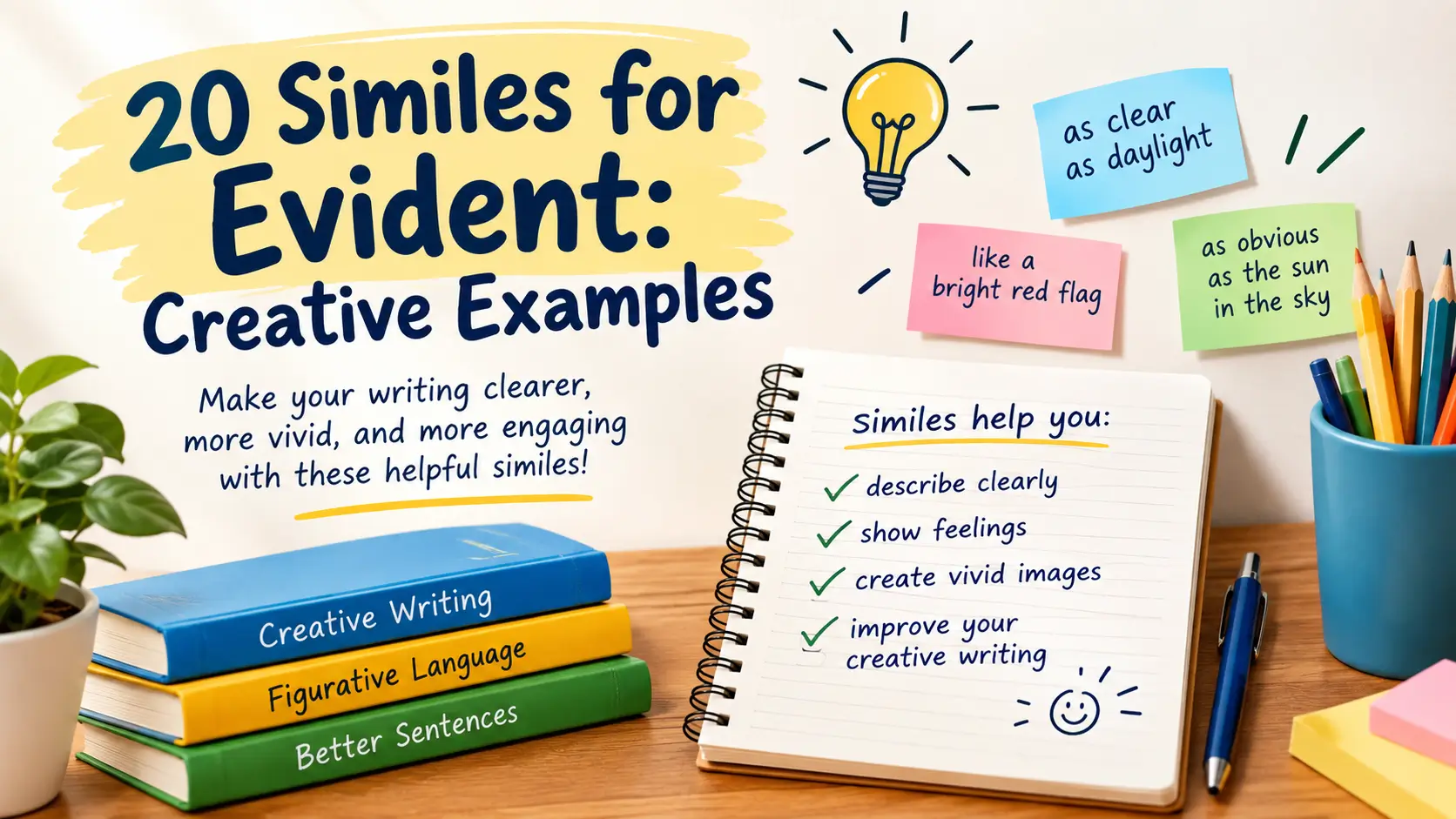
The word evident means clear, easy to see, or easy to understand. When something is evident, there is little doubt about it. For example, a person’s bright smile may make their happiness as clear as daylight.
Using similes for evident can help you describe clear facts, visible feelings, obvious changes, and easy-to-understand ideas. They can make your stories, essays, and everyday conversations more interesting.
In this article, you will discover 20 creative similes that describe things that are evident. Each example includes a simple meaning, an explanation, and two natural sentences. You will also learn how to use similes in writing, understand the difference between similes and metaphors, and practice your skills with 10 questions.
Whether you are a student, a beginner, or a creative writer, these examples will help you express clear ideas in a memorable way.
20 Similes for Evident
Here are 20 useful similes for describing something that is obvious, visible, or easy to understand.
1. As clear as daylight
Meaning: Something is very easy to see or understand.
What it conveys: This simile creates an image of bright daylight, when things are easy to see.
Example sentences:
- Her excitement was as clear as daylight when she opened her birthday gift.
- The answer was as clear as daylight after the teacher explained the problem.
2. As plain as the nose on your face
Meaning: Something is so obvious that it is hard to miss.
What it conveys: It compares an evident fact to something everyone can easily see.
Example sentences:
- It was as plain as the nose on your face that Jake had eaten the last cookie.
- The mistake was as plain as the nose on your face once we checked the numbers.
3. Like a bright red flag
Meaning: Something stands out and draws attention.
What it conveys: A bright red flag is easy to notice, making it a useful comparison for an obvious warning sign.
Example sentences:
- His sudden change in behavior stood out like a bright red flag.
- The strange smell was like a bright red flag that something was wrong.
4. As obvious as the sun in the sky
Meaning: Something is extremely easy to notice.
What it conveys: It compares an evident fact to the sun, which is easy to see in the sky.
Example sentences:
- Her love for animals was as obvious as the sun in the sky.
- It was as obvious as the sun in the sky that the team was ready to win.
5. Like words written in bold
Meaning: Something is easy to notice or understand.
What it conveys: Bold words stand out on a page, just as an evident fact stands out in a situation.
Example sentences:
- The need for more practice was like words written in bold on the teacher’s report.
- His disappointment was like words written in bold across his face.
6. As easy to spot as a white sheep in a black flock
Meaning: Something is very noticeable because it looks different from everything around it.
What it conveys: The strong contrast makes the object stand out.
Example sentences:
- The bright yellow car was as easy to spot as a white sheep in a black flock.
- Her colorful hat was as easy to spot as a white sheep in a black flock.
7. Like a window with no curtains
Meaning: Something is open and easy to see.
What it conveys: It creates an image of a clear view without anything blocking it.
Example sentences:
- His happiness was like a window with no curtains.
- The truth about the broken vase was like a window with no curtains once everyone talked.
8. As clear as a glass of water
Meaning: Something is easy to understand or see through.
What it conveys: Clear water creates an image of something without confusion or hidden details.
Example sentences:
- The instructions were as clear as a glass of water.
- Her reason for leaving was as clear as a glass of water after she explained it.
9. Like a spotlight on a stage
Meaning: Something attracts attention and becomes easy to notice.
What it conveys: A spotlight shines directly on something, making it stand out.
Example sentences:
- His mistake was like a spotlight on a stage during the presentation.
- Her kindness shone like a spotlight on a stage during the school event.
10. As noticeable as a bell in a quiet room
Meaning: Something is easy to notice because it stands out from its surroundings.
What it conveys: A bell makes a clear sound that is hard to ignore in a quiet place.
Example sentences:
- His loud laughter was as noticeable as a bell in a quiet room.
- The sudden change in the plan was as noticeable as a bell in a quiet room.
11. Like a map with a big red arrow
Meaning: Something is clearly pointed out or easy to identify.
What it conveys: A large arrow directs attention to one specific place or answer.
Example sentences:
- The main problem was like a map with a big red arrow pointing toward it.
- Her favorite subject was like a map with a big red arrow on her school schedule.
12. As easy to read as an open book
Meaning: Someone’s feelings or thoughts are easy to understand.
What it conveys: An open book suggests that nothing is hidden from view.
Example sentences:
- Her disappointment was as easy to read as an open book.
- My little brother’s excitement was as easy to read as an open book.
13. Like a fingerprint on glass
Meaning: Something leaves a clear and noticeable mark.
What it conveys: A fingerprint can stand out on a clean glass surface.
Example sentences:
- The evidence of muddy shoes was like a fingerprint on glass.
- His carelessness left marks like fingerprints on glass throughout the room.
14. As bright as a neon sign
Meaning: Something is highly noticeable or stands out clearly.
What it conveys: A glowing neon sign catches people’s attention.
Example sentences:
- Her happiness was as bright as a neon sign.
- The warning was as bright as a neon sign in the middle of the instructions.
15. Like a missing puzzle piece in an empty space
Meaning: Something becomes easy to identify because it is noticeably absent or different.
What it conveys: An empty space in a puzzle draws attention to what is missing.
Example sentences:
- His absence from the team photo stood out like a missing puzzle piece in an empty space.
- The missing page was like a missing puzzle piece in an empty space in the book.
16. As clear as a freshly cleaned mirror
Meaning: Something is easy to see or understand without confusion.
What it conveys: A clean mirror gives a clear reflection.
Example sentences:
- Her intentions were as clear as a freshly cleaned mirror.
- The reason for the delay became as clear as a freshly cleaned mirror after the meeting.
17. Like a giant arrow pointing at the answer
Meaning: Something makes the correct answer or explanation easy to find.
What it conveys: A giant arrow directs attention toward one clear choice.
Example sentences:
- The final clue was like a giant arrow pointing at the answer.
- His muddy footprints were like a giant arrow pointing at the answer to the mystery.
18. As visible as footprints in fresh snow
Meaning: Something can be seen easily.
What it conveys: Footprints leave clear marks on fresh snow.
Example sentences:
- The children’s path through the garden was as visible as footprints in fresh snow.
- Her progress in reading was as visible as footprints in fresh snow.
19. Like a drumbeat in a silent room
Meaning: Something is easy to notice because it stands out strongly.
What it conveys: A drumbeat sounds especially clear in a silent room.
Example sentences:
- His nervous tapping was like a drumbeat in a silent room.
- The sudden change in her voice was like a drumbeat in a silent room.
20. As unmistakable as a rainbow after rain
Meaning: Something is easy to recognize and difficult to mistake.
What it conveys: A rainbow is a distinct sight that stands out after a rain shower.
Example sentences:
- Her joy was as unmistakable as a rainbow after rain.
- The team’s excitement was as unmistakable as a rainbow after rain.
How to Use Similes in Writing
Similes can make your writing clearer, more colorful, and more engaging. You do not need to use difficult words to create one.
Here is an easy way to make your own similes.
1. Choose what you want to describe
Start with something that is evident.
For example:
- A person’s happiness
- A visible mistake
- A clear answer
- An obvious warning
2. Find a familiar comparison
Think of something that people can easily see, hear, or understand.
For example, the sun is easy to see, and a bell is easy to hear in a quiet room.
You might say:
“Her smile was as bright as the sun.”
3. Use “like” or “as”
These words help connect the two things in a simile.
Examples:
- His mistake stood out like a red flag.
- The answer was as clear as daylight.
4. Make the comparison clear
Your reader should understand why the two things are being compared.
Weak example: “The answer was like a chair.”
Better example: “The answer was as clear as daylight.”
The second example gives the reader a clear picture of what you mean.
5. Match the tone of your writing
Choose a simile that fits the mood.
For a funny story:
“His guilty face was as obvious as chocolate on a white shirt.”
For a serious story:
“The warning stood out like a red flag.”
For a descriptive story:
“Her smile was as bright as a summer sunrise.”
6. Add sensory details
Sensory details help readers imagine what they see, hear, smell, taste, or feel.
For example:
- Basic: “The noise was evident.”
- Better: “The noise rang out like a bell in a silent room.”
The second sentence helps readers imagine the sound.
7. Avoid using too many clichés
Common comparisons can be useful, but original ones can make your writing more interesting.
Instead of always saying “as clear as daylight,” try:
“His answer shone like a clean window in the morning sun.”
The goal is to make your comparison natural and easy to understand.
What Is a Simile?
A simile is a figure of speech that compares two different things using words such as “like” or “as.”
Writers use similes to help readers picture an idea, feeling, sound, or action.
In simple terms, a simile says that one thing is similar to another in a particular way.
For example:
- “Her smile was as bright as the sun.”
- “The room was as quiet as a library.”
- “His voice sounded like a soft bell.”
These are examples of similes because they compare different things using “as” or “like.”
Why Do Writers Use Similes?
Similes help writers:
- Make descriptions more vivid.
- Explain ideas in simple ways.
- Show feelings more clearly.
- Make stories more enjoyable.
- Help readers imagine what is happening.
For example, “The answer was evident” tells the reader that something was clear.
“The answer was as clear as daylight” gives the reader a stronger image.
Similes are a useful part of figurative language because they help turn simple statements into memorable descriptions.
Simile vs. Metaphor
Similes and metaphors both compare things, but they do it in different ways.
|
Simile
|
Metaphor
|
| — | — |
|
Uses “like” or “as” to compare things.
|
Says one thing is another.
|
|
“The room smelled like rotten eggs.”
|
“The room was a rotten-egg factory.”
|
|
Makes a direct comparison.
|
Makes a comparison without “like” or “as.”
|
Here is another example:
Simile: Her happiness was as bright as the sun.
Metaphor: Her happiness was sunshine.
Both sentences describe happiness, but the simile uses “as,” while the metaphor makes a direct comparison.
For beginners, the easiest way to tell them apart is to look for the comparison words “like” and “as.”
Practical Exercise: 10 Questions
Test your understanding of similes with these 10 questions. Try to answer them before checking the explanations below.
Simile practice quiz
0/10 answered
1. Fill in the blank: The answer was as clear as ____.
A. daylight
B. a pillow
C. mud
2. Which sentence contains a simile?
A. The truth was evident.
B. The truth was like a bright light.
C. The truth surprised everyone.
3. What does “as plain as the nose on your face” mean?
A. Very confusing
B. Easy to miss
C. Very obvious
4. Which word is commonly used in a simile?
A. Like
B. Because
C. Although
5. Complete this simile: Her happiness was as bright as ____.
A. a stone
B. a neon sign
C. a closed book
6. Which sentence is a metaphor rather than a simile?
A. His smile was like sunshine.
B. His smile was as bright as sunshine.
C. His smile was sunshine.
7. What does “like a spotlight on a stage” suggest?
A. Something is hidden.
B. Something attracts attention.
C. Something is very quiet.
8. Create your own simile: The mistake was as evident as ____.
A. a red flag
B. a soft pillow
C. a quiet breeze
9. Which sentence uses a simile to describe a sound?
A. His tapping was like a drumbeat in a silent room.
B. His tapping was annoying.
C. He tapped his desk.
10. Compare: “The clue was evident” and “The clue was like a giant arrow pointing at the answer.” What does the second sentence add?
A. A clearer image of how easy the clue was to notice.
B. A new character.
C. A different ending.
Check my answersReset quiz
Answers and Explanations
Here are the correct answers for all 10 questions, with simple explanations.
- Daylight. Daylight is easy to see, so the phrase describes something clear and obvious.
- The truth was like a bright light. This sentence uses “like” to compare truth to a bright light.
- Very obvious. The expression means that something is easy to notice.
- Like. It is one of the most common signal words used in similes.
- A neon sign. Neon signs are bright and noticeable, making them useful for describing evident things.
- His smile was sunshine. This is a metaphor because it directly compares his smile to sunshine without using “like” or “as.”
- Something attracts attention. A spotlight shines on something and makes it stand out.
- A red flag. This is a suitable comparison because a red flag is easy to notice. Other original comparisons can also be correct if they clearly express the meaning.
- His tapping was like a drumbeat in a silent room. This simile compares a sound to a drumbeat using “like.”
- A clearer image of how easy the clue was to notice. The giant arrow helps readers picture how clearly the clue points toward the answer.
Conclusion
Similes are a simple and creative way to make your writing more vivid. They help you explain ideas, describe feelings, and show when something is easy to notice or understand.
These 20 similes for evident give you many ways to describe clear facts, visible emotions, and obvious changes. You can use them in stories, school assignments, poems, and everyday conversations.
Remember, a good simile uses a familiar comparison to help readers understand what you mean. You do not need complicated words to make your writing interesting.
Try creating your own comparisons using things you see, hear, and experience every day. Start with one simple idea, add “like” or “as,” and see where your imagination takes you. With practice, your creative writing will become clearer, stronger, and more memorable.

I am Beau Thomas, the Administrator at SimilyHub. I enjoy making similes, metaphors, and idioms easy to understand through clear explanations, helpful examples, and engaging content for English learners and writers.