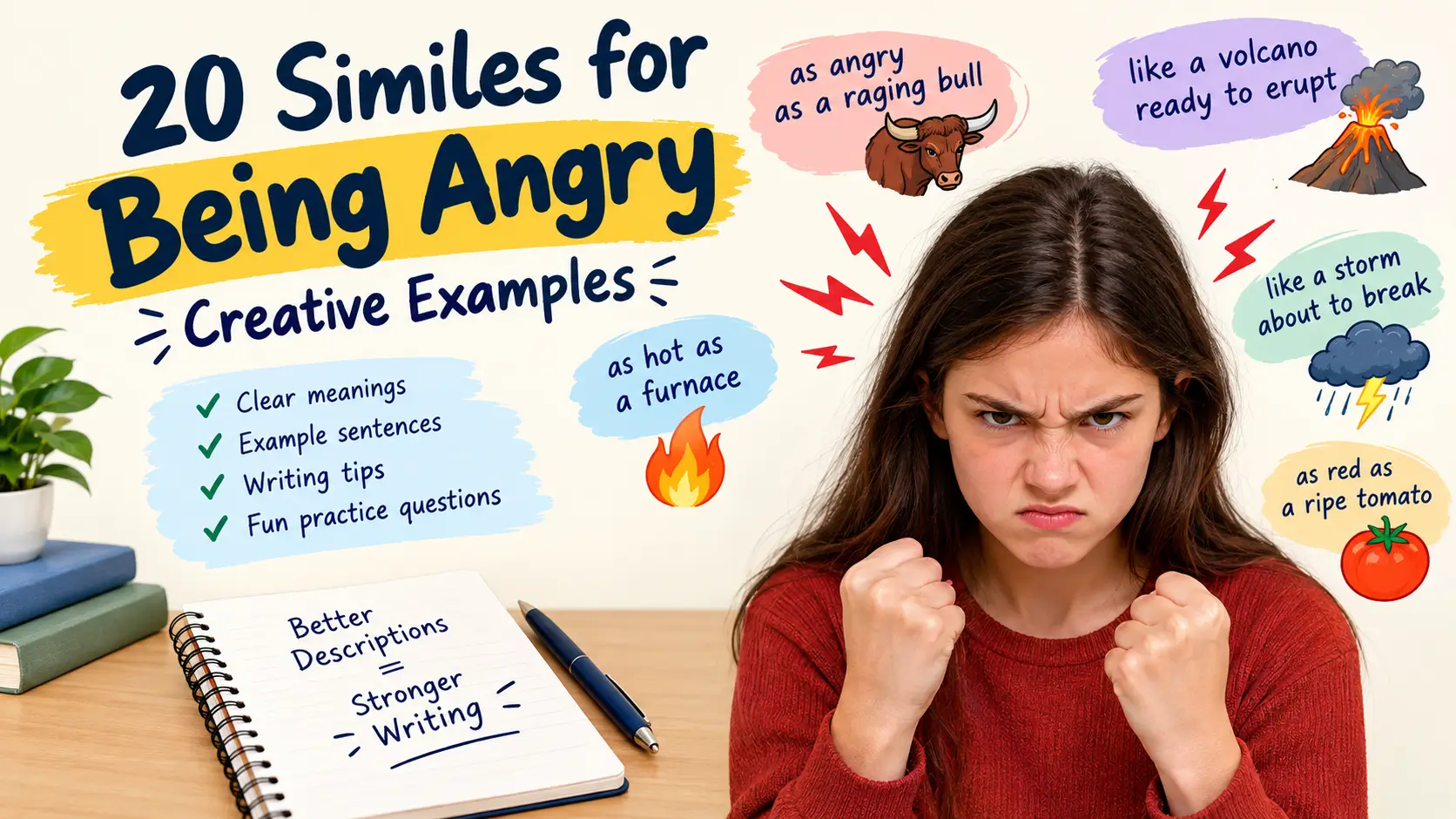
Anger is a strong emotion, but simply saying “I was angry” does not always show the reader how powerful that feeling was. Similes can make anger easier to picture by comparing it to something familiar, intense, or dramatic. For example, saying someone was “as angry as a raging bull” creates a much stronger image than simply saying they were angry. These comparisons are useful in stories, poems, school assignments, descriptive writing, and everyday creative writing. In this guide, you will find 20 similes for being angry, along with simple meanings and natural example sentences. Some are calm enough for everyday writing, while others show explosive or intense anger. You will also learn how to create your own similes, understand the meaning of similes, and tell the difference between a simile and a metaphor. By the end, you should have plenty of creative writing examples you can use to make angry characters, scenes, and emotions more vivid.
20 Similes for Being Angry
1. As angry as a raging bull
Meaning: This means someone is extremely angry and difficult to calm down.
What it conveys: It creates an image of powerful, wild, and uncontrolled anger.
Example sentences:
- Marcus was as angry as a raging bull when he discovered his bike was missing.
- She looked as angry as a raging bull after hearing the unfair accusation.
2. Like a volcano ready to erupt
Meaning: This describes someone who is holding in intense anger that may burst out soon.
What it conveys: It suggests pressure, tension, and anger that is becoming harder to control.
Example sentences:
- He sat at the table like a volcano ready to erupt.
- My sister was like a volcano ready to erupt after her brother broke her favorite toy.
3. As hot as a furnace
Meaning: This describes someone whose anger feels extremely intense.
What it conveys: The comparison makes anger seem hot, powerful, and overwhelming.
Example sentences:
- His temper was as hot as a furnace after the argument.
- She felt as hot as a furnace when she realized she had been lied to.
4. Like a storm about to break
Meaning: This means someone is very angry and may soon express that anger.
What it conveys: It creates a tense picture of emotions building before an outburst.
Example sentences:
- Dad stood silently, like a storm about to break.
- Her face looked like a storm about to break as she listened to the complaint.
5. As fierce as a wildcat
Meaning: This describes anger that is strong, sharp, and aggressive.
What it conveys: It gives the reader a picture of someone ready to defend themselves.
Example sentences:
- She became as fierce as a wildcat when someone insulted her brother.
- The normally gentle teacher sounded as fierce as a wildcat during the argument.
6. Like fire spreading through dry grass
Meaning: This means anger grows quickly and can become intense in a short time.
What it conveys: It shows how quickly one small problem can turn into powerful anger.
Example sentences:
- His frustration spread like fire through dry grass.
- The team’s anger grew like fire spreading through dry grass after the unfair decision.
7. As red as a ripe tomato
Meaning: This describes someone whose face becomes red because of strong anger.
What it conveys: It gives a simple, visual picture of visible anger.
Example sentences:
- Tom became as red as a ripe tomato when his classmates laughed at him.
- Her face was as red as a ripe tomato after the heated argument.
8. Like a shaken soda bottle
Meaning: This describes someone who is full of bottled-up anger and may explode emotionally.
What it conveys: It suggests pressure building inside until the anger bursts out.
Example sentences:
- He was like a shaken soda bottle after listening to the complaints all morning.
- She felt like a shaken soda bottle, ready to burst after one more rude comment.
9. As furious as a thunderstorm
Meaning: This means someone is extremely angry and making their feelings obvious.
What it conveys: It makes anger seem loud, powerful, and impossible to ignore.
Example sentences:
- She was as furious as a thunderstorm when she saw the damaged painting.
- He sounded as furious as a thunderstorm on the phone.
10. Like a boiling kettle
Meaning: This describes anger that is steadily building until it may finally explode.
What it conveys: It shows pressure increasing little by little.
Example sentences:
- I could tell he was like a boiling kettle after waiting for an hour.
- She sat quietly, like a boiling kettle, trying not to lose her temper.
11. As angry as a bear disturbed from sleep
Meaning: This describes someone who becomes extremely irritated when bothered unexpectedly.
What it conveys: It creates a humorous image of someone who does not want to be disturbed.
Example sentences:
- Before his morning coffee, Dad was as angry as a bear disturbed from sleep.
- She became as angry as a bear disturbed from sleep when the alarm rang again.
12. Like a pressure cooker
Meaning: This describes someone keeping anger inside until it becomes too strong to contain.
What it conveys: It suggests emotional pressure that is building toward an outburst.
Example sentences:
- After hours of criticism, he felt like a pressure cooker.
- She was like a pressure cooker, holding back her anger during the meeting.
13. As fiery as a dragon
Meaning: This means someone is showing fierce and powerful anger.
What it conveys: It creates a dramatic and imaginative picture of intense emotion.
Example sentences:
- The coach became as fiery as a dragon after the careless mistake.
- She gave him an as-fiery-as-a-dragon look when he interrupted her.
14. Like a thundercloud
Meaning: This describes someone whose appearance or mood clearly shows anger.
What it conveys: It suggests a dark, heavy mood that makes others expect trouble.
Example sentences:
- He walked into the room like a thundercloud.
- She looked like a thundercloud after reading the message.
15. As hot-tempered as a spark near gasoline
Meaning: This describes someone who becomes angry very quickly.
What it conveys: It shows that even a small problem can trigger a strong reaction.
Example sentences:
- His brother was as hot-tempered as a spark near gasoline.
- The character was as hot-tempered as a spark near gasoline, reacting to every little problem.
16. Like a firecracker about to pop
Meaning: This describes someone who is very tense and close to losing their temper.
What it conveys: It creates a lively image of sudden, explosive anger.
Example sentences:
- She looked like a firecracker about to pop during the debate.
- He was like a firecracker about to pop after being interrupted three times.
17. As bitter as sour lemons
Meaning: This describes anger mixed with resentment or unpleasant feelings.
What it conveys: The comparison focuses on the harsh, unpleasant side of anger.
Example sentences:
- His words were as bitter as sour lemons after the disagreement.
- She gave him an as-bitter-as-sour-lemons reply.
18. Like a dark cloud following me
Meaning: This describes anger that stays with someone instead of disappearing quickly.
What it conveys: It shows a lingering mood that affects the person’s thoughts and actions.
Example sentences:
- My anger followed me like a dark cloud all afternoon.
- The argument stayed with her like a dark cloud following her everywhere.
19. As explosive as a firework
Meaning: This describes anger that comes out suddenly and forcefully.
What it conveys: It emphasizes a quick, dramatic emotional reaction.
Example sentences:
- His reaction was as explosive as a firework when he heard the news.
- She became as explosive as a firework after discovering what had happened.
20. Like a lion defending its territory
Meaning: This describes someone showing fierce anger because they feel threatened or protective.
What it conveys: It suggests courage, strength, and a strong desire to protect something important.
Example sentences:
- She stood like a lion defending its territory when someone threatened her family.
- The player argued like a lion defending its territory after the unfair accusation.
How to Use Similes in Writing
Creating your own similes is easier than it may seem. Start with the emotion or idea you want to describe. Then find something familiar that has a similar quality.
Here is a simple process:
- Choose what you want to describe.
For example: anger, fear, happiness, speed, or sadness. - Think about its strongest quality.
Anger might be hot, loud, explosive, dark, or intense. - Find a familiar comparison.
You could compare anger to fire, thunder, a storm, or a boiling kettle. - Use “like” or “as.”
For example: “Her anger was like a raging fire.” - Make the comparison clear.
The reader should understand why the two things are being compared. - Match the tone.
A funny story might use “as angry as a cat in a bathtub,” while a serious story might use “like a storm about to break.” - Add sensory details.
Think about what anger looks, sounds, feels, or even seems like.
For example:
- “He was angry” is simple.
- “He was like a boiling kettle” is more visual.
- “His face grew hot, and his words burst out like sparks from a fire” is even more descriptive.
The best creative writing similes help readers experience the emotion instead of simply being told about it.
What Is a Simile?
A simile is a figure of speech that compares two different things using words such as “like” or “as.”
For example:
- “Her anger was like a roaring fire.”
- “He was as red as a tomato.”
- “The argument sounded like a thunderstorm.”
In each example, one thing is compared with another to create a clearer mental picture. Similes are useful because they turn abstract ideas and emotions into images readers can understand.
In simple terms, a simile says that something is like something else without saying that the two things are literally the same.
You may also come across unusual search phrases related to similes. “Strohl simile,” for example, is not a standard literary term. If someone uses that phrase, they may simply be looking for information about similes or a particular example. The usual literary term is simply simile.
Simile vs. Metaphor
A simile and a metaphor both make comparisons, but they do it differently.
Simile: “The room smelled like rotten eggs.”
Metaphor: “The room was a rotten-egg factory.”
The simile uses “like” to make the comparison. The metaphor directly describes one thing as another.
Here is another easy example:
- Simile: “Her anger was like a fire.”
- Metaphor: “Her anger was a fire.”
Both create a strong image, but the simile makes the comparison more direct by using a comparison word.
Practical Exercise: 10 Questions
- Fill in the blank:
“His anger was like a ______ ready to erupt.”
Choose a word that creates a strong image. - Identify the simile:
Which sentence contains a simile?
A. “Mia was furious.”
B. “Mia was like a storm.”
C. “Mia shouted loudly.” - Fill in the blank:
“She was as red as a ______ when she became angry.” - Multiple choice:
Which comparison best shows anger building slowly?
A. Like a sleeping kitten
B. Like a boiling kettle
C. Like a gentle breeze - Identify the simile:
Is this a simile?
“His temper was a volcano.” - Create your own simile:
Complete this sentence with your own comparison:
“My anger felt like ______.” - Compare two sentences:
Which sentence creates a stronger image?
A. “He was angry.”
B. “He was like a firecracker about to pop.”
Explain why. - Multiple choice:
Which simile best describes anger that appears suddenly?
A. Like a firecracker
B. Like a quiet lake
C. Like a soft pillow - Create your own simile:
Write a sentence comparing an angry person’s face to something you can see in everyday life. - Identify and explain:
What two things are being compared in this sentence?
“She stood like a lion defending its territory.”
Answers and Explanations
- Answer: “volcano.”
Explanation: A volcano can build pressure before erupting, making it a useful comparison for anger that is about to burst out. - Answer: B. “Mia was like a storm.”
Explanation: This is a simile because it compares Mia with a storm using the word “like.” - Answer: “tomato.”
Explanation: A tomato is commonly associated with a bright red color, making it a simple visual comparison for an angry face. - Answer: B. Like a boiling kettle.
Explanation: A boiling kettle suggests pressure and heat that gradually build before something happens. - Answer: No.
Explanation: “His temper was a volcano” is a metaphor because it directly says his temper was a volcano. It does not use “like” or “as.” - Sample answer: “My anger felt like a storm trapped inside me.”
Explanation: This works because a storm suggests powerful energy and movement. Your own answer can be different as long as the comparison is clear. - Answer: B. “He was like a firecracker about to pop.”
Explanation: The second sentence gives readers a clear image of someone who is tense, angry, and close to an emotional outburst. - Answer: A. Like a firecracker.
Explanation: A firecracker suggests something sudden and explosive, which fits anger that appears quickly. - Sample answer: “Her face was as red as a ripe tomato.”
Explanation: This simile compares the person’s red face with a tomato, helping readers picture the character. - Answer: The angry person is compared with a lion defending its territory.
Explanation: The comparison suggests strength, fierceness, and a desire to protect something important.
Conclusion
Similes make writing more vivid by turning feelings and ideas into pictures readers can imagine. Instead of simply saying that someone is angry, you can describe that person as being “like a boiling kettle,” “as furious as a thunderstorm,” or “like a firecracker about to pop.” These comparisons help readers understand the strength, mood, and character behind an emotion. The 20 similes for being angry in this guide give you a useful starting point, but you can also create your own by thinking about familiar sights, sounds, objects, animals, and natural events. When writing, choose comparisons that fit the situation and tone. With practice, your simile sentences can become clearer, more creative, and more memorable. Try creating three new anger similes today and use them in your own descriptive writing.

I am Beau Thomas, the Administrator at SimilyHub. I enjoy making similes, metaphors, and idioms easy to understand through clear explanations, helpful examples, and engaging content for English learners and writers.