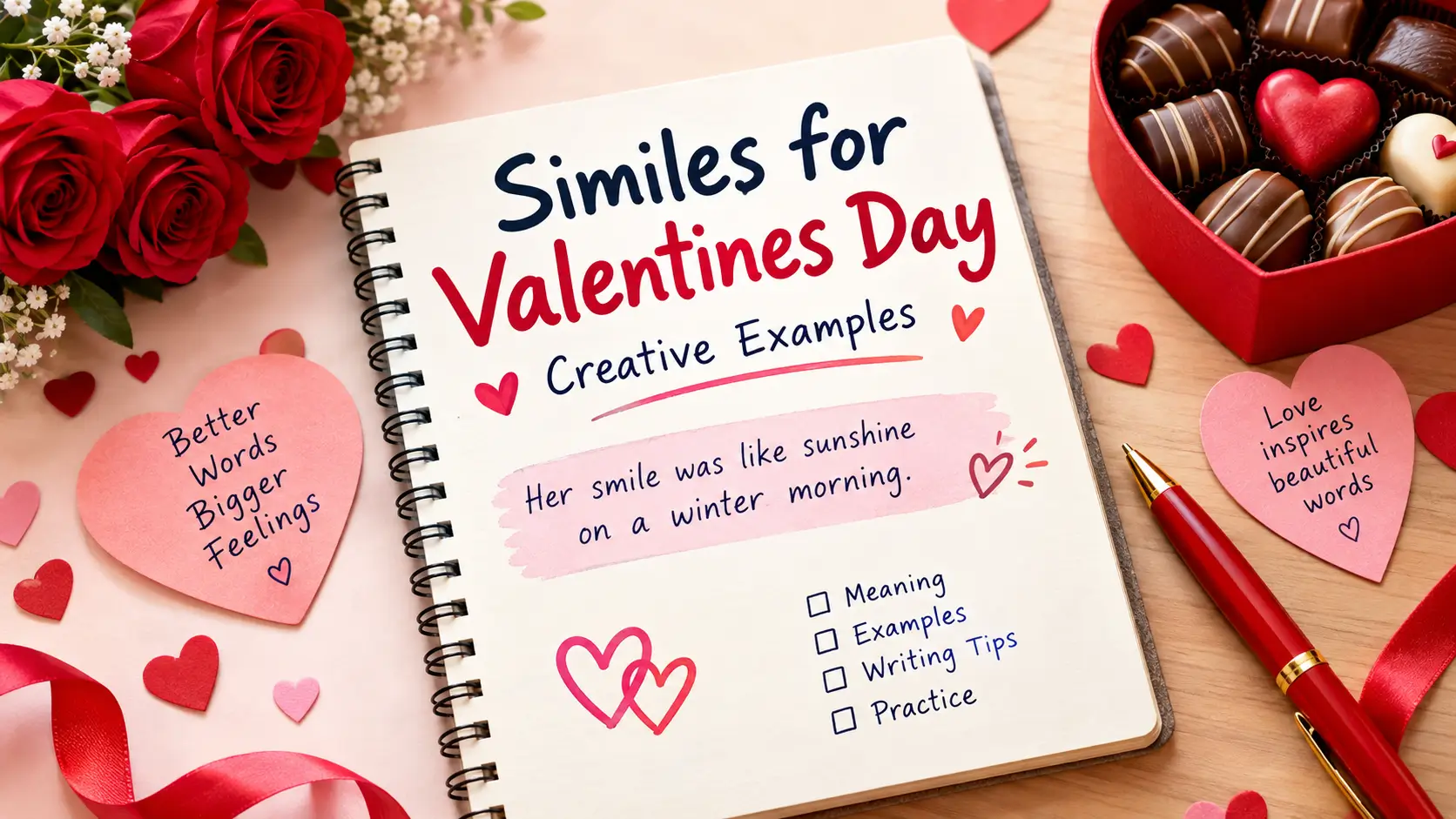
Valentine’s Day is a time for love, kindness, friendship, and sweet memories. Sometimes, simple words are not enough to describe how special the day feels. That is where similes can help. A simile compares one thing with another using words such as like or as. For example, you might say, “Her smile was like sunshine on a winter morning.” This comparison makes the sentence more vivid and helps the reader picture the feeling.
If you are looking for similes for Valentines Day, you can use them in cards, poems, stories, classroom activities, social posts, or creative writing. They can describe love, happiness, hearts, flowers, gifts, romance, and the warm feeling of being with someone special.
In this guide, you will find 20 creative and easy-to-understand examples. Each one includes its meaning and two example sentences. You will also learn how to create your own similes and practice identifying them. Let’s explore some fun ways to make your Valentine’s Day writing more colorful.
20 Similes for Valentines Day
1. Love is like a warm blanket
Meaning: This simile compares love to a warm blanket that provides comfort and security.
What it conveys: It creates a cozy image of love that makes someone feel safe, cared for, and protected.
Example sentences:
- Her love was like a warm blanket on a cold Valentine’s Day.
- Being with him felt like wrapping myself in a warm blanket.
2. Her smile was like sunshine
Meaning: This compares a person’s smile to bright, cheerful sunshine.
What it conveys: It shows that the smile brings happiness and warmth to others.
Example sentences:
- Her Valentine’s Day smile was like sunshine after a rainy morning.
- His smile was like sunshine, lighting up the whole room.
3. Their hearts were like two matching stars
Meaning: This compares two loving hearts to stars that belong together.
What it conveys: It suggests connection, closeness, and a special bond.
Example sentences:
- Their hearts were like two matching stars shining in the night.
- On Valentine’s Day, they felt like two matching stars in the same sky.
4. The Valentine’s flowers were like a rainbow
Meaning: This compares colorful flowers to a bright rainbow.
What it conveys: It creates a cheerful picture full of color, beauty, and joy.
Example sentences:
- The Valentine’s flowers were like a rainbow spread across the table.
- Red roses, pink tulips, and white lilies looked like a rainbow of love.
5. Her laughter was like bells
Meaning: This compares a person’s laughter to the clear, pleasant sound of bells.
What it conveys: It makes the laughter sound joyful, bright, and beautiful.
Example sentences:
- Her laughter was like bells ringing across the Valentine’s Day party.
- I could hear her laughter, bright like little bells in the room.
6. His love was as strong as an oak tree
Meaning: This compares strong love to a sturdy oak tree.
What it conveys: It suggests that the love is steady, dependable, and lasting.
Example sentences:
- His love was as strong as an oak tree.
- She believed their friendship was as strong as an oak tree.
7. The Valentine’s card was like a little treasure
Meaning: This compares a special card to something valuable and precious.
What it conveys: It shows that the card has emotional value because of the feelings behind it.
Example sentences:
- The handmade Valentine’s card was like a little treasure.
- I kept her card because it was like a little treasure from someone special.
8. The chocolates were as sweet as a love song
Meaning: This compares the sweetness of chocolates to the pleasant feeling of a love song.
What it conveys: It creates a playful connection between taste and romance.
Example sentences:
- The Valentine’s chocolates were as sweet as a love song.
- Each chocolate tasted as sweet as a love song playing softly nearby.
9. Their friendship was like a blooming rose
Meaning: This compares friendship to a rose that grows and opens over time.
What it conveys: It suggests that the friendship is becoming stronger and more beautiful.
Example sentences:
- Their friendship was like a blooming rose.
- Over the years, their bond grew like a blooming rose in spring.
10. His words were like a gentle breeze
Meaning: This compares kind words to a soft and pleasant breeze.
What it conveys: It creates a peaceful feeling and shows that the words were comforting.
Example sentences:
- His Valentine’s Day message was like a gentle breeze.
- Her kind words felt like a gentle breeze on a warm afternoon.
11. Her heart was as light as a feather
Meaning: This compares happiness to the lightness of a feather.
What it conveys: It suggests that the person feels joyful, relaxed, and free from worry.
Example sentences:
- After receiving the Valentine’s card, her heart felt as light as a feather.
- He walked home with a heart as light as a feather.
12. The room glowed like a candlelit garden
Meaning: This compares a beautifully decorated room to a garden lit by candles.
What it conveys: It creates a warm, romantic, and magical image.
Example sentences:
- The Valentine’s dinner room glowed like a candlelit garden.
- Soft lights made the restaurant look like a candlelit garden.
13. Their love was like a never-ending song
Meaning: This compares lasting love to a song that continues without stopping.
What it conveys: It suggests that the love is beautiful, memorable, and enduring.
Example sentences:
- They described their love as like a never-ending song.
- Every Valentine’s Day reminded them of their love, like a never-ending song.
14. The heart-shaped balloons floated like clouds
Meaning: This compares floating balloons to soft clouds moving through the sky.
What it conveys: It creates a light, dreamy, and cheerful picture.
Example sentences:
- Heart-shaped balloons floated like clouds above the Valentine’s Day table.
- The red balloons drifted like clouds across the decorated room.
15. Her kindness was like a bright lantern
Meaning: This compares kindness to a lantern that gives light in the darkness.
What it conveys: It shows that kindness can guide, comfort, and brighten someone’s day.
Example sentences:
- Her kindness was like a bright lantern on Valentine’s Day.
- Even a small act of kindness can shine like a bright lantern.
16. His eyes sparkled like diamonds
Meaning: This compares the brightness in someone’s eyes to sparkling diamonds.
What it conveys: It suggests excitement, happiness, and strong emotion.
Example sentences:
- His eyes sparkled like diamonds when he opened his Valentine’s gift.
- She smiled, and her eyes sparkled like diamonds.
17. The Valentine’s Day party was as lively as a carnival
Meaning: This compares the energy of a Valentine’s party to a busy carnival.
What it conveys: It shows that the celebration was exciting, colorful, and full of activity.
Example sentences:
- Our Valentine’s Day party was as lively as a carnival.
- The classroom became as lively as a carnival during the celebration.
18. The red roses stood like little flames
Meaning: This compares red roses to small flames because of their bright color and shape.
What it conveys: It creates a vivid image of passionate, beautiful flowers.
Example sentences:
- The red roses stood like little flames in the vase.
- A dozen roses looked like little flames against the white tablecloth.
19. Her Valentine’s message was like a warm hug
Meaning: This compares a loving message to the comfort of a warm hug.
What it conveys: It shows that the words made someone feel loved, supported, and cared for.
Example sentences:
- Her Valentine’s message was like a warm hug.
- Reading his thoughtful note felt like receiving a warm hug from far away.
20. Happiness spread like sunshine
Meaning: This compares spreading happiness to sunshine reaching everything around it.
What it conveys: It shows how one joyful feeling can affect many people.
Example sentences:
- Happiness spread like sunshine throughout the Valentine’s Day celebration.
- Her cheerful smile made happiness spread like sunshine across the room.
How to Use Similes in Writing
Creating your own similes can be easy once you know what you want to describe. Start with these simple steps:
Choose the thing you want to describe
Think about the person, object, feeling, or event you want to make more vivid.
For example:
- Love
- Happiness
- A Valentine’s card
- Roses
- A smile
- Friendship
Find a familiar comparison
Ask yourself, “What does this remind me of?”
For example, love might remind you of warmth. You could write:
Love is like a warm fire.
Use “like” or “as”
These are common signal words in similes.
For example:
- Her smile was like sunshine.
- His heart was as warm as a summer afternoon.
Make the comparison clear
A good simile should help readers understand or imagine something.
Instead of:
The card was like something.
Try:
The card was like a little treasure.
The second sentence gives the reader a clearer picture.
Avoid clichés when possible
Common comparisons can work, but original comparisons can make your writing more interesting. Instead of always saying “love is like a rose,” try something fresh:
Love is like a small light that stays bright during a storm.
Match the tone
A romantic poem may need a gentle simile. A funny Valentine’s card can use something playful.
For example:
His heart raced like a puppy chasing a ball.
This has a fun and light tone.
Add sensory details
Think about what something looks, sounds, smells, tastes, or feels like.
For example:
The roses smelled like a sweet spring morning.
This gives the reader both an image and a scent.
What Is a Simile?
A simile is a figure of speech that compares two different things to make an idea easier to imagine. It usually uses words such as like or as.
For example:
- Her smile was like sunshine.
- His heart was as warm as a fireplace.
- The flowers looked like tiny stars.
The comparison does not mean the two things are literally the same. Instead, the writer connects them because they share a quality.
For example, sunshine and a smile are different things. However, both can create feelings of warmth and happiness.
Similes are useful in figurative language because they make ordinary descriptions more vivid. They are especially helpful in poems, stories, greeting cards, and descriptive writing.
The phrase “strohl simile” is not a standard literary term. If you have seen that phrase in a search or assignment, it may be a typo, a name, or a specific classroom reference rather than a recognized type of simile.
Simile vs. Metaphor
Both similes and metaphors compare things, but they do it in different ways.
Simile: “The room smelled like rotten eggs.”
Metaphor: “The room was a rotten-egg factory.”
The simile uses like to make the comparison clear. The metaphor directly says that one thing is another.
Here is another simple example:
- Simile: Her smile was like sunshine.
- Metaphor: Her smile was sunshine.
For beginners, an easy way to remember the difference is this: similes often say that something is like another thing, while metaphors make a direct comparison.
Practical Exercise: 10 Questions
- Fill in the blank:
Her smile was as bright as ________.
Create your own comparison. - Identify the simile:
Which sentence contains a simile?
A. The roses were red.
B. The roses were like tiny flames.
C. The roses sat on the table. - Fill in the blank:
His kindness was like ________.
Choose something that gives warmth, light, or comfort. - Identify the simile:
Is this sentence a simile?
“Their friendship was like a blooming rose.” - Multiple choice:
Which sentence uses a simile correctly?
A. Her heart is a golden treasure.
B. Her heart was like a golden treasure.
C. Her heart became gold. - Create your own simile:
Write a simile comparing Valentine’s Day flowers to something beautiful. - Compare two sentences:
Which sentence gives a clearer image?
A. The Valentine’s party was fun.
B. The Valentine’s party was as lively as a carnival. - Multiple choice:
Which word is commonly used to signal a simile?
A. Because
B. Like
C. Therefore - Create your own simile:
Write a simile describing the feeling of receiving a thoughtful Valentine’s card. - Identify and explain:
In the sentence “Happiness spread like sunshine,” what two things are being compared, and why does the comparison work?
Answers and Explanations
- Possible answer: sunshine.
“Her smile was as bright as sunshine” compares the brightness and happiness of a smile with sunshine. Other creative answers can also work. - B. The roses were like tiny flames.
This is a simile because it uses like to compare roses with flames. - Possible answer: a warm blanket.
“His kindness was like a warm blanket” works because both kindness and a warm blanket can make someone feel comfortable and cared for. - Yes.
“Their friendship was like a blooming rose” is a simile because it uses like to compare friendship with a blooming rose. - B. Her heart was like a golden treasure.
The word like creates a direct comparison, making it a simile. - Possible answer: “The Valentine’s flowers were like a rainbow.”
This works because both colorful flowers and rainbows can create a bright and beautiful image. - B. The Valentine’s party was as lively as a carnival.
The second sentence gives readers a stronger picture of the party’s energy. - B. Like.
“Like” is one of the most common signal words used in similes. “As” is another common choice. - Possible answer: “The Valentine’s card felt like a warm hug.”
This comparison connects the comfort of kind words with the comfort of a hug. - Happiness and sunshine are being compared.
The comparison works because sunshine spreads light and warmth, while happiness can also spread from one person to another and brighten a situation.
Conclusion
Similes can turn simple Valentine’s Day writing into something colorful, warm, and memorable. Instead of simply saying that someone is happy, kind, or loved, you can use a creative comparison to help readers feel the idea. A smile can be like sunshine, kindness can be like a bright lantern, and a thoughtful message can be like a warm hug.
The 20 similes for Valentines Day in this guide can help you write cards, poems, stories, classroom assignments, and other creative writing examples. More importantly, you now know how to build your own similes. Start with an idea, find a familiar comparison, and connect the two with like or as. Keep practicing, and your writing will become more vivid one comparison at a time.

I am Beau Thomas, the Administrator at SimilyHub. I enjoy making similes, metaphors, and idioms easy to understand through clear explanations, helpful examples, and engaging content for English learners and writers.