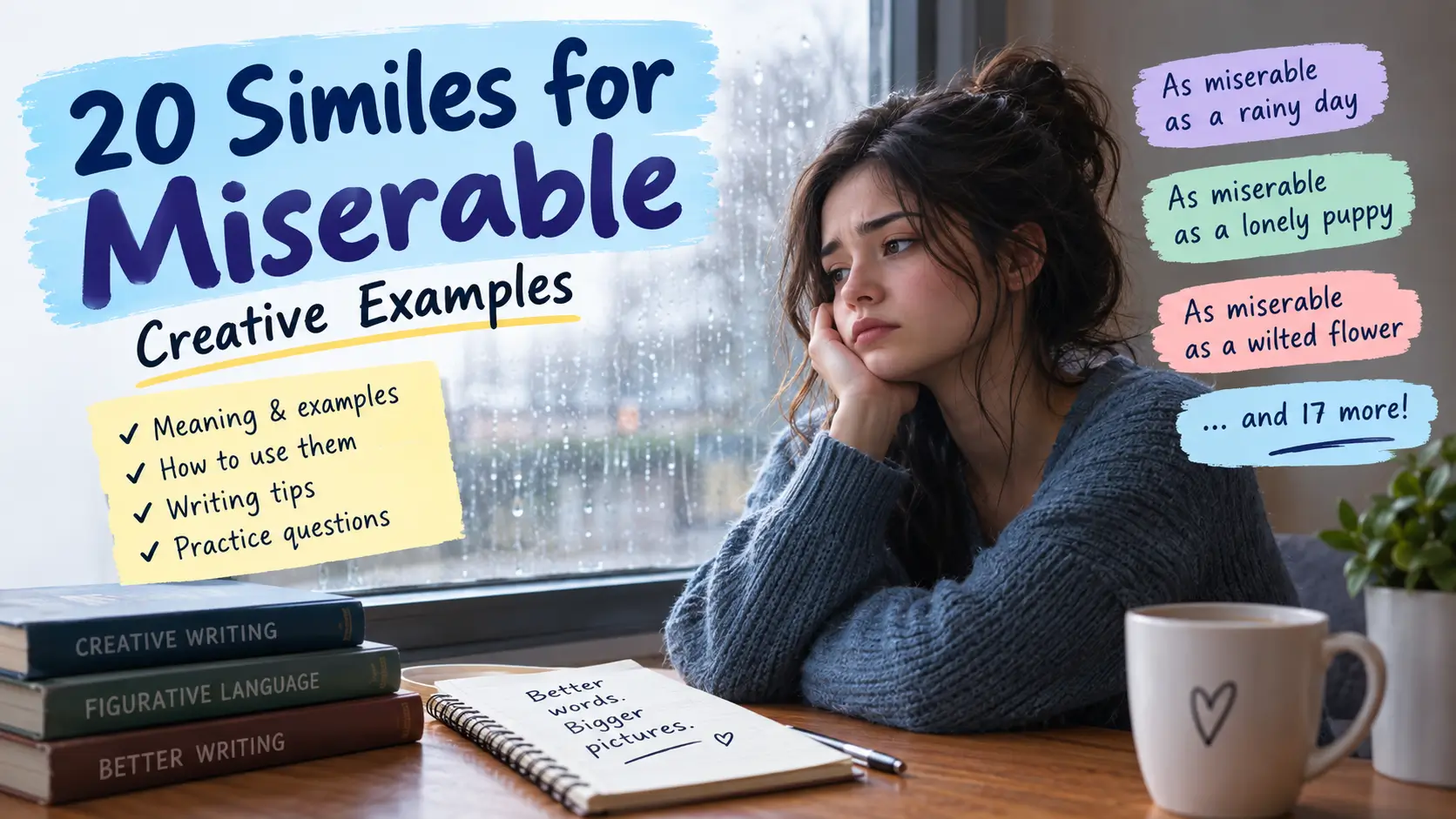
Feeling miserable is more than simply being sad. It can describe a deep sense of unhappiness, discomfort, loneliness, disappointment, or emotional pain. When you want to show that feeling in creative writing, a good simile can make your words much stronger. Instead of saying, “She felt miserable,” you might write, “She felt as miserable as a rainy-day bird trapped indoors.” The comparison gives the reader something they can picture.
In this article, you’ll find 20 similes for miserable that can help you describe difficult emotions in stories, poems, essays, and everyday writing. Each example includes a simple meaning, what it conveys, and two natural simile sentences. You’ll also learn how to create your own comparisons, understand the meaning of similes, and tell the difference between a simile and a metaphor. Finally, you can test your understanding with ten practical questions. Let’s explore these creative writing examples and discover how simple comparisons can turn a plain description into something much more vivid.
20 Similes for Miserable
1. As miserable as a rainy day
Meaning: This means someone feels very unhappy, gloomy, or low in spirits.
What it conveys: It creates an image of gray skies, constant rain, and a gloomy mood.
Example sentences:
- After losing the game, Jake was as miserable as a rainy day.
- She looked as miserable as a rainy day when her vacation was canceled.
2. As miserable as a lonely puppy
Meaning: This describes someone who feels sad, alone, and in need of comfort.
What it conveys: It creates a tender image of loneliness and helplessness.
Example sentences:
- Without her friends around, Mia felt as miserable as a lonely puppy.
- He sat quietly in the corner, as miserable as a lonely puppy.
3. As miserable as a soaked cat
Meaning: This means someone looks extremely uncomfortable and unhappy.
What it conveys: It gives a slightly funny but vivid picture of someone cold, wet, and annoyed.
Example sentences:
- Tom arrived home as miserable as a soaked cat.
- After walking through the storm, I was as miserable as a soaked cat.
4. As miserable as a wilted flower
Meaning: This describes someone who has lost energy, happiness, or hope.
What it conveys: The image suggests weakness, sadness, and a lack of freshness.
Example sentences:
- Without any good news, she looked as miserable as a wilted flower.
- The disappointed student sat at his desk as miserable as a wilted flower.
5. As miserable as a cloud without sunshine
Meaning: This means someone feels gloomy and unable to find happiness.
What it conveys: It contrasts darkness with sunshine, making the sadness feel stronger.
Example sentences:
- After the argument, she felt as miserable as a cloud without sunshine.
- He wandered around the house as miserable as a cloud without sunshine.
6. As miserable as a bird with a broken wing
Meaning: This describes someone who feels helpless, hurt, or unable to move forward.
What it conveys: It creates a strong picture of emotional pain and helplessness.
Example sentences:
- After hearing the bad news, Daniel felt as miserable as a bird with a broken wing.
- She looked as miserable as a bird with a broken wing after her best friend moved away.
7. As miserable as a child who lost their favorite toy
Meaning: This describes intense disappointment or sadness.
What it conveys: It shows how deeply a seemingly small loss can affect someone.
Example sentences:
- I was as miserable as a child who lost their favorite toy when my old bicycle broke.
- He looked as miserable as a child who lost their favorite toy after the gift disappeared.
8. As miserable as a shadow in the rain
Meaning: This means someone feels lonely, gloomy, and almost invisible.
What it conveys: The comparison creates a quiet and poetic feeling of isolation.
Example sentences:
- She walked through the empty street as miserable as a shadow in the rain.
- After everyone left, he felt as miserable as a shadow in the rain.
9. As miserable as a candle in a storm
Meaning: This describes someone who feels fragile, troubled, or close to losing hope.
What it conveys: The candle suggests a small amount of hope struggling against difficult circumstances.
Example sentences:
- During the difficult days, she felt as miserable as a candle in a storm.
- He stood there as miserable as a candle in a storm, unsure of what to do next.
10. As miserable as a dog left out in the cold
Meaning: This means someone feels unwanted, lonely, or forgotten.
What it conveys: It creates a strong sense of rejection and emotional discomfort.
Example sentences:
- After being excluded from the group, Liam felt as miserable as a dog left out in the cold.
- She looked as miserable as a dog left out in the cold when nobody answered her call.
11. As miserable as a song played in a minor key
Meaning: This describes a deeply sad or gloomy emotional state.
What it conveys: The musical image gives the feeling a soft, dramatic, and emotional quality.
Example sentences:
- His mood was as miserable as a song played in a minor key.
- The empty room made her feel as miserable as a song played in a minor key.
12. As miserable as a broken umbrella in a downpour
Meaning: This means someone feels helpless when facing a difficult situation.
What it conveys: It suggests being unprepared, overwhelmed, and unable to escape trouble.
Example sentences:
- After missing the last bus, I felt as miserable as a broken umbrella in a downpour.
- He stood outside as miserable as a broken umbrella in a downpour.
13. As miserable as a snowman in the summer
Meaning: This describes someone who feels uncomfortable, out of place, or doomed to fail.
What it conveys: The unusual comparison can add humor while still showing discomfort.
Example sentences:
- Wearing a heavy coat on that hot day, I felt as miserable as a snowman in the summer.
- He looked as miserable as a snowman in the summer at the crowded beach.
14. As miserable as a fish out of water
Meaning: This describes someone who feels uncomfortable, helpless, or out of place.
What it conveys: It shows a strong sense of discomfort and not belonging.
Example sentences:
- At the unfamiliar party, I felt as miserable as a fish out of water.
- Without his teammates, he was as miserable as a fish out of water.
15. As miserable as an empty playground
Meaning: This means someone feels lonely, quiet, and without joy.
What it conveys: An empty playground normally associated with laughter becomes a powerful image of loneliness.
Example sentences:
- After her friends left town, she felt as miserable as an empty playground.
- The abandoned house made him feel as miserable as an empty playground.
16. As miserable as a wilted rose
Meaning: This describes someone whose happiness, hope, or energy has faded.
What it conveys: The rose creates an image of beauty that has lost its life and freshness.
Example sentences:
- After the heartbreaking news, she looked as miserable as a wilted rose.
- He felt as miserable as a wilted rose after months of disappointment.
17. As miserable as a traveler stuck at a closed station
Meaning: This describes frustration, disappointment, and uncertainty.
What it conveys: It gives the reader a clear picture of someone stranded and unsure what will happen next.
Example sentences:
- After the flight was canceled, we were as miserable as travelers stuck at a closed station.
- She felt as miserable as a traveler stuck at a closed station with nowhere to go.
18. As miserable as a rainy picnic
Meaning: This describes an experience that is disappointing, uncomfortable, and gloomy.
What it conveys: It combines disappointment with an unpleasant setting.
Example sentences:
- Without his friends there, his birthday felt as miserable as a rainy picnic.
- The failed celebration was as miserable as a rainy picnic.
19. As miserable as a cracked mirror
Meaning: This describes someone who feels emotionally broken or unable to see things positively.
What it conveys: The cracked mirror suggests damage, sadness, and a distorted view of life.
Example sentences:
- After the breakup, he felt as miserable as a cracked mirror.
- She stared at the floor, as miserable as a cracked mirror.
20. As miserable as a forgotten letter
Meaning: This describes someone who feels ignored, unwanted, or forgotten.
What it conveys: The image suggests loneliness and the pain of being overlooked.
Example sentences:
- After nobody replied to her messages, she felt as miserable as a forgotten letter.
- He sat alone, as miserable as a forgotten letter in an old drawer.
How to Use Similes in Writing
Creating your own simile does not have to be difficult. Start with the feeling, object, person, or situation you want to describe. Then ask yourself what familiar thing has a similar quality.
For example:
- Feeling miserable: “She felt as miserable as a wilted flower.”
- Feeling lonely: “He stood alone like a single tree in an empty field.”
- Feeling nervous: “Her hands shook like leaves in the wind.”
- Feeling exhausted: “He was as tired as an old machine running without rest.”
Here are a few simple steps:
- Choose what you want to describe.
Decide whether you are describing sadness, anger, fear, happiness, or another feeling. - Find a familiar comparison.
Think of something people can easily picture. - Use a signal word.
Most similes use words such as like or as. - Make the connection clear.
The comparison should help readers understand the original idea. - Avoid clichés when possible.
Familiar comparisons can work, but an unexpected image can make creative writing stronger. - Match the tone.
A serious story may need a poetic comparison, while a funny scene can use something playful. - Add sensory details.
Think about what the reader can see, hear, smell, taste, or feel.
For example, instead of writing, “He was miserable,” you could write, “He sat beneath the cold window like a forgotten traveler waiting for a train.”
What Is a Simile?
A simile is a figure of speech that compares two different things to make an idea easier to picture or understand. Similes commonly use words such as like and as.
For example:
- “Her smile was like sunshine.”
- “He ran like the wind.”
- “The room was as quiet as a library.”
The comparison does not mean the two things are literally the same. Instead, it highlights a shared quality. Sunshine can suggest warmth and happiness, while the wind can suggest speed.
Writers use similes because they make descriptions more vivid. Instead of simply telling readers that someone is miserable, a simile can help readers imagine what that misery looks or feels like.
The phrase “strohl simile” is not a standard literary term. If you encountered that phrase in a search or worksheet, it may be a typo, a specific reference, or an unusual wording for a simile-related topic. It should not automatically be treated as an established type of simile.
Simile vs. Metaphor
Both similes and metaphors make comparisons, but they do it in different ways.
Simile: “The room smelled like rotten eggs.”
Metaphor: “The room was a rotten-egg factory.”
The simile openly signals the comparison with like. The metaphor directly describes one thing as another.
Here is another simple example:
- Simile: “Her voice was like a soft bell.”
- Metaphor: “Her voice was a soft bell.”
Both create a similar image, but the sentence structure is different. For beginners, remember this easy rule: similes usually compare using “like” or “as,” while metaphors make a direct comparison.
Practical Exercise: 10 Questions
Try these questions before looking at the answers.
- Fill in the blank:
“After hearing the disappointing news, she felt as miserable as a ______.” - Identify the simile:
Which sentence contains a simile?
A. The boy was miserable.
B. The boy felt as miserable as a rainy day.
C. The boy walked home sadly. - Multiple choice:
Which comparison best describes someone who feels forgotten?
A. As miserable as a forgotten letter
B. As bright as the sun
C. As quick as a rabbit - Fill in the blank:
Complete this simile: “He looked as miserable as a ______ in the rain.” - Identify the comparison:
In the sentence “She felt as miserable as a wilted rose,” what two things are being compared? - Create your own:
Write a simile describing someone who feels lonely. - Compare two sentences:
Which sentence creates a stronger image?
A. “Tom was miserable.”
B. “Tom was as miserable as a soaked cat.”
Explain why. - Multiple choice:
Which word is commonly used to introduce a simile?
A. Because
B. Like
C. Therefore - Create your own:
Write a simile for someone who feels disappointed after an important event is canceled. - Identify the type:
Is this a simile or metaphor?
“Her sadness was like a dark cloud over her day.”
Answers and Explanations
- Possible answer: “a rainy day.”
“As miserable as a rainy day” works because gloomy weather is often associated with a gloomy mood. Other creative answers can also be correct if the comparison makes sense. - Correct answer: B.
“The boy felt as miserable as a rainy day” is a simile because it compares the boy’s emotional state with a rainy day using as. - Correct answer: A.
A forgotten letter suggests being overlooked or ignored, making it a suitable comparison for someone who feels forgotten. - Possible answer: “a soaked cat.”
A soaked cat can suggest discomfort, unhappiness, and irritation. Other logical comparisons may also work. - Answer: Her feelings and a wilted rose.
The simile compares her miserable emotional state with the faded, lifeless appearance of a wilted rose. - Possible answer: “He felt as lonely as a single star in an empty sky.”
This works because the image of one star surrounded by darkness suggests isolation. - Correct answer: B.
“Tom was miserable” tells the reader about his emotion. “Tom was as miserable as a soaked cat” shows the emotion through a specific image. - Correct answer: B. Like.
Like is one of the most common signal words used in similes. As is another common choice. - Possible answer: “She felt as disappointed as a child whose birthday party was canceled.”
The comparison clearly shows how strongly the cancellation affected her. - Correct answer: Simile.
The sentence uses like to compare sadness with a dark cloud, so it is a simile rather than a metaphor.
Conclusion
Similes can turn simple descriptions into vivid and memorable writing. Instead of saying that someone is miserable, you can compare that feeling with something readers can easily imagine, such as a rainy day, a wilted flower, or a forgotten letter. These comparisons help readers see and feel the emotion rather than simply being told about it.
The 20 similes for miserable in this guide give you plenty of starting points for stories, poems, essays, and descriptive writing. You can also use the same creative process to invent your own comparisons. Choose a feeling, find a familiar image, and connect the two with like or as. With practice, your simile sentences will become more natural, specific, and expressive. Keep experimenting, and let your comparisons bring your writing to life.

I’m Evelyn Marie, an author passionate about similes, metaphors, and idioms. I enjoy explaining creative expressions simply, helping readers understand language and make their writing more engaging.