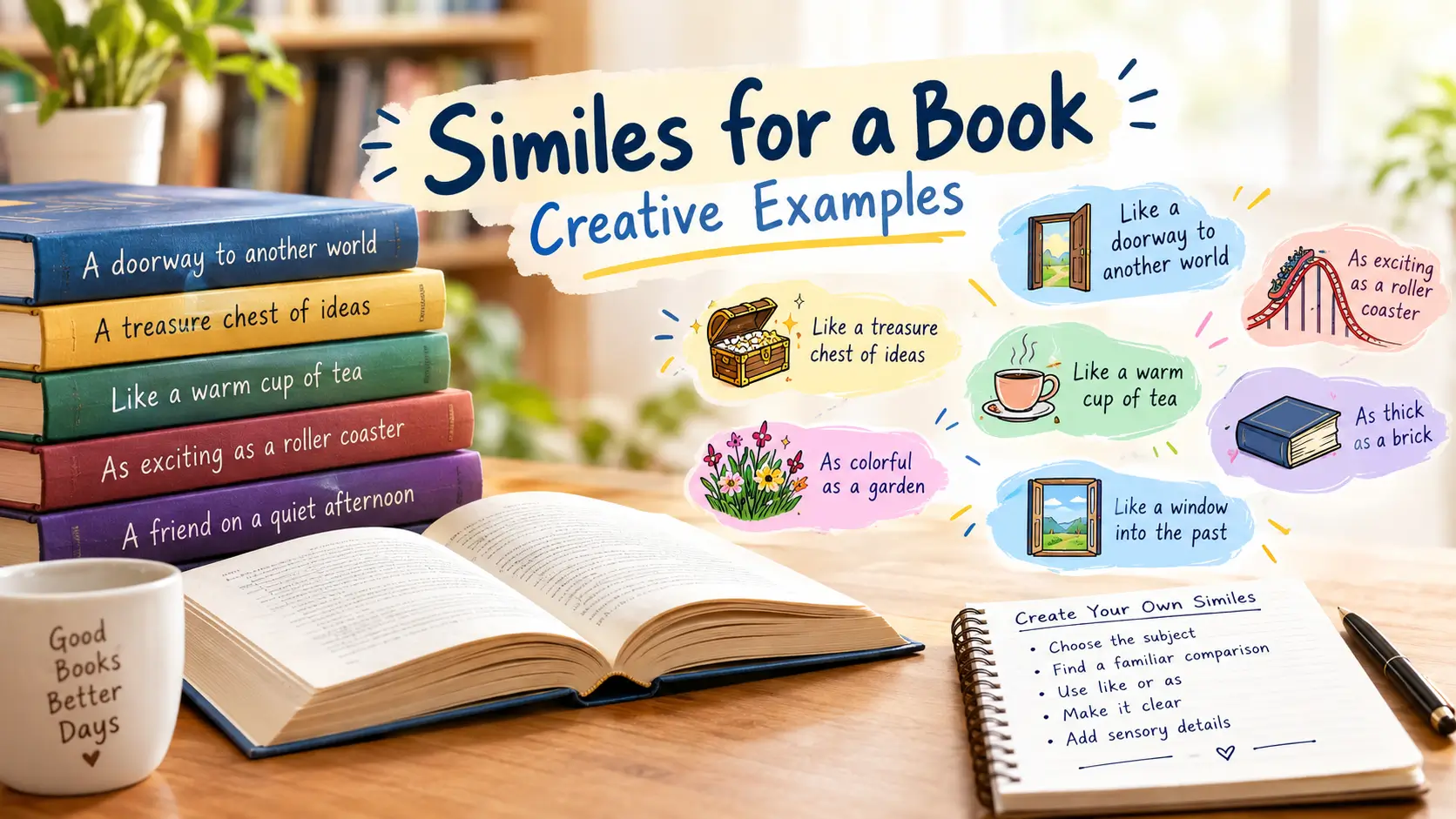
A good book can take you somewhere new without you ever leaving your chair. Similes help writers describe that feeling in a vivid and memorable way. A simile compares one thing with another using words such as like or as. When you use similes for a book, you can show how exciting, mysterious, beautiful, funny, or powerful a book feels instead of simply saying, “This book is good.”
For example, you might say, “The book was like a doorway to another world.” That comparison gives the reader a clear picture of the experience.
In this article, you will find 20 creative and natural similes for describing a book. Each one includes its meaning, what it conveys, and two example sentences. You will also learn how to create your own simile sentences, understand the difference between a simile and a metaphor, and test your skills with a short exercise. Whether you are a student, teacher, or creative writer, these examples can help make your descriptive writing more colorful and engaging.
20 Similes for a Book
1. The book was like a doorway to another world
Meaning: This simile compares a book to a doorway that leads somewhere new.
What it conveys: It shows that reading the book feels like entering a different world filled with new places, people, or ideas.
Example sentences:
- The fantasy novel was like a doorway to another world.
- Every time I opened the book, it felt like I was stepping through a doorway.
2. The book was as exciting as a roller coaster
Meaning: The book is compared to a roller coaster because both can be thrilling and full of surprises.
What it conveys: It creates a sense of excitement, suspense, and changing emotions.
Example sentences:
- The mystery book was as exciting as a roller coaster.
- Its unexpected twists made the story feel like a wild roller coaster ride.
3. The book was like a treasure chest of ideas
Meaning: The book is compared to a treasure chest containing valuable things.
What it conveys: It suggests that the book contains many useful, interesting, or surprising ideas.
Example sentences:
- This science book is like a treasure chest of ideas.
- I found new facts on every page, as if I were opening a treasure chest.
4. The book was as thick as a brick
Meaning: This simile compares the thickness of a book to a brick.
What it conveys: It emphasizes that the book is very thick and may take a long time to read.
Example sentences:
- The history book was as thick as a brick.
- I needed both hands to carry the book because it was as thick as a brick.
5. The book was like a warm cup of tea
Meaning: The book is compared to something warm, comforting, and relaxing.
What it conveys: It gives the feeling of comfort, peace, and enjoyment.
Example sentences:
- Her favorite novel was like a warm cup of tea on a rainy afternoon.
- Reading that gentle story felt like enjoying a warm cup of tea.
6. The book was as mysterious as a locked door
Meaning: The book is compared to a locked door because its secrets are not immediately known.
What it conveys: It creates curiosity and makes the reader want to discover what is hidden inside.
Example sentences:
- The old mystery book was as mysterious as a locked door.
- Every chapter seemed to hide another secret behind it.
7. The book was like a window into the past
Meaning: The book is compared to a window that lets readers see another time.
What it conveys: It shows how books can help us understand history, people, and life from earlier periods.
Example sentences:
- The historical novel was like a window into the past.
- Reading the diary felt like looking through a window into another century.
8. The book was as colorful as a garden
Meaning: This compares the variety and richness of a book to the many colors found in a garden.
What it conveys: It suggests that the book is full of beautiful descriptions, characters, ideas, or emotions.
Example sentences:
- The children’s story was as colorful as a garden in spring.
- Its pages were filled with characters as varied and lively as flowers.
9. The book was like a map for the imagination
Meaning: The book is compared to a map that guides the imagination toward new places and ideas.
What it conveys: It shows how reading can help readers imagine different worlds and possibilities.
Example sentences:
- The adventure novel was like a map for the imagination.
- Each chapter guided my thoughts somewhere new, like a map leading to an unknown land.
10. The book was as gripping as a pair of strong hands
Meaning: The book is compared to strong hands that hold something tightly.
What it conveys: It shows that the story is so interesting that the reader finds it hard to stop reading.
Example sentences:
- The thriller was as gripping as a pair of strong hands.
- The story grabbed my attention and held it tightly from beginning to end.
11. The book was like a friend on a quiet afternoon
Meaning: The book is compared to a friend who provides company.
What it conveys: It creates a warm feeling of companionship and comfort.
Example sentences:
- My favorite novel is like a friend on a quiet afternoon.
- When I felt bored, the book was always there like a friendly companion.
12. The book was as light as a feather
Meaning: This simile can describe a book that is physically lightweight.
What it conveys: It gives the reader a simple picture of a thin or lightweight book.
Example sentences:
- The small poetry book was as light as a feather.
- I slipped the book into my bag because it was almost as light as a feather.
13. The book was like a puzzle waiting to be solved
Meaning: The book is compared to a puzzle whose pieces must be understood.
What it conveys: It suggests mystery, clues, challenges, and a story that makes the reader think.
Example sentences:
- The detective novel was like a puzzle waiting to be solved.
- Every clue made the book feel more like a puzzle.
14. The book was as captivating as a bright sunset
Meaning: The book is compared to a beautiful sunset that naturally attracts attention.
What it conveys: It suggests that the book is beautiful, fascinating, and difficult to ignore.
Example sentences:
- Her poetry collection was as captivating as a bright sunset.
- The beautiful descriptions made the novel as captivating as an evening sky.
15. The book was like a mirror reflecting human life
Meaning: The book is compared to a mirror because it can show feelings, struggles, relationships, and experiences that readers recognize.
What it conveys: It shows how literature can help us understand ourselves and other people.
Example sentences:
- The novel was like a mirror reflecting human life.
- Its characters felt real because the book reflected emotions we all understand.
16. The book was as quiet as a sleeping cat
Meaning: This simile describes the calm and peaceful feeling of a book or reading experience.
What it conveys: It creates an image of silence, relaxation, and stillness.
Example sentences:
- The poetry book was as quiet as a sleeping cat.
- I enjoyed reading its peaceful pages in a room as quiet as a sleeping cat.
17. The book was like a spark that started a fire
Meaning: The book is compared to a small spark that creates a much larger fire.
What it conveys: It suggests that a book can start powerful ideas, curiosity, or inspiration.
Example sentences:
- That little book was like a spark that started a fire in my imagination.
- Her first novel became a spark that inspired her interest in writing.
18. The book was as fast-paced as a racing car
Meaning: The book is compared to a racing car because the story moves quickly.
What it conveys: It creates a sense of action, speed, excitement, and constant movement.
Example sentences:
- The action novel was as fast-paced as a racing car.
- The story moved from one exciting scene to another like a racing car speeding around a track.
19. The book was like a garden full of stories
Meaning: The book is compared to a garden containing many different things.
What it conveys: It suggests that the book has many stories, characters, ideas, and discoveries to explore.
Example sentences:
- The story collection was like a garden full of stories.
- Every chapter felt like another beautiful corner of a garden waiting to be explored.
20. The book was as precious as a family heirloom
Meaning: The book is compared to something valuable that a family carefully keeps for generations.
What it conveys: It shows that the book is deeply meaningful, special, or emotionally valuable.
Example sentences:
- My grandmother’s old novel was as precious as a family heirloom.
- I kept the signed book safely because it was as precious to me as a family treasure.
How to Use Similes in Writing
Creating your own simile does not have to be difficult. Start with the thing you want to describe, then think of something familiar that shares an important quality.
Here is a simple process:
- Choose what you want to describe.
For example: a book. - Choose its main quality.
Is the book exciting, thick, mysterious, funny, peaceful, or inspiring? - Find a familiar comparison.
An exciting book might remind you of a roller coaster. - Use “like” or “as.”
You could write: “The book was like a roller coaster.” - Make the comparison clear.
The reader should understand why the two things are being compared. - Match the tone.
A funny story may need a playful simile, while a serious story may need a thoughtful one. - Add sensory details.
Think about what the reader can see, hear, feel, smell, or imagine.
For example:
- “The pages were soft like silk.”
- “The story moved like a rushing river.”
- “The mystery was as dark as a moonless night.”
- “The funny characters bounced through the story like rubber balls.”
Good creative writing similes add an image without making the sentence confusing. Try to choose comparisons that fit the exact feeling you want to create.
What Is a Simile?
A simile is a figure of speech that compares two different things to make an idea easier to picture. Similes often use signal words such as like and as.
For example:
- “The book was like a doorway.”
- “The story was as exciting as a race.”
- “Her words flowed like a river.”
In each example, one thing is compared with another. The comparison gives the reader a stronger mental image.
Similes are useful because they can make ordinary descriptions more vivid. Instead of saying, “The book was interesting,” you might say, “The book was like a treasure chest of ideas.” The second sentence gives the reader something specific to imagine.
You may sometimes see unusual phrases such as “strohl simile” in search queries. “Strohl simile” is not a standard literary term. If you encounter the phrase, it is better to focus on the intended idea of similes and explain the comparison clearly rather than treating “strohl simile” as an established type of figurative language.
Simile vs. Metaphor
A simile makes a comparison using words such as like or as. A metaphor makes the comparison directly.
For example:
Simile: “The room smelled like rotten eggs.”
Metaphor: “The room was a rotten-egg factory.”
Both sentences create a similar image, but they do it differently.
Here is another example:
- Simile: “The book was like a treasure chest.”
- Metaphor: “The book was a treasure chest.”
A simple way to remember the difference is this: similes say something is like something else, while metaphors say it is something else.
Practical Exercise: 10 Questions
Test your understanding with these 10 questions. Try answering them before looking at the answers.
- Fill in the blank: “The book was ___ a doorway to another world.”
a) like
b) under
c) beside - Identify the simile: Which sentence contains a simile?
a) The book was exciting.
b) The book was a treasure chest.
c) The book was like a treasure chest. - Multiple choice: Which simile best describes a very mysterious book?
a) The book was as mysterious as a locked door.
b) The book was as bright as a sunny window.
c) The book was as soft as cotton. - Fill in the blank: Complete the simile: “The story moved like ______.”
- Identify the comparison: In “The novel was like a window into the past,” what is the book compared to?
- Multiple choice: Which sentence uses a simile correctly?
a) The book like a friend.
b) The book was like a friend.
c) The book was friend like. - Create your own simile: Write a simile describing a book that is very funny.
- Compare two sentences: Which sentence creates a stronger image?
a) The book was interesting.
b) The book was like a doorway to another world.
Explain why. - Fill in the blank: Complete this simile with your own idea: “The book was as quiet as ______.”
- Create your own simile: Write a simile describing a book that inspires you.
Answers and Explanations
- Answer: a) like
“The book was like a doorway to another world” is a simile because it compares the book with a doorway using the word “like.” - Answer: c) The book was like a treasure chest.
This is a simile because the book is directly compared with a treasure chest using “like.” - Answer: a) The book was as mysterious as a locked door.
A locked door suggests secrets and hidden information, so it is a strong comparison for a mysterious book. - Answer: Answers may vary.
One possible answer is, “The story moved like a rushing river.” This works because a rushing river suggests quick, continuous movement. - Answer: A window into the past.
The comparison suggests that the book lets readers see or understand people, events, and experiences from an earlier time. - Answer: b) The book was like a friend.
The sentence uses “like” to compare the book with a friend, making it a clear simile. - Answer: Answers may vary.
One possible answer is, “The funny book was like a comedian on every page.” The comparison gives the reader an image of constant humor. - Answer: b) The book was like a doorway to another world.
The first sentence simply states that the book is interesting. The second creates a clear picture of reading as entering another world. - Answer: Answers may vary.
One possible answer is, “The book was as quiet as a sleeping cat.” The comparison creates a peaceful image. - Answer: Answers may vary.
One possible answer is, “The book was like a spark that started a fire.” This suggests that the book started new ideas, motivation, or creativity.
Conclusion
Similes make writing more vivid by helping readers picture an idea through a familiar comparison. Instead of simply saying that a book is exciting, mysterious, comforting, or inspiring, you can show those qualities with an imaginative image. The 20 similes for a book in this guide give you useful starting points for descriptive writing, school assignments, stories, reviews, and creative writing.
The best similes are clear, natural, and connected to the feeling you want to create. Once you understand how similes work, you can build your own by thinking about familiar objects, places, sounds, feelings, and experiences. Try creating one today. Look at a book near you and ask, “What does this book remind me of?” Your answer could become your next great simile.

I am Beau Thomas, the Administrator at SimilyHub. I enjoy making similes, metaphors, and idioms easy to understand through clear explanations, helpful examples, and engaging content for English learners and writers.