Searching is something we do every day. We search for lost keys, look for answers, explore new places, and try to find things we need. But how can you describe the act of searching in a more vivid way? Similes for searching can help you do just that.
A simile compares one thing to another using words such as “like” or “as.” For example, you might say, “She searched the room like a detective hunting for clues.” This comparison helps readers picture someone looking carefully and with purpose.
Whether you are writing a story, a poem, a school assignment, or a blog post, similes can make your descriptions more interesting. They can show a person’s patience, curiosity, confusion, or excitement while searching for something.
In this article, you will discover 20 creative similes for searching, each with a simple meaning and two example sentences. You will also learn how to create your own similes, understand the difference between similes and metaphors, and practice with ten helpful questions.
Let’s explore how a simple comparison can turn an ordinary search into a memorable scene.
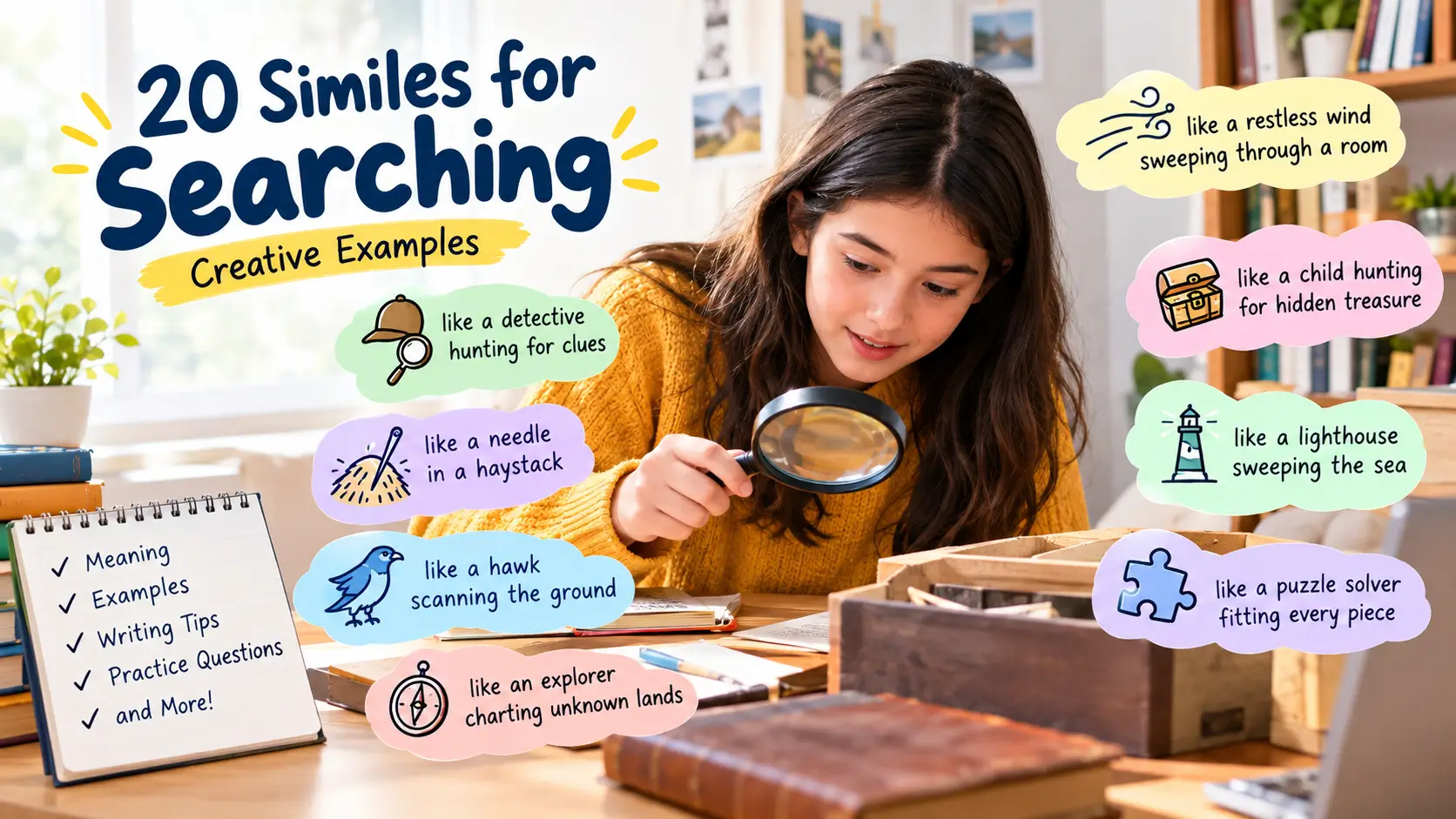
20 Similes for Searching
Here are 20 creative and natural similes for describing different kinds of searching. Some show careful investigation, while others capture confusion, curiosity, or a desperate hunt.
1. Searching like a detective hunting for clues
Meaning: Looking carefully for information or evidence.
What it conveys: Focus, patience, and a desire to solve a mystery.
Example sentences:
- Mia searched the old desk like a detective hunting for clues.
- He examined every message like a detective looking for a missing piece of evidence.
2. Searching like a needle in a haystack
Meaning: Trying to find something very small or hard to locate among many other things.
What it conveys: A difficult search that may feel almost impossible.
Example sentences:
- Finding my tiny earring in the garden was like searching for a needle in a haystack.
- Looking for one spelling mistake in the long essay felt like finding a needle in a haystack.
3. Searching like a dog sniffing out a bone
Meaning: Looking eagerly and persistently for something.
What it conveys: Strong interest and determination.
Example sentences:
- The children searched for Easter eggs like dogs sniffing out bones.
- He looked through the old boxes like a dog sniffing out a hidden bone.
4. Searching like an explorer charting unknown lands
Meaning: Looking through unfamiliar places or information.
What it conveys: Adventure, curiosity, and excitement about discovery.
Example sentences:
- She explored the dusty attic like an explorer charting unknown lands.
- The students searched the library like explorers discovering a new world.
5. Searching like a hawk scanning the ground
Meaning: Watching an area closely to spot something.
What it conveys: Sharp attention and careful observation.
Example sentences:
- Dad searched the grass like a hawk scanning the ground for prey.
- I watched the crowded street like a hawk looking for my friend.
6. Searching like a miner digging for gold
Meaning: Working hard to find something valuable.
What it conveys: Effort, patience, and hope of finding a reward.
Example sentences:
- She searched the old records like a miner digging for gold.
- He read through the dusty books like a miner searching for a hidden treasure.
7. Searching like a sailor looking for land
Meaning: Looking eagerly for a sign of something important.
What it conveys: Hope, longing, and a strong need to find something.
Example sentences:
- After hours in the fog, we scanned the horizon like sailors searching for land.
- She checked every road sign like a sailor looking for land after a long voyage.
8. Searching like a squirrel hunting for nuts
Meaning: Looking through different places for something needed.
What it conveys: Busy, quick, and sometimes playful searching.
Example sentences:
- The little boy searched the kitchen like a squirrel hunting for nuts.
- I rummaged through my backpack like a squirrel looking for a hidden snack.
9. Searching like a magnet pulling at metal
Meaning: Being drawn toward something you want to find.
What it conveys: Strong curiosity or attraction.
Example sentences:
- Her curiosity pulled her toward the old book like a magnet attracting metal.
- He followed every interesting clue like a magnet drawn to iron.
10. Searching like a flashlight cutting through darkness
Meaning: Looking for something in a confusing or unclear situation.
What it conveys: A careful effort to bring clarity to uncertainty.
Example sentences:
- His questions moved through the mystery like a flashlight cutting through darkness.
- She searched the confusing instructions like a flashlight shining into a dark room.
11. Searching like a bee exploring every flower
Meaning: Moving from one place to another to find something useful.
What it conveys: Energy, curiosity, and a thorough search.
Example sentences:
- The children searched the garden like bees exploring every flower.
- She browsed the shops like a bee visiting one flower after another.
12. Searching like a cat stalking a mouse
Meaning: Watching and moving carefully while trying to find something.
What it conveys: Patience, caution, and quiet determination.
Example sentences:
- He searched the quiet house like a cat stalking a mouse.
- The detective followed each clue like a cat tracking its prey.
13. Searching like a traveler following a map
Meaning: Looking for something by following directions or clues.
What it conveys: Purpose, planning, and steady progress.
Example sentences:
- She searched the website like a traveler following a map.
- We explored the old town like travelers tracing a path on a map.
14. Searching like a child hunting for hidden treasure
Meaning: Looking for something with excitement and wonder.
What it conveys: Playfulness, enthusiasm, and anticipation.
Example sentences:
- The children searched the backyard like treasure hunters on a secret mission.
- He opened each birthday gift like a child searching for hidden treasure.
15. Searching like a librarian tracking down a rare book
Meaning: Looking carefully for a specific item or piece of information.
What it conveys: Organization, knowledge, and attention to detail.
Example sentences:
- She searched the archives like a librarian tracking down a rare book.
- I checked every shelf like a librarian looking for a missing volume.
16. Searching like a spider feeling every thread
Meaning: Checking each small detail to find an answer.
What it conveys: Careful, methodical investigation.
Example sentences:
- He examined the strange pattern like a spider feeling every thread of its web.
- The scientist checked each result like a spider testing every strand.
17. Searching like a restless wind sweeping through a room
Meaning: Moving quickly through an area while looking for something.
What it conveys: Urgency, movement, and restless energy.
Example sentences:
- She rushed through the house like a restless wind searching every room.
- He looked through the piles of paper like a wind sweeping through fallen leaves.
18. Searching like a puzzle solver fitting every piece
Meaning: Examining different clues until they form a clear answer.
What it conveys: Logical thinking and careful problem-solving.
Example sentences:
- The detective searched for answers like a puzzle solver fitting every piece together.
- I studied the clues like a puzzle solver trying to complete a picture.
19. Searching like a lighthouse sweeping the sea
Meaning: Looking across a wide area in a steady, repeated way.
What it conveys: Broad observation and a persistent search.
Example sentences:
- Her eyes moved across the crowd like a lighthouse beam sweeping the sea.
- The rescue team scanned the coastline like a lighthouse searching the waves.
20. Searching like a gardener looking for the first flower of spring
Meaning: Looking patiently and hopefully for something special.
What it conveys: Hope, care, and quiet anticipation.
Example sentences:
- She searched the garden like a gardener waiting for the first flower of spring.
- He looked through the old photographs like a gardener searching for a fresh bloom.
How to Use Similes in Writing
Similes help readers picture what a search looks and feels like. They can turn a simple sentence into a more engaging moment.
For beginners, creating your own similes is easier than it may seem.
1. Choose what you want to describe
First, decide what kind of searching is happening.
Is someone searching:
- Quickly for a lost phone?
- Carefully for a hidden clue?
- Hopefully for a new opportunity?
- Confusedly through a messy room?
For example:
“She searched her bedroom.”
This tells us what happened, but not how she searched.
2. Find a familiar comparison
Think of something that behaves in a similar way.
A detective looks for clues. A hawk scans the ground. A treasure hunter explores hidden places.
You could write:
“She searched her bedroom like a detective hunting for clues.”
Now the reader can picture her careful movements.
3. Use “like” or “as”
These words help connect the two things being compared.
- He searched like a detective.
- She was as focused as a hawk watching its prey.
- They looked through the boxes like treasure hunters.
The comparison should make sense to the reader.
4. Make the comparison clear
A useful simile helps readers understand the action or feeling.
Weak example: “He searched like a cloud.”
This does not clearly show how he searched.
Clearer example: “He searched the room like a storm sweeping through a field.”
This creates an image of fast, restless movement.
5. Match the simile to the tone
Think about the mood of your writing.
|
Tone
|
Example
|
| — | — |
|
Funny
|
He searched for his glasses like a squirrel hunting for a lost nut.
|
|
Serious
|
She searched the records like a detective following a vital clue.
|
|
Exciting
|
They explored the cave like adventurers seeking hidden treasure.
|
|
Peaceful
|
He searched the garden like a gardener waiting for spring.
|
The right simile should fit the scene.
6. Add sensory details
Sensory details help readers imagine what a person sees, hears, feels, smells, or touches.
Instead of writing:
“She searched the attic like an explorer.”
Try:
“She searched the dusty attic like an explorer, brushing cobwebs from the boxes as the floorboards creaked.”
The added details make the scene feel more real.
7. Avoid overused comparisons
Common comparisons can be useful, but fresh wording can make your writing more memorable.
Instead of always saying:
“He searched like a detective.”
Try:
“He searched the scattered letters like a gardener sorting seeds for spring.”
Use a comparison that fits the object, action, and mood.
What Is a Simile?
A simile is a figure of speech that compares two different things using words such as “like” or “as.”
It helps readers understand an idea by connecting it to something familiar.
For example:
- “She searched like a detective.” This compares her search to a detective’s investigation.
- “His eyes moved like a lighthouse beam.” This compares the movement of his eyes to a sweeping light.
- “The room was as quiet as a library.” This compares the room’s quietness to a familiar place.
How do similes work?
A simile takes one thing and describes it through another.
For example:
“Tom searched the garden like a treasure hunter.”
Tom is not really a treasure hunter. The comparison shows that he is searching with excitement and purpose.
Why do writers use similes?
Writers use similes to:
- Make descriptions more vivid.
- Help readers imagine actions and feelings.
- Add humor or emotion.
- Make creative writing more memorable.
Similes are common in stories, poems, conversations, and descriptive writing.
Simile vs. Metaphor
A simile and a metaphor both compare things, but they do so in different ways.
A simile uses words such as “like” or “as.” A metaphor describes one thing as if it were another.
|
Simile
|
Metaphor
|
| — | — |
|
He searched like a detective.
|
He was a detective searching for answers.
|
|
Her eyes moved like a lighthouse beam.
|
Her eyes were lighthouse beams.
|
|
She searched as eagerly as a treasure hunter.
|
She was a treasure hunter in the attic.
|
Here is another simple example:
Simile: “The room smelled like rotten eggs.”
Metaphor: “The room was a rotten-egg factory.”
The simile compares the smell to rotten eggs. The metaphor describes the room as if it were a factory producing that smell.
Both can make writing vivid, but similes often make the comparison more direct.
Practical Exercise: 10 Questions
Test what you have learned about similes for searching. Try answering all ten questions before checking the answer section.
10 questions
0 of 10 answered
QUESTION 1 · Fill in the blank
Complete the simile: “She searched the room like a _____ hunting for clues.”
A. detective
B. flower
C. cloud
D. pillow
QUESTION 2 · Identify the simile
Which sentence contains a simile?
A. He searched the desk.
B. He searched like a detective.
C. He found his keys.
D. The desk was messy.
QUESTION 3 · Multiple choice
What does “searching like a needle in a haystack” mean?
A. Finding something very easily
B. Searching for something difficult to find
C. Making a lot of noise
D. Searching only outdoors
QUESTION 4 · Create your own
Create your own simile about someone searching quickly.
QUESTION 5 · Multiple choice
Which comparison best shows careful searching?
A. Like a detective examining clues
B. Like a bird flying away
C. Like rain falling softly
D. Like a bell ringing
QUESTION 6 · Fill in the blank
Complete the simile: “He searched the dusty attic like an explorer charting _____.”
A. unknown lands
B. a sandwich
C. a loud song
D. a warm blanket
QUESTION 7 · Multiple choice
What feeling does “searching like a child hunting for hidden treasure” create?
A. Boredom
B. Excitement and wonder
C. Anger
D. Sleepiness
QUESTION 8 · Compare two sentences
Which sentence is a metaphor rather than a simile?
A. She searched like a hawk.
B. He searched as carefully as a librarian.
C. She was a detective hunting for answers.
D. He looked like a treasure hunter.
QUESTION 9 · Create your own
Create a simile about searching for a lost phone.
QUESTION 10 · Multiple choice
Which detail makes a searching simile more vivid?
A. Adding sensory details
B. Repeating the same word
C. Removing all descriptions
D. Using unrelated comparisons
Check answers
Answers and Explanations
Here are the correct answers and explanations for all ten questions.
1. Searching like a detective hunting for clues
Answer: Detective.
A detective looks for clues and evidence. This comparison shows that the person is searching carefully.
2. “He searched like a detective.”
Answer: Option B.
The word “like” makes a comparison between the person’s search and a detective’s investigation.
3. Searching like a needle in a haystack
Answer: Searching for something difficult to find.
A needle is tiny, and a haystack contains many pieces of hay. The comparison describes a challenging search.
4. Create a simile about searching quickly
Sample answer: “She searched the room like a gust of wind sweeping through a garden.”
This simile suggests fast movement and urgency. Other answers are possible if the comparison clearly shows a quick search.
5. Careful searching
Answer: Like a detective examining clues.
Detectives often inspect details and look for evidence. This makes the comparison suitable for someone searching with care.
6. An explorer charting unknown lands
Answer: Unknown lands.
This phrase suggests exploring unfamiliar places. It fits the idea of searching through a dusty attic as if it were a new world.
7. Searching like a child hunting for hidden treasure
Answer: Excitement and wonder.
A treasure hunt often brings curiosity and anticipation. The simile makes the search feel fun and exciting.
8. Metaphor rather than simile
Answer: “She was a detective hunting for answers.”
This sentence directly describes her as a detective. It does not use “like” or “as” to make the comparison.
9. Create a simile about searching for a lost phone
Sample answer: “I searched the sofa like a squirrel hunting for a hidden nut.”
The squirrel comparison suggests a busy, determined search. Your answer can be different as long as it makes a clear comparison.
10. Making a simile more vivid
Answer: Adding sensory details.
Details such as the sound of creaking floorboards or the feel of dusty boxes help readers imagine the scene.
Conclusion
Similes for searching can make ordinary moments more vivid and interesting. Whether someone is hunting for lost keys, looking for clues, or exploring a new place, a good comparison helps readers picture the action.
You have explored 20 creative examples, learned how to use similes in writing, and practiced identifying and creating your own comparisons. You have also seen how similes differ from metaphors and how sensory details can make a description stronger.
Now, try creating a few original similes of your own. Think about how the person searches, what they feel, and what familiar object or action matches that experience. With practice, your creative writing can become clearer, livelier, and more memorable.

I am Beau Thomas, the Administrator at SimilyHub. I enjoy making similes, metaphors, and idioms easy to understand through clear explanations, helpful examples, and engaging content for English learners and writers.