Have you ever seen a storm shake the trees or watched a river rush through a valley? Some things seem so strong that ordinary words cannot fully describe them. That is where similes come in!
A simile compares one thing to another using words such as “like” or “as.” It helps readers picture an idea and feel its strength. For example, saying “Her voice was as powerful as thunder” creates a stronger image than simply saying “Her voice was loud.”
In this article, you will discover 20 similes for powerful things, people, emotions, and actions. Each example includes a simple meaning, what it conveys, and two sentences showing how to use it naturally.
Whether you are writing a school assignment, a short story, a poem, or a blog post, these creative writing similes can help you express strength and impact. You will also learn how to create your own similes, understand the difference between similes and metaphors, and practice with ten fun questions.
Let’s explore how a few simple comparisons can make your writing more vivid and memorable!
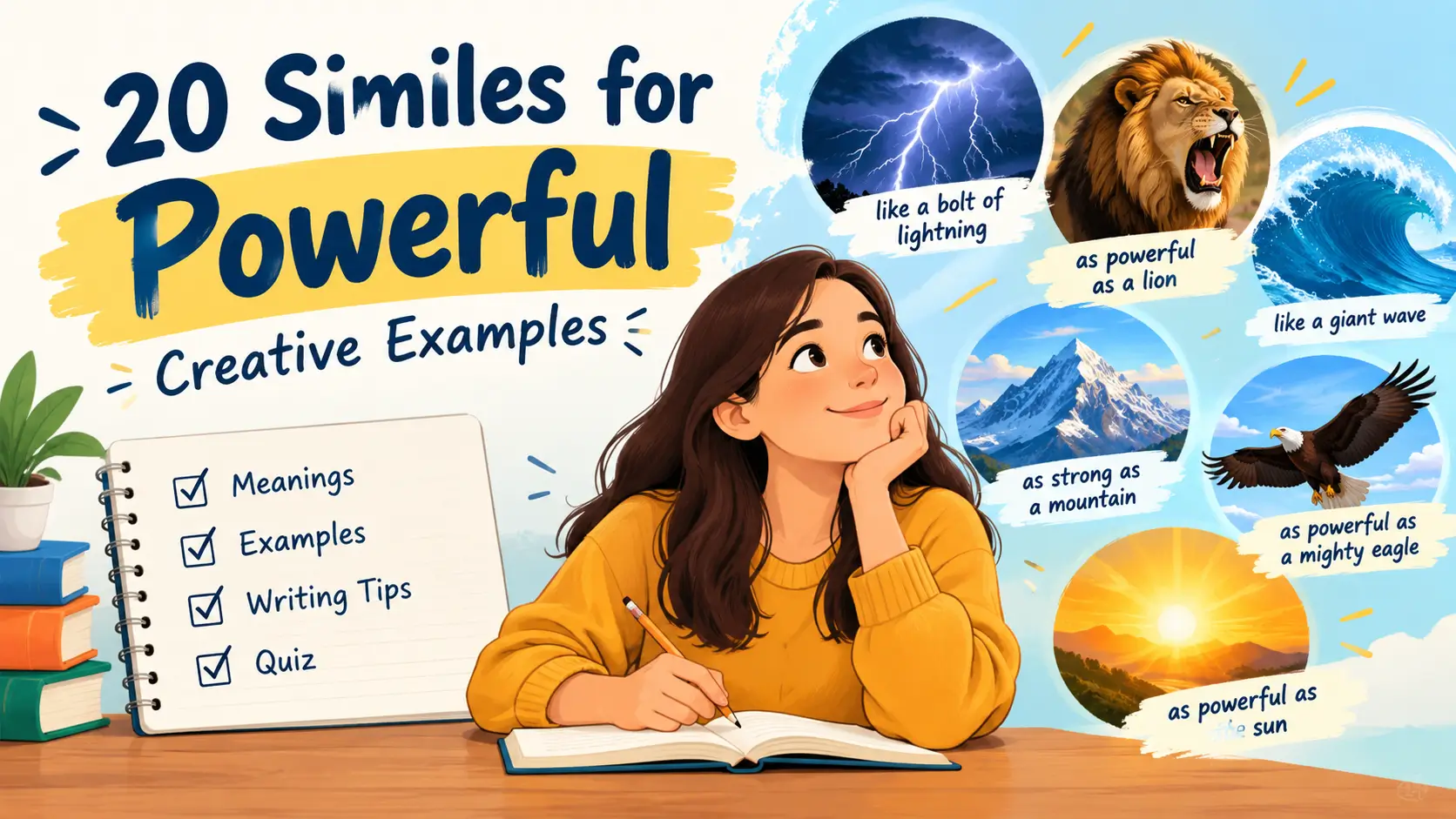
20 Similes for Powerful
These similes describe physical strength, strong emotions, influential people, and forces that make a big impact. Choose the ones that best match what you want your reader to imagine.
1. As powerful as a thunderstorm
Meaning: Extremely strong and forceful, like a storm with loud thunder and powerful winds.
What it conveys: Great energy, intensity, and a force that is hard to ignore.
Example sentences:
- The speaker’s voice was as powerful as a thunderstorm.
- Her anger rolled through the room like a powerful storm.
2. As powerful as a lion
Meaning: Very strong, brave, and full of force.
What it conveys: Courage, confidence, and physical or personal strength.
Example sentences:
- The young athlete was as powerful as a lion on the field.
- She stood as powerful as a lion when she defended her friend.
3. Like a rushing river
Meaning: Moving forward with great force and energy.
What it conveys: Unstoppable movement and strong momentum.
Example sentences:
- The crowd surged through the streets like a rushing river.
- His ideas flowed like a rushing river during the discussion.
4. As strong as an oak tree
Meaning: Very strong, steady, and able to withstand challenges.
What it conveys: Lasting strength, stability, and resilience.
Example sentences:
- My grandfather was as strong as an oak tree.
- She remained as steady as an oak tree during the crisis.
5. Like a bolt of lightning
Meaning: Having sudden, intense power or energy.
What it conveys: Speed, surprise, and a dramatic burst of force.
Example sentences:
- The runner shot forward like a bolt of lightning.
- A powerful idea struck him like a bolt of lightning.
6. As powerful as a volcano
Meaning: Having enormous force that can burst out suddenly.
What it conveys: Intense energy, explosive emotions, or a dramatic release of power.
Example sentences:
- His frustration was as powerful as a volcano ready to erupt.
- The volcano-like force of the eruption shook the ground.
7. Like a giant wave
Meaning: Coming with overwhelming force or strength.
What it conveys: Something large and powerful that is difficult to resist.
Example sentences:
- Excitement swept through the audience like a giant wave.
- The floodwater rushed toward the village like a giant wave.
8. As powerful as a hurricane
Meaning: Extremely forceful, with the ability to cause major change or disruption.
What it conveys: Overwhelming energy and a force that can transform its surroundings.
Example sentences:
- The wind howled as powerfully as a hurricane.
- Her campaign spread through the town like a hurricane.
9. Like a mighty hammer
Meaning: Having a strong, direct impact.
What it conveys: Force, impact, and the ability to break through resistance.
Example sentences:
- His final words struck the audience like a mighty hammer.
- The blacksmith swung the tool like a mighty hammer against the metal.
10. As powerful as the sun
Meaning: Having great energy or an influence that reaches far.
What it conveys: Warmth, strength, brightness, and a wide-reaching effect.
Example sentences:
- Her smile was as powerful as the sun, brightening everyone’s day.
- The sunlight poured over the hills like a powerful golden glow.
11. Like a roaring engine
Meaning: Full of energy and force, with the ability to keep going.
What it conveys: Drive, determination, and steady power.
Example sentences:
- The machine worked like a roaring engine.
- His ambition ran like a roaring engine that never slowed down.
12. As powerful as a tidal wave
Meaning: So strong that it can overwhelm whatever stands in its way.
What it conveys: Massive force and a feeling of being unable to stop something.
Example sentences:
- The fans’ cheers hit the stadium like a tidal wave.
- Change swept through the company as powerfully as a tidal wave.
13. Like a mighty mountain
Meaning: Strong, imposing, and difficult to move or overcome.
What it conveys: Stability, size, and unshakable strength.
Example sentences:
- The old fortress stood like a mighty mountain above the town.
- He remained firm like a mighty mountain despite the criticism.
14. As powerful as a charging bull
Meaning: Full of force and energy while moving forward.
What it conveys: Determination, physical strength, and fierce momentum.
Example sentences:
- The player charged toward the goal as powerfully as a bull.
- She tackled the challenge like a charging bull.
15. Like a booming drum
Meaning: Having a strong, deep, and attention-grabbing sound.
What it conveys: Loudness, rhythm, and an impact that people can feel.
Example sentences:
- His voice echoed through the hall like a booming drum.
- The music pulsed like a booming drum beneath our feet.
16. As powerful as a mighty eagle
Meaning: Strong, confident, and capable of rising above challenges.
What it conveys: Freedom, control, courage, and strength.
Example sentences:
- She spread her wings in the competition like a mighty eagle.
- His spirit was as powerful as a mighty eagle soaring above the clouds.
17. Like a wall of stone
Meaning: Firm, solid, and difficult to overcome.
What it conveys: Resistance, protection, and unyielding strength.
Example sentences:
- The defenders stood like a wall of stone.
- His determination was like a wall of stone against every setback.
18. As powerful as a blacksmith’s forge
Meaning: Full of intense heat, energy, and force.
What it conveys: Hard work, creation, and strength that shapes something new.
Example sentences:
- The workshop glowed with heat as powerful as a blacksmith’s forge.
- Her passion burned like a blacksmith’s forge as she worked on her invention.
19. Like a giant magnet
Meaning: Having a strong ability to attract people or attention.
What it conveys: Influence, charm, and a force that draws others in.
Example sentences:
- The famous singer drew fans like a giant magnet.
- His friendly nature attracted new friends like a giant magnet.
20. As powerful as a champion’s punch
Meaning: Having a sudden, forceful, and memorable impact.
What it conveys: Strength, impact, and an action that gets noticed.
Example sentences:
- The final scene hit the audience as powerfully as a champion’s punch.
- Her opening line landed like a champion’s punch and caught everyone’s attention.
How to Use Similes in Writing
You can create your own powerful similes by following a few simple steps. The goal is to help readers picture the strength or impact you want to describe.
1. Choose what you want to describe
Start with a person, object, feeling, sound, or action.
For example:
- A powerful voice
- A strong friendship
- A powerful storm
- A determined athlete
2. Find a familiar comparison
Think of something that has a similar quality. A lion may suggest courage, while a mountain may suggest stability.
For example:
- Her voice was as powerful as thunder.
- His courage was like a mighty oak.
3. Use “like” or “as”
These words help signal a simile.
- The crowd moved like a rushing river.
- Her determination was as strong as iron.
Both sentences compare one thing to another.
4. Make the comparison clear
Your reader should understand why the two things are being compared.
Instead of saying, “His thoughts were like a mountain,” try:
“His ideas stood firm like a mountain.”
The second sentence makes the intended meaning clearer.
5. Match the tone
A serious story may need a dramatic simile. A funny story can use a playful one.
- Serious: His voice boomed like thunder across the valley.
- Funny: My little brother charged into the kitchen like a tiny bull.
6. Add sensory details
Sensory details help readers imagine what something looks, sounds, feels, smells, or even tastes like.
Compare these examples:
- Basic: The wind was powerful.
- More vivid: The wind roared like a giant beast, rattling every window.
The second sentence helps readers hear and picture the wind.
7. Avoid overused comparisons
Some similes are familiar, such as “strong as an ox.” They can still work, but a fresh comparison may make your writing more memorable.
Try describing the exact quality you mean:
- For physical strength: “His arms were as strong as steel cables.”
- For influence: “Her words spread like ripples across a still lake.”
- For determination: “His resolve held firm like a lighthouse in a storm.”
The best simile is not always the fanciest one. It is the one that helps your reader understand your meaning.
What Is a Simile?
A simile is a figure of speech that compares two different things using words such as “like” or “as.”
It helps readers understand an idea by connecting it to something familiar. Writers use similes to make descriptions clearer, more vivid, and more interesting.
For example:
- “The baby was as quiet as a mouse.” This suggests that the baby made very little noise.
- “The waves crashed like thunder.” This helps readers imagine the loud sound of the waves.
- “Her confidence shone like a bright star.” This suggests that her confidence was easy to notice.
Similes are a form of figurative language. They do not usually mean that one thing is literally another. Instead, they highlight a shared quality.
When you use a simile, ask yourself: What two things am I comparing, and what quality do they share?
That simple question can help you create clear and natural simile sentences.
Simile vs. Metaphor
A simile and a metaphor both compare things, but they do it in different ways.
|
Simile
|
Metaphor
|
| — | — |
|
Uses “like” or “as” to make a comparison.
|
Says one thing is another.
|
|
“The room smelled like rotten eggs.”
|
“The room was a rotten-egg factory.”
|
|
“Her voice was as powerful as thunder.”
|
“Her voice was thunder.”
|
In simple terms, a simile makes the comparison directly visible through words like “like” or “as.” A metaphor describes something as if it were something else.
Both can make your writing more vivid. Use the one that best fits the image and tone you want to create.
Practical Exercise: 10 Questions
Test what you have learned about powerful similes. Try answering all ten questions before checking the answer section.
Practice quiz
0 / 10 answered
Choose an answer for each question. For the two writing questions, type your own simile.
1. Complete the simile: “Her voice was as powerful as ____.”
A whisper
Thunder
A feather
2. Which sentence contains a simile?
The athlete was a lion.
The athlete was strong.
The athlete ran like a cheetah.
3. What does “His determination was like a wall of stone” suggest?
He gives up easily.
He is firm and difficult to discourage.
He is very quiet.
4. Choose the best comparison for a sudden burst of power.
Like a bolt of lightning
Like a slow cloud
Like a soft pillow
5. Fill in the blank: “The crowd surged like a rushing ____.”
River
Leaf
Candle
6. Which sentence is a metaphor rather than a simile?
Her courage was like a lion’s.
Her courage was as strong as iron.
Her courage was a blazing fire.
7. Create your own simile describing a powerful storm.
8. Which simile best describes someone who attracts attention?
Like a giant magnet
Like a stone wall
Like a sleeping cat
9. Compare these: “The engine was loud” and “The engine roared like a thunderstorm.” What does the simile add?
A stronger sound image
A measurement of the engine
A different location
10. Create a simile about a powerful leader using “as” or “like.”
Check my answers
Answers and Explanations
Here are the answers to all ten questions, with simple explanations to help you understand how each simile works.
- Thunder. Thunder is loud and forceful, so it helps describe a voice with great strength and impact.
- “The athlete ran like a cheetah.” The word “like” introduces a comparison, making this a simile.
- He is firm and difficult to discourage. A wall of stone suggests strength and resistance.
- Like a bolt of lightning. Lightning is sudden and intense, making it a useful image for a quick burst of power.
- River. A rushing river suggests strong movement and unstoppable momentum.
- “Her courage was a blazing fire.” This is a metaphor because it directly describes courage as a fire without using “like” or “as.”
- Example: “The storm roared like a hungry beast.” This simile compares the storm’s sound and force to a fierce animal. Your answer may be different and still be correct.
- Like a giant magnet. A magnet attracts things, so this comparison suggests that someone draws attention or people toward them.
- A stronger sound image. Comparing the engine to a thunderstorm helps readers imagine its loud, powerful roar.
- Example: “The leader stood as steady as an oak tree.” This compares the leader’s steadiness to a strong tree. Other clear comparisons using “like” or “as” can also work.
Conclusion
Similes are a simple way to make your writing more vivid and engaging. By comparing something powerful to a familiar object, animal, or natural force, you help readers picture its strength and understand its impact.
These 20 similes for powerful things can help you describe strong voices, determined people, intense emotions, and forces of nature. You can also use them as inspiration for your own creative writing examples.
Remember to choose comparisons that fit your meaning, use “like” or “as,” and keep your descriptions clear. You do not need fancy words to create a memorable image.
Now try writing three original similes of your own. Think about what makes something powerful, find a comparison that captures that quality, and let your imagination do the rest!

I’m Jude James, a passionate writer who loves making similes, metaphors, and idioms easy to understand. I enjoy helping readers explore creative language and express ideas with confidence.