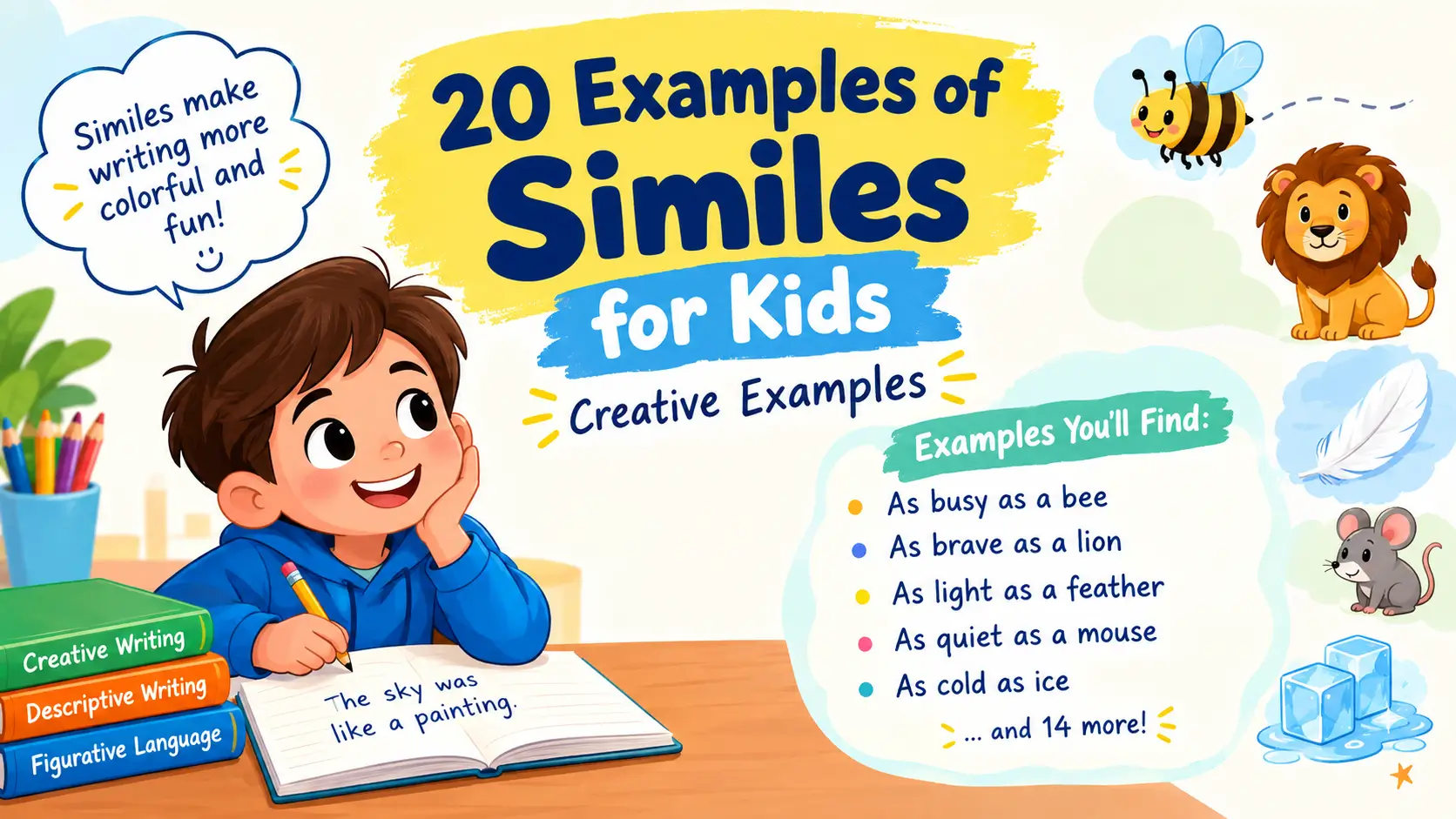
Similes are a fun way to make writing more colorful and exciting. They help us describe people, animals, places, and things by comparing them to something familiar. For example, you might say, “The puppy is as soft as a cloud.” This helps readers imagine how soft the puppy feels.
If you are looking for an example of similes for kids, you are in the right place! Similes are easy to learn, and you can use them in stories, poems, schoolwork, and everyday conversations.
A simile often uses the words “like” or “as” to compare two different things. These comparisons help readers picture what you mean. They can also make your writing funny, sweet, or full of adventure.
In this article, you will discover 20 simple similes for kids, learn what each one means, and see how to use it in a sentence. You will also learn the difference between similes and metaphors and try a fun exercise with 10 questions.
Let’s get started and make your words shine!
20 Similes for Kids
Here are 20 easy and creative examples of similes that children can understand and use in their writing.
1. As busy as a bee
Meaning: Someone who is always working or doing something.
What it conveys: A person who is active and full of energy.
Example sentences:
- Mia was as busy as a bee, finishing her homework before dinner.
- The little bee was as busy as a bee, flying from flower to flower.
2. As brave as a lion
Meaning: Someone who shows great courage.
What it conveys: Strength and confidence when facing something scary.
Example sentences:
- Sam was as brave as a lion when he spoke in front of the class.
- The young knight was as brave as a lion as he entered the dark cave.
3. As light as a feather
Meaning: Something that weighs very little.
What it conveys: A feeling of being easy to lift or carry.
Example sentences:
- The tiny paper boat was as light as a feather.
- My new backpack felt as light as a feather after I unpacked it.
4. As quiet as a mouse
Meaning: Making very little noise.
What it conveys: Silence or a gentle, quiet manner.
Example sentences:
- The children were as quiet as mice while the baby slept.
- Lily walked into the room as quiet as a mouse.
5. As cold as ice
Meaning: Very cold to the touch.
What it conveys: A strong feeling of chill.
Example sentences:
- My hands were as cold as ice after playing in the snow.
- The lemonade was as cold as ice on a hot afternoon.
6. As sweet as honey
Meaning: Very sweet in taste or kind in behavior.
What it conveys: Warmth, kindness, or a pleasant sweetness.
Example sentences:
- Grandma’s cookies were as sweet as honey.
- The new student was as sweet as honey to everyone in class.
7. As fast as a cheetah
Meaning: Moving very quickly.
What it conveys: Great speed and energy.
Example sentences:
- Jay ran as fast as a cheetah during sports day.
- The cartoon rabbit dashed across the screen as fast as a cheetah.
8. As strong as an ox
Meaning: Very strong.
What it conveys: Great physical power.
Example sentences:
- My big brother is as strong as an ox.
- The farmer was as strong as an ox and lifted the heavy sack.
9. Like a fish out of water
Meaning: Feeling uncomfortable in a new or unfamiliar place.
What it conveys: Awkwardness or not knowing how to fit in.
Example sentences:
- I felt like a fish out of water at my first dance class.
- The city cat felt like a fish out of water on the farm.
10. Like a shining star
Meaning: Standing out because of talent, kindness, or achievement.
What it conveys: Brightness, confidence, and being noticed.
Example sentences:
- Ava sang like a shining star at the school concert.
- The young artist stood out like a shining star in the competition.
11. As slippery as an eel
Meaning: Very difficult to hold because it keeps slipping away.
What it conveys: A smooth, slippery surface or a tricky escape.
Example sentences:
- The wet fish was as slippery as an eel.
- The bar of soap was as slippery as an eel in my hands.
12. As happy as a lark
Meaning: Feeling very cheerful.
What it conveys: Joy, lightness, and a bright mood.
Example sentences:
- Ella was as happy as a lark on her birthday.
- The children were as happy as larks when school ended for the holidays.
13. Like a bull in a china shop
Meaning: Moving in a clumsy or careless way in a place with fragile things.
What it conveys: Awkward movement that could cause a mess.
Example sentences:
- Max moved like a bull in a china shop among the glass ornaments.
- The puppy ran through the living room like a bull in a china shop.
14. As bright as the sun
Meaning: Very bright or full of light.
What it conveys: A strong glow or cheerful brightness.
Example sentences:
- Her yellow dress was as bright as the sun.
- The classroom looked as bright as the sun after we opened the curtains.
15. As gentle as a lamb
Meaning: Very kind, calm, and soft in behavior.
What it conveys: Tenderness and care.
Example sentences:
- The nurse was as gentle as a lamb when she helped the child.
- Our kitten was as gentle as a lamb while playing with the baby.
16. Like a rocket
Meaning: Moving or rising very quickly.
What it conveys: Sudden speed and excitement.
Example sentences:
- The ball shot into the sky like a rocket.
- When the bell rang, the children ran out like rockets.
17. As proud as a peacock
Meaning: Feeling very pleased with yourself or your achievements.
What it conveys: Confidence and happiness about doing something well.
Example sentences:
- Noah was as proud as a peacock after winning his spelling bee.
- Mom looked as proud as a peacock when I showed her my painting.
18. Like a dream
Meaning: Something that feels wonderful, beautiful, or almost magical.
What it conveys: A sense of delight or wonder.
Example sentences:
- Our trip to the mountains felt like a dream.
- The ballet performance looked like a dream under the sparkling lights.
19. As playful as a puppy
Meaning: Full of fun and eager to play.
What it conveys: Energy, excitement, and a cheerful mood.
Example sentences:
- My little cousin was as playful as a puppy at the park.
- The kittens were as playful as puppies, chasing each other around the room.
20. Like a candle in the dark
Meaning: Something or someone that brings hope or comfort during a difficult time.
What it conveys: Warmth, guidance, and a little light when things feel hard.
Example sentences:
- My friend’s kind words were like a candle in the dark on a sad day.
- The small lamp glowed like a candle in the dark during the power cut.
How to Use Similes in Writing
You can make your writing more interesting by creating your own similes. You do not need big words or complicated ideas. Just look for something familiar that helps readers picture what you mean.
Here are six easy steps to follow.
1. Choose what you want to describe
Think about the person, place, animal, or thing you are writing about.
Example: The dog is fast.
2. Find a familiar comparison
Think of something that is known for being fast.
Example: A cheetah.
3. Use “like” or “as”
These words help connect your two ideas.
- The dog runs like a cheetah.
- The dog is as fast as a cheetah.
Both sentences are similes.
4. Make the comparison clear
Choose a comparison that helps readers understand your meaning.
Instead of saying, “The dog is like a thing,” try:
“The dog is as playful as a puppy.”
5. Match the feeling of your writing
A funny story can use silly comparisons. A calm story can use gentle ones.
- Funny: My hair looked like a bird’s nest.
- Calm: The lake was as still as glass.
6. Add sensory details
Think about what something looks, sounds, feels, smells, or tastes like.
For example:
- Sight: The stars sparkled like tiny diamonds.
- Sound: The drum boomed like thunder.
- Touch: The blanket felt as soft as velvet.
- Taste: The lemon tasted as sour as vinegar.
Writing tip: Try to make your similes fresh and clear. Familiar comparisons are useful, but a new comparison can make your story stand out.
What Is a Simile?
A simile is a figure of speech that compares two different things using words such as “like” or “as.”
It helps readers imagine something by connecting it to an idea they already know.
For example:
- “The snow was as white as a sheet.”
- “The baby slept like a log.”
- “The stars looked like diamonds.”
In each example, the comparison helps create a clear picture.
Writers use similes to:
- Make descriptions more vivid.
- Help readers understand feelings and ideas.
- Add humor and imagination.
- Make stories and poems more enjoyable.
Similes are part of figurative language, which uses words in creative ways rather than only their literal meanings.
You can find similes in children’s books, poems, songs, and everyday conversations. You can also create your own by thinking about what something reminds you of.
Simile vs. Metaphor
Similes and metaphors both compare things, but they do it in different ways.
|
Simile
|
Metaphor
|
| — | — |
|
Uses “like” or “as” to make a comparison.
|
Says one thing is another.
|
|
“The room smelled like rotten eggs.”
|
“The room was a rotten-egg factory.”
|
|
“Her smile was as bright as the sun.”
|
“Her smile was the sun.”
|
Easy way to remember: A simile says something is like something else. A metaphor says it is something else in a figurative way.
Both can make creative writing more exciting.
Practical Exercise: 10 Questions
Now it is your turn! Try these 10 questions to practice identifying and creating similes.
10 questions
0 of 10 answered
1. Fill in the blank: The kitten was as soft as a ____.
A. rock
B. cloud
C. drum
2. Which sentence contains a simile?
A. The sun is bright.
B. The sun smiled at us.
C. The sun was like a golden ball.
3. Choose the word that completes the simile: He ran as fast as a ____.
A. cheetah
B. snail
C. stone
4. Which phrase describes someone who is very quiet?
A. As loud as thunder
B. As quiet as a mouse
C. As tall as a tree
5. Is this a simile or a metaphor? “My brother is a walking dictionary.”
A. Simile
B. Metaphor
C. Neither
6. Fill in the blank: The ice was as cold as ____.
A. fire
B. ice
C. sand
7. Which sentence uses a simile to describe sound?
A. The bell rang like a bird singing.
B. The bell is round.
C. The bell was on the table.
8. Create your own simile: The little boy was as happy as ____.
A. a sunny day
B. a broken chair
C. a dark cave
9. Which sentence is a metaphor rather than a simile?
A. Her eyes sparkled like stars.
B. Her eyes were stars.
C. Her eyes were as bright as stars.
10. Create a simile to describe a very slow turtle. Which is a suitable example?
A. The turtle moved like a speeding rocket.
B. The turtle moved as slowly as a snail.
C. The turtle was bright as a lamp.
Check my answers
Answers and Explanations
Here are the answers to all 10 questions, with a simple explanation for each one.
- B — Cloud. A cloud is a familiar way to describe something soft and fluffy.
- C — The sun was like a golden ball. It uses “like” to compare the sun to a ball.
- A — Cheetah. A cheetah represents great speed.
- B — As quiet as a mouse. This simile describes someone who makes very little noise.
- B — Metaphor. It directly calls the brother a walking dictionary, without using “like” or “as.”
- B — Ice. Ice is cold, so it makes the comparison easy to understand.
- A — The bell rang like a bird singing. The sentence compares two sounds using “like.”
- A — A sunny day. A sunny day can suggest a cheerful, happy feeling. Other creative answers can also be correct.
- B — Her eyes were stars. This is a metaphor because it makes a direct figurative comparison.
- B — The turtle moved as slowly as a snail. The comparison helps readers imagine slow movement.
Conclusion
Similes are a simple and fun way to make writing more vivid. They help you describe feelings, people, animals, and places by comparing them to familiar things.
In this guide, you explored 20 examples of similes for kids, learned their meanings, and saw how to use them in sentences. You also discovered how similes differ from metaphors and practiced creating and identifying comparisons.
Remember, you do not need to use fancy words to write a great simile. Start with something you want to describe, think of something familiar, and connect the two with “like” or “as.”
Keep looking for interesting comparisons in the world around you. The more you practice, the easier it becomes to create your own fun and memorable similes. Your next great story could begin with just one creative comparison!

I am Beau Thomas, the Administrator at SimilyHub. I enjoy making similes, metaphors, and idioms easy to understand through clear explanations, helpful examples, and engaging content for English learners and writers.