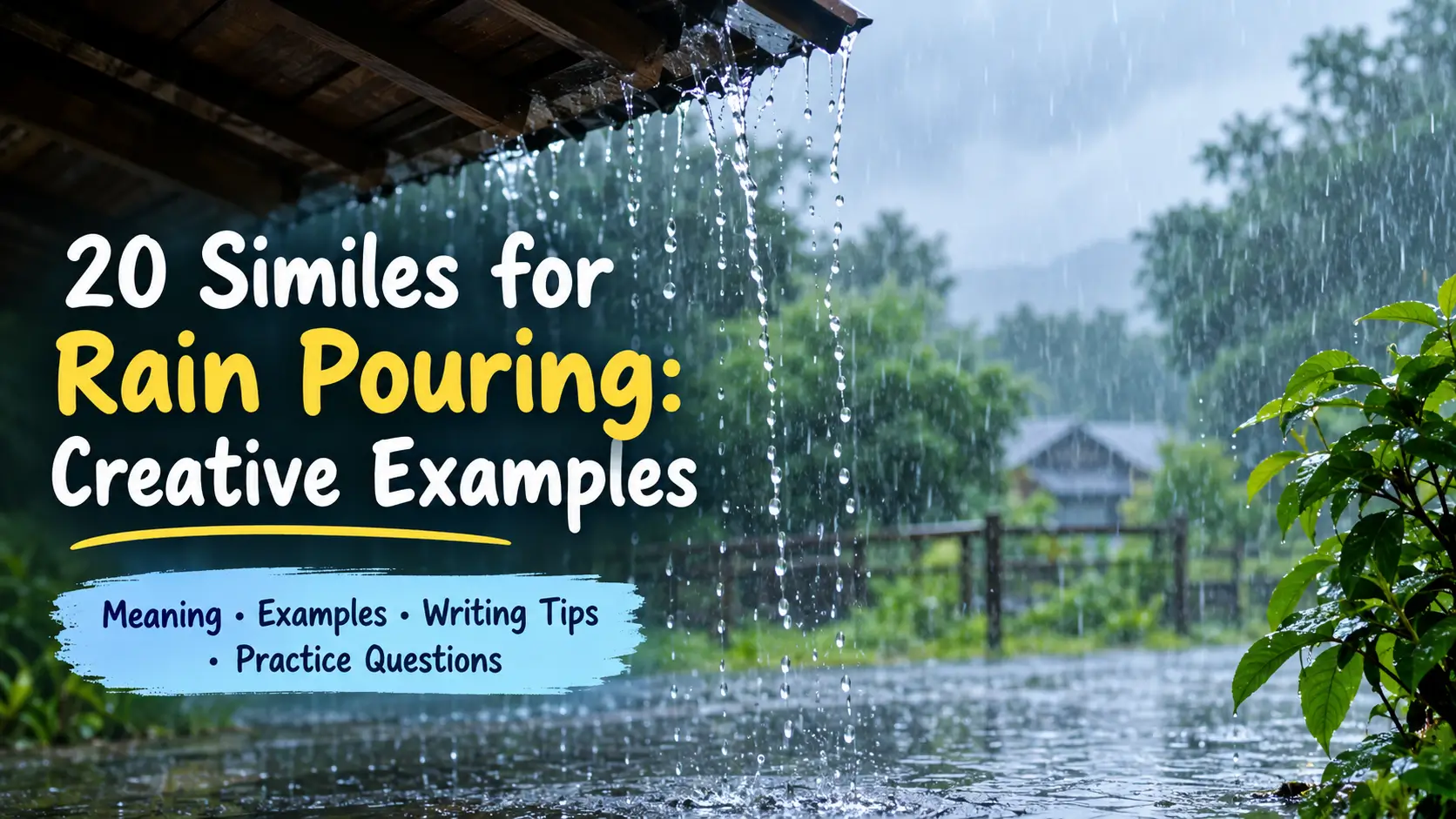
When rain starts pouring, it can change the whole mood of a scene. A light shower may feel calm, but heavy rain can seem wild, powerful, noisy, or even magical. This is where similes can make your writing much more vivid. Instead of simply saying, “The rain was heavy,” you can compare it to something familiar and help your reader picture the scene.
These similes for rain pouring give you creative ways to describe a sudden downpour, a stormy afternoon, or rain falling hard against windows and streets. You will find simple meanings, what each comparison conveys, and two natural simile sentences for every example.
Whether you are writing a story, poem, school assignment, or descriptive paragraph, these examples can help you make your writing more colorful. You will also learn how to create your own comparisons, understand the meaning of similes, and practice using them. Let’s explore some creative ways to describe pouring rain.
20 Similes for Rain Pouring
1. The rain poured like a waterfall
Meaning: The rain was falling very heavily and continuously, much like water rushing over a waterfall.
What it conveys: This creates a strong image of a huge amount of water falling quickly.
Example sentences:
- The rain poured like a waterfall outside our windows.
- By evening, the rain was falling like a waterfall from the dark clouds.
2. The rain fell like buckets of water
Meaning: This means a very large amount of rain was falling at once.
What it conveys: It makes the downpour sound sudden, heavy, and overwhelming.
Example sentences:
- Rain fell like buckets of water as we hurried home.
- It started raining like buckets of water just before the game.
3. The rain came down like a curtain
Meaning: The heavy rain looked like a thick curtain hanging between the viewer and the world.
What it conveys: This comparison shows how rain can make everything behind it look blurry or hidden.
Example sentences:
- The rain came down like a curtain across the road.
- A curtain of rain covered the houses in the distance.
4. The rain poured like a broken pipe
Meaning: The rain was falling with a fast, steady, and uncontrolled flow.
What it conveys: It gives the downpour a forceful and slightly chaotic feeling.
Example sentences:
- Rain poured like a broken pipe onto the empty street.
- Outside, the storm released rain like a broken pipe.
5. The rain fell like silver ropes
Meaning: The streams of rain looked long and bright, almost like shining ropes.
What it conveys: This creates a vivid visual image of rain falling in straight, sparkling lines.
Example sentences:
- The rain fell like silver ropes beneath the streetlights.
- From the porch, I watched the rain fall like silver ropes from the sky.
6. The rain hammered down like a drummer
Meaning: The rain was falling hard and making a strong, steady noise.
What it conveys: This comparison focuses on the loud rhythm of heavy rain.
Example sentences:
- The rain hammered down like a drummer on the metal roof.
- All night, the rain beat against the windows like a drummer.
7. The rain poured like a flooded river
Meaning: The rain was falling in such a large amount that it seemed like a river flowing from the sky.
What it conveys: It emphasizes the huge volume and force of the rain.
Example sentences:
- Rain poured like a flooded river over the rooftops.
- The storm sent rain down like a flooded river.
8. The rain fell like thousands of tiny arrows
Meaning: The drops were falling quickly and sharply.
What it conveys: This creates an intense image of fast, forceful rain.
Example sentences:
- Rain fell like thousands of tiny arrows against the glass.
- The wind drove the rain like thousands of tiny arrows into the trees.
9. The rain poured like a waterfall from the sky
Meaning: The rain was extremely heavy and seemed to flow directly downward from the clouds.
What it conveys: It makes the sky seem as though it has opened into a giant stream of water.
Example sentences:
- Rain poured like a waterfall from the sky.
- We could barely see the road as rain fell like a waterfall from the clouds.
10. The rain fell like beads from a broken necklace
Meaning: The raindrops appeared like many small beads falling rapidly together.
What it conveys: This gives heavy rain a creative and visual quality.
Example sentences:
- Rain fell like beads from a broken necklace across the garden.
- Under the porch light, the drops looked like beads from a broken necklace.
11. The rain poured like a raging river
Meaning: The rain was flowing with great force and speed.
What it conveys: This comparison highlights the strength and unstoppable nature of the downpour.
Example sentences:
- The rain poured like a raging river through the streets.
- Water rushed along the gutters as the rain fell like a raging river.
12. The rain crashed down like waves
Meaning: The rain was falling with powerful movement, similar to waves crashing onto a shore.
What it conveys: It gives the storm a dramatic and energetic feeling.
Example sentences:
- The rain crashed down like waves against the windows.
- Outside, rain came down like waves pounding the shore.
13. The rain poured like water from an overturned bucket
Meaning: A great amount of water seemed to be falling all at once.
What it conveys: This is an easy comparison for a sudden and very heavy downpour.
Example sentences:
- The rain poured like water from an overturned bucket.
- Without warning, the clouds opened and rain fell like water from an overturned bucket.
14. The rain fell like a thousand drumbeats
Meaning: The many raindrops created a loud, repeated sound.
What it conveys: This simile focuses on the rhythm and noise of heavy rain.
Example sentences:
- Rain fell like a thousand drumbeats on the roof.
- I listened to the rain tapping like a thousand drumbeats through the night.
15. The rain poured like a rushing stream
Meaning: The rain was falling continuously and quickly.
What it conveys: It gives the impression of movement, flow, and constant water.
Example sentences:
- The rain poured like a rushing stream across the pavement.
- Water ran down the windows as rain fell like a rushing stream.
16. The rain fell like a blanket of water
Meaning: The heavy rain seemed to cover everything in a thick layer.
What it conveys: This comparison shows how the rain can surround and hide the landscape.
Example sentences:
- The rain fell like a blanket of water over the town.
- A blanket of rain covered the fields before sunset.
17. The rain poured like the sky had sprung a leak
Meaning: The rain was so heavy that it seemed as if the sky itself had a huge hole in it.
What it conveys: This creates a playful and imaginative image of an enormous downpour.
Example sentences:
- The rain poured like the sky had sprung a leak.
- We laughed and ran for shelter as rain fell like the sky had sprung a leak.
18. The rain fell like strings of glass
Meaning: The falling drops looked thin, straight, and shiny.
What it conveys: This gives the rain a delicate but striking visual appearance.
Example sentences:
- The rain fell like strings of glass beneath the porch light.
- Outside, the storm sent down rain like strings of glass.
19. The rain poured like an endless shower
Meaning: The rain continued for a long time without stopping.
What it conveys: It emphasizes the steady and seemingly never-ending nature of the rain.
Example sentences:
- The rain poured like an endless shower throughout the afternoon.
- We stayed indoors while the rain fell like an endless shower.
20. The rain came down like the heavens had opened
Meaning: An enormous amount of rain suddenly began falling.
What it conveys: This creates a dramatic picture of an intense, sudden downpour.
Example sentences:
- The rain came down like the heavens had opened.
- Just as we reached the park, rain poured down like the heavens had opened.
How to Use Similes in Writing
Creating your own similes is easier than it may seem. Start with the thing you want to describe. Then think about what it looks, sounds, feels, or moves like.
For example, if you want to describe heavy rain, ask yourself:
- What does the rain look like?
- What does it sound like?
- How does it move?
- What feeling does it create?
Then choose a familiar comparison and connect it with like or as.
For example:
- The rain fell like silver strings.
- The rain sounded like thousands of tiny drums.
- The streets became as wet as a riverbank.
- The storm moved like a giant rushing wave.
Try to avoid comparisons that feel forced. A good simile should help the reader see or feel something more clearly.
Also think about tone. A playful story might use “rain poured like a giant spilled a bucket.” A serious story might use “rain fell like dark curtains across the road.”
Sensory details can make your creative writing similes even stronger. Describe what the rain looks like, what it sounds like against the roof, or how cold it feels on someone’s skin.
What Is a Simile?
A simile is a figure of speech that compares two different things to make a description clearer or more interesting. Similes commonly use words such as like or as.
For example:
- The rain fell like a waterfall.
- Her voice was as soft as rain.
- The drops glittered like tiny diamonds.
The comparison does not mean the two things are literally the same. Instead, it helps the reader imagine a quality they share.
Writers use similes because they make descriptions more vivid. Rather than saying “the rain was loud,” you could say, “The rain sounded like thousands of drums.”
You may also see unusual phrases such as “strohl simile” in search queries. “Strohl simile” is not a standard literary term. If someone uses that phrase, they may simply be looking for information about similes or a particular example involving the word “Strohl.”
Simile vs. Metaphor
A simile makes a comparison using words such as like or as.
A metaphor makes the comparison directly, without using those signal words.
For example:
Simile: “The room smelled like rotten eggs.”
Metaphor: “The room was a rotten-egg factory.”
Both sentences create a similar image, but they do it differently.
Here is another example:
Simile: “The rain was like a waterfall.”
Metaphor: “The rain was a waterfall.”
A simple way to remember the difference is this: similes compare; metaphors say one thing is another.
Practical Exercise: 10 Questions
- Fill in the blank: The rain poured ___ a waterfall.
a) like
b) but
c) because - Identify the simile: Which sentence contains a simile?
a) The rain covered the road.
b) The rain fell like silver strings.
c) The road became wet. - Fill in the blank: The rain sounded as loud ___ a thousand drums.
- Multiple choice: Which sentence uses a simile to describe heavy rain?
a) The rain was heavy.
b) The rain flooded the street.
c) The rain fell like a curtain of water. - Identify the comparison: In “The rain crashed down like waves,” what is the rain compared to?
- Create your own: Write a simile comparing heavy rain to something you might see in nature.
- Compare two sentences: Which sentence creates a stronger visual image?
a) The rain was heavy.
b) The rain fell like thousands of tiny arrows.
Explain why. - Fill in the blank: Rain fell ___ a blanket of water over the town.
- Create your own: Complete this sentence with a creative simile:
“The rain tapped against the window like ______.” - Multiple choice: Which sentence is a metaphor rather than a simile?
a) The rain fell like a waterfall.
b) The rain sounded like drums.
c) The rain was a silver curtain.
Answers and Explanations
- Answer: a) like
The sentence uses “like” to compare the heavy rain to a waterfall. This makes it a simile. - Answer: b) The rain fell like silver strings.
The word “like” signals a comparison, so this is a simile. - Answer: as
The complete sentence is: “The rain sounded as loud as a thousand drums.” The structure as…as is commonly used to form similes. - Answer: c) The rain fell like a curtain of water.
This sentence compares the rain to a curtain of water and gives the reader a stronger visual image. - Answer: Waves.
The rain is compared to waves. The comparison suggests powerful, crashing movement. - Sample answer: “The rain poured like a river falling from the clouds.”
This works because it compares heavy rain to a familiar natural flow of water. Other creative answers can also be correct. - Answer: b) The rain fell like thousands of tiny arrows.
Sentence B gives the reader a specific picture of the speed and force of the rain. Sentence A simply states a fact. - Answer: like
The complete sentence is: “Rain fell like a blanket of water over the town.” The comparison shows how the rain seemed to cover everything. - Sample answer: “The rain tapped against the window like tiny fingers.”
This comparison gives the reader a clear sound and image. Many other imaginative answers can work. - Answer: c) The rain was a silver curtain.
This is a metaphor because it directly says the rain was a curtain. It does not use “like” or “as.”
Conclusion
Similes are a simple way to make ordinary descriptions more vivid. Instead of simply saying that rain is heavy, you can compare it to a waterfall, a curtain, waves, or thousands of tiny arrows. These comparisons help readers picture the scene and connect with its mood.
The similes for rain pouring in this article can give you ideas for stories, poems, school assignments, and descriptive writing. The key is to choose comparisons that feel natural and match the scene you are creating.
When you write your own similes, think about what the rain looks, sounds, and feels like. Then find a familiar image that captures that quality. With practice, you can turn simple sentences into memorable creative writing examples. Keep experimenting, and let your imagination make the rain come alive.

I am Beau Thomas, the Administrator at SimilyHub. I enjoy making similes, metaphors, and idioms easy to understand through clear explanations, helpful examples, and engaging content for English learners and writers.