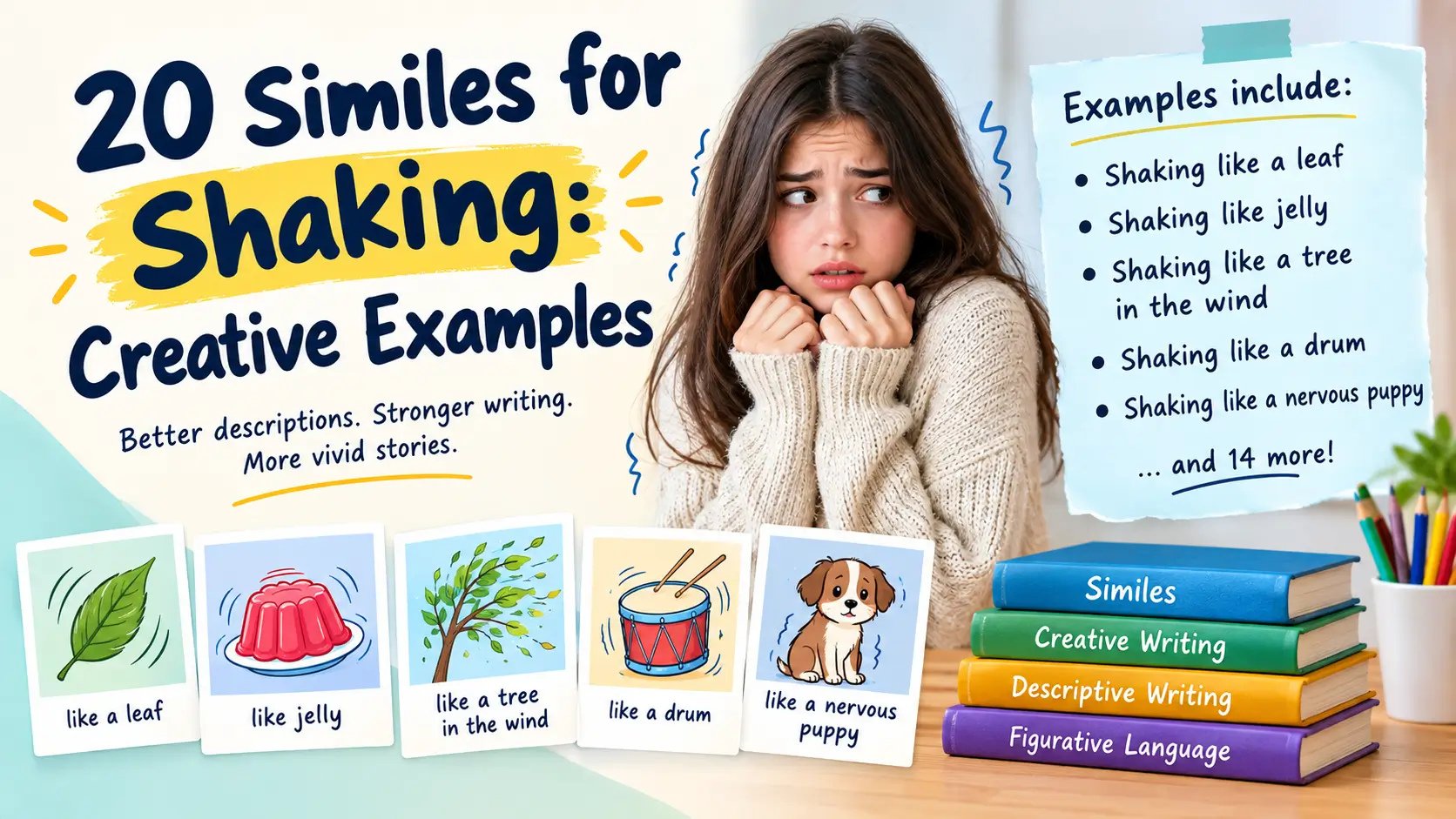
Shaking can show many different feelings. You might shake because you are cold, scared, nervous, excited, angry, or full of energy. A simple sentence such as “He was shaking” tells us what happened, but it does not always help the reader picture the moment. This is where similes can make your writing stronger. By comparing shaking to something familiar, you can show how strong, fast, gentle, or uncontrollable the movement feels. For example, saying someone “shook like a leaf” creates a clear picture of a person trembling with fear or cold. In this guide, you will find 20 useful similes for shaking, along with meanings and natural simile sentences. You will also learn how to create your own comparisons, understand the meaning of similes, and tell the difference between a simile and a metaphor. Whether you are writing a story, poem, school assignment, or descriptive paragraph, these creative writing examples can help you make your descriptions more vivid and memorable.
20 Similes for Shaking
1. Shaking like a leaf
Meaning: This means shaking gently and uncontrollably, often because of fear or cold.
What it conveys: It creates the image of a small leaf trembling in the wind.
Example sentences:
- The frightened puppy was shaking like a leaf during the thunderstorm.
- I stood outside in the cold, shaking like a leaf.
2. Shaking like jelly
Meaning: This means shaking so much that the body seems soft and unsteady.
What it conveys: It gives a funny and vivid picture of someone struggling to stay still.
Example sentences:
- My knees were shaking like jelly before I walked onto the stage.
- After the scary movie, he was shaking like jelly.
3. Shaking like a washing machine
Meaning: This describes strong, rapid shaking that seems difficult to control.
What it conveys: It creates an energetic image of constant movement.
Example sentences:
- The old truck was shaking like a washing machine on the rough road.
- His hands were shaking like a washing machine during the tense moment.
4. Shaking like a frightened rabbit
Meaning: This means trembling because of fear or nervousness.
What it conveys: The comparison makes the person seem small, scared, and helpless.
Example sentences:
- The child stood at the doorway, shaking like a frightened rabbit.
- She was shaking like a frightened rabbit when she heard the sudden noise.
5. Shaking like a tree in the wind
Meaning: This describes strong shaking caused by fear, cold, or another powerful feeling.
What it conveys: It creates a picture of something moving back and forth in a strong breeze.
Example sentences:
- His whole body was shaking like a tree in the wind.
- She stood outside, shaking like a tree in the winter breeze.
6. Shaking like a drum
Meaning: This means shaking or vibrating with repeated, noticeable movement.
What it conveys: The comparison suggests quick, rhythmic movement.
Example sentences:
- The windows were shaking like a drum during the storm.
- His hands were shaking like a drum as he tried to open the letter.
7. Shaking like a nervous puppy
Meaning: This describes small, rapid trembling caused by nervousness or fear.
What it conveys: It gives the reader a cute but clear image of nervous shaking.
Example sentences:
- I was shaking like a nervous puppy before my first speech.
- He stood in front of the crowd, shaking like a nervous puppy.
8. Shaking like a bowl of water
Meaning: This means moving so much that everything seems to tremble or ripple.
What it conveys: It creates an image of constant, visible movement.
Example sentences:
- Her hands were shaking like a bowl of water in a moving car.
- The ground felt as if it were shaking like a bowl of water.
9. Shaking like a rattling window
Meaning: This describes quick, repeated shaking that makes something appear unstable.
What it conveys: It suggests a nervous or restless movement that does not stop easily.
Example sentences:
- His hands were shaking like a rattling window in the storm.
- The old chair was shaking like a rattling window whenever he moved.
10. Shaking like a drumstick
Meaning: This means trembling quickly and repeatedly.
What it conveys: It gives the shaking a sharp, energetic quality.
Example sentences:
- Her fingers were shaking like drumsticks as she waited for the results.
- He held the microphone with hands shaking like drumsticks.
11. Shaking like a candle flame
Meaning: This describes gentle but noticeable trembling.
What it conveys: It creates a delicate image of something moving back and forth.
Example sentences:
- His voice was shaking like a candle flame in the breeze.
- Her hands trembled like a candle flame as she opened the old box.
12. Shaking like a bridge in a storm
Meaning: This means shaking strongly under pressure or stress.
What it conveys: It gives a powerful sense of instability and force.
Example sentences:
- The wooden platform was shaking like a bridge in a storm.
- My legs felt like they were shaking like a bridge in a storm before the race.
13. Shaking like a loose tooth
Meaning: This describes small, unsteady movement that seems impossible to stop.
What it conveys: It gives the reader an easy image of something wobbling back and forth.
Example sentences:
- The broken table was shaking like a loose tooth.
- His nervous hand was shaking like a loose tooth as he reached for the handle.
14. Shaking like a leaf in a hurricane
Meaning: This means shaking extremely hard and uncontrollably.
What it conveys: The comparison increases the intensity by placing a delicate leaf against a powerful storm.
Example sentences:
- She was shaking like a leaf in a hurricane after the frightening accident.
- His knees were shaking like a leaf in a hurricane before the big performance.
15. Shaking like a train on old tracks
Meaning: This describes rough, repeated, and sometimes noisy shaking.
What it conveys: It creates a strong sense of movement and vibration.
Example sentences:
- The bus was shaking like a train on old tracks.
- My hands were shaking like a train on old tracks while I tried to write.
16. Shaking like a frightened bird
Meaning: This means trembling because of fear, surprise, or nervousness.
What it conveys: It creates an image of quick and delicate movements.
Example sentences:
- The little boy was shaking like a frightened bird after the loud crash.
- She looked at the strange animal, shaking like a frightened bird.
17. Shaking like a phone on silent
Meaning: This describes quick, repeated vibrations that happen again and again.
What it conveys: It creates a modern and familiar image of rapid movement.
Example sentences:
- His pocket was shaking like a phone on silent.
- My hand was shaking like a phone on silent when I received the unexpected news.
18. Shaking like a drum in a marching band
Meaning: This means shaking strongly and repeatedly with a steady rhythm.
What it conveys: It suggests energetic, noticeable, and almost rhythmic movement.
Example sentences:
- The floor was shaking like a drum in a marching band.
- Her excited hands were shaking like a drum in a marching band.
19. Shaking like a boat on rough water
Meaning: This describes uneven movement caused by fear, instability, or physical motion.
What it conveys: It gives the reader a strong feeling of rocking and uncertainty.
Example sentences:
- My legs were shaking like a boat on rough water.
- The old wooden bridge was shaking like a boat on rough water.
20. Shaking like a branch in a winter wind
Meaning: This means trembling strongly because of cold, fear, or pressure.
What it conveys: It creates a vivid picture of a thin branch moving in a cold breeze.
Example sentences:
- He stood outside, shaking like a branch in a winter wind.
- Her hands were shaking like branches in a winter wind as she waited for the answer.
How to Use Similes in Writing
Creating your own simile for shaking is easier than it may seem. Start by thinking about why something is shaking. Is the character cold, frightened, excited, angry, or nervous? The reason will help you choose a better comparison.
Try these simple steps:
- Choose what is shaking.
For example: “Her hands were shaking.” - Think of something that moves in a similar way.
A leaf, candle flame, tree branch, or bowl of water might work. - Use a comparison word.
Words such as “like” and “as” often signal a simile. - Make the image clear.
“His knees shook like leaves in the wind” is easier to picture than a vague comparison. - Match the tone.
A funny story might use “shaking like jelly,” while a serious story might use “shaking like a frightened bird.” - Add sensory details.
Show what the shaking looks or feels like.
For example:
- Her hands shook like leaves in the wind.
- His voice trembled like a candle flame.
- The old floor moved like a boat on rough water.
Try to avoid comparisons that feel forced. A good simile should help the reader see, feel, or understand the moment more clearly.
What Is a Simile?
A simile is a figure of speech that compares two different things using words such as “like” or “as.” Writers use similes to make descriptions easier to picture.
For example:
- “The baby shook like a leaf.”
- “Her hands trembled like candle flames.”
- “The old house shook like a boat on rough water.”
The first thing is the subject being described. The second thing gives the reader a familiar image.
In simple terms, a simile says, “This thing is similar to that thing in a particular way.”
Similes are useful in stories, poems, essays, and descriptive writing because they can turn a plain statement into a vivid picture.
The phrase “strohl simile” is not a standard literary term. If you have seen that phrase somewhere, it may be a typo, a name, or wording specific to a particular source. It should not be treated as a recognized type of simile without reliable evidence.
Simile vs. Metaphor
A simile makes a comparison using words such as “like” or “as.” A metaphor makes a direct comparison without using those signal words.
For example:
Simile: “The room smelled like rotten eggs.”
Metaphor: “The room was a rotten-egg factory.”
Both sentences create a strong image, but they do it differently. The simile openly compares the smell to rotten eggs. The metaphor says the room was a rotten-egg factory.
Here is another simple example:
- Simile: “Her hands shook like leaves.”
- Metaphor: “Her hands were leaves in the wind.”
For beginners, look for comparison words first. If you see “like” or “as” being used for comparison, you are often looking at a simile.
Practical Exercise: 10 Questions
- Fill in the blank:
“His hands were shaking like ______.”
Choose a comparison that clearly shows nervousness. - Identify the simile:
Which sentence contains a simile?
A. The boy was scared.
B. The boy shook like a frightened rabbit.
C. The boy ran home. - Multiple choice:
Which comparison best describes gentle shaking?
A. Like a candle flame
B. Like a crashing mountain
C. Like a solid wall - Fill in the blank:
“Her knees were shaking like ______ before the performance.” - Identify the simile:
Is this a simile? “The old floor shook like a train on old tracks.” Explain your choice. - Multiple choice:
Which sentence uses a simile correctly?
A. His hands were like shaking.
B. His hands shook like leaves in the wind.
C. His hands were shaking. - Create your own:
Write a simile describing someone shaking because they are very cold. - Compare two sentences:
Which sentence creates a stronger image?
A. “She was shaking.”
B. “She was shaking like a leaf in the winter wind.”
Explain why. - Create your own:
Write a funny simile for someone shaking with nervousness. - Multiple choice:
Which comparison suggests strong, repeated movement?
A. Like a still pond
B. Like a drum in a marching band
C. Like a sleeping cat
Answers and Explanations
- Possible answer: “Like a leaf in the wind.”
Explanation: A leaf moves gently and repeatedly, making it a clear comparison for nervous or fearful shaking. - Answer: B. The boy shook like a frightened rabbit.
Explanation: The word “like” connects the boy’s shaking to the movement of a frightened rabbit. - Answer: A. Like a candle flame.
Explanation: A candle flame can move gently from side to side, so it works well for mild shaking. - Possible answer: “Like jelly.”
Explanation: Jelly wobbles and moves easily, making it a useful comparison for unsteady knees. - Answer: Yes.
Explanation: The sentence uses “like” to compare the shaking floor with the rough movement of a train on old tracks. - Answer: B. His hands shook like leaves in the wind.
Explanation: This sentence clearly compares the movement of the hands with leaves moving in the wind. - Possible answer: “I was shaking like a tiny leaf in an icy wind.”
Explanation: The leaf and icy wind create a clear image of cold and trembling. - Answer: B. “She was shaking like a leaf in the winter wind.”
Explanation: Sentence B gives the reader a visual comparison, while sentence A simply states the action. - Possible answer: “I was shaking like jelly before the talent show.”
Explanation: Jelly is a playful comparison that shows someone feeling nervous and unsteady. - Answer: B. Like a drum in a marching band.
Explanation: A marching-band drum is associated with repeated, energetic movement, making it suitable for strong shaking.
Conclusion
Similes help turn simple descriptions into clear mental pictures. Instead of saying someone is simply shaking, you can show the reader what that movement looks or feels like. Comparing shaking to a leaf, jelly, a candle flame, or a boat on rough water gives the description more life. The best similes for shaking depend on the situation. Fear may call for a frightened rabbit, while cold might fit a branch in a winter wind. When writing your own similes, think about the reason for the shaking and choose a familiar image that matches it. Keep your comparisons natural, simple, and easy to picture. With practice, you can use similes to make stories, poems, school assignments, and descriptive writing more vivid. Start with one ordinary sentence today, add a creative comparison, and see how much stronger your writing becomes.

I’m Jude James, a passionate writer who loves making similes, metaphors, and idioms easy to understand. I enjoy helping readers explore creative language and express ideas with confidence.