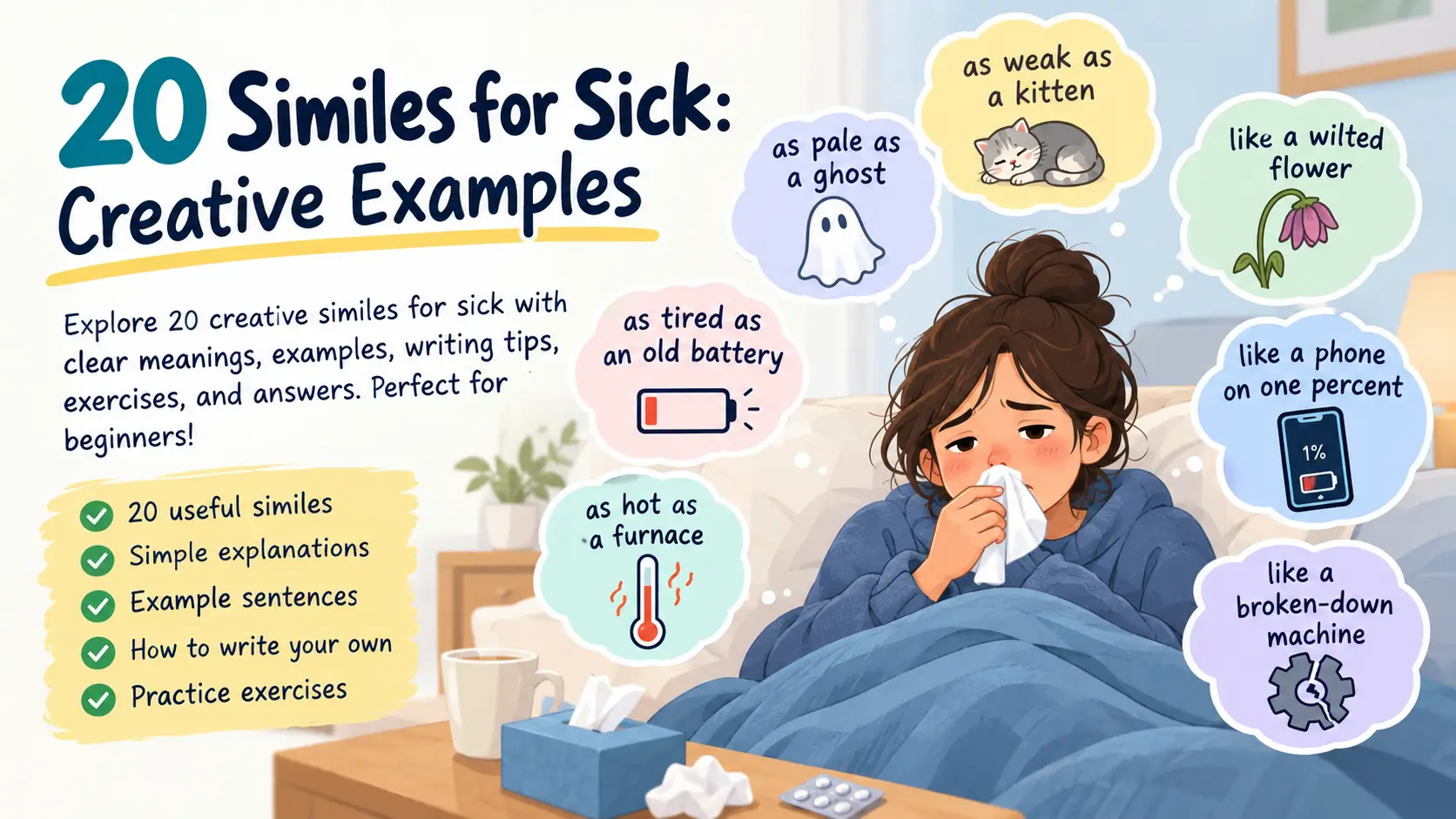
When you feel sick, simple words like “ill,” “weak,” or “unwell” can describe the basic idea, but they may not show the reader exactly what the experience feels like. That is where similes can help. Similes compare one thing with another using words such as “like” or “as.” They make descriptions easier to picture and more interesting to read. For example, saying “He was as pale as a sheet” gives a clearer image than simply saying “He looked sick.” In this guide, you will find 20 similes for sick that can help you describe illness, weakness, discomfort, tiredness, and recovery. Each example includes a simple meaning and two natural simile sentences. These creative writing similes can work well in stories, school assignments, poems, journals, and descriptive writing. You will also learn how to create your own comparisons, understand the meaning of similes, tell a simile from a metaphor, and practice using figurative language. Let’s explore some useful and memorable examples.
20 Similes for Sick
1. As sick as a dog
Meaning: This means feeling very ill or unwell.
What it conveys: It creates a familiar and slightly informal image of someone feeling extremely sick.
Example sentences:
- After eating the spoiled food, Jake was as sick as a dog.
- I felt as sick as a dog after the long boat ride.
2. As pale as a ghost
Meaning: This describes someone whose face has become very pale because of illness, fear, or weakness.
What it conveys: It gives a strong visual picture of someone who looks unusually white or drained.
Example sentences:
- She looked as pale as a ghost when she came downstairs.
- Tom was as pale as a ghost after being sick all night.
3. As weak as a kitten
Meaning: This means having very little strength or energy.
What it conveys: It creates a gentle image of someone who feels too weak to do much.
Example sentences:
- After three days of fever, I felt as weak as a kitten.
- He was as weak as a kitten when he finally got out of bed.
4. Like a wilted flower
Meaning: This describes someone who looks tired, weak, or drained because of sickness.
What it conveys: The comparison creates an image of a flower that has lost its freshness and energy.
Example sentences:
- She lay on the sofa like a wilted flower.
- After the flu, he looked like a wilted flower in the garden.
5. Like a washed-out picture
Meaning: This means someone looks pale, tired, and lacking their usual energy.
What it conveys: It suggests that sickness has taken away a person’s normal color and liveliness.
Example sentences:
- After a sleepless night, Maya looked like a washed-out picture.
- He seemed like a washed-out picture after several days of fever.
6. As tired as an old battery
Meaning: This means feeling extremely tired and having almost no energy.
What it conveys: It compares a sick person’s low energy to a battery that is nearly empty.
Example sentences:
- After the fever, I was as tired as an old battery.
- She felt as tired as an old battery and went straight to bed.
7. Like a wilted leaf
Meaning: This describes someone who appears weak, tired, or lifeless.
What it conveys: A wilted leaf suggests loss of energy and strength.
Example sentences:
- He sat quietly on the couch like a wilted leaf.
- After being sick for a week, she moved like a wilted leaf.
8. As hot as a furnace
Meaning: This can describe someone who feels extremely hot because of a fever.
What it conveys: It creates a strong image of intense body heat.
Example sentences:
- His forehead felt as hot as a furnace.
- She was as hot as a furnace with the fever.
9. Like a broken-down machine
Meaning: This describes someone whose body feels unable to work normally because of sickness.
What it conveys: It makes illness sound like the body has stopped working properly.
Example sentences:
- After catching the flu, I felt like a broken-down machine.
- He moved slowly, like a broken-down machine.
10. As dizzy as a spinning top
Meaning: This describes feeling as though everything is moving or spinning.
What it conveys: The comparison gives a clear picture of dizziness and confusion.
Example sentences:
- I felt as dizzy as a spinning top when I stood up.
- After the illness, she was as dizzy as a spinning top.
11. Like a balloon losing air
Meaning: This describes someone who is gradually losing strength or energy.
What it conveys: It shows a person becoming weaker and less energetic.
Example sentences:
- With every hour of the fever, he felt like a balloon losing air.
- She seemed like a balloon losing air as the day went on.
12. As drained as an empty cup
Meaning: This means having almost no physical or emotional energy left.
What it conveys: An empty cup provides an easy image of someone who has nothing left to give.
Example sentences:
- After the stomach bug, I felt as drained as an empty cup.
- She was as drained as an empty cup after spending the night awake.
13. Like a shadow of yourself
Meaning: This describes someone who looks or feels much weaker than usual.
What it conveys: It suggests that sickness has taken away the person’s usual energy and appearance.
Example sentences:
- During the worst part of his illness, he looked like a shadow of himself.
- She felt like a shadow of herself after several days in bed.
14. As shaky as a leaf in the wind
Meaning: This means trembling or having difficulty keeping still because of weakness, fever, or illness.
What it conveys: It creates a vivid picture of uncontrollable shaking.
Example sentences:
- His hands were as shaky as leaves in the wind.
- I felt as shaky as a leaf in the wind after getting out of bed.
15. Like a phone on one percent
Meaning: This describes having almost no energy left.
What it conveys: It uses a modern, familiar image to show extreme tiredness.
Example sentences:
- After the flu, I felt like a phone on one percent.
- She dragged herself across the room like a phone on one percent.
16. As miserable as a rainy Monday
Meaning: This describes feeling very unhappy, uncomfortable, or low because of sickness.
What it conveys: It creates a gloomy but relatable picture of feeling miserable.
Example sentences:
- I was as miserable as a rainy Monday while I had the flu.
- He looked as miserable as a rainy Monday when he woke up sick.
17. Like a candle burning low
Meaning: This describes someone whose energy is fading.
What it conveys: A candle that is burning low suggests that a person’s strength is slowly running out.
Example sentences:
- By evening, she felt like a candle burning low.
- He grew quieter and weaker, like a candle burning low.
18. As sluggish as a sleepy turtle
Meaning: This means moving very slowly because of tiredness or illness.
What it conveys: The comparison creates a simple and slightly playful picture of slow movement.
Example sentences:
- I was as sluggish as a sleepy turtle after taking a long nap.
- He walked around the house as sluggish as a sleepy turtle.
19. Like a storm cloud
Meaning: This can describe someone who looks gloomy, uncomfortable, or weighed down by illness.
What it conveys: A storm cloud creates an image of darkness and heaviness.
Example sentences:
- She sat quietly like a storm cloud over the breakfast table.
- His sick mood hung over the room like a storm cloud.
20. As worn out as an old shoe
Meaning: This means feeling extremely tired, weak, or exhausted.
What it conveys: An old shoe suggests something that has been used heavily and has little energy left.
Example sentences:
- After the fever finally broke, I was as worn out as an old shoe.
- He felt as worn out as an old shoe after being sick for several days.
How to Use Similes in Writing
Creating your own similes becomes easier when you follow a few simple steps.
Start with the feeling or condition
First, decide what you want to describe. Is the person weak, pale, dizzy, tired, uncomfortable, or recovering?
For example:
- Weak → “as weak as a kitten”
- Pale → “as pale as a ghost”
- Tired → “like a phone on one percent”
Find a familiar comparison
Choose something readers already understand. Familiar objects, animals, nature, and everyday experiences often make strong comparisons.
For example:
- “Her hands shook like leaves in the wind.”
- “He felt like a battery with no charge.”
Use “like” or “as”
These are common signal words for similes.
- “He looked like a ghost.”
- “She was as pale as a sheet.”
Make the comparison clear
A good simile should help readers understand the original idea. If the comparison is too strange, the reader may become confused.
Instead of forcing a complicated comparison, try something simple:
“After the fever, he felt like a phone on one percent.”
Avoid clichés when possible
Common similes can be useful, especially for beginners, but original comparisons can make your writing stand out.
For example:
“Her energy disappeared like water through a cracked cup.”
Match the tone
A serious story may need a serious simile. A funny story can use playful comparisons.
Serious:
“He looked like a candle burning low.”
Playful:
“He moved like a sleepy turtle.”
Add sensory details
Think about what the reader can see, hear, feel, smell, or imagine.
Instead of:
“I felt sick.”
Try:
“I felt as weak as a kitten, with my head spinning like a top.”
That extra detail makes descriptive writing more vivid.
What Is a Simile?
A simile is a figure of speech that compares two different things to make an idea clearer or more vivid. It often uses words such as like or as.
For example:
“Her face was as pale as a ghost.”
The writer does not mean that her face is literally a ghost. The comparison helps the reader imagine how pale she looks.
Another example is:
“He moved like a broken-down machine.”
This suggests that his movements were slow, difficult, or weak.
Similes are useful because they turn plain statements into pictures in the reader’s mind. They are common in stories, poems, essays, conversations, and other forms of creative writing.
If you have seen the phrase “strohl simile,” it is important not to treat it as a standard literary term. It is not a commonly recognized category of simile. In most cases, the intended meaning may simply be a request for a particular simile or a comparison involving a word that sounds similar.
Simile vs. Metaphor
Both similes and metaphors make comparisons, but they do it in different ways.
Simile: “The room smelled like rotten eggs.”
Metaphor: “The room was a rotten-egg factory.”
The first sentence clearly signals a comparison with like. The second directly describes the room as something else without using “like” or “as.”
Here is another simple example:
- Simile: “She was as pale as a ghost.”
- Metaphor: “She was a ghost.”
For beginners, an easy rule is this: if the comparison uses words such as like or as, it is often a simile.
Practical Exercise: 10 Questions
- Fill in the blank: After the flu, Sam felt as weak as a ________.
- Identify the simile: Which sentence contains a simile?
- A. Liam was tired.
- B. Liam was as tired as an old battery.
- C. Liam went to bed early.
- Fill in the blank: Her hands were as shaky as a ________ in the wind.
- Multiple choice: Which comparison best describes someone with almost no energy?
- A. Like a bright star
- B. Like a phone on one percent
- C. Like a racing car
- D. Like a loud drum
- Identify the simile: Is this sentence a simile? “He moved like a broken-down machine.”
- Create your own simile: Complete this sentence: “After being sick, I felt as tired as ________.”
- Compare two sentences: Which sentence gives a more vivid description?
- A. She looked pale.
- B. She looked as pale as a ghost.
- Multiple choice: Which word is commonly used to signal a simile?
- A. Because
- B. Although
- C. Like
- D. Therefore
- Create your own simile: Write a simile describing someone who feels dizzy.
- Compare two sentences: Which sentence uses figurative language?
- A. He was sick in bed.
- B. He lay in bed like a wilted flower.
Answers and Explanations
- Answer: Kitten.
Explanation: “As weak as a kitten” compares a sick person’s lack of strength with the gentle weakness associated with a small kitten. - Answer: B. Liam was as tired as an old battery.
Explanation: The sentence compares Liam’s tiredness with an old battery that has little energy left. - Answer: Leaf.
Explanation: “As shaky as a leaf in the wind” creates an image of trembling. - Answer: B. Like a phone on one percent.
Explanation: A phone at one percent has very little power, so it is a clear comparison for someone with almost no energy. - Answer: Yes.
Explanation: The sentence uses “like” to compare the person’s movement with a broken-down machine. - Answer: Answers may vary.
Explanation: A good answer should make a clear comparison, such as “I felt as tired as an empty battery.” - Answer: B. She looked as pale as a ghost.
Explanation: The simile gives the reader a stronger visual image than the simple statement “She looked pale.” - Answer: C. Like.
Explanation: “Like” is one of the most common signal words used to form similes. - Answer: Answers may vary.
Explanation: A possible answer is, “I felt as dizzy as a spinning top.” The comparison helps readers imagine the sensation. - Answer: B. He lay in bed like a wilted flower.
Explanation: The word “like” creates a comparison, making the sentence an example of figurative language and a simile.
Conclusion
Similes can turn a simple description of sickness into a clear picture that readers can imagine. Instead of saying someone is only tired, pale, weak, or dizzy, you can compare that feeling with something familiar. The 20 similes for sick in this guide give you useful starting points for stories, poems, school assignments, and everyday creative writing. Remember that strong similes do not need to be complicated. A simple comparison can often be the most effective. Try choosing one feeling, finding something familiar that matches it, and connecting the two with “like” or “as.” With practice, you will become more comfortable creating your own simile sentences. Keep experimenting, and let your comparisons make your writing clearer, more vivid, and more memorable.

I am Silas Michael, an enthusiastic writer passionate about similes, metaphors, and idioms. I enjoy explaining creative expressions through simple meanings and examples that help readers understand and improve their English.