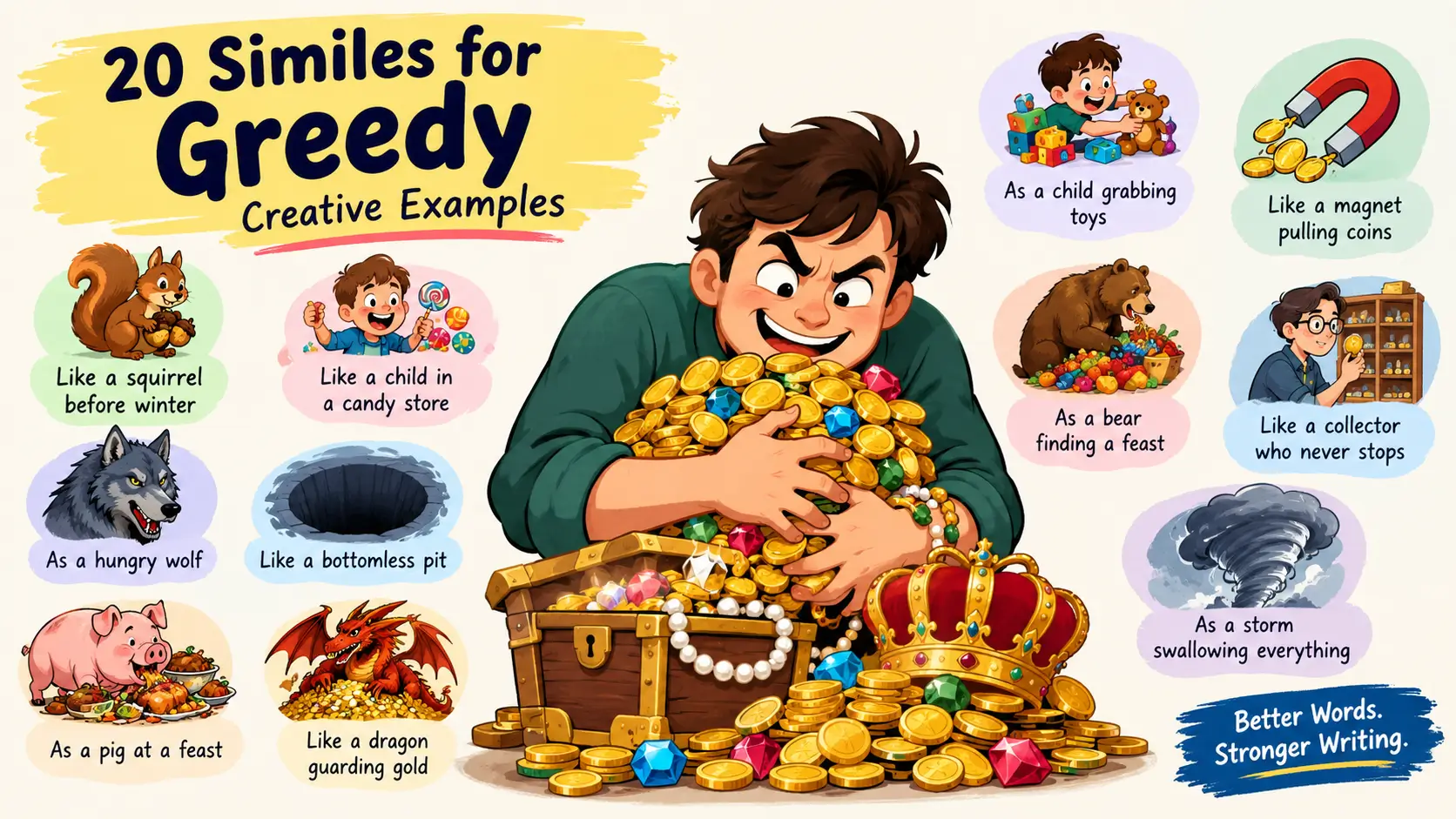
Greed is a strong feeling that can be hard to describe with plain words. If someone always wants more money, food, attention, power, or possessions, simply calling that person “greedy” may not fully show what they are like. This is where similes can make your writing more vivid. Similes compare one thing to another using words such as like or as, helping readers picture an idea clearly. In this article, you will find 20 useful similes for greedy people and behaviors. Each example includes a simple meaning, what it conveys, and two natural sentences. These examples can help with stories, school assignments, poems, creative writing, and everyday descriptions. You will also learn how to create your own similes, understand the meaning of similes, and tell the difference between a simile and a metaphor. Whether you are a beginner or simply looking for fresh ideas, these creative comparisons will give you plenty of ways to describe greed in a clear and memorable way.
20 Similes for Greedy
1. Greedy as a squirrel before winter
Meaning: This describes someone who keeps collecting and storing more than they need.
What it conveys: It creates an image of someone constantly gathering things because they never feel they have enough.
Example sentences:
- Jake was as greedy as a squirrel before winter, stuffing every prize into his bag.
- She became as greedy as a squirrel before winter when she started collecting every available resource.
2. Greedy like a child in a candy store
Meaning: This describes someone who wants everything that catches their attention.
What it conveys: It suggests excitement, temptation, and a strong desire to have more.
Example sentences:
- He was greedy like a child in a candy store, reaching for every treat on the shelf.
- The shopper looked greedy like a child in a candy store when the sale began.
3. Greedy as a hungry wolf
Meaning: This describes someone who strongly wants something and does not want to share.
What it conveys: The comparison gives greed a fierce and powerful image.
Example sentences:
- He guarded the treasure as greedily as a hungry wolf guards its food.
- The players grabbed the rewards like hungry wolves fighting over a meal.
4. Greedy like a bottomless pit
Meaning: This describes someone whose desire for more never seems to end.
What it conveys: It shows endless wanting and an inability to feel satisfied.
Example sentences:
- His appetite for money was like a bottomless pit.
- Her desire for attention seemed greedy like a bottomless pit that could never be filled.
5. Greedy as a pig at a feast
Meaning: This describes someone taking far more food or resources than they need.
What it conveys: It creates a humorous but clear picture of excessive wanting.
Example sentences:
- He ate as greedily as a pig at a feast.
- The children laughed when their greedy uncle piled his plate as high as a pig at a feast.
6. Greedy like a dragon guarding gold
Meaning: This describes someone who strongly wants to keep wealth or possessions for themselves.
What it conveys: It creates a vivid fantasy image of someone fiercely protecting valuable things.
Example sentences:
- The king was greedy like a dragon guarding gold.
- She held onto her collection like a dragon guarding its treasure.
7. Greedy as a child grabbing toys
Meaning: This describes someone who wants everything available and does not want others to have it.
What it conveys: It suggests selfishness and an unwillingness to share.
Example sentences:
- He was as greedy as a child grabbing toys from a crowded box.
- The brothers became greedy as children grabbing toys when they saw the prizes.
8. Greedy like a magnet pulling coins
Meaning: This describes someone who is strongly attracted to money.
What it conveys: It gives the idea that money seems impossible for the person to resist.
Example sentences:
- He was greedy like a magnet pulling coins toward itself.
- Her attention moved toward every business deal, greedy like a magnet for money.
9. Greedy as a bear finding a feast
Meaning: This describes someone who takes advantage of a large opportunity to get more than enough.
What it conveys: It creates a strong picture of eagerness and excessive taking.
Example sentences:
- He became as greedy as a bear finding a feast when the buffet opened.
- The shoppers rushed toward the discounts like bears finding a feast.
10. Greedy like a collector who never stops
Meaning: This describes someone who continues collecting even when they already have plenty.
What it conveys: It highlights endless desire and dissatisfaction.
Example sentences:
- He was greedy like a collector who never stops buying rare coins.
- She kept ordering more decorations, greedy like a collector who never stops searching.
11. Greedy as a king who wants every kingdom
Meaning: This describes someone who wants power, control, or possessions beyond what they already have.
What it conveys: It suggests ambition that has grown into excessive desire.
Example sentences:
- The ruler was as greedy as a king who wanted every kingdom on the map.
- His hunger for power made him seem like a king who wanted every kingdom.
12. Greedy like a vacuum cleaner
Meaning: This describes someone who seems to take in everything around them.
What it conveys: It gives greed a simple and slightly funny image.
Example sentences:
- He grabbed every snack like a vacuum cleaner.
- The child was greedy like a vacuum cleaner when the birthday cake arrived.
13. Greedy as a bee at a field of flowers
Meaning: This describes someone eager to take advantage of many available opportunities.
What it conveys: It creates a lively image of constant activity and taking.
Example sentences:
- She moved from one offer to another as greedily as a bee among flowers.
- The salesman chased every possible deal like a bee searching a field of flowers.
14. Greedy like a fox with a full basket
Meaning: This describes someone who already has plenty but still wants more.
What it conveys: It emphasizes cleverness mixed with excessive desire.
Example sentences:
- He was greedy like a fox with a full basket, yet he kept asking for more.
- Even after receiving several gifts, she acted like a fox with a full basket looking for another prize.
15. Greedy as a storm swallowing everything
Meaning: This describes greed that seems powerful enough to consume everything in its path.
What it conveys: It gives the feeling of uncontrolled and destructive desire.
Example sentences:
- His greed spread through the company like a storm swallowing everything.
- The character’s greed was as fierce as a storm swallowing everything around it.
16. Greedy like a child who wants every present
Meaning: This describes someone who wants all the rewards or possessions for themselves.
What it conveys: It shows selfish desire in a simple and familiar way.
Example sentences:
- He acted greedy like a child who wanted every present under the tree.
- The winner became greedy like a child who wanted every present.
17. Greedy as a fire that keeps asking for fuel
Meaning: This describes desire that grows instead of becoming satisfied.
What it conveys: It shows how greed can keep increasing once it is fed.
Example sentences:
- Her desire for wealth was as greedy as a fire that kept asking for fuel.
- Every new success only fed his greed like more wood on a fire.
18. Greedy like a hand reaching into every jar
Meaning: This describes someone who wants to take something from every available source.
What it conveys: It creates an image of constant taking and grabbing.
Example sentences:
- The greedy manager was like a hand reaching into every jar.
- He acted greedy like a hand reaching into every jar whenever an opportunity appeared.
19. Greedy as a shopper who fills every cart
Meaning: This describes someone who keeps taking things simply because they are available.
What it conveys: It shows excess and a lack of restraint.
Example sentences:
- She was as greedy as a shopper who fills every cart during a huge sale.
- He bought everything he saw, greedy like a shopper filling every cart.
20. Greedy like a treasure hunter who wants it all
Meaning: This describes someone who is never satisfied with what they already have.
What it conveys: It creates an adventurous image of endless wanting.
Example sentences:
- He was greedy like a treasure hunter who wanted every jewel in the cave.
- The character searched for more wealth, greedy like a treasure hunter who wanted it all.
How to Use Similes in Writing
Creating your own similes becomes easier when you follow a few simple steps.
- Choose what you want to describe. Start with the person, feeling, object, or action. For example, you might want to describe someone’s greed.
- Think of a familiar comparison. Ask yourself what behaves in a similar way. A bottomless pit suggests something that never seems full.
- Use “like” or “as.” These words often make the comparison clear.
- Make the connection easy to understand. A good simile should help readers picture your idea.
- Avoid clichés when possible. Common comparisons can work, but a fresh image can make your writing more memorable.
- Match the tone. A funny story may need a playful comparison, while a serious story may need a darker one.
- Add sensory details. Think about what readers could see, hear, feel, smell, or imagine.
For example:
- Plain: “The man was greedy.”
- Simile: “The man was greedy like a dragon guarding gold.”
- More descriptive: “The man clutched the coins like a dragon guarding gold, refusing to give even one away.”
The goal is not to make every sentence fancy. Use a simile when it adds a clear image or stronger feeling.
What Is a Simile?
A simile is a figure of speech that compares two different things in a clear way. Writers commonly use words such as like or as to make the comparison.
For example:
- “She was as quiet as a mouse.”
- “His greed spread like wildfire.”
- “The treasure glittered like stars.”
These comparisons do not mean the person is literally a mouse or that greed is literally fire. Instead, the comparison helps the reader understand an idea through a familiar image.
Similes are useful because they make descriptions easier to picture. They can also add humor, emotion, drama, or personality to creative writing.
The phrase “strohl simile” is not a standard literary term. If you came across that phrase while searching for simile-related information, it may be a typo, a name, or a context-specific phrase. It should not be treated as a recognized type of simile without reliable evidence.
Simile vs. Metaphor
A simile makes a comparison using words such as “like” or “as.”
Simile: “The room smelled like rotten eggs.”
A metaphor makes the comparison directly without using “like” or “as.”
Metaphor: “The room was a rotten-egg factory.”
Both forms create an image, but they do it differently.
Here is another simple example:
- Simile: “His greed was like a hungry wolf.”
- Metaphor: “His greed was a hungry wolf.”
For beginners, remember this easy rule: similes compare, while metaphors say one thing is another.
Practical Exercise: 10 Questions
- Fill in the blank: “He was as greedy as a ________ guarding its treasure.”
- Identify the simile: Which sentence contains a simile?
- A. The boy wanted everything.
- B. The boy was greedy like a child in a candy store.
- C. The boy took the prize.
- Fill in the blank: “Her desire for money was like a ________ pit.”
- Multiple choice: Which comparison best describes someone who never feels satisfied?
- A. Like a bottomless pit
- B. Like a quiet cloud
- C. Like a sleeping cat
- Identify the comparison: Is this sentence a simile? “His greed was a hungry wolf.”
- Create your own simile: Complete this sentence: “The greedy shopper was like ________.”
- Compare two sentences: Which sentence gives a more vivid image?
- A. “Tom was greedy.”
- B. “Tom was greedy like a dragon guarding gold.”
- Multiple choice: Which signal word appears in this simile? “She grabbed the prizes like a squirrel gathering food.”
- A. But
- B. Like
- C. And
- Fill in the blank: “His greed grew as quickly as ________.”
- Create your own simile: Write a simile describing someone who wants more power, using like or as.
Answers and Explanations
- Answer: Dragon.
Explanation: “A dragon guarding its treasure” is a familiar image of someone protecting valuable possessions and wanting to keep them. - Answer: B. “The boy was greedy like a child in a candy store.”
Explanation: The sentence compares the boy to a child in a candy store using the word “like.” - Answer: Bottomless.
Explanation: A bottomless pit suggests something that never becomes full, making it useful for describing endless desire. - Answer: A. Like a bottomless pit.
Explanation: A bottomless pit has no apparent end, so it is a clear comparison for endless wanting. - Answer: No, it is a metaphor.
Explanation: The sentence says greed “was” a hungry wolf rather than comparing it with “like” or “as.” - Answer: Answers will vary. For example, “The greedy shopper was like a vacuum cleaner.”
Explanation: The comparison suggests that the shopper keeps taking everything available. - Answer: B. “Tom was greedy like a dragon guarding gold.”
Explanation: The second sentence gives readers a clear mental picture instead of simply stating the quality. - Answer: B. Like.
Explanation: “Like” is the signal word that connects the shopper’s action to the squirrel comparison. - Answer: Answers will vary. For example, “His greed grew as quickly as a spreading fire.”
Explanation: Fire can spread quickly, making it a strong comparison for rapidly increasing greed. - Answer: Answers will vary. For example, “He wanted power like a king who wanted every kingdom.”
Explanation: The comparison connects excessive desire for power with a ruler who wants to control every kingdom.
Conclusion
Similes can turn a simple description into a vivid picture. Instead of saying someone is greedy, you can compare that person to a dragon guarding gold, a child in a candy store, or a bottomless pit. These similes for greedy behavior help readers understand not only what a character does but also how that behavior feels. When creating your own similes, choose a familiar image, use words such as “like” or “as,” and make sure the comparison fits your writing. Try different comparisons until you find one that feels natural and clear. Whether you are writing a story, poem, school assignment, or descriptive paragraph, a well-chosen simile can make your words more memorable. Keep practicing, and soon you will be creating strong creative writing examples of your own.

I’m Evelyn Marie, an author passionate about similes, metaphors, and idioms. I enjoy explaining creative expressions simply, helping readers understand language and make their writing more engaging.