Problems are part of everyday life. Sometimes a problem feels small, like a pebble in your shoe. Other times, it can feel huge and hard to escape. This is where similes for problems can make your writing much more powerful.
A simile compares one thing with another using words such as “like” or “as.” Instead of simply saying, “She had a difficult problem,” you might say, “Her problem was like a tangled knot.” That comparison helps the reader picture the situation.
In simple terms, similes turn plain ideas into vivid images. They can make stories, poems, essays, and everyday writing more interesting. You might say a problem is like a mountain, as stubborn as a locked door, or like a storm that will not pass.
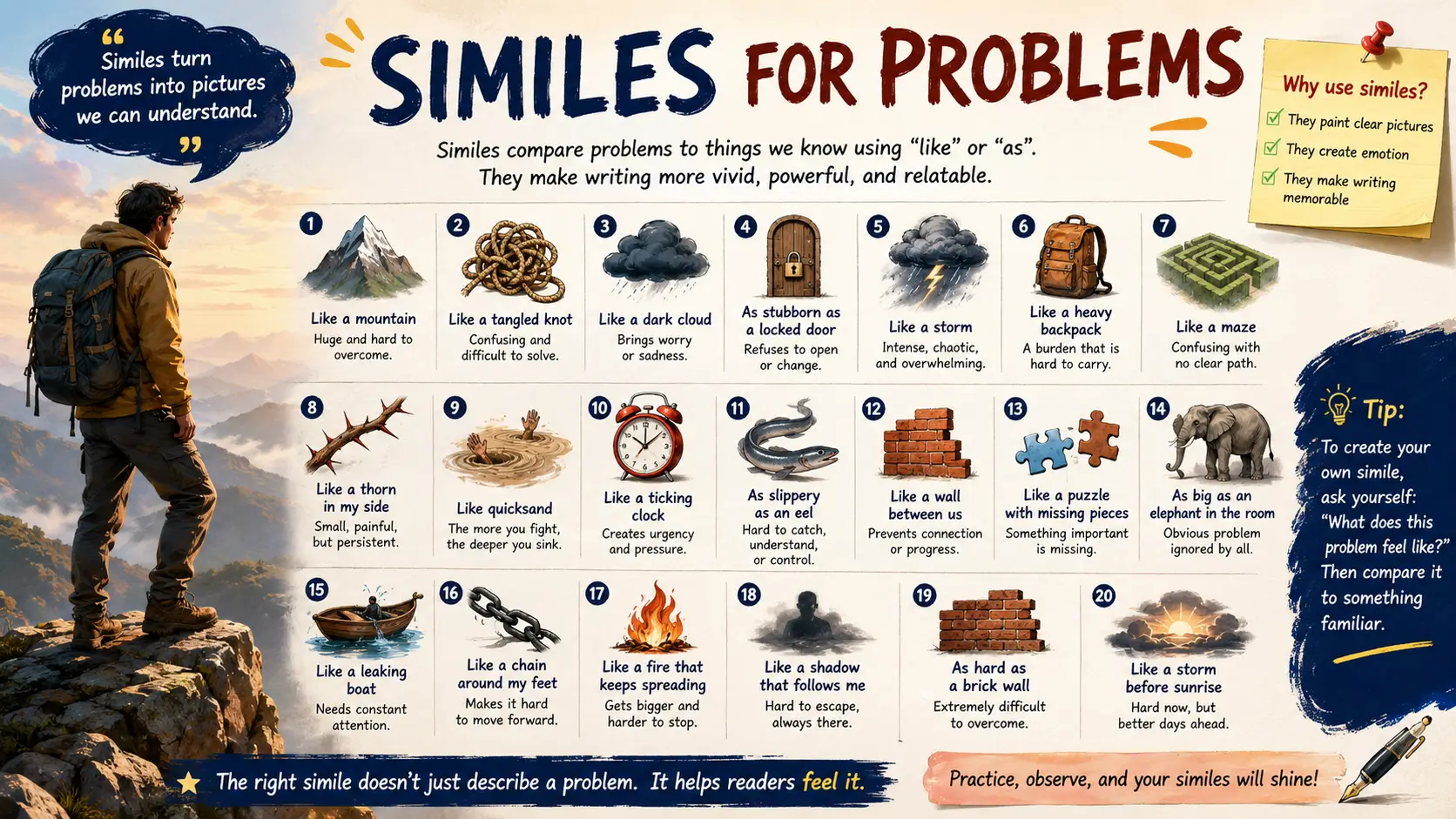
Let’s explore 20 creative writing similes for problems. Each example includes its meaning and two simile sentences, so you can see exactly how to use similes in writing.
What Is a Simile?
A simile is a figure of speech that compares two different things using “like” or “as.”
For example:
“The problem was like a giant wall.”
The problem is not really a wall. The writer compares it to a wall to show that it feels difficult to get past.
The meaning of similes depends on the comparison. A strong simile gives the reader a clear picture and often creates an emotion.
What Does “Strohl Simile” Mean?
If you have searched for “strohl simile,” you may be wondering what it means. “Strohl simile” is not a standard literary term. It may be a typo, a search variation, or a reference to a particular source or lesson. The standard term you need is simply simile: a comparison using words such as “like” or “as.”
20 Similes for Problems
1. The problem was like a mountain.
Meaning: The problem felt very large and difficult to overcome.
What it conveys: This simile shows that the challenge seems enormous, but it also suggests that it can be overcome step by step.
Example sentences:
- The mountain of homework was like a mountain standing in front of me.
- Her financial problem felt like a mountain she had to climb.
2. The problem was like a tangled knot.
Meaning: The problem was confusing and difficult to solve.
What it conveys: A tangled knot represents confusion. You must work patiently to loosen it.
Example sentences:
- The family argument was like a tangled knot that nobody could undo.
- My thoughts became like a tangled knot when I tried to solve the problem.
3. The problem was like a dark cloud.
Meaning: The problem caused worry or sadness.
What it conveys: A dark cloud suggests something unpleasant hanging over a person.
Example sentences:
- The unpaid bill was like a dark cloud over his weekend.
- Her mistake followed her like a dark cloud all day.
4. The problem was as stubborn as a locked door.
Meaning: The problem refused to go away or be solved easily.
What it conveys: A locked door suggests an obstacle blocking your path.
Example sentences:
- The computer error was as stubborn as a locked door.
- Their disagreement was as stubborn as a locked door that would not open.
5. The problem was like a storm.
Meaning: The problem was intense and upsetting.
What it conveys: A storm suggests confusion, pressure, noise, and strong emotions.
Example sentences:
- The sudden argument was like a storm in the middle of a quiet day.
- His worries came like a storm and filled his mind.
6. The problem was like a heavy backpack.
Meaning: The problem was difficult to carry emotionally or mentally.
What it conveys: A heavy backpack represents a burden that becomes tiring over time.
Example sentences:
- Keeping the secret was like carrying a heavy backpack.
- His responsibilities felt like a heavy backpack on his shoulders.
7. The problem was like a maze.
Meaning: The problem was confusing and had no obvious solution.
What it conveys: A maze suggests many wrong turns and a difficult search for the right path.
Example sentences:
- Finding the missing file was like walking through a maze.
- The complicated instructions were like a maze with no exit.
8. The problem was like a thorn in my side.
Meaning: The problem was small or persistent but constantly annoying.
What it conveys: A thorn creates pain whenever you touch it, making it a useful image for an ongoing irritation.
Example sentences:
- That broken printer was like a thorn in my side.
- The unfinished task became a thorn in my side.
9. The problem was like quicksand.
Meaning: The more someone struggled, the worse the situation seemed to become.
What it conveys: Quicksand creates a powerful image of becoming trapped.
Example sentences:
- The argument was like quicksand; every word made things worse.
- His debt felt like quicksand pulling him deeper.
10. The problem was like a ticking clock.
Meaning: The problem was becoming more urgent because time was running out.
What it conveys: A ticking clock creates pressure and reminds the reader that action is needed.
Example sentences:
- The deadline was like a ticking clock in the back of her mind.
- The growing problem felt like a ticking clock.
11. The problem was as slippery as an eel.
Meaning: The problem was difficult to understand, control, or solve.
What it conveys: An eel is hard to hold, so the comparison suggests that the solution keeps escaping.
Example sentences:
- The truth was as slippery as an eel.
- The mystery was as slippery as an eel whenever we thought we had solved it.
12. The problem was like a wall between us.
Meaning: The problem prevented people from communicating or getting along.
What it conveys: A wall represents separation and emotional distance.
Example sentences:
- Their misunderstanding was like a wall between them.
- Anger became like a wall between the two friends.
13. The problem was like a puzzle with missing pieces.
Meaning: Important information was missing, making the problem hard to solve.
What it conveys: A puzzle normally has a solution, but missing pieces make it incomplete.
Example sentences:
- The mystery was like a puzzle with missing pieces.
- Understanding the report was like solving a puzzle with missing pieces.
14. The problem was as big as an elephant in the room.
Meaning: The problem was obvious, but nobody wanted to talk about it.
What it conveys: The image emphasizes a huge issue that everyone notices but ignores.
Example sentences:
- Their failing business was like an elephant in the room.
- The disagreement became an elephant in the room during dinner.
15. The problem was like a leaking boat.
Meaning: The situation required constant attention because more problems could appear.
What it conveys: A leaking boat shows how ignoring one issue can create a bigger danger.
Example sentences:
- Managing the old house was like sailing in a leaking boat.
- Their business felt like a leaking boat that needed repairs everywhere.
16. The problem was like a chain around my feet.
Meaning: The problem made it difficult to move forward.
What it conveys: Chains suggest restriction, pressure, and a lack of freedom.
Example sentences:
- Fear was like a chain around his feet.
- The debt felt like a chain around her feet.
17. The problem was like a fire that kept spreading.
Meaning: A small problem was becoming larger and harder to control.
What it conveys: A spreading fire represents rapid growth and increasing danger.
Example sentences:
- One small lie became like a fire that kept spreading.
- The argument was like a fire spreading through the whole team.
18. The problem was like a shadow that followed me.
Meaning: The problem stayed with someone wherever they went.
What it conveys: A shadow suggests a problem that is difficult to escape.
Example sentences:
- The mistake was like a shadow that followed me everywhere.
- His worry became like a shadow following him through each day.
19. The problem was as hard as a brick wall.
Meaning: The problem was extremely difficult to overcome.
What it conveys: A brick wall creates the image of a solid obstacle blocking progress.
Example sentences:
- The difficult question was as hard as a brick wall.
- Finding a solution felt as hard as breaking through a brick wall.
20. The problem was like a storm before sunrise.
Meaning: The problem felt frightening, but it suggested that better times might come.
What it conveys: This simile gives the problem a hopeful feeling. Storms can pass, and sunrise follows darkness.
Example sentences:
- Their difficult year was like a storm before sunrise.
- The painful experience was like a storm before sunrise, promising a brighter future.
How to Create Your Own Similes for Problems
Creating your own similes is easier than it may seem. Start by asking yourself what the problem feels like.
For example:
Problem: A difficult exam
Feeling: Stressful and confusing
Comparison: A maze
Simile: “The exam was like a maze.”
You can also use these simple patterns:
- The problem was like a ______.
- The problem felt like a ______.
- The problem was as difficult as ______.
- My worries were like ______.
- The situation was as confusing as ______.
Try to choose comparisons that readers can easily picture. A good simile does more than sound clever. It helps readers feel or understand the problem.
Practical Exercise: 10 Questions
Questions
1. Complete the simile:
The difficult problem was like a ______.
2. Which simile best shows confusion?
A. The problem was like a sunny beach.
B. The problem was like a maze.
C. The problem was like a warm blanket.
3. Complete the sentence:
Her worries followed her like a ______.
4. Which simile suggests an urgent problem?
A. Like a ticking clock
B. Like a soft pillow
C. Like a quiet garden
5. What does this simile mean?
“The problem was like quicksand.”
6. Create a simile for a problem that keeps getting bigger.
7. Which comparison best shows a problem that blocks progress?
A. A wall
B. A feather
C. A flower
8. What does “The problem was like a heavy backpack” suggest?
9. Complete the simile:
The disagreement was like a ______ between the two friends.
10. Write your own simile for a problem that eventually gets better.
Answers and Explanations
1. Possible answer: “mountain.”
“The difficult problem was like a mountain.” A mountain represents something large and challenging.
2. B — The problem was like a maze.
A maze suggests confusion and difficulty finding the right path.
3. Possible answer: “shadow.”
A shadow suggests that the worries stay close and are difficult to escape.
4. A — Like a ticking clock.
A ticking clock suggests that time is running out.
5. It means the problem feels difficult to escape.
Quicksand represents a situation in which struggling can make things worse.
6. Possible answer: “The problem was like a fire that kept spreading.”
A spreading fire shows how a small issue can become much larger.
7. A — A wall.
A wall represents an obstacle that prevents someone from moving forward.
8. It suggests that the problem feels like a burden.
A heavy backpack is tiring to carry, just as a difficult problem can be tiring emotionally or mentally.
9. Possible answer: “wall.”
“The disagreement was like a wall between the two friends.” The wall represents emotional separation.
10. Possible answer: “The problem was like a storm before sunrise.”
This suggests that the difficult period may eventually lead to something brighter.
Quick Tips for Using Similes in Writing
When you use similes, keep your comparisons clear and purposeful.
Choose familiar images.
A mountain, storm, wall, maze, or shadow is easy for readers to picture.
Match the emotion.
If the problem is frightening, compare it to something threatening. If it is confusing, use an image such as a maze or tangled knot.
Avoid forcing a comparison.
A simile should make the sentence clearer, not more confusing.
Use similes naturally.
One strong comparison can be more effective than several weak ones.
Make your comparisons specific.
Instead of saying, “The problem was like something bad,” say, “The problem was like a storm that would not pass.”
These simple choices can make your simile sentences stronger and more memorable.
Conclusion
Similes give ordinary problems a clear and powerful picture. Instead of simply telling readers that something is difficult, you can show what the difficulty feels like. A problem can be like a mountain, like a maze, like quicksand, or like a storm.
The best similes help readers connect with an idea quickly. They can make stories, poems, essays, and personal writing more vivid and emotional.
Now that you have explored these 20 similes for problems, try creating a few of your own. Think about the problem, identify its feeling, and compare it with something familiar. With practice, you will learn how to use similes naturally and make your creative writing more expressive.

I am Beau Thomas, the Administrator at SimilyHub. I enjoy making similes, metaphors, and idioms easy to understand through clear explanations, helpful examples, and engaging content for English learners and writers.