Anger is a strong emotion, but simply writing “he was angry” does not always help your reader feel it. This is where similes can make your writing much more vivid.
A simile compares two different things using words such as “like” or “as.” For example, instead of saying, “She was very angry,” you might say, “She was as angry as a storm at sea.” Suddenly, the emotion feels bigger, louder, and easier to imagine.
Good similes for anger can show heat, pressure, speed, danger, frustration, or loss of control. They are useful in stories, poems, essays, dialogue, and other forms of creative writing.
You may also come across the phrase “strohl simile.” This is not a standard literary term. It may be a typo or a mistaken phrase for “simile.” In simple terms, a simile is a direct comparison that helps readers picture an idea or emotion.
Let’s explore 20 creative writing similes for anger and see how to use them naturally.
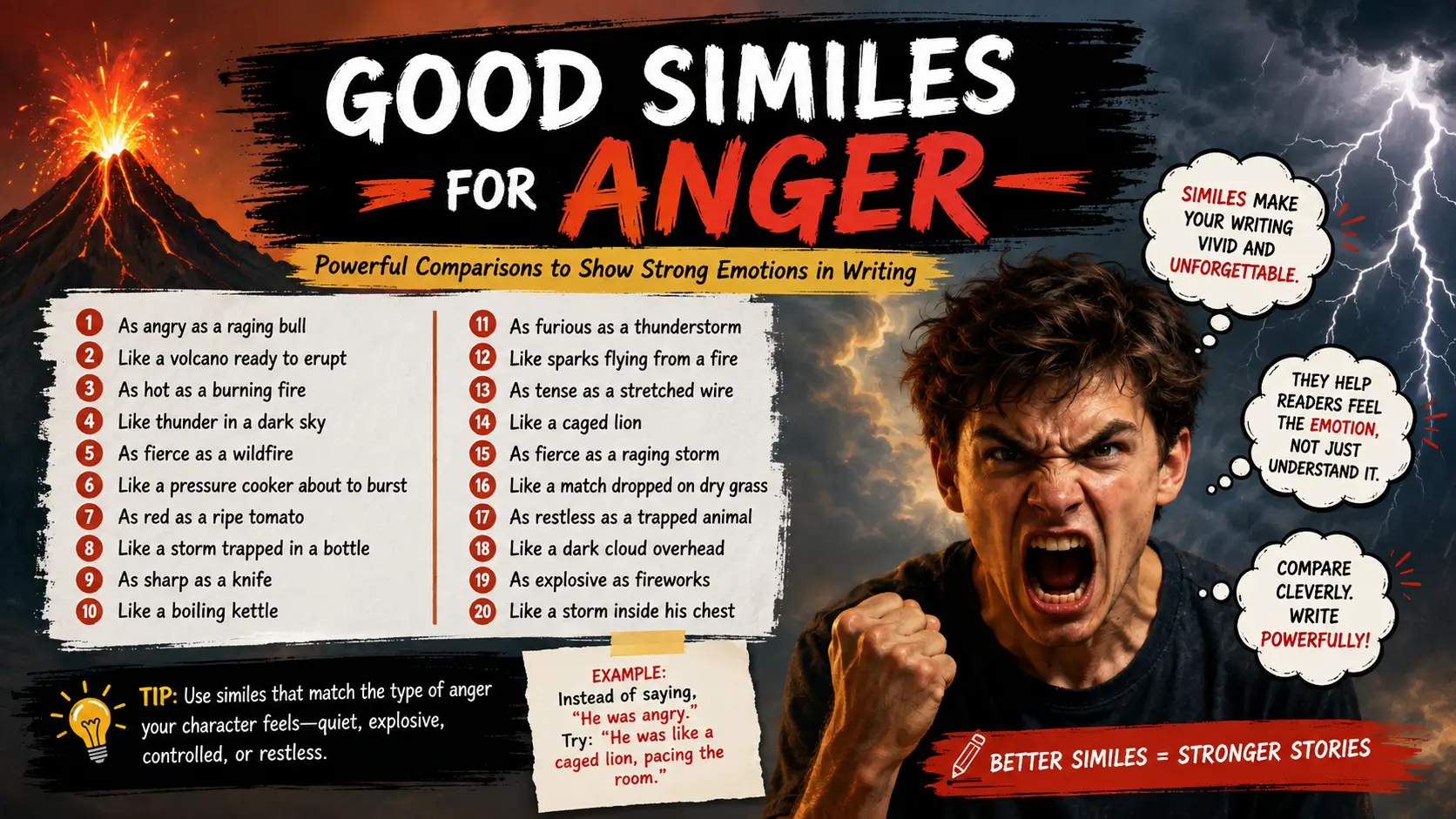
20 Good Similes for Anger
1. As angry as a raging bull
Simile: He was as angry as a raging bull.
Meaning: Extremely angry and ready to react.
What it conveys: This comparison makes anger seem powerful, wild, and difficult to control.
Example sentences:
- He was as angry as a raging bull when he saw the broken window.
- She looked as angry as a raging bull after hearing the unfair accusation.
2. Like a volcano ready to erupt
Simile: Her anger was like a volcano ready to erupt.
Meaning: She was holding in intense anger.
What it conveys: The simile suggests that the anger is building and may suddenly explode.
Example sentences:
- His anger was like a volcano ready to erupt.
- She sat quietly, but her anger was like a volcano ready to erupt.
3. As hot as a burning fire
Simile: His temper was as hot as a burning fire.
Meaning: He was extremely angry.
What it conveys: Heat is often linked with anger, making this a simple and clear comparison.
Example sentences:
- His temper was as hot as a burning fire.
- After the argument, her face felt as hot as a burning fire.
4. Like thunder in a dark sky
Simile: His voice was like thunder in a dark sky.
Meaning: His angry voice was loud and frightening.
What it conveys: This comparison creates a strong sound image and gives the anger a sense of danger.
Example sentences:
- His voice was like thunder in a dark sky.
- She spoke like thunder in a dark sky when she finally lost patience.
5. As fierce as a wildfire
Simile: Her anger was as fierce as a wildfire.
Meaning: Her anger was powerful and difficult to stop.
What it conveys: A wildfire spreads quickly and can be hard to control, making it a strong image for intense anger.
Example sentences:
- Her anger was as fierce as a wildfire.
- His frustration grew as fierce as a wildfire after hours of waiting.
6. Like a pressure cooker about to burst
Simile: He felt like a pressure cooker about to burst.
Meaning: He was struggling to control his anger.
What it conveys: The comparison shows emotional pressure building inside someone.
Example sentences:
- After listening to the insults, he felt like a pressure cooker about to burst.
- I felt like a pressure cooker about to burst during the long argument.
7. As red as a ripe tomato
Simile: His face became as red as a ripe tomato.
Meaning: He became visibly angry.
What it conveys: This simile focuses on a physical sign of anger rather than the emotion itself.
Example sentences:
- His face became as red as a ripe tomato.
- She was as red as a ripe tomato after the accusation.
8. Like a storm trapped in a bottle
Simile: She was like a storm trapped in a bottle.
Meaning: She had powerful anger that she was trying to contain.
What it conveys: This creative comparison shows emotional energy being held inside.
Example sentences:
- She sat silently, like a storm trapped in a bottle.
- He felt like a storm trapped in a bottle as he listened to the criticism.
9. As sharp as a knife
Simile: Her angry words were as sharp as a knife.
Meaning: Her words were painful and hurtful.
What it conveys: This focuses on the effect of anger on another person.
Example sentences:
- Her angry words were as sharp as a knife.
- His reply was as sharp as a knife when she questioned him.
10. Like a boiling kettle
Simile: He was like a boiling kettle.
Meaning: He was becoming increasingly angry.
What it conveys: The comparison suggests pressure and rising emotion.
Example sentences:
- He was like a boiling kettle after waiting for two hours.
- She became like a boiling kettle when nobody listened to her.
11. As furious as a thunderstorm
Simile: He was as furious as a thunderstorm.
Meaning: He was extremely angry.
What it conveys: The simile makes his anger feel loud, powerful, and unpredictable.
Example sentences:
- He was as furious as a thunderstorm after discovering the mistake.
- She looked as furious as a thunderstorm when the meeting was canceled.
12. Like sparks flying from a fire
Simile: Her angry words flew like sparks from a fire.
Meaning: She spoke with sudden, energetic anger.
What it conveys: The image makes her words seem fast, hot, and potentially harmful.
Example sentences:
- Her angry words flew like sparks from a fire.
- His complaints came like sparks flying from a fire.
13. As tense as a stretched wire
Simile: He was as tense as a stretched wire.
Meaning: He was under great emotional pressure.
What it conveys: This is useful when anger is controlled rather than openly expressed.
Example sentences:
- He sat as tense as a stretched wire.
- She looked as tense as a stretched wire during the confrontation.
14. Like a caged lion
Simile: He paced around like a caged lion.
Meaning: He was angry, restless, and unable to act freely.
What it conveys: The image suggests frustration, power, and trapped emotion.
Example sentences:
- He paced around like a caged lion.
- She moved through the room like a caged lion waiting for an answer.
15. As fierce as a raging storm
Simile: Her temper was as fierce as a raging storm.
Meaning: Her anger was intense and overwhelming.
What it conveys: This comparison gives anger movement and power.
Example sentences:
- Her temper was as fierce as a raging storm.
- His reaction was as fierce as a raging storm.
16. Like a match dropped on dry grass
Simile: His anger was like a match dropped on dry grass.
Meaning: A small event could cause his anger to spread quickly.
What it conveys: This works well for a character who is already frustrated and easily triggered.
Example sentences:
- His anger was like a match dropped on dry grass.
- One careless comment was like a match dropped on dry grass.
17. As restless as a trapped animal
Simile: She was as restless as a trapped animal.
Meaning: She was frustrated, uncomfortable, and unable to calm down.
What it conveys: This focuses on the physical behavior that can come with anger.
Example sentences:
- She was as restless as a trapped animal while waiting for the decision.
- He paced the floor, as restless as a trapped animal.
18. Like a dark cloud overhead
Simile: His anger hung over him like a dark cloud.
Meaning: His anger stayed with him and affected his mood.
What it conveys: This is useful for quiet, lasting anger rather than explosive rage.
Example sentences:
- His anger hung over him like a dark cloud all afternoon.
- Her disappointment remained like a dark cloud over the celebration.
19. As explosive as fireworks
Simile: His temper was as explosive as fireworks.
Meaning: He could suddenly become very angry.
What it conveys: The simile suggests a quick, dramatic burst of emotion.
Example sentences:
- His temper was as explosive as fireworks.
- Her reaction was as explosive as fireworks when she heard the news.
20. Like a storm inside his chest
Simile: He felt like there was a storm inside his chest.
Meaning: He felt powerful emotional turmoil.
What it conveys: This simile brings the reader inside the character’s emotional experience.
Example sentences:
- He felt like there was a storm inside his chest.
- A storm seemed to rage inside her chest as she tried to stay calm.
How to Use Similes for Anger in Writing
The best similes do more than say that someone is angry. They show what the anger feels like.
For example:
Basic:
Mark was angry.
With a simile:
Mark was like a caged lion, pacing from one side of the room to the other.
The second sentence gives the reader something to picture.
When choosing a simile, think about the type of anger you want to show:
- Explosive anger: volcano, fireworks, wildfire
- Controlled anger: stretched wire, pressure cooker
- Loud anger: thunder, storm
- Restless anger: caged lion, trapped animal
- Quiet anger: dark cloud
- Hurtful anger: sharp knife
You might say that the strongest simile is not always the most dramatic one. Choose the comparison that fits your character and situation.
Practical Exercise: 10 Questions and Answers
Questions
1. Complete the simile:
“His anger was like a ______ ready to erupt.”
2. Which simile best shows someone who is trapped and angry?
A. Like a calm lake
B. Like a caged lion
C. Like a soft pillow
D. Like falling snow
3. Complete the sentence:
“She was as red as a ______ when she heard the accusation.”
4. Which simile best shows anger that is building inside someone?
A. Like a pressure cooker about to burst
B. Like a gentle breeze
C. Like a quiet flower
D. Like a sleeping kitten
5. Identify the simile:
“His angry words were as sharp as a knife.”
What two things are being compared?
6. Complete the simile:
“Her anger spread like ______.”
7. Which sentence contains a simile?
A. Tom was angry.
B. Tom shouted loudly.
C. Tom was like a raging bull.
D. Tom left the room.
8. Create your own simile using “like a storm.”
9. What does this simile suggest?
“His temper was as explosive as fireworks.”
A. His anger appeared suddenly.
B. He was very peaceful.
C. He was sleepy.
D. He was confused.
10. Rewrite this sentence using a simile:
“Sarah was extremely angry.”
Answers and Explanations
1. Volcano
Answer: “His anger was like a volcano ready to erupt.”
Why: A volcano can build pressure before suddenly erupting, just like intense anger.
2. Like a caged lion
Answer: B. Like a caged lion
Why: A caged lion suggests strength, frustration, restlessness, and feeling trapped.
3. Ripe tomato
Answer: “She was as red as a ripe tomato.”
Why: Anger can cause the face to become red, making this an easy visual comparison.
4. Like a pressure cooker about to burst
Answer: A. Like a pressure cooker about to burst
Why: It suggests that emotional pressure is increasing and may soon be released.
5. Angry words and a knife
Answer: The sentence compares angry words to a knife.
Why: A knife can cut and hurt, just as cruel words can hurt someone emotionally.
6. A wildfire
Answer: “Her anger spread like a wildfire.”
Why: A wildfire can spread quickly, making it useful for describing anger that grows rapidly.
7. Tom was like a raging bull.
Answer: C. Tom was like a raging bull.
Why: The sentence uses “like” to compare Tom with a raging bull, so it is a simile.
8. Sample answer
Answer: “His anger rolled through him like a storm.”
Why: The comparison gives anger movement and power.
9. His anger appeared suddenly.
Answer: A. His anger appeared suddenly.
Why: Fireworks create sudden bursts, making them a useful comparison for explosive anger.
10. Sample answer
Answer: “Sarah was as furious as a raging storm.”
Why: The comparison makes Sarah’s intense anger easier for the reader to imagine.
Conclusion
Good similes for anger can turn a simple emotion into a vivid picture. Instead of telling readers that a character is angry, you can show that anger through storms, fire, volcanoes, pressure, animals, or other powerful images.
The meaning of similes becomes easier to understand when you notice what each comparison adds. Some similes show explosive anger, while others reveal quiet frustration or emotional pressure.
When you learn how to use similes in writing, your sentences can become more colorful and memorable. The key is to choose comparisons that fit the feeling and situation.
Now try creating your own. Think about what anger looks, sounds, feels, or moves like. Then turn that idea into a fresh comparison. Your best creative writing similes may come from everyday experiences.

I’m Evelyn Marie, an author passionate about similes, metaphors, and idioms. I enjoy explaining creative expressions simply, helping readers understand language and make their writing more engaging.