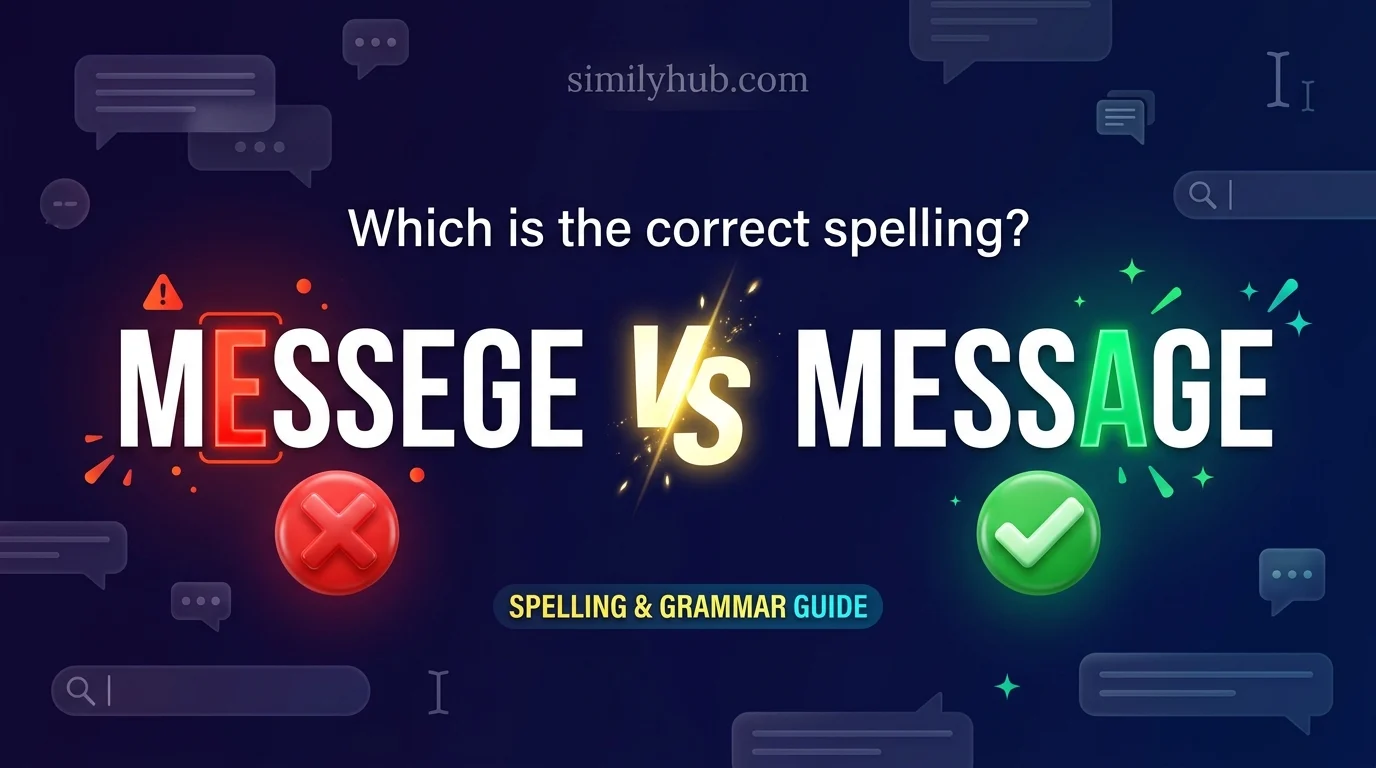
Have you ever typed messege instead of message and wondered which spelling is correct? You are not alone. Many English learners and even native speakers make this common spelling mistake when writing text messages, emails, social media posts, and professional documents. Although both versions look similar, only one follows standard English spelling.
The correct spelling is message, while messege is an incorrect spelling. A message refers to information, news, or communication that someone sends or shares with another person. You can use it for a text, email, written note, spoken communication, or the main idea of a book, speech, or film.
Understanding the difference between message vs. messege can help you improve your spelling, write more confidently, and avoid unnecessary mistakes. In this guide, you will learn the correct spelling, meaning, pronunciation, common uses, practical examples, and an easy memory trick to remember the word.
Quick Answer: Is It Message or Messege?
Message is the correct spelling in standard English. Messege is a common spelling mistake and should not appear in formal or professional writing.
- Message: Correct spelling.
- Messege: Incorrect spelling.
- Meaning: Information or communication sent from one person to another.
- Pronunciation: MESS-ij.
- Word type: Noun and verb.
Example:
- Incorrect: I received your messege yesterday.
- Correct: I received your message yesterday.
Remember that the correct spelling is M-E-S-S-A-G-E, not M-E-S-S-E-G-E.
Message vs. Messege: What Is the Difference?
The main difference between these two spellings is that message is a recognized English word, whereas messege is a misspelling.
People often confuse these versions because they look almost identical and have similar pronunciations. However, replacing the letter a with e makes the spelling incorrect.
| Word | Correct or Incorrect? | Explanation |
|---|---|---|
| Message | Correct | Standard English word for information or communication |
| Messege | Incorrect | Common misspelling of message |
| Mesage | Incorrect | Missing one letter s |
| Messsage | Incorrect | Contains an extra letter s |
The correct spelling is always message in standard American and British English.
What Does Message Mean?
Message means a piece of information, communication, or news that someone sends, delivers, or shares with another person or group.
People communicate messages in different ways, including speaking, writing, texting, emailing, and using social media applications.
For example:
- I received your message this morning.
- The teacher sent a message to all the students.
- Please leave a message after the tone.
- The movie has a powerful message about friendship.
- She sent me a message through WhatsApp.
The word can also describe the central idea or lesson that a person wants to communicate.
For instance, a book may have a message about kindness, while a speech may communicate an important message about education.
Message as a Noun
As a noun, message refers to information or communication that someone sends or shares.
It can describe a written note, text, email, announcement, spoken communication, or important idea.
Examples:
- I found a message on my desk.
- She left a message for her brother.
- Did you receive my message?
- His speech delivered an inspiring message.
- The company shared an important message with its employees.
- I have an unread message on my phone.
The plural form is messages.
Example: I received three messages from my friends.
Message as a Verb
Message can also function as a verb. It means to send someone information through a text, email, messaging application, or another communication platform.
The verb is commonly used in everyday and digital communication.
Examples:
- I will message you after work.
- She messaged me last night.
- Please message the manager about the meeting.
- He is messaging his friend right now.
- They have messaged everyone about the event.
Forms of the Verb Message
| Verb Form | Example |
|---|---|
| Base form: Message | I message my friends regularly. |
| Third-person singular: Messages | She messages her teacher. |
| Past tense: Messaged | He messaged me yesterday. |
| Present participle: Messaging | They are messaging each other. |
| Past participle: Messaged | I have messaged the customer. |
These forms all retain the correct spelling of the root word message.
Why Do People Spell Message as Messege?
The confusion between messege vs. message happens for several reasons. Although the correct spelling is straightforward, pronunciation, typing habits, and unfamiliarity with English spelling patterns can lead to mistakes.
Here are the most common reasons.
Pronunciation Confusion
One major reason involves pronunciation.
The word message is pronounced approximately as MESS-ij. When people hear it, they may not recognize that the correct spelling contains the letter a before g.
As a result, they sometimes write messege instead of message.
The best solution is to memorize the correct letter sequence rather than relying entirely on pronunciation.
Typing Too Quickly
Typing quickly can cause spelling mistakes, especially when using smartphones or small keyboards.
For example, someone may accidentally type:
- messege
- mesage
- messsage
These errors can appear in text messages, emails, online comments, and social media posts.
Taking a few seconds to review your writing can help prevent these mistakes.
Confusion With Similar Words
English contains many words with similar letter patterns. Sometimes, people remember the general appearance of a word but forget its exact spelling.
For example, message and massage look similar, but they have different meanings.
- Message: Information or communication sent to someone.
- Massage: A treatment involving the rubbing or pressing of muscles and body tissues.
Understanding these differences can improve your spelling and vocabulary.
Limited Proofreading
People often read their writing too quickly and overlook familiar spelling mistakes.
For example, when someone writes I sent you a messege, they may understand the intended meaning without noticing the incorrect spelling.
Reading your sentences slowly and checking unfamiliar words can help you identify these errors.
How to Remember the Correct Spelling of Message
If you frequently confuse message and messege, use a simple memory trick.
Remember: MESS + AGE = MESSAGE
Break the word into two recognizable parts:
MESS + AGE = MESSAGE
The word contains the ending AGE, not EGE.
Remember this letter sequence:
M – E – S – S – A – G – E
You can also use this simple sentence:
A wise sage sends a message.
The word sage shares the same ending letters as message, making it easier to remember the correct spelling.
Another useful trick is to remember that message contains two S’s followed by A-G-E.
Whenever you hesitate between the two spellings, recall this pattern.
Correct and Incorrect Examples of Message
Seeing the word in complete sentences makes it easier to understand how to use it correctly.
| Incorrect Sentence | Correct Sentence |
|---|---|
| I received your messege. | I received your message. |
| Please send me a messege. | Please send me a message. |
| She left a messege for me. | She left a message for me. |
| Did you read my messege? | Did you read my message? |
| I will send another messege. | I will send another message. |
| He got my messege yesterday. | He got my message yesterday. |
Always choose message when you want to refer to communication or information.
20 Example Sentences Using Message
Here are 20 practical examples showing how to use message in everyday conversations, professional communication, and academic writing.
- I received your message while I was at work.
- Please send me a message when you reach home.
- She left an important message on my phone.
- Did you read the message I sent yesterday?
- My teacher sent a message about the upcoming examination.
- He forgot to reply to my message.
- I will message you when the meeting ends.
- The manager shared a message with the entire team.
- Her message made everyone smile.
- Please check your phone for the latest message.
- The company sent a message to its customers.
- I received several messages from my classmates.
- The film delivers a meaningful message about family.
- She messaged me to confirm the appointment.
- His speech contained a powerful message about honesty.
- I left a message because nobody answered the phone.
- You can message me through the application.
- The advertisement communicates a clear message to its audience.
- He sent a short message before leaving.
- Please read the entire message before replying.
These examples demonstrate that message works as both a noun and a verb.
Common Misspellings of Message
Besides messege, people sometimes make other spelling mistakes when writing this word.
Understanding these variations can help you recognize and correct them.
| Incorrect Spelling | Correct Spelling | Explanation |
|---|---|---|
| Messege | Message | Incorrect vowel |
| Mesage | Message | Missing one s |
| Messsage | Message | Extra s |
| Messeges | Messages | Incorrect plural spelling |
| Mesages | Messages | Missing one s |
| Messenging | Messaging | Incorrect spelling of the verb form |
The correct forms include:
- Message – Singular noun or base verb.
- Messages – Plural noun or third-person singular verb.
- Messaged – Past tense and past participle.
- Messaging – Present participle.
Paying attention to these forms will help you avoid common spelling errors.
Message vs. Massage: Understanding the Difference
Another common source of confusion is the difference between message and massage.
Although these words look similar, they have completely different meanings.
| Word | Meaning | Example |
|---|---|---|
| Message | Information or communication sent to someone | I received your message. |
| Massage | A treatment involving rubbing or pressing muscles | She booked a relaxing massage. |
When to Use Message
Use message when referring to communication, information, or an important idea.
Example: Please send me a message after the interview.
When to Use Massage
Use massage when discussing a physical treatment for relaxation or muscle relief.
Example: He received a massage after a long day.
Remember that message and massage are different words, not alternative spellings.
Message vs. Note vs. Text vs. Communication
The word message is related to several other English words. However, each term has a slightly different meaning.
Message
A message is information communicated to someone through writing, speech, or digital platforms.
Example: I sent her a message about the meeting.
Note
A note is usually a short written piece of information or reminder.
Example: She left a note on the kitchen table.
Text
A text commonly refers to a written communication sent through a mobile phone or messaging service.
Example: I received a text from my brother.
Communication
Communication refers to the broader process of exchanging information, thoughts, or ideas.
Example: Good communication helps employees work together.
Memo
A memo is a short formal communication, usually shared within an organization.
Example: The director sent a memo to the staff.
Although these words are related, they are not always interchangeable.
American vs. British English: Is Message Spelled Differently?
No. The spelling of message remains the same in both American and British English.
Both varieties use:
Message
Neither American nor British English recognizes messege as a standard alternative spelling.
Examples:
- American English: I sent you a message.
- British English: I sent you a message.
The spelling and basic meaning remain unchanged regardless of the variety of English you use.
Tips to Avoid Common Spelling Mistakes
Improving your spelling requires regular practice and attention to detail. These simple habits can help you avoid writing messege instead of message.
Proofread Before Sending
Read your emails, text messages, assignments, and documents before submitting them. A quick review can help you catch spelling errors.
Use Spell-Check Tools
Tools such as Microsoft Word, Google Docs, Grammarly, and built-in browser spell-checkers can identify many common spelling mistakes.
However, always review their suggestions instead of accepting every correction automatically.
Practice Difficult Words
Create a list of words that you frequently misspell. Write each word correctly several times and use it in different sentences.
For example:
- Message
- Separate
- Definitely
- Receive
- Necessary
Read Regularly
Reading books, articles, educational websites, and other quality content helps you become familiar with correct English spelling.
Slow Down While Typing
Avoid rushing when writing important emails, professional documents, or academic assignments. Taking a moment to check your spelling can improve the quality of your writing.
The Importance of Correct Spelling in Digital Communication
Digital communication has become an essential part of everyday life. People send messages through WhatsApp, email, Facebook, Instagram, and many other platforms.
Because people rely heavily on written communication, correct spelling plays an important role in sharing information clearly.
For example, a spelling mistake in a casual conversation may not create a serious problem. However, repeated errors in business emails, job applications, reports, or professional documents can make writing appear less polished.
Using the correct spelling of message helps you:
- Communicate information clearly.
- Improve your writing skills.
- Create a professional impression.
- Avoid unnecessary spelling mistakes.
- Build confidence in English communication.
- Make your emails and documents easier to understand.
Correct spelling does not mean every informal text must be perfect. However, learning standard English spelling helps you communicate more effectively in situations where accuracy matters.
Frequently Asked Questions
Is it messege or message?
Message is the correct spelling. Messege is an incorrect spelling that people commonly use by mistake. Always write message in standard English.
Is messege a real English word?
No. Messege is not a standard English word. It is a misspelling of message and should be corrected in formal, academic, and professional writing.
How do you spell message correctly?
The correct spelling is M-E-S-S-A-G-E. Remember that the word contains two S’s followed by A-G-E.
Why do people write messege instead of message?
People often write messege because the pronunciation of message does not clearly indicate its exact vowel sequence. Fast typing and unfamiliarity with the spelling can also cause this mistake.
What does message mean?
A message is information, news, or communication sent from one person to another. It can be a text, email, note, spoken communication, or the main idea of a story.
Can message be used as a verb?
Yes. Message can function as both a noun and a verb. As a verb, it means to send someone information through a communication platform.
Example: I will message you tomorrow.
What is the plural of message?
The plural form of message is messages.
Example: I received five messages from my friends.
Is message spelled the same in American and British English?
Yes. Both American and British English use the spelling message. There is no regional spelling difference.
What is the easiest trick to remember message?
Remember the pattern MESS + AGE = MESSAGE. The correct word ends with AGE, not EGE.
What is the difference between message and massage?
A message is information communicated to someone, while a massage is a physical treatment involving rubbing or pressing muscles and other body tissues.
Is messaged the correct past tense of message?
Yes. Messaged is the correct simple past and past participle form of the verb message.
Example: She messaged me last night.
Is messaging the correct spelling?
Yes. Messaging is the correct present participle form of the verb message.
Example: They are messaging their friends.
How can I improve my English spelling?
You can improve your spelling by reading regularly, practicing difficult words, using spell-check tools, learning common spelling patterns, and proofreading your writing before sending it.
Final Verdict: Message or Messege?
The answer is simple: message is the correct spelling, while messege is incorrect.
Use message when referring to a text, email, written note, spoken communication, or an important idea. You can also use it as a verb when talking about sending information to someone.
The easiest way to remember the spelling is:
MESS + AGE = MESSAGE
Remember the correct letter sequence:
M-E-S-S-A-G-E
Whether you are writing a casual text, professional email, school assignment, or online article, always choose message instead of messege.
Correct spelling makes your writing clearer, improves communication, and helps you express your ideas with confidence.

I am Silas Michael, an enthusiastic writer passionate about similes, metaphors, and idioms. I enjoy explaining creative expressions through simple meanings and examples that help readers understand and improve their English.