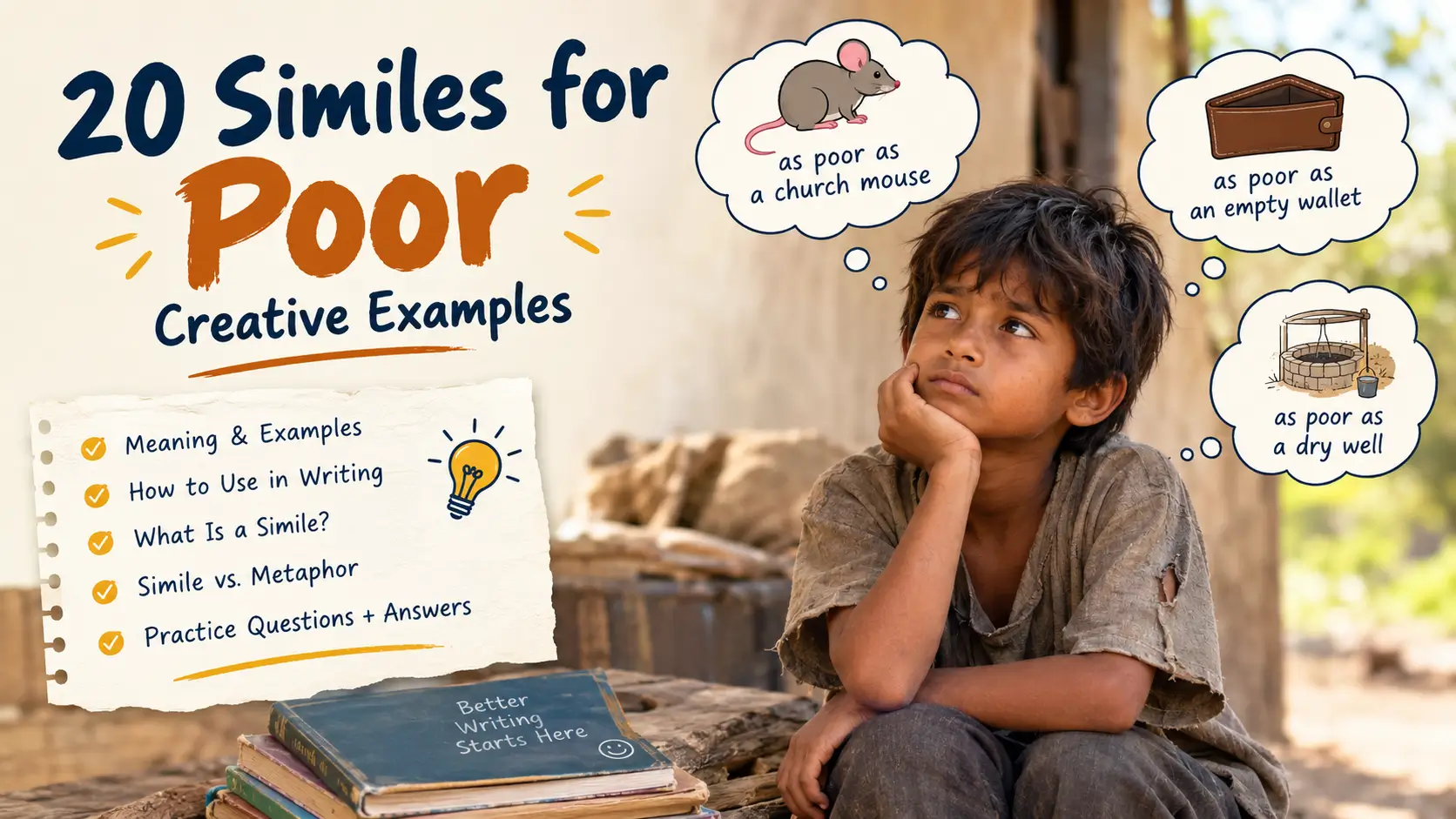
When you want to describe someone or something as poor, simply saying “poor” can sometimes feel too plain. Similes help you paint a clearer picture by comparing poverty, lack of money, limited resources, or a difficult situation to something familiar. Instead of only saying, “He was poor,” you might say, “He was as poor as a church mouse.” The comparison gives the reader a stronger image.
In this article, you’ll find 20 similes for poor that you can use in creative writing, descriptive writing, stories, essays, and everyday sentences. Each example includes a simple meaning, what it conveys, and two natural simile sentences.
Some comparisons focus on having very little money, while others describe a person, place, or situation with few resources. You’ll also learn how to create your own similes, understand the meaning of similes, tell a simile from a metaphor, and practice with ten questions. Let’s explore these creative writing examples and make your descriptions more vivid.
20 Similes for Poor
1. As poor as a church mouse
Meaning: This means having very little money or almost no resources.
What it conveys: It creates a clear picture of extreme poverty and having very little to live on.
Example sentences:
- After losing his job, he was as poor as a church mouse.
- The family was as poor as a church mouse but still shared what they had.
2. As poor as a beggar
Meaning: This describes someone who has very little money or possessions.
What it conveys: It emphasizes severe financial hardship.
Example sentences:
- After spending all his savings, he felt as poor as a beggar.
- The character in the story was as poor as a beggar but never lost hope.
3. As poor as a pauper
Meaning: This means extremely poor, with few possessions or financial resources.
What it conveys: It gives the writing a slightly old-fashioned or literary feeling.
Example sentences:
- He lived as poor as a pauper in a tiny room.
- Although she worked hard, she remained as poor as a pauper.
4. As poor as a rat
Meaning: This describes someone who has almost nothing.
What it conveys: It creates a strong and slightly humorous image of extreme poverty.
Example sentences:
- By the end of the month, I was as poor as a rat.
- The traveler arrived in town as poor as a rat.
5. As poor as dirt
Meaning: This means having very little money.
What it conveys: It gives a casual and direct impression of being extremely short of money.
Example sentences:
- When college started, I was as poor as dirt.
- He joked that he was as poor as dirt after paying his bills.
6. As poor as a beggar on the street
Meaning: This describes someone with very few financial resources.
What it conveys: The comparison highlights hardship and a lack of basic possessions.
Example sentences:
- After the business failed, he became as poor as a beggar on the street.
- The novel follows a young man who starts life as poor as a beggar on the street.
7. As poor as an empty pocket
Meaning: This means having little or no money available.
What it conveys: It creates an easy-to-understand image of having nothing in your pocket.
Example sentences:
- I arrived at the market as poor as an empty pocket.
- After buying the books, she was as poor as an empty pocket.
8. As poor as a dry well
Meaning: This describes someone or something with nothing left to give.
What it conveys: It suggests that resources have completely run out.
Example sentences:
- After months without work, his savings were as poor as a dry well.
- By winter, the family’s resources were as poor as a dry well.
9. As poor as a bare cupboard
Meaning: This means having very little food, money, or supplies.
What it conveys: It creates a strong household image of scarcity.
Example sentences:
- After the storm, the village was as poor as a bare cupboard.
- Their kitchen looked as poor as a bare cupboard after the long winter.
10. As poor as an empty wallet
Meaning: This means having almost no money.
What it conveys: It is a simple, modern comparison that readers can understand immediately.
Example sentences:
- By Friday, I was as poor as an empty wallet.
- He laughed and said he was as poor as an empty wallet after the trip.
11. As poor as a forgotten farm
Meaning: This describes a place or person with very limited resources.
What it conveys: It creates an image of neglect, loneliness, and scarcity.
Example sentences:
- The abandoned village looked as poor as a forgotten farm.
- His childhood home was as poor as a forgotten farm on the edge of town.
12. As poor as a cracked pot
Meaning: This describes someone or something with very little value or resources.
What it conveys: It gives a simple image of something worn out and unable to hold much.
Example sentences:
- After years of hardship, their old home looked as poor as a cracked pot.
- The tiny shop stood as poor as a cracked pot beside the new buildings.
13. As poor as a leafless tree
Meaning: This describes someone or something lacking resources, possessions, or abundance.
What it conveys: It suggests emptiness and a lack of growth.
Example sentences:
- After the failed harvest, the farmer felt as poor as a leafless tree.
- The once-busy business became as poor as a leafless tree.
14. As poor as an empty basket
Meaning: This means having little or nothing to show for your efforts.
What it conveys: The image of an empty basket suggests a complete lack of supplies or rewards.
Example sentences:
- He returned from the market as poor as an empty basket.
- After the failed harvest, the villagers were left as poor as an empty basket.
15. As poor as a lonely hut
Meaning: This describes someone or somewhere with very few comforts or possessions.
What it conveys: It creates an image of simplicity, isolation, and hardship.
Example sentences:
- The family lived as poor as a lonely hut in the mountains.
- Their old settlement was as poor as a lonely hut surrounded by fields.
16. As poor as a pennyless traveler
Meaning: This describes someone who has almost no money while traveling or living away from home.
What it conveys: It suggests uncertainty, hardship, and limited resources.
Example sentences:
- He arrived in the city as poor as a penniless traveler.
- The young hero began his journey as poor as a penniless traveler.
17. As poor as a dry riverbed
Meaning: This means having no resources or abundance left.
What it conveys: A dry riverbed gives a vivid picture of something that once had plenty but is now empty.
Example sentences:
- After the drought, the farmland was as poor as a dry riverbed.
- His savings became as poor as a dry riverbed after years of unemployment.
18. As poor as an empty cupboard in winter
Meaning: This describes severe scarcity, especially when basic needs are difficult to meet.
What it conveys: It creates a strong image of hardship and having almost nothing available.
Example sentences:
- The struggling family was as poor as an empty cupboard in winter.
- Without work or savings, they were as poor as an empty cupboard in winter.
19. As poor as a worn-out shoe
Meaning: This describes someone or something with very little money, value, or comfort.
What it conveys: It gives a vivid image of something used, tired, and lacking resources.
Example sentences:
- After years of financial trouble, he felt as poor as a worn-out shoe.
- The tiny village looked as poor as a worn-out shoe after the storm.
20. As poor as a field after harvest
Meaning: This describes a person or place that has very little left after resources have been used.
What it conveys: It suggests emptiness after everything useful has already been taken away.
Example sentences:
- After paying every bill, my bank account was as poor as a field after harvest.
- The family’s supplies were as poor as a field after harvest by the end of winter.
How to Use Similes in Writing
Creating your own similes becomes easy when you follow a few simple steps.
Choose what you want to describe
First, decide what you want readers to understand. Are you describing a person’s lack of money, an empty home, or a difficult situation?
For example:
- He was poor.
- The village was poor.
- Her family had very little.
Find a familiar comparison
Think of something that naturally represents emptiness, scarcity, or having very little.
For example:
- an empty wallet
- a bare cupboard
- a dry well
- a leafless tree
Use “like” or “as”
Similes often use like or as to make the comparison clear.
- His wallet was like an empty box.
- She was as poor as a church mouse.
Make the comparison clear
A good simile should help the reader understand the idea. Avoid a comparison that makes readers stop and wonder what you mean.
Weak: “He was poor like a strange cloud.”
Better: “He was as poor as an empty wallet.”
Avoid clichés when possible
Common similes can be useful, especially for beginners. But original comparisons can make creative writing more memorable.
Instead of:
She was as poor as a church mouse.
You could write:
Her pockets were as empty as a bird’s nest after winter.
Match the tone
A funny story can use a playful comparison. A serious story should use a more emotional image.
For example:
- Funny: “After shopping, I was as poor as an empty wallet.”
- Serious: “His family was as poor as a dry riverbed.”
Add sensory details
Sensory details can make descriptive writing stronger.
Instead of:
The house was poor.
Try:
The house was as bare as an empty cupboard, with cracked walls and a cold wooden floor.
That gives readers something they can picture and feel.
What Is a Simile?
A simile is a figure of speech that compares two different things using words such as like or as.
The comparison is not meant to be taken literally. Its purpose is to create a clearer picture in the reader’s mind.
For example:
- “Her smile was like sunshine.”
- “He was as quiet as a mouse.”
- “The road was like a ribbon through the hills.”
In each example, the writer compares one thing with another to make the description more vivid.
Similes are common in stories, poems, essays, speeches, and everyday conversation. They are a useful form of figurative language because they help readers imagine an emotion, person, place, or action.
If you have seen the phrase “strohl simile,” it is worth noting that this is not a standard literary term. It may be a misspelling, a search variation, or a reference to a particular person’s name or phrase. A normal literary simile is simply a comparison between unlike things, often using like or as.
Simile vs. Metaphor
Both similes and metaphors make comparisons, but they do it differently.
Simile: The room smelled like rotten eggs.
Metaphor: The room was a rotten-egg factory.
The simile openly signals the comparison with like. The metaphor states the comparison directly without using “like” or “as.”
Here is another simple pair:
- Simile: Her voice was like music.
- Metaphor: Her voice was music.
For beginners, remember this simple rule: similes compare using words such as “like” or “as,” while metaphors make a direct comparison.
Practical Exercise: 10 Questions
Test your understanding with these ten questions. Try answering them before checking the answers below.
- Fill in the blank: “After paying all his bills, his wallet was as empty as a ______.”
- Identify the simile: Which sentence contains a simile?
A. The boy was poor.
B. The boy was as poor as a church mouse.
C. The boy had no money. - Fill in the blank: Complete this simile: “The family’s resources were as dry as a ______.”
- Multiple choice: Which comparison best describes having almost no money?
A. As rich as a king
B. As poor as a church mouse
C. As bright as the sun
D. As fast as lightning - Identify the comparison: What two things are compared in “Her pockets were like empty baskets”?
- Create your own simile: Write a simile describing a person who has very little money.
- Compare the sentences: Which sentence gives a more vivid description?
A. “The village was poor.”
B. “The village was as poor as a dry riverbed.” - Multiple choice: Which word is commonly used to introduce a simile?
A. Because
B. Although
C. Like
D. Therefore - Create your own simile: Complete this sentence creatively: “After the expensive trip, my bank account was as empty as ______.”
- Simile or metaphor? Is this a simile or a metaphor? “His wallet was a desert.”
Answers and Explanations
- Answer: “empty wallet” or another suitable comparison.
Explanation: An empty wallet clearly suggests that someone has little or no money. The sentence uses a comparison to make the idea more vivid. - Answer: B. The boy was as poor as a church mouse.
Explanation: This sentence directly compares the boy’s poverty with a church mouse using “as.” - Answer: dry well is a strong answer.
Explanation: A dry well contains no water, so it creates a useful image for resources that have run out. - Answer: B. As poor as a church mouse.
Explanation: This familiar comparison is used to describe someone who has very little money. - Answer: Her pockets and empty baskets.
Explanation: The sentence compares the pockets to empty baskets, showing that they contain little or nothing. - Answer: Answers will vary.
Explanation: A possible answer is, “He was as poor as an empty wallet.” Your comparison should clearly suggest a lack of money or resources. - Answer: B. “The village was as poor as a dry riverbed.”
Explanation: The second sentence uses a vivid comparison, helping the reader picture emptiness and scarcity. - Answer: C. Like.
Explanation: “Like” is one of the most common signal words used in similes. “As” is another common choice. - Answer: Answers will vary.
Explanation: For example, “After the expensive trip, my bank account was as empty as a dry well.” The comparison makes the lack of money easy to imagine. - Answer: Metaphor.
Explanation: The sentence directly says that the wallet “was” a desert. It does not use “like” or “as,” so it is a metaphor rather than a simile.
Conclusion
Similes make simple descriptions more vivid and memorable. Instead of simply saying someone is poor, you can use a comparison such as “as poor as a church mouse” or create your own fresh image, such as an empty wallet or a dry riverbed. These comparisons help readers see the situation rather than just read about it.
The best similes are clear, natural, and suited to the tone of your writing. Whether you are writing a story, poem, school assignment, or descriptive paragraph, a well-chosen simile can add life to your words.
Use these similes for poor as inspiration, then experiment with your own comparisons. Start with something familiar, connect it to the idea you want to express, and let your creativity do the rest.

I am Silas Michael, an enthusiastic writer passionate about similes, metaphors, and idioms. I enjoy explaining creative expressions through simple meanings and examples that help readers understand and improve their English.