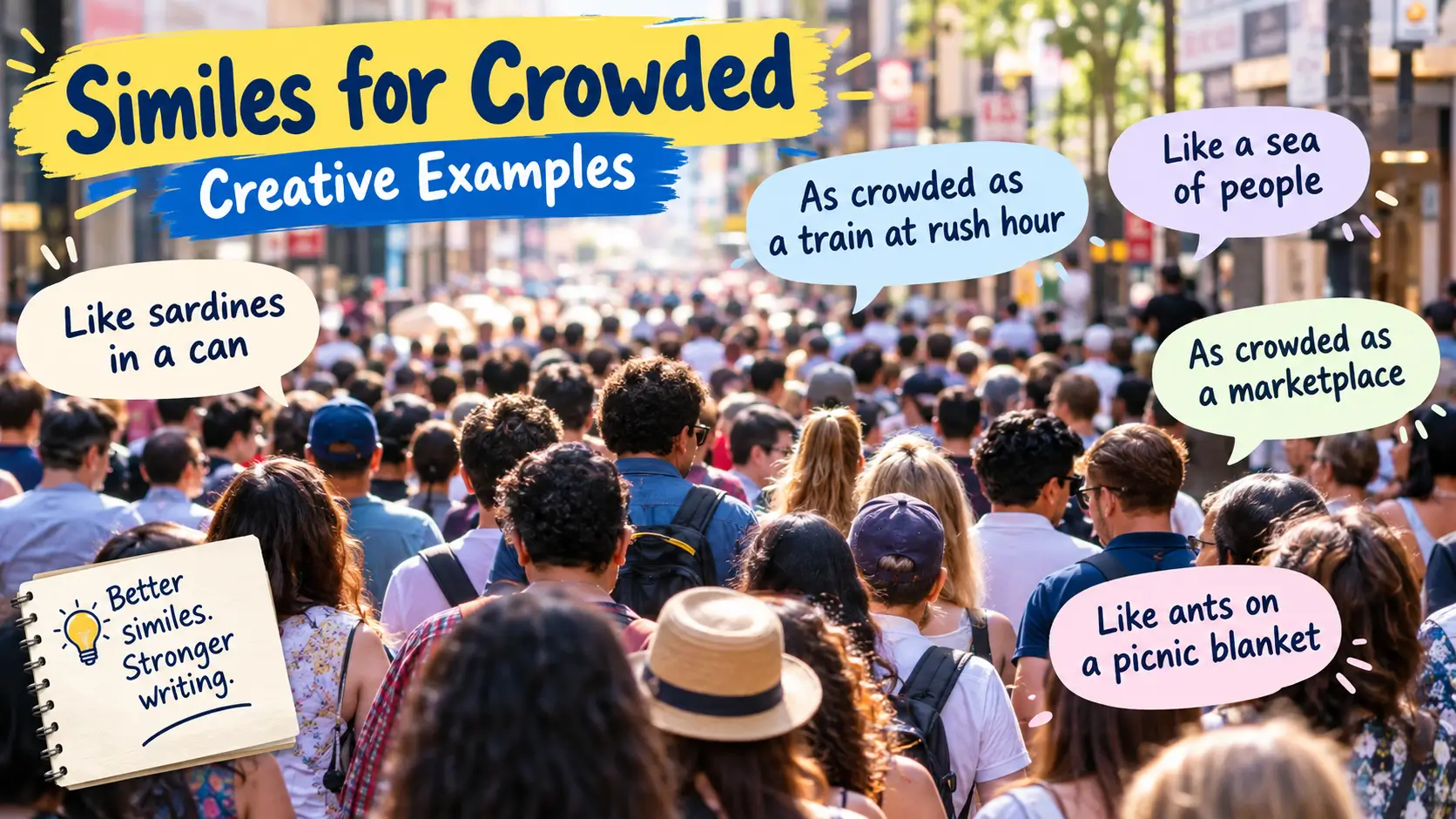
A crowded place can be hard to describe with plain words. Saying that a room, street, bus, or event is “crowded” tells the reader there are many people, but it does not help them picture the scene. This is where similes can make your writing much more vivid. Similes compare one thing to another using words such as like or as. For example, instead of saying, “The market was crowded,” you could write, “The market was as crowded as a train at rush hour.” Suddenly, the reader can imagine people packed closely together and moving through a busy space. In this guide, you will find 20 creative and natural similes for crowded places and situations. Each one includes its meaning, what it conveys, and two example sentences. You will also learn how to create your own simile sentences, understand the meaning of similes, and tell the difference between a simile and a metaphor. Whether you are a student, teacher, blogger, or creative writer, these examples can help make your descriptive writing clearer and more engaging.
20 Similes for Crowded
1. As crowded as a train at rush hour
Meaning: This means a place is packed with people, much like a busy train during the busiest part of the day.
What it conveys: It creates a strong picture of people standing close together with very little space.
Example sentences:
- The subway was as crowded as a train at rush hour.
- By lunchtime, the small café was as crowded as a train at rush hour.
2. Like sardines in a can
Meaning: This describes people packed tightly into a small space.
What it conveys: It gives a funny but clear image of people squeezed closely together.
Example sentences:
- We stood like sardines in a can inside the tiny elevator.
- The passengers were packed like sardines in a can on the bus.
3. As crowded as a packed stadium
Meaning: This means a place has a very large number of people in it.
What it conveys: It suggests a lively, busy space filled with a huge crowd.
Example sentences:
- The town square was as crowded as a packed stadium.
- The concert entrance became as crowded as a packed stadium before the show.
4. Like bees around a hive
Meaning: This compares a busy crowd to bees constantly moving around their hive.
What it conveys: It creates an image of movement, activity, and excitement.
Example sentences:
- Shoppers moved around the market like bees around a hive.
- The workers rushed through the station like bees around a hive.
5. As crowded as a busy marketplace
Meaning: This describes a place filled with people shopping, talking, and moving around.
What it conveys: It suggests noise, activity, and constant movement.
Example sentences:
- The old street was as crowded as a busy marketplace.
- The festival grounds were as crowded as a busy marketplace.
6. Like ants on a picnic blanket
Meaning: This compares many people moving across an area to ants covering a picnic blanket.
What it conveys: It makes the crowd seem numerous and constantly active.
Example sentences:
- People covered the park like ants on a picnic blanket.
- Tourists filled the plaza like ants on a picnic blanket.
7. As packed as a suitcase before a trip
Meaning: This means there is almost no empty space.
What it conveys: It gives a familiar image of something stuffed tightly with many things.
Example sentences:
- The bus was as packed as a suitcase before a trip.
- Her tiny office was as packed as a suitcase before a trip.
8. Like a flock of birds in a tree
Meaning: This compares a large group gathered closely together with birds crowded onto branches.
What it conveys: It creates a lively image of a noisy, active crowd.
Example sentences:
- Students gathered outside the classroom like a flock of birds in a tree.
- The visitors stood together like a flock of birds in a tree.
9. As crowded as a city street at noon
Meaning: This describes a place filled with people during a busy time of day.
What it conveys: It suggests heavy foot traffic and constant movement.
Example sentences:
- The shopping center was as crowded as a city street at noon.
- The festival entrance became as crowded as a city street at noon.
10. Like a jar full of marbles
Meaning: This means people or objects are packed closely together with very little room.
What it conveys: It creates a simple picture of many things pressed into a small space.
Example sentences:
- The classroom felt like a jar full of marbles before the exam.
- The waiting room was like a jar full of marbles, with chairs filled everywhere.
11. As crowded as a school hallway between classes
Meaning: This describes a hallway filled with students moving from one class to another.
What it conveys: It suggests noise, movement, and very little room to walk.
Example sentences:
- The corridor was as crowded as a school hallway between classes.
- The shopping mall became as crowded as a school hallway between classes.
12. Like a swarm of bees
Meaning: This compares a busy crowd to a large group of bees moving together.
What it conveys: It emphasizes fast movement, noise, and activity.
Example sentences:
- Fans rushed through the gates like a swarm of bees.
- The children ran across the playground like a swarm of bees.
13. As packed as a bus on a rainy morning
Meaning: This describes a bus or another place filled tightly with people.
What it conveys: It creates a familiar picture of commuters trying to find space during bad weather.
Example sentences:
- The morning train was as packed as a bus on a rainy morning.
- The waiting area was as packed as a bus on a rainy morning.
14. Like books stacked on a shelf
Meaning: This compares closely packed people or objects to books placed tightly together.
What it conveys: It emphasizes how little empty space is available.
Example sentences:
- The passengers stood like books stacked on a shelf.
- Cars filled the parking lot like books stacked on a shelf.
15. As crowded as a festival on opening night
Meaning: This means a place is filled with people eager to attend an event.
What it conveys: It suggests excitement, energy, and a large crowd.
Example sentences:
- The downtown square was as crowded as a festival on opening night.
- The food court became as crowded as a festival on opening night.
16. Like waves of people at the beach
Meaning: This compares a large moving crowd to waves continuously arriving at the shore.
What it conveys: It gives a strong sense of movement and a crowd that seems endless.
Example sentences:
- Waves of people entered the stadium like waves of people at the beach.
- Visitors flowed through the gates like waves of people at the beach.
17. As crowded as a marketplace before a holiday
Meaning: This describes a place filled with shoppers preparing for a special occasion.
What it conveys: It suggests heavy crowds, excitement, and busy activity.
Example sentences:
- The shopping district was as crowded as a marketplace before a holiday.
- The stores were as crowded as a marketplace before a holiday.
18. Like clothes stuffed into a drawer
Meaning: This describes people or things squeezed into a limited space.
What it conveys: It creates a humorous image of something packed tightly and without order.
Example sentences:
- The passengers were squeezed together like clothes stuffed into a drawer.
- The tiny room felt like clothes stuffed into a drawer after everyone arrived.
19. As crowded as a popular beach in summer
Meaning: This means a place has many people gathered together, leaving little open space.
What it conveys: It creates an easy image of a busy, lively place.
Example sentences:
- The public pool was as crowded as a popular beach in summer.
- The park was as crowded as a popular beach in summer.
20. Like a sea of people
Meaning: This compares a huge crowd to a vast sea that seems to stretch in every direction.
What it conveys: It creates a powerful image of an enormous crowd.
Example sentences:
- From the stage, the singer could see a sea of people.
- A sea of people filled the city square during the celebration.
How to Use Similes in Writing
Creating your own similes is easier when you follow a few simple steps.
Choose what you want to describe
Start with the thing, place, person, or feeling you want readers to picture.
For example:
- A crowded bus
- A busy street
- A full classroom
- A packed concert
Find a familiar comparison
Think of something that is also full, busy, tight, or overflowing.
For example:
The bus was crowded like a jar full of marbles.
The jar gives the reader a familiar picture of limited space.
Use “like” or “as”
These are common signal words in similes.
For example:
The hallway was like a busy marketplace.
Or:
The hallway was as crowded as a busy marketplace.
Make the comparison clear
A good simile should help the reader understand the description. Avoid comparisons that are so unusual that the reader cannot see the connection.
Instead of:
The room was like Tuesday.
Try:
The room was as crowded as a train at rush hour.
Avoid clichés when possible
Common similes can be useful, but original comparisons can make your writing stand out.
For example:
The hallway was packed like a box of crayons.
This gives the reader a fresh and playful image.
Match the tone
A funny story may need a playful simile:
The elevator was packed like clothes stuffed into a drawer.
A serious description may work better with:
The square was filled like a sea of people.
Add sensory details
Make your creative writing similes stronger by adding sounds, movement, sights, or feelings.
For example:
The crowded market buzzed like a hive, with voices rising from every corner.
This does more than say the market was crowded. It helps the reader hear and picture it.
What Is a Simile?
A simile is a figure of speech that compares two different things to make a description clearer or more vivid.
Similes often use words such as like and as.
For example:
The children moved like ants across the playground.
The children are not really ants. The comparison shows that there were many of them moving around.
Another example is:
The theater was as crowded as a packed train.
The comparison helps readers imagine how little space was available.
Writers use similes because they turn simple statements into stronger images. Instead of simply saying, “The street was crowded,” you can help the reader see the scene:
The street was like a river of people.
This is why similes are useful in descriptive writing, stories, poems, and other creative writing examples.
The phrase “strohl simile” is not a standard literary term. If you have seen that phrase used in a search query, it may be a typo, a specific reference, or an intended search for information about similes. A standard simile is simply a comparison between unlike things, usually using words such as “like” or “as.”
Simile vs. Metaphor
Both similes and metaphors make writing more vivid, but they work in different ways.
Simile: The room smelled like rotten eggs.
Metaphor: The room was a rotten-egg factory.
The simile directly compares the smell to rotten eggs using like. The metaphor makes the comparison more direct by saying the room was a “rotten-egg factory.”
Here’s an easy way to remember it:
- Simile: compares using words such as like or as.
- Metaphor: says one thing is another to create a comparison.
Both forms of figurative language can make ordinary descriptions more memorable.
Practical Exercise: 10 Questions
- Fill in the blank: The bus was as crowded as a ________ at rush hour.
- Identify the simile: Which sentence contains a simile?
A. The stadium was full of people.
B. The stadium was a giant bowl.
C. The stadium was like a sea of people. - Fill in the blank: The passengers stood like ________ in a can.
- Multiple choice: Which comparison best describes a huge, moving crowd?
A. Like a quiet pond
B. Like a sea of people
C. Like an empty room - Identify the simile: What is being compared in this sentence?
“The shoppers moved like bees around a hive.” - Create your own simile: Write a simile describing a crowded classroom.
- Compare two sentences: Which sentence creates a stronger picture?
A. The street was crowded.
B. The street was like a river of people.
Explain your choice. - Multiple choice: Which sentence uses “as” in a simile?
A. The mall was a maze.
B. The mall was as crowded as a festival.
C. The mall had many shops. - Create your own simile: Describe a packed bus using a comparison with something that has very little empty space.
- Identify the simile: Is this a simile or a metaphor?
“The concert was a sea of people.”
Answers and Explanations
- Answer: Train.
Explanation: “As crowded as a train at rush hour” is a common comparison for a place with many people and very little space. - Answer: C. The stadium was like a sea of people.
Explanation: The word like signals a simile. It compares the crowd to a sea. - Answer: Sardines.
Explanation: “Like sardines in a can” describes people squeezed closely together. - Answer: B. Like a sea of people.
Explanation: A sea suggests something huge and spreading in every direction, making it useful for describing a very large crowd. - Answer: The shoppers are compared to bees around a hive.
Explanation: The comparison suggests that the shoppers are busy, active, and constantly moving. - Answer: Answers will vary.
Explanation: One possible answer is, “The classroom was as crowded as a packed bus.” It clearly compares the classroom to another tightly filled space. - Answer: B. The street was like a river of people.
Explanation: Sentence B creates a visual image. The comparison makes readers imagine people flowing along the street. - Answer: B. The mall was as crowded as a festival.
Explanation: The structure as + adjective + as is a common way to form a simile. - Answer: Answers will vary.
Explanation: One possible answer is, “The bus was packed like clothes stuffed into a drawer.” Both images suggest very little space. - Answer: Metaphor.
Explanation: “The concert was a sea of people” directly identifies the crowd as a sea rather than using “like” or “as.”
Conclusion
Similes help ordinary descriptions come alive. Instead of simply telling readers that a place is crowded, you can show them what that crowd feels and looks like. Comparing people to sardines, bees, ants, or a sea of people gives readers an image they can quickly understand. The best similes for crowded places are clear, natural, and suited to the mood of your writing. As you practice, try looking around you and asking, “What does this scene remind me of?” Then use like or as to build your comparison. Do not worry about making every simile perfect on your first try. Experiment with familiar objects, sounds, movements, and places. With practice, your simile sentences will become more vivid, creative, and effective.

I am Beau Thomas, the Administrator at SimilyHub. I enjoy making similes, metaphors, and idioms easy to understand through clear explanations, helpful examples, and engaging content for English learners and writers.