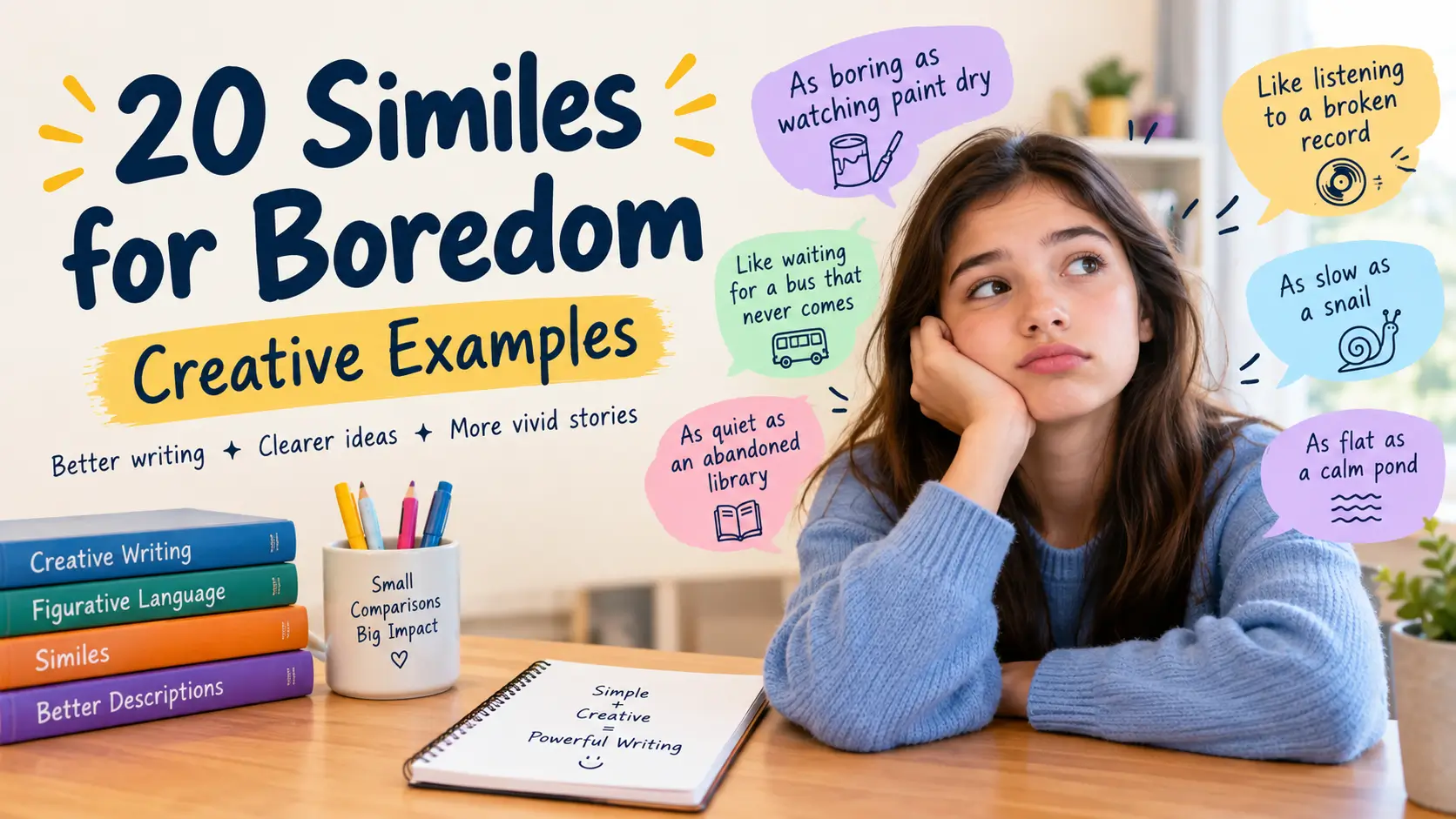
Boredom is a feeling we all know. Sometimes a class seems to last forever. Sometimes a rainy afternoon feels like it will never end. Other times, you simply sit around with nothing interesting to do. This is where similes can make your writing much more vivid. Instead of simply saying, “I was bored,” you can compare boredom to something familiar, funny, or dramatic. For example, you might say, “The lecture was as dull as watching paint dry.” Suddenly, the reader can picture just how boring it felt.
In this article, you’ll find 20 creative and natural similes for boredom. Each one includes a simple meaning, what it conveys, and two example sentences. You’ll also learn how to use similes in writing, understand the difference between similes and metaphors, and practice with ten questions. Whether you are a student, teacher, blogger, or creative writer, these examples can help make your descriptions stronger. Let’s explore some fun ways to describe boredom!
20 Similes for Boredom
1. As boring as watching paint dry
Meaning: This means something is extremely dull and uninteresting.
What it conveys: It creates a funny image of someone waiting while nothing exciting happens.
Example sentences:
- The long meeting was as boring as watching paint dry.
- That documentary was as boring as watching paint dry.
2. As dull as a rainy Monday
Meaning: This describes something that feels gloomy, uneventful, and boring.
What it conveys: It gives the feeling of a slow day when nothing exciting seems to happen.
Example sentences:
- The afternoon felt as dull as a rainy Monday.
- Without anything to do, the weekend became as dull as a rainy Monday.
3. Like waiting for a bus that never comes
Meaning: This describes a boring experience that seems to go on forever.
What it conveys: It emphasizes waiting, frustration, and the slow passage of time.
Example sentences:
- Sitting through the speech was like waiting for a bus that never comes.
- The afternoon without my friends felt like waiting for a bus that never comes.
4. As exciting as a blank wall
Meaning: This means something has almost nothing interesting about it.
What it conveys: The comparison creates a simple, humorous picture of complete dullness.
Example sentences:
- The old textbook was as exciting as a blank wall.
- His story was as exciting as a blank wall.
5. Like watching grass grow
Meaning: This describes an activity that feels extremely slow and boring.
What it conveys: It suggests that very little seems to happen while you wait.
Example sentences:
- Waiting for the computer to update was like watching grass grow.
- The empty afternoon felt like watching grass grow.
6. As lifeless as an empty playground
Meaning: This means something feels quiet, inactive, and boring.
What it conveys: It creates an image of a place that normally has energy but is completely still.
Example sentences:
- The schoolyard was as lifeless as an empty playground during the holiday.
- The party became as lifeless as an empty playground after everyone left.
7. Like listening to a broken record
Meaning: This describes something repetitive and boring.
What it conveys: It suggests that the same thing keeps happening again and again.
Example sentences:
- Hearing the same complaint all day was like listening to a broken record.
- His repeated instructions felt like listening to a broken record.
8. As slow as a snail on a sleepy afternoon
Meaning: This describes something that moves or progresses very slowly.
What it conveys: It gives boredom a playful image by combining a slow animal with a quiet afternoon.
Example sentences:
- The boring lesson passed as slow as a snail on a sleepy afternoon.
- Time moved as slow as a snail on a sleepy afternoon.
9. Like being stuck in a waiting room
Meaning: This describes a situation where you have little to do and must simply wait.
What it conveys: It creates a familiar feeling of sitting quietly with nothing interesting happening.
Example sentences:
- The long journey felt like being stuck in a waiting room.
- Spending the whole afternoon alone was like being stuck in a waiting room.
10. As dry as an old textbook
Meaning: This describes something that is difficult to enjoy because it is dull or overly serious.
What it conveys: It suggests a lack of excitement, humor, or energy.
Example sentences:
- The presentation was as dry as an old textbook.
- His explanation was as dry as an old textbook.
11. Like counting grains of sand
Meaning: This describes an activity that is repetitive and tedious.
What it conveys: It shows how boring a task can become when there is no variety.
Example sentences:
- Sorting the tiny pieces was like counting grains of sand.
- Doing the same worksheet for hours felt like counting grains of sand.
12. As quiet as an abandoned library
Meaning: This describes a place or situation with very little activity.
What it conveys: It creates a picture of deep silence and stillness.
Example sentences:
- The classroom was as quiet as an abandoned library after lunch.
- The office felt as quiet as an abandoned library on the weekend.
13. Like a clock with no hands
Meaning: This describes a situation where time seems impossible to track or feels strangely slow.
What it conveys: It gives the feeling that the moment is dragging on without progress.
Example sentences:
- The boring lecture felt like a clock with no hands.
- That endless afternoon was like a clock with no hands.
14. As tedious as sorting a box of buttons
Meaning: This describes a task that is repetitive and tiring.
What it conveys: It creates an everyday image of doing a small, repetitive job for too long.
Example sentences:
- Entering the same information again and again was as tedious as sorting a box of buttons.
- The paperwork was as tedious as sorting a box of buttons.
15. Like sitting in a room with no windows
Meaning: This describes a feeling of being trapped in a dull or unchanging situation.
What it conveys: It suggests stillness, confinement, and a lack of stimulation.
Example sentences:
- The long seminar felt like sitting in a room with no windows.
- Being stuck at home all day was like sitting in a room with no windows.
16. As flat as a calm pond
Meaning: This describes something with no excitement, action, or change.
What it conveys: It creates a peaceful but potentially lifeless picture.
Example sentences:
- The conversation was as flat as a calm pond.
- The party remained as flat as a calm pond all evening.
17. Like a song played on repeat
Meaning: This describes something that becomes boring because it happens repeatedly.
What it conveys: It highlights repetition and the loss of excitement.
Example sentences:
- Doing the same task every day felt like a song played on repeat.
- The routine became like a song played on repeat.
18. As sleepy as a deserted street
Meaning: This describes a place or moment that is unusually quiet and inactive.
What it conveys: It creates an image of emptiness and a complete lack of action.
Example sentences:
- The town was as sleepy as a deserted street on Sunday morning.
- The neighborhood felt as sleepy as a deserted street after midnight.
19. Like waiting for ice to melt
Meaning: This describes an experience that seems to take a very long time.
What it conveys: It makes boredom feel slow, passive, and almost endless.
Example sentences:
- Waiting for the results felt like waiting for ice to melt.
- The final ten minutes of class were like waiting for ice to melt.
20. As boring as an empty notebook
Meaning: This means something offers no excitement, ideas, or stimulation.
What it conveys: It creates an image of emptiness and a lack of activity.
Example sentences:
- The afternoon was as boring as an empty notebook.
- Without anything planned, the holiday felt as boring as an empty notebook.
How to Use Similes in Writing
Creating your own similes is easier than it may seem. Start with the feeling or thing you want to describe. Then think of something familiar that has a similar quality.
Here’s an easy process:
- Choose what you want to describe.
For example: boredom. - Think about its main quality.
Boredom can feel slow, empty, quiet, repetitive, or endless. - Find a familiar comparison.
You could compare it to waiting, watching something slow, or sitting somewhere empty. - Use “like” or “as.”
For example: “The class was like watching a clock.” - Make the comparison clear.
The reader should quickly understand the connection. - Match the tone.
A funny story might use a playful simile, while a serious story may need a calmer comparison. - Add sensory details.
Instead of saying, “The room was boring,” try: “The room was as quiet as a library, with only the ticking clock breaking the silence.”
For example:
- Simple: The lesson was boring.
- Better: The lesson was like watching grass grow.
- More descriptive: The lesson dragged on like a slow train under a gray sky.
Try to avoid using the same familiar comparisons every time. Original creative writing similes can make your work feel fresh and personal.
What Is a Simile?
A simile is a figure of speech that compares two different things to make an idea easier to picture. Similes often use words such as “like” or “as.”
For example:
- The classroom was as quiet as a library.
- The lecture was like watching paint dry.
- Time moved like a snail.
These comparisons do not mean the two things are literally the same. They help the reader imagine a quality they share.
Writers use similes because they make descriptions more vivid. Instead of simply saying that something is boring, a writer can give the reader a clear mental picture.
If you have seen the phrase “strohl simile” while searching online, it is worth noting that this is not a standard literary term. It may be a typo, a specific reference, or a misunderstanding of the word “simile.” A normal simile is simply a comparison that usually uses words such as “like” or “as.”
Simile vs. Metaphor
A simile makes a comparison using words such as “like” or “as.”
A metaphor makes a direct comparison without using those signal words.
For example:
- Simile: “The room smelled like rotten eggs.”
- Metaphor: “The room was a rotten-egg factory.”
Both sentences create a strong image, but they do it differently.
Another example:
- Simile: “The classroom was as quiet as a library.”
- Metaphor: “The classroom was a library.”
A simple way to remember the difference is this: similes compare; metaphors say one thing is another.
Practical Exercise: 10 Questions
Test what you have learned with these ten questions. Try answering them before checking the explanations below.
- Fill in the blank: The boring lecture was as dull as ________.
- Identify the simile: Which sentence contains a simile?
A. The classroom was silent.
B. The classroom was like an empty theater.
C. The classroom had twenty desks. - Fill in the blank: Waiting for the computer to start was like ________.
- Multiple choice: Which comparison best describes repetitive boredom?
A. Like listening to a song on repeat
B. Like flying through the clouds
C. Like eating fresh fruit - Identify the simile: Is this a simile? “The afternoon was as empty as a deserted street.”
- Create your own: Write a simile describing a boring school lesson.
- Compare two sentences: Which sentence gives a stronger image?
A. The meeting was boring.
B. The meeting was like watching paint dry.
Explain why. - Fill in the blank: Time moved as slow as ________.
- Multiple choice: Which word is commonly used to introduce a simile?
A. Like
B. Because
C. Therefore - Create your own: Write a simile that describes waiting for something exciting to happen.
Answers and Explanations
- Answer: “watching paint dry.”
Explanation: “As boring as watching paint dry” is a common comparison for something extremely dull. - Answer: B. “The classroom was like an empty theater.”
Explanation: The word “like” connects the classroom with another image, making it a simile. - Answer: “watching grass grow.”
Explanation: Waiting for something slow, such as grass growing, creates a clear picture of boredom and impatience. - Answer: A. “Like listening to a song on repeat.”
Explanation: Repetition can quickly become boring, so this comparison works well. - Answer: Yes.
Explanation: The phrase “as empty as” compares the afternoon with a deserted street. - Answer: Answers will vary.
Explanation: A possible answer is, “The school lesson was like watching a clock crawl.” Your comparison should clearly show how boring the lesson feels. - Answer: B. “The meeting was like watching paint dry.”
Explanation: The first sentence simply tells the reader the meeting was boring. The second creates a specific image. - Answer: “a snail.”
Explanation: Snails are commonly associated with slow movement, making them useful for describing slow time. - Answer: A. Like.
Explanation: “Like” is one of the most common signal words used to form a simile. - Answer: Answers will vary.
Explanation: For example, “Waiting for the surprise felt like watching ice melt.” The comparison should show that the waiting feels slow.
Conclusion
Similes can turn a simple statement about boredom into a clear and memorable image. Instead of saying that something was boring, you can compare it to watching paint dry, waiting for a bus, counting grains of sand, or listening to a song on repeat. These comparisons help readers feel the slowness, silence, or repetition you want to describe.
The similes for boredom in this guide are useful for school assignments, stories, poems, and other forms of descriptive writing. As you practice, try creating comparisons from your own experiences. Think about what boredom looks, sounds, or feels like, then find something familiar that creates the same feeling. A strong simile does more than describe—it helps the reader see the moment in their mind. Keep experimenting, and your creative writing will become more vivid and engaging.

I am Beau Thomas, the Administrator at SimilyHub. I enjoy making similes, metaphors, and idioms easy to understand through clear explanations, helpful examples, and engaging content for English learners and writers.