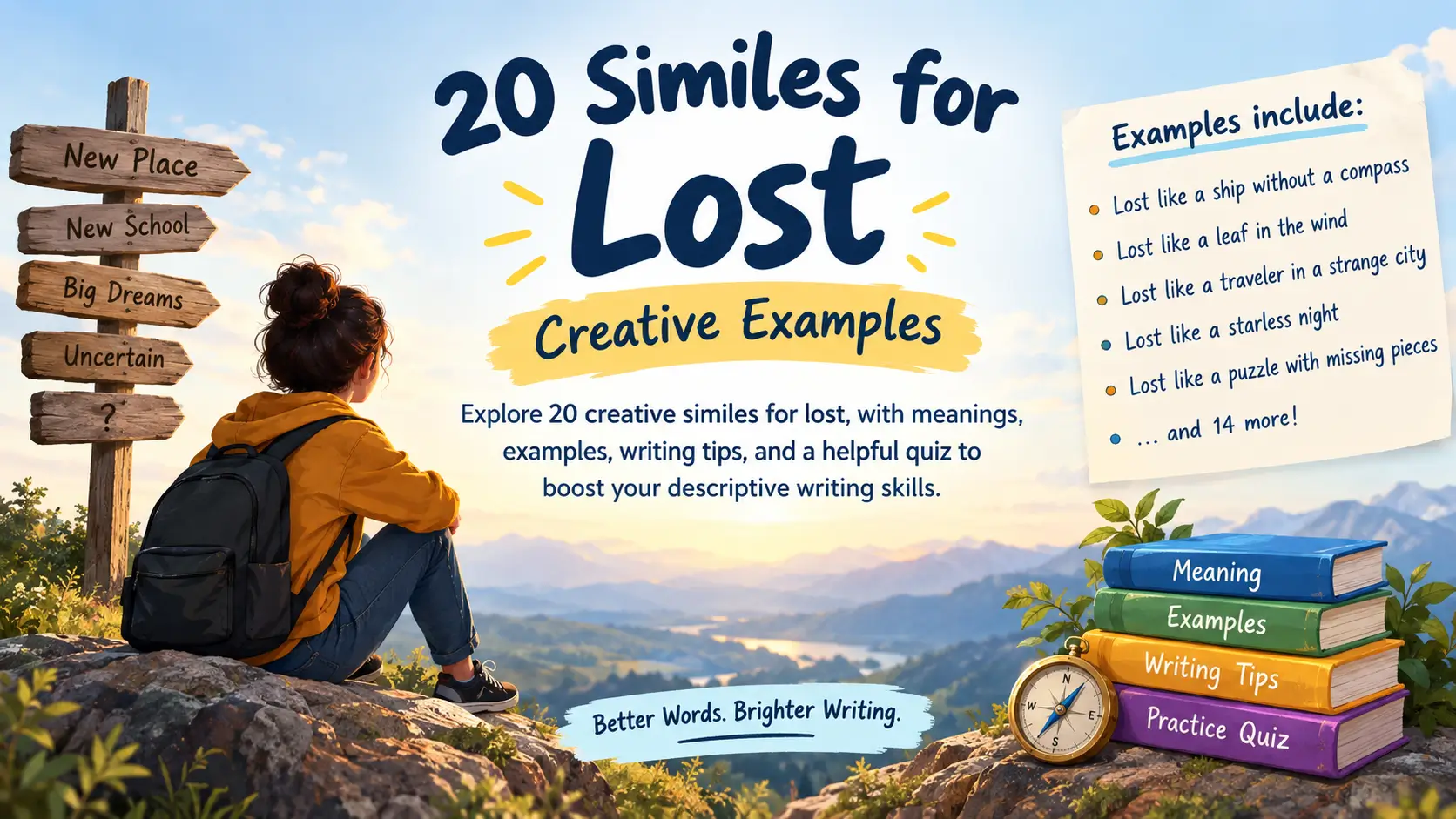
Feeling lost can mean more than not knowing where you are. You can feel lost in a new place, confused about a choice, unsure about the future, or lonely when you do not know what to do next. Similes help describe these feelings in a clear and vivid way. Instead of simply saying, “I felt lost,” you can say, “I felt like a leaf floating on a river.” That comparison gives the reader a picture of uncertainty and helplessness.
In this guide, you will find 20 creative similes for lost, along with simple meanings and natural simile sentences. Some comparisons are gentle, while others show confusion, loneliness, or a complete lack of direction. You will also learn how to create your own comparisons and tell the difference between a simile and a metaphor. Whether you are a student, teacher, beginner writer, or simply looking for creative writing ideas, these examples can help make your descriptive writing more colorful and expressive.
20 Similes for Lost
1. Lost like a ship without a compass
Meaning: This means feeling unsure about where to go or what to do.
What it conveys: It creates an image of someone searching for direction without guidance.
Example sentences:
- After moving to a new city, I felt lost like a ship without a compass.
- Without a clear plan, she wandered through the project like a ship without a compass.
2. Lost like a leaf in the wind
Meaning: This describes someone who feels helpless or unable to control where life is taking them.
What it conveys: It gives a picture of being carried from place to place without direction.
Example sentences:
- After leaving school, he felt lost like a leaf in the wind.
- Without anyone to guide her, Maya felt like a leaf in the wind.
3. Lost like a traveler in a strange city
Meaning: This means feeling confused in an unfamiliar situation.
What it conveys: It shows uncertainty and a lack of knowledge about what to do next.
Example sentences:
- On my first day at the new school, I felt lost like a traveler in a strange city.
- He looked lost like a traveler in a strange city when everyone started using unfamiliar words.
4. Lost like a starless night
Meaning: This describes a deep feeling of uncertainty or having no clear direction.
What it conveys: It creates a dark, quiet image where there is no visible guide.
Example sentences:
- Without a goal, my future seemed lost like a starless night.
- She felt lost like a starless night after her plans suddenly changed.
5. Lost like a puzzle with missing pieces
Meaning: This means feeling confused because important information or answers are missing.
What it conveys: It suggests that something is incomplete and difficult to understand.
Example sentences:
- I felt lost like a puzzle with missing pieces when I read the complicated instructions.
- His thoughts were like a puzzle with missing pieces after the surprising news.
6. Lost like a cloud drifting across the sky
Meaning: This means moving through life without a fixed purpose or destination.
What it conveys: It gives a soft image of uncertainty and aimless movement.
Example sentences:
- After graduation, she felt lost like a cloud drifting across the sky.
- He spent the summer feeling like a cloud drifting across the sky.
7. Lost like a mouse in a maze
Meaning: This describes someone who is confused and cannot find a way forward.
What it conveys: It creates an image of repeated turns, confusion, and frustration.
Example sentences:
- I felt lost like a mouse in a maze while trying to find the right classroom.
- Without instructions, the new employee was like a mouse in a maze.
8. Lost like a book without a title
Meaning: This means feeling unsure about your identity, purpose, or place.
What it conveys: It suggests that something important is missing or unclear.
Example sentences:
- After years of following someone else’s plans, he felt lost like a book without a title.
- She felt like a book without a title when she could not decide what she wanted.
9. Lost like a traveler without a map
Meaning: This means not knowing which direction to take.
What it conveys: It creates a simple image of someone who needs guidance.
Example sentences:
- Without advice from my teacher, I felt lost like a traveler without a map.
- He entered the unfamiliar forest like a traveler without a map.
10. Lost like a voice in a crowded room
Meaning: This describes feeling unnoticed, unheard, or unsure of where you belong.
What it conveys: It combines confusion with loneliness.
Example sentences:
- At the huge conference, I felt lost like a voice in a crowded room.
- She felt like a voice in a crowded room when nobody listened to her ideas.
11. Lost like a boat in a fog
Meaning: This means being unable to see clearly what lies ahead.
What it conveys: It suggests uncertainty, confusion, and limited understanding.
Example sentences:
- After hearing the unexpected news, he felt lost like a boat in a fog.
- I was like a boat in a fog when I had to choose between two difficult paths.
12. Lost like a coin beneath deep water
Meaning: This describes something or someone that feels difficult to find or understand.
What it conveys: It creates an image of being hidden, distant, and hard to reach.
Example sentences:
- My sense of purpose felt lost like a coin beneath deep water.
- After the argument, her confidence seemed lost like a coin beneath deep water.
13. Lost like a child in a giant forest
Meaning: This means feeling small, confused, and unsure about what to do.
What it conveys: It creates a strong image of being surrounded by unfamiliar things.
Example sentences:
- On my first day in the huge school, I felt lost like a child in a giant forest.
- He stood among the complicated rules like a child in a giant forest.
14. Lost like a kite with a broken string
Meaning: This means being free to move but having no clear direction or control.
What it conveys: It suggests drifting away after losing support or guidance.
Example sentences:
- After her best friend moved away, she felt lost like a kite with a broken string.
- Without his usual routine, he was like a kite with a broken string.
15. Lost like a shadow at midnight
Meaning: This describes feeling invisible, uncertain, or completely without direction.
What it conveys: It creates a mysterious image of loneliness and darkness.
Example sentences:
- He wandered through his thoughts like a shadow at midnight.
- After the sudden change, I felt lost like a shadow at midnight.
16. Lost like a single star in a cloudy sky
Meaning: This means feeling alone or difficult to notice among many problems.
What it conveys: It combines loneliness with a small sense of hope.
Example sentences:
- She felt lost like a single star in a cloudy sky.
- In the busy city, I sometimes felt like a single star in a cloudy sky.
17. Lost like a key in a field of grass
Meaning: This means something is difficult to find or understand because it is surrounded by too many possibilities.
What it conveys: It suggests frustration and an overwhelming search.
Example sentences:
- The answer seemed lost like a key in a field of grass.
- My confidence felt like a key in a field of grass after so many mistakes.
18. Lost like a train on the wrong track
Meaning: This describes someone who is moving forward but heading in the wrong direction.
What it conveys: It shows that progress is possible even when the destination is wrong.
Example sentences:
- I felt lost like a train on the wrong track after choosing the wrong career path.
- Without checking the instructions, we were like a train on the wrong track.
19. Lost like a song with no ending
Meaning: This means feeling incomplete or unsure about how something will turn out.
What it conveys: It creates an emotional image of uncertainty and unfinished business.
Example sentences:
- After the friendship ended suddenly, he felt lost like a song with no ending.
- Her future seemed like a song with no ending.
20. Lost like a compass spinning in circles
Meaning: This means being unable to choose a direction or make a decision.
What it conveys: It vividly shows confusion, hesitation, and constant uncertainty.
Example sentences:
- My mind was lost like a compass spinning in circles as I considered my choices.
- He felt like a compass spinning in circles when asked which path he wanted to take.
How to Use Similes in Writing
Creating your own similes is easier when you follow a few simple steps.
Choose what you want to describe
Start with the feeling, person, object, or situation. For example:
- feeling lost
- being confused
- feeling lonely
- having no direction
Find a familiar comparison
Think about something people already understand. A map, compass, maze, fog, or drifting leaf can all suggest a lack of direction.
For example:
- Lost → like a traveler without a map
- Confused → like a mouse in a maze
- Unsure → like a boat in a fog
Use “like” or “as”
Similes often use words such as like or as to make the comparison clear.
For example:
She felt lost like a boat in a fog.
You can also use an “as” structure:
He was as lost as a traveler in a strange city.
Make the comparison clear
A good simile should help readers understand the feeling. Avoid a comparison that has no clear connection.
Weak:
I felt lost like a spoon.
Stronger:
I felt lost like a traveler without a map.
Avoid clichés when possible
Common comparisons can be useful, but original comparisons can make creative writing more memorable.
Instead of:
He was lost like a person in a maze.
Try:
He felt lost like a compass spinning in circles.
Match the tone
A serious story may need an emotional comparison. A funny story can use a playful one.
Serious:
She felt lost like a boat in a fog.
Funny:
I was as lost as a puppy trying to understand a chess game.
Add sensory details
Sensory details make creative writing similes stronger.
Instead of:
I felt lost like a traveler.
Try:
I felt lost like a traveler in a cold city, surrounded by strange streets and unfamiliar signs.
The extra details help the reader see and feel the situation.
What Is a Simile?
A simile is a figure of speech that compares two different things to make an idea clearer or more vivid. It commonly uses words such as like or as.
For example:
The baby slept like a quiet kitten.
The baby is not actually a kitten. The comparison simply shows that the baby slept peacefully.
Another example is:
He was as quiet as a mouse.
The person is not a mouse. The comparison helps readers imagine how quiet he was.
For the topic of being lost, you might write:
I felt lost like a ship without a compass.
The comparison makes the feeling easier to picture.
The phrase “strohl simile” is not a standard literary term. If you encounter that phrase, it may be a typo, a name, or an unusual wording for a request about similes. The important point is to focus on the intended comparison and use accurate literary terms.
Simile vs. Metaphor
A simile makes a comparison using words such as like or as.
Simile: The room smelled like rotten eggs.
A metaphor makes a direct comparison without using “like” or “as.”
Metaphor: The room was a rotten-egg factory.
Both forms create vivid images, but they work in different ways.
Here is another simple example:
Simile: She was like a compass without a needle.
Metaphor: She was a compass without a needle.
For beginners, remember this easy rule: similes compare openly, while metaphors compare directly.
Practical Exercise: 10 Questions
- Fill in the blank:
“I felt lost like a ______ without a compass.” - Identify the simile:
Which sentence contains a simile?
A. The boy walked home.
B. The boy was a storm.
C. The boy wandered like a traveler without a map. - Multiple choice:
Which comparison best describes someone who cannot find the right direction?
A. Like a compass spinning in circles
B. Like a bright sunflower
C. Like a warm blanket - Fill in the blank:
“She felt lost like a leaf ______ in the wind.” - Identify the comparison:
What two things are compared in this sentence?
“He felt lost like a mouse in a maze.” - Create your own simile:
Write a simile describing someone who feels lost in a new school. - Multiple choice:
Which sentence is a simile?
A. Her thoughts were a maze.
B. Her thoughts were like a maze.
C. Her thoughts formed a maze. - Compare two sentences:
Which sentence gives a stronger picture of uncertainty? Explain why.
A. “I felt lost.”
B. “I felt lost like a boat in a fog.” - Create your own simile:
Complete this sentence creatively:
“Without a plan, I felt as lost as ______.” - Identify the figurative language:
Is this a simile or a metaphor?
“His future was like a road hidden by fog.”
Answers and Explanations
- Answer: “ship”
Explanation: “I felt lost like a ship without a compass” compares a confused person to a ship that has no tool for finding direction. - Answer: C. “The boy wandered like a traveler without a map.”
Explanation: The word “like” introduces a comparison, making this sentence a simile. - Answer: A. “Like a compass spinning in circles.”
Explanation: A spinning compass suggests that someone cannot settle on a direction. - Answer: “drifting”
Explanation: A leaf drifting in the wind has little control over where it goes, which makes it a useful comparison for feeling lost. - Answer: A lost person and a mouse in a maze.
Explanation: Both are pictured as being confused and unable to find the correct way out. - Sample answer: “I felt lost like a traveler in a strange city.”
Explanation: The unfamiliar city represents the confusion someone may feel in a new school. - Answer: B. “Her thoughts were like a maze.”
Explanation: The word “like” creates a direct comparison, so this is a simile. - Answer: B. “I felt lost like a boat in a fog.”
Explanation: The second sentence gives readers a visual image of a boat that cannot clearly see where it is going. - Sample answer: “Without a plan, I felt as lost as a traveler without a map.”
Explanation: A traveler without a map does not know which direction to take, making the comparison clear. - Answer: Simile.
Explanation: The sentence uses the word “like” to compare a future to a road hidden by fog.
Conclusion
Similes can turn a simple statement into a vivid picture. Saying “I felt lost” tells the reader the basic idea, but “I felt lost like a ship without a compass” helps the reader imagine the confusion. The 20 similes for lost in this guide show different ways to describe uncertainty, loneliness, confusion, and a lack of direction.
When writing your own similes, start with the feeling you want to express. Then choose a familiar image that helps readers understand it. Use like or as, keep the comparison clear, and add sensory details when useful. With practice, your simile sentences can become more natural and creative. Try creating one new comparison today, and use it in a short piece of descriptive writing.

I am Beau Thomas, the Administrator at SimilyHub. I enjoy making similes, metaphors, and idioms easy to understand through clear explanations, helpful examples, and engaging content for English learners and writers.