Helping others is one of the simplest ways to make the world a little brighter. A kind word, a helping hand, or a small act of care can mean so much to someone in need. But how can you describe these moments in a way that makes readers feel them, too? That is where similes come in!
A simile compares two different things using words such as “like” or “as.” It helps readers picture an idea, feel an emotion, or understand a situation more clearly. For example, you might say, “She was like a ray of sunshine on a cloudy day.” This comparison shows how someone’s kindness can bring joy to others.
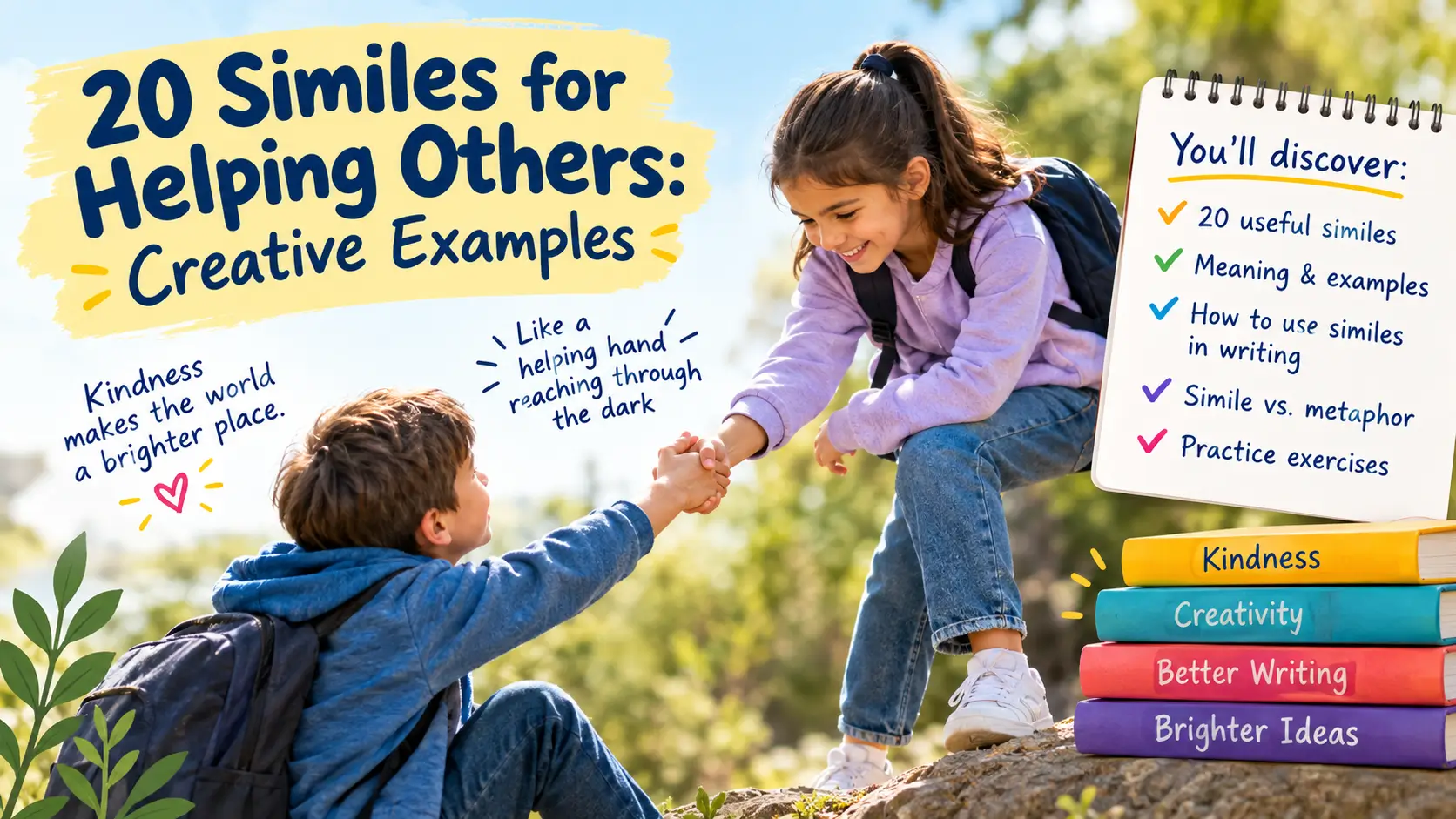
In this article, you will discover 20 similes for helping others, each with a simple meaning and two example sentences. You will also learn how to use similes in writing, understand the difference between similes and metaphors, and practice with ten fun questions. Whether you are a student, teacher, or creative writer, these examples will help you describe kindness and caring in fresh, meaningful ways.
20 Similes for Helping Others
These creative writing similes describe kindness, support, teamwork, and the joy of helping people. Use them in stories, school assignments, poems, or everyday writing.
1. Like a ray of sunshine on a cloudy day
Meaning: Someone brings happiness and hope when another person feels sad or troubled.
What it conveys: Warmth, comfort, and a sudden feeling of joy.
Example sentences:
- When I felt lonely, my friend was like a ray of sunshine on a cloudy day.
- Her kind words were like a ray of sunshine on a cloudy day for the worried child.
2. Like a helping hand reaching through the dark
Meaning: Someone offers support when another person is having a hard time.
What it conveys: Hope, safety, and the comfort of knowing someone cares.
Example sentences:
- My teacher was like a helping hand reaching through the dark when I struggled with my homework.
- The volunteer’s kindness was like a helping hand reaching through the dark for the family.
3. As gentle as a mother’s hug
Meaning: Helping someone with great care, love, and tenderness.
What it conveys: Warmth, protection, and emotional comfort.
Example sentences:
- She comforted her frightened friend as gently as a mother’s hug.
- His words were as gentle as a mother’s hug when I felt upset.
4. Like a bridge over troubled waters
Meaning: Helping someone cross a difficult time or overcome a problem.
What it conveys: Support, connection, and a path toward safety.
Example sentences:
- My older brother was like a bridge over troubled waters when I faced a difficult choice.
- The caring counselor became like a bridge over troubled waters for the struggling student.
5. As steady as a lighthouse in a storm
Meaning: Offering reliable support during a difficult situation.
What it conveys: Guidance, strength, and a sense of security.
Example sentences:
- My best friend was as steady as a lighthouse in a storm when I needed advice.
- The nurse stayed as steady as a lighthouse in a storm while caring for the frightened patients.
6. Like a seed growing into a mighty tree
Meaning: A small act of kindness can help someone grow and become stronger.
What it conveys: Growth, encouragement, and the lasting effects of support.
Example sentences:
- Her encouragement was like a seed growing into a mighty tree in my young mind.
- The teacher’s help was like a seed growing into a mighty tree, giving the student confidence.
7. As warm as a cozy blanket on a cold night
Meaning: Helping someone feel safe, cared for, and comforted.
What it conveys: Peace, kindness, and emotional warmth.
Example sentences:
- His offer to listen was as warm as a cozy blanket on a cold night.
- The volunteer’s welcome felt as warm as a cozy blanket on a cold night.
8. Like a lifeboat in a rough sea
Meaning: Giving urgent support to someone facing a serious problem.
What it conveys: Rescue, relief, and hope during hardship.
Example sentences:
- My neighbor’s help was like a lifeboat in a rough sea when our car broke down.
- The charity’s support became like a lifeboat in a rough sea for families in need.
9. As patient as a gardener tending young plants
Meaning: Helping someone slowly and carefully as they learn or improve.
What it conveys: Patience, care, and a willingness to support growth.
Example sentences:
- My tutor was as patient as a gardener tending young plants while teaching me math.
- She helped her little brother as patiently as a gardener tending young plants.
10. Like a candle lighting another candle
Meaning: Sharing kindness or knowledge so that others can also spread it.
What it conveys: Generosity, inspiration, and kindness that grows.
Example sentences:
- By teaching her classmates, Sara was like a candle lighting another candle.
- His small act of kindness was like a candle lighting another candle in the community.
11. As strong as an oak tree supporting a climbing vine
Meaning: Giving someone dependable support while they face challenges.
What it conveys: Strength, stability, and protection.
Example sentences:
- My father was as strong as an oak tree supporting a climbing vine when I needed encouragement.
- The coach stood by his players as strong as an oak tree supporting a climbing vine.
12. Like a compass guiding a lost traveler
Meaning: Helping someone find the right direction or make a good choice.
What it conveys: Guidance, wisdom, and reassurance.
Example sentences:
- My older sister was like a compass guiding a lost traveler when I felt confused about school.
- The mentor acted like a compass guiding a lost traveler for the new employee.
13. As cheerful as birds singing at sunrise
Meaning: Helping others with a happy and positive attitude.
What it conveys: Joy, energy, and encouragement.
Example sentences:
- The volunteers were as cheerful as birds singing at sunrise as they served breakfast.
- My friend was as cheerful as birds singing at sunrise while helping me clean my room.
14. Like a safety net beneath a tightrope walker
Meaning: Supporting someone so they can take risks without feeling alone.
What it conveys: Trust, security, and confidence.
Example sentences:
- My family was like a safety net beneath a tightrope walker when I tried something new.
- Her friends acted like a safety net beneath a tightrope walker during her first school performance.
15. As giving as a tree offering shade
Meaning: Sharing time, resources, or kindness without expecting anything in return.
What it conveys: Generosity, selflessness, and care.
Example sentences:
- Our neighbor was as giving as a tree offering shade when she helped the elderly couple.
- The kind shopkeeper was as giving as a tree offering shade to people in the community.
16. Like a warm fire on a freezing night
Meaning: Offering comfort and kindness when someone feels cold, sad, or alone.
What it conveys: Relief, welcome, and a feeling of belonging.
Example sentences:
- Her invitation to join the group was like a warm fire on a freezing night.
- The caring teacher’s support felt like a warm fire on a freezing night to the new student.
17. As quick as a flash when help is needed
Meaning: Responding quickly when someone needs assistance.
What it conveys: Readiness, energy, and a desire to help.
Example sentences:
- My brother was as quick as a flash when I dropped my books.
- The lifeguard moved as quick as a flash when someone called for help.
18. Like a strong rope pulling someone up a steep hill
Meaning: Giving someone the support they need to overcome a difficult challenge.
What it conveys: Teamwork, determination, and encouragement.
Example sentences:
- My classmates were like a strong rope pulling me up a steep hill during exam week.
- Her friends became like a strong rope pulling her up a steep hill after a tough loss.
19. As kind as a gentle breeze on a hot day
Meaning: Helping someone in a calm, thoughtful, and caring way.
What it conveys: Relief, peace, and gentle kindness.
Example sentences:
- The nurse was as kind as a gentle breeze on a hot day when she cared for the child.
- His quiet offer to help was as kind as a gentle breeze on a hot day.
20. Like a team of ants carrying a crumb
Meaning: Working together to help someone achieve something difficult.
What it conveys: Cooperation, shared effort, and the power of teamwork.
Example sentences:
- We were like a team of ants carrying a crumb as we cleaned the school garden.
- The neighbors worked like a team of ants carrying a crumb to repair the damaged playground.
How to Use Similes in Writing
Similes help readers picture acts of kindness and understand how helping others feels. You can use them in stories, poems, essays, and even everyday conversations.
Here are some simple ways to create your own similes.
1. Choose what you want to describe
Start by thinking about the action or feeling.
Are you describing someone who is:
- Kind?
- Helpful?
- Patient?
- Generous?
- Supportive?
For example, if you want to describe a helpful friend, you might write:
“My friend helped me like a caring nurse.”
2. Find a familiar comparison
Think of something readers already know.
For example:
- A lighthouse gives guidance.
- A blanket provides warmth.
- A bridge helps people cross.
- A tree offers shade.
You can use these familiar things to describe helpful actions.
3. Use “like” or “as”
Similes often use the words “like” or “as” to connect two things.
Examples:
- She was like a guiding star when I felt lost.
- He was as patient as a teacher helping a young child.
The comparison should make the meaning easy to understand.
4. Make the comparison clear
A good simile helps readers understand your idea without making them guess.
Instead of writing:
“She helped like a thing.”
Try:
“She helped like a lighthouse guiding ships through the fog.”
The second example gives readers a clear picture of guidance and support.
5. Avoid using the same old comparisons
Some comparisons are used very often, such as “as busy as a bee.”
They can still work, but try creating fresh images when you can.
For example:
- Common: He was as kind as an angel.
- More creative: He was like a small lantern glowing in a dark room.
Both describe kindness, but the second creates a more specific picture.
6. Match the simile to the mood
Choose a comparison that fits the feeling of your writing.
|
Mood
|
Example
|
| — | — |
|
Happy
|
She was like sunshine after rain.
|
|
Serious
|
He was like a lifeboat in a storm.
|
|
Gentle
|
Her words were as soft as falling snow.
|
|
Funny
|
He rushed to help like a puppy chasing a bouncing ball.
|
7. Add sensory details
Sensory details help readers imagine what they see, hear, feel, smell, or taste.
For example:
- Basic: Her help was like a warm blanket.
- More vivid: Her help felt like a soft, warm blanket wrapped around me on a chilly evening.
The second example gives readers a stronger feeling of comfort.
Quick tip: When writing creative similes, ask yourself, “What does this act of kindness remind me of?” Your answer may lead to a fresh and memorable comparison.
What Is a Simile?
A simile is a figure of speech that compares two different things using words such as “like” or “as.”
It helps readers understand an idea by connecting it to something familiar.
For example, instead of simply saying, “My friend was helpful,” you could write:
“My friend was like a lighthouse guiding me through the fog.”
This comparison makes your friend’s support easier to picture.
How do similes work?
Similes connect two things that share a quality.
For example:
- “Her smile was like sunshine.” Both can bring warmth and happiness.
- “He was as brave as a lion.” Both suggest courage.
- “The classroom was as quiet as a library.” Both suggest silence.
The two things do not need to be exactly alike. They only need to share a quality that helps explain the meaning.
Why do writers use similes?
Writers use similes to:
- Make descriptions more vivid.
- Show emotions in a clear way.
- Help readers imagine a scene.
- Make stories and poems more interesting.
- Add color and personality to everyday language.
When writing about helping others, similes can turn a simple action into a memorable image.
For example, “She helped me” tells readers what happened.
“She helped me like a bridge leading me out of a dark forest” gives readers a stronger picture of support.
Simile vs. Metaphor
A simile and a metaphor both compare things, but they do it in different ways.
|
Simile
|
Metaphor
|
| — | — |
|
Uses “like” or “as” to compare.
|
Says one thing is another.
|
|
“Her help was like sunshine.”
|
“Her help was sunshine.”
|
|
Makes the comparison direct.
|
Makes the comparison more direct and imaginative.
|
Here is another simple example:
Simile: “The room smelled like rotten eggs.”
Metaphor: “The room was a rotten-egg factory.”
Both sentences describe a bad smell. The simile uses “like,” while the metaphor describes the room as if it were a factory.
When writing about helping others, you could say:
- Simile: “My friend was like a lighthouse in the storm.”
- Metaphor: “My friend was a lighthouse in the storm.”
Both express support and guidance, but the wording is different.
Practical Exercise: 10 Questions
Now it is your turn! Try these ten questions to practice recognizing and creating similes about helping others.
Some questions ask you to fill in a blank. Others ask you to identify a simile or create your own.
Practice quiz
0 of 10 answered
Choose an answer for each question or write your own. Check your work when you are ready.
1. Complete the simile: “My friend was like a _____ guiding me through a difficult time.”
A. lighthouse
B. pillow
C. spoon
2. Which sentence contains a simile?
A. She helped her neighbor.
B. He was as patient as a gardener.
C. They worked together.
3. What does “like a warm fire on a freezing night” suggest?
A. Anger
B. Comfort and kindness
C. Confusion
4. Complete the simile: “The volunteers worked like a team of _____ carrying a crumb.”
A. ants
B. eagles
C. fish
5. Which comparison best describes someone giving guidance?
A. Like a compass guiding a traveler
B. Like a rock in a shoe
C. Like a noisy alarm
6. Create your own simile about a friend who comforts someone. Use “like” or “as.”
7. Which sentence is a metaphor rather than a simile?
A. She was like a ray of sunshine.
B. He was as kind as a gentle breeze.
C. Her support was a safety net.
8. Complete the simile: “She helped her little brother as patiently as a _____ tending young plants.”
A. gardener
B. race car
C. drum
9. Which simile best describes quick help?
A. As quick as a flash
B. As quiet as a mouse
C. As cold as ice
10. Compare these sentences: “He helped me.” and “He helped me like a bridge over troubled waters.” What does the second sentence add?
Check answersReset quiz
Answers and Explanations
Here are the answers to the ten practice questions, with simple explanations to help you understand each one.
1. Lighthouse
Answer: Lighthouse.
A lighthouse guides ships through darkness and rough waters. It is a helpful comparison for a friend who offers direction and support.
2. “He was as patient as a gardener.”
Answer: The second sentence.
It uses “as” to compare someone’s patience with the patience of a gardener.
3. Comfort and kindness
Answer: Comfort and kindness.
A warm fire provides warmth on a cold night. In the same way, a caring person can make someone feel safe and supported.
4. Ants
Answer: Ants.
Ants are known for working together to carry food. They create a clear image of teamwork and shared effort.
5. A compass guiding a traveler
Answer: Like a compass guiding a traveler.
A compass helps people find their direction. This comparison describes someone who gives advice or helps others make decisions.
6. Example of a comforting simile
Sample answer: “My friend was like a soft blanket on a cold day.”
This simile compares a friend’s comfort to the warmth and safety of a blanket. Other clear and creative answers are also correct.
7. “Her support was a safety net.”
Answer: The third sentence.
It is a metaphor because it directly describes support as a safety net. It does not use “like” or “as.”
8. Gardener
Answer: Gardener.
A gardener carefully tends young plants. This makes the gardener a good comparison for someone who helps another person patiently.
9. As quick as a flash
Answer: As quick as a flash.
This expression describes someone who acts very quickly when help is needed.
10. A bridge over troubled waters
Sample answer: The second sentence adds an image of support during a difficult time.
The bridge suggests a way to cross an obstacle. It helps readers imagine how the person made a difficult situation easier. Other answers that explain the image of support are also correct.
Conclusion
Similes are a fun and simple way to describe kindness, care, and support. They help readers picture what it means to lend a hand, comfort a friend, or work together to solve a problem. In this article, you explored 20 similes for helping others, learned their meanings, and saw how to use them in natural sentences.
You also discovered how similes differ from metaphors and practiced creating your own comparisons. Remember, a good simile does not need fancy words. It only needs a clear and meaningful connection.
As you write, think about what kindness reminds you of. Is it sunshine, a warm blanket, or a guiding light? Try turning that idea into a sentence. With practice, your creative writing will become more vivid, thoughtful, and full of heart.

I am Silas Michael, an enthusiastic writer passionate about similes, metaphors, and idioms. I enjoy explaining creative expressions through simple meanings and examples that help readers understand and improve their English.