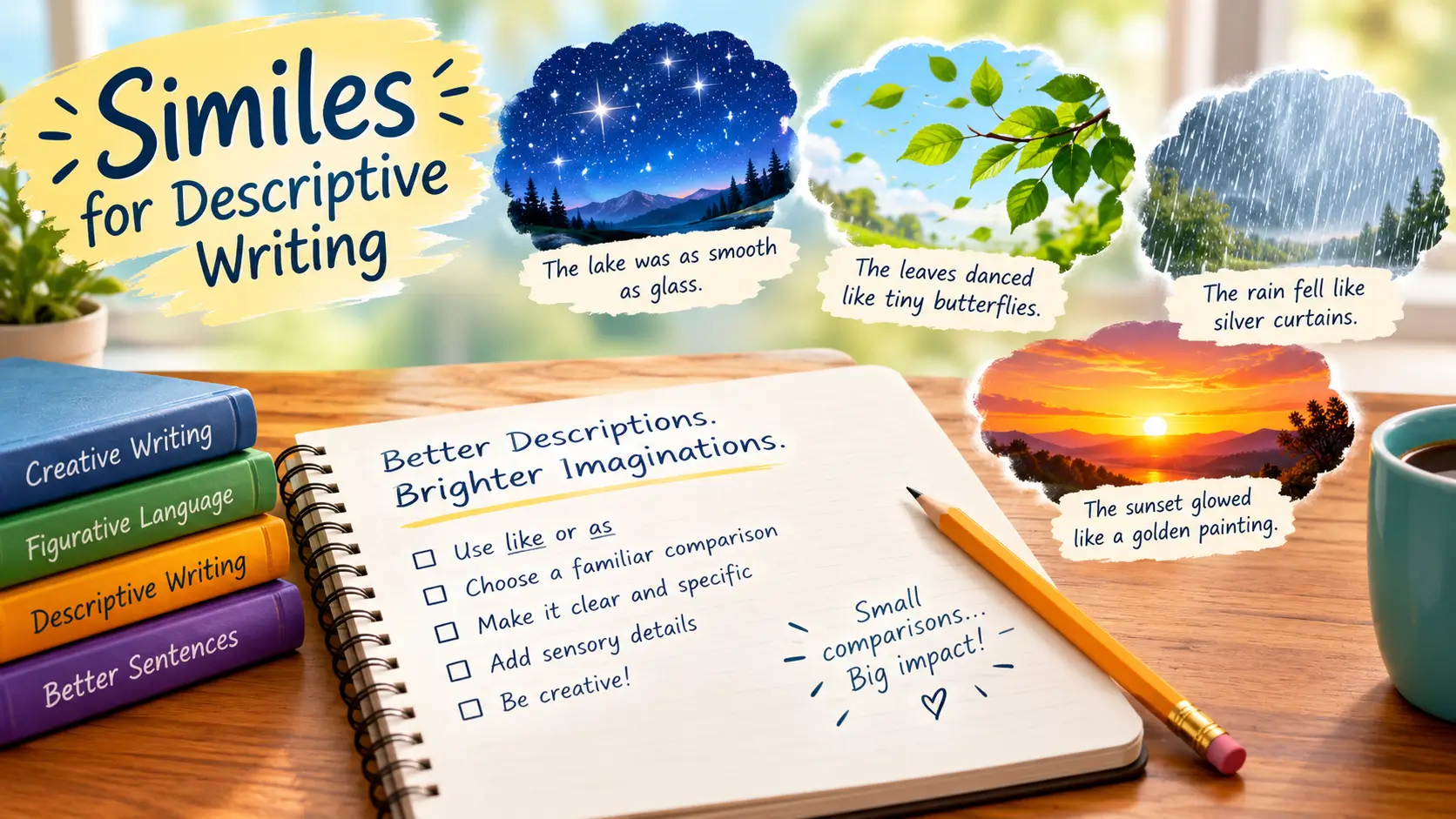
Good descriptive writing helps readers see, hear, smell, taste, touch, and feel what you are describing. One of the easiest ways to make your descriptions more vivid is by using similes. A simile compares two different things using words such as “like” or “as.” Instead of simply saying, “The sky was beautiful,” you might write, “The sky glowed like a golden painting.” Suddenly, the reader has a clearer picture.
Similes for descriptive writing can make ordinary scenes feel fresh and memorable. They can help you describe a person, place, sound, weather, emotion, object, or action in a way that creates a strong image in the reader’s mind.
In this article, you’ll find 20 creative writing similes with simple meanings and natural example sentences. You’ll also learn how to use similes in writing, understand the difference between similes and metaphors, and practice creating your own. Whether you are a student, beginner writer, or simply trying to make your sentences more interesting, these examples can give your descriptive writing a creative boost.
20 Similes for Descriptive Writing
1. Her smile was like sunshine after a storm.
Meaning:
Her smile was warm, bright, and comforting after a difficult time.
What it conveys:
This simile creates a feeling of hope, happiness, and relief.
Example sentences:
- Her smile was like sunshine after a storm when she welcomed everyone home.
- The child’s smile was like sunshine after a storm on a gloomy afternoon.
2. The lake was as smooth as glass.
Meaning:
The surface of the lake was extremely calm and flat.
What it conveys:
It gives the reader a clear visual image of still water with hardly a ripple.
Example sentences:
- At dawn, the lake was as smooth as glass.
- The boat moved slowly across the water, which was as smooth as glass.
3. The wind howled like a hungry wolf.
Meaning:
The wind made a loud, wild, and frightening sound.
What it conveys:
This comparison makes the weather feel powerful and slightly mysterious.
Example sentences:
- The wind howled like a hungry wolf outside the old cabin.
- All night, the wind howled like a hungry wolf through the trees.
4. The stars sparkled like diamonds.
Meaning:
The stars looked bright and shiny in the night sky.
What it conveys:
It creates a beautiful and magical picture of the night.
Example sentences:
- The stars sparkled like diamonds above the quiet village.
- We lay on the grass and watched the stars sparkle like diamonds.
5. The old house stood like a silent giant.
Meaning:
The house was large, still, and imposing.
What it conveys:
The simile gives the building a powerful presence and a slightly mysterious feeling.
Example sentences:
- The old house stood like a silent giant at the end of the road.
- Behind the trees, the abandoned mansion stood like a silent giant.
6. Her voice was as soft as a whisper.
Meaning:
She spoke very quietly and gently.
What it conveys:
The comparison creates a delicate, peaceful sound.
Example sentences:
- Her voice was as soft as a whisper as she told the story.
- He could barely hear her because her voice was as soft as a whisper.
7. The classroom was as noisy as a busy market.
Meaning:
The classroom was extremely loud and full of activity.
What it conveys:
It helps the reader imagine many people talking, moving, and making sounds at once.
Example sentences:
- Before the teacher arrived, the classroom was as noisy as a busy market.
- During the celebration, the room became as noisy as a busy market.
8. The leaves danced like tiny green butterflies.
Meaning:
The leaves moved lightly and playfully in the wind.
What it conveys:
This creates a lively and colorful image of nature.
Example sentences:
- The leaves danced like tiny green butterflies in the afternoon breeze.
- As the wind passed through the branches, the leaves danced like tiny green butterflies.
9. His hands were as cold as ice.
Meaning:
His hands felt extremely cold.
What it conveys:
The reader can almost feel the freezing temperature.
Example sentences:
- His hands were as cold as ice after walking through the snow.
- I held her fingers and noticed that her hands were as cold as ice.
10. The baby slept like a peaceful angel.
Meaning:
The baby slept quietly and peacefully.
What it conveys:
The simile creates a gentle, innocent, and calm image.
Example sentences:
- After a long day, the baby slept like a peaceful angel.
- She looked adorable as she slept like a peaceful angel in her crib.
11. The rain fell like silver curtains.
Meaning:
The rain appeared to form long, shining sheets.
What it conveys:
It gives the reader a vivid visual image of heavy or steady rainfall.
Example sentences:
- The rain fell like silver curtains across the garden.
- From the window, we watched the rain fall like silver curtains.
12. The runner moved as fast as a cheetah.
Meaning:
The runner moved extremely quickly.
What it conveys:
The comparison emphasizes speed, energy, and athletic ability.
Example sentences:
- The runner moved as fast as a cheetah toward the finish line.
- When the race began, Maya sprinted as fast as a cheetah.
13. The fire crackled like a handful of tiny fireworks.
Meaning:
The fire made many small popping and snapping sounds.
What it conveys:
It makes the sound of the fire feel lively, bright, and energetic.
Example sentences:
- The campfire crackled like a handful of tiny fireworks.
- We sat quietly while the logs crackled like a handful of tiny fireworks.
14. The soup smelled like a warm kitchen on a winter day.
Meaning:
The soup had a comforting, inviting smell.
What it conveys:
It connects the smell with warmth, home, comfort, and cold weather.
Example sentences:
- The soup smelled like a warm kitchen on a winter day.
- As I entered the house, the stew smelled like a warm kitchen on a winter day.
15. Her laughter was like bells in the morning.
Meaning:
Her laughter was bright, pleasant, and cheerful.
What it conveys:
The comparison creates a light and joyful sound.
Example sentences:
- Her laughter was like bells in the morning.
- Everyone smiled when her laughter rang out like bells in the morning.
16. The road stretched like a ribbon across the valley.
Meaning:
The road was long, narrow, and winding through the landscape.
What it conveys:
It gives the reader a strong visual picture of the road from a distance.
Example sentences:
- The road stretched like a ribbon across the green valley.
- From the hilltop, the highway looked like a ribbon across the countryside.
17. His words hit me like a sudden wave.
Meaning:
His words affected the speaker strongly and unexpectedly.
What it conveys:
The simile expresses emotional impact and surprise.
Example sentences:
- Her final words hit me like a sudden wave.
- The news hit him like a sudden wave of cold water.
18. The city glittered like a field of stars.
Meaning:
The city was filled with many bright lights.
What it conveys:
It creates a beautiful nighttime image and emphasizes the city’s brightness.
Example sentences:
- At night, the city glittered like a field of stars.
- From the airplane window, the city glittered like a field of stars below us.
19. The old man’s face was lined like a weathered map.
Meaning:
His face had many deep lines and wrinkles.
What it conveys:
The comparison suggests age, experience, and a life filled with many experiences.
Example sentences:
- The old man’s face was lined like a weathered map.
- Her grandmother’s face was lined like a weathered map after decades of hard work.
20. The morning was as fresh as a newly opened window.
Meaning:
The morning air felt clean, cool, and refreshing.
What it conveys:
This simile gives the reader a sensory feeling of freshness and new beginnings.
Example sentences:
- The morning was as fresh as a newly opened window after the rain.
- I stepped outside, and the air felt as fresh as a newly opened window.
How to Use Similes in Writing
Creating a good simile does not have to be difficult. Start with the thing you want your reader to imagine clearly.
Choose What You Want to Describe
First, identify the subject.
It could be:
- A person’s appearance
- A sound
- A smell
- A place
- Weather
- An emotion
- An action
- An object
For example, suppose you want to describe a dark forest.
Instead of writing:
The forest was dark.
You could write:
The forest was as dark as a locked room.
The second sentence gives the reader a stronger mental picture.
Find a Familiar Comparison
Think of something your reader already knows.
If you want to describe extreme heat, you might compare it to:
- A blazing oven
- A summer sidewalk
- A roaring fire
- Hot sand
For example:
The pavement was as hot as an oven.
The comparison is simple, but it immediately communicates the feeling.
Use “Like” or “As”
Traditional similes often use like or as.
Examples:
- The clouds looked like cotton balls.
- The child was as quiet as a mouse.
- The water shone like silver.
- Her cheeks were as red as roses.
These signal words help readers recognize the comparison.
Make the Comparison Clear
A good simile should help rather than confuse the reader.
Weak:
The tree was like an idea.
This does not give the reader enough information.
Stronger:
The tree spread its branches like an enormous umbrella.
Now the reader can imagine the tree’s shape.
Avoid Clichés When Possible
Common similes can be useful, especially for beginners, but original comparisons can make creative writing more memorable.
Instead of:
He ran like the wind.
You might write:
He raced down the path like an arrow released from a bow.
The second example gives the reader a more specific image.
Match the Simile to Your Tone
Your comparison should fit the mood.
For a scary scene:
The hallway was as silent as an empty graveyard.
For a cheerful scene:
Her laughter was like sunlight spilling through curtains.
For a humorous scene:
He ate like a hungry bear at a picnic.
The right simile supports the emotion of the scene.
Add Sensory Details
Strong descriptive writing often appeals to the senses.
Instead of:
The bakery smelled good.
Try:
The bakery smelled like warm cinnamon drifting through the morning air.
The reader can almost smell it.
What Is a Simile?
A simile is a figure of speech that compares two different things to help create a clearer or more imaginative picture.
Similes commonly use words such as like and as.
For example:
The clouds looked like fluffy cotton.
The clouds are not actually cotton. The writer compares them to cotton because they look soft and fluffy.
Another example is:
She was as quiet as a mouse.
The person is not literally a mouse. The comparison tells us that she was very quiet.
A third example is:
The moon shone like a lantern.
The moon is being compared to a lantern because both provide light.
What Does “Strohl Simile” Mean?
“Strohl simile” is not a standard literary term commonly used to describe a recognized type of simile. If you encountered that phrase while searching for simile examples, it may be a typo, a name, or an unusual wording for a normal simile-related query.
For standard writing instruction, it is better to focus on the established concept of simile: a comparison between two different things, usually signaled by words such as “like” or “as.”
Simile vs. Metaphor
Similes and metaphors both make writing more vivid, but they form comparisons in different ways.
Simile:
“The room smelled like rotten eggs.”
The comparison is direct and uses like.
Metaphor:
“The room was a rotten-egg factory.”
The metaphor describes the room as if it actually were a rotten-egg factory.
Here is another simple example:
Simile:
Her eyes sparkled like stars.
Metaphor:
Her eyes were stars.
A useful beginner tip is this: similes usually say that one thing is like another, while metaphors directly describe one thing as another.
Practical Exercise: 10 Questions
1. Fill in the Blank
Complete the simile:
The snow was as white as ________.
Choose a comparison that makes sense.
2. Identify the Simile
Which sentence contains a simile?
A. The sun disappeared behind the clouds.
B. The sun was like a glowing orange.
C. The clouds covered the sky.
D. Evening arrived quickly.
3. Choose the Best Comparison
Which simile best describes a very loud classroom?
A. The classroom was as quiet as a sleeping cat.
B. The classroom was like a silent garden.
C. The classroom was as noisy as a busy market.
D. The classroom was like an empty room.
4. Create Your Own Simile
Write a simile describing heavy rain. Use either like or as.
5. Identify the Comparison
What two things are being compared in this sentence?
The road stretched like a ribbon across the valley.
6. Improve the Description
Rewrite this sentence using a simile:
The boy was very fast.
7. Simile or Metaphor?
Is this sentence a simile or a metaphor?
The moon was a silver coin in the sky.
8. Complete the Simile
Choose a suitable ending:
Her voice was as gentle as ________.
A. thunder
B. a whisper
C. a crashing wave
D. a barking dog
9. Compare Two Sentences
Which sentence creates a stronger visual image?
A. The lake was calm.
B. The lake was as smooth as glass.
Explain why.
10. Create Your Own Simile
Write a creative simile describing a dark forest. Try to create a comparison that is more original than “dark as night.”
Answers and Explanations
1. Answer
Possible answer: “The snow was as white as cotton.”
Explanation:
Cotton is commonly associated with a soft, bright white appearance, so it creates a clear image of the snow.
2. Answer
B. The sun was like a glowing orange.
Explanation:
The sentence directly compares the sun with an orange using the word like, making it a simile.
3. Answer
C. The classroom was as noisy as a busy market.
Explanation:
A busy market can be crowded and loud, so this comparison clearly communicates the noise level.
4. Answer
Possible answer: “The rain fell like a silver curtain.”
Explanation:
This simile compares falling rain to a curtain, helping the reader imagine rain covering the scene in a sheet.
5. Answer
The road is compared to a ribbon.
Explanation:
A ribbon is long and narrow, which makes it a useful comparison for a road stretching through a landscape.
6. Answer
Possible answer: “The boy was as fast as a cheetah.”
Explanation:
Cheetahs are widely associated with speed, so the comparison makes the boy’s quick movement easy to imagine.
7. Answer
Metaphor.
Explanation:
The sentence directly says the moon was a silver coin. It does not use “like” or “as” to make the comparison.
8. Answer
B. a whisper
Explanation:
A whisper is quiet and gentle, so it creates an appropriate comparison for a soft voice.
9. Answer
B. The lake was as smooth as glass.
Explanation:
The first sentence tells us the lake was calm, but the second gives us a visual comparison. Glass suggests a very smooth, flat surface.
10. Answer
Possible answer: “The forest was as dark as a room with every curtain drawn.”
Explanation:
This comparison gives the reader a specific picture of darkness rather than simply repeating the familiar phrase “dark as night.” Many answers are possible as long as the comparison is clear and descriptive.
Conclusion
Similes are simple tools that can make ordinary sentences much more vivid. By comparing something familiar with something new, you give readers a picture they can quickly understand. The best similes do more than decorate a sentence—they help readers see, hear, smell, feel, or imagine the scene.
The 20 similes for descriptive writing in this guide can give you ideas, but you do not have to copy them. Use them as inspiration for your own creative writing examples. Start with something you want to describe, think of a familiar image, and connect the two with like or as.
Most importantly, experiment. Try unusual but clear comparisons, match them to your mood, and keep your reader in mind. With practice, writing strong simile sentences will become easier and more natural.

I am Beau Thomas, the Administrator at SimilyHub. I enjoy making similes, metaphors, and idioms easy to understand through clear explanations, helpful examples, and engaging content for English learners and writers.