Have you ever felt like you are trying to move forward, but something keeps holding you back? That feeling can be hard to describe with plain words. This is where similes can help. Similes compare one thing to another using words such as like or as, making an idea easier to picture.
If you are looking for similes for being stuck, you may want to describe physical stillness, emotional frustration, writer’s block, or a difficult situation with no clear way out. A good comparison can turn a simple sentence into a vivid image.
For example, instead of saying, “I couldn’t make progress,” you could write, “I felt like a car stuck in deep mud.” Suddenly, the reader can imagine the struggle.
In this article, you will find 20 creative examples of similes, their meanings, and natural simile sentences. You will also learn how to create your own comparisons and practice identifying similes in writing.
20 Similes for Being Stuck
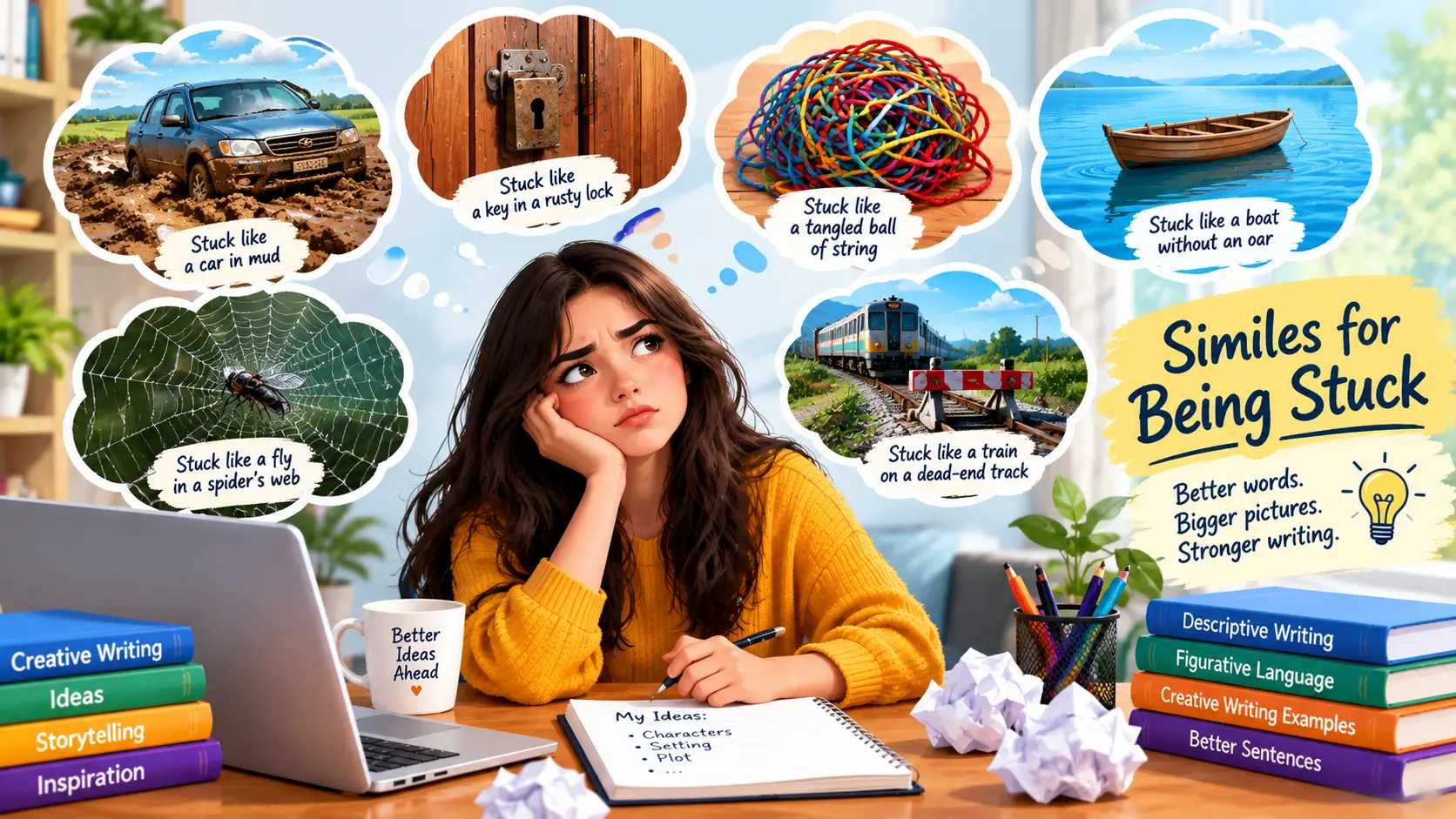
1. Stuck like a car in deep mud
Meaning: This describes someone or something that cannot move forward because of an obstacle.
What it conveys: It creates a strong image of struggling to make progress despite trying.
Example sentences:
- I felt stuck like a car in deep mud, unable to move forward.
- Her plans were stuck like a car in deep mud after the project lost its funding.
2. Stuck like glue to a surface
Meaning: This means being unable to separate, leave, or move away from something.
What it conveys: It suggests being firmly held in one place.
Example sentences:
- My feet felt stuck like glue to the floor.
- He remained stuck like glue to his chair during the long meeting.
3. Stuck like a fly in a spider’s web
Meaning: This describes being trapped by a difficult situation.
What it conveys: It gives the feeling of having very little freedom or escape.
Example sentences:
- I was stuck like a fly in a spider’s web after making that mistake.
- Without a backup plan, the team felt stuck like flies in a spider’s web.
4. Stuck like a broken record
Meaning: This describes someone who keeps repeating the same thought, action, or problem.
What it conveys: It suggests a frustrating cycle that never seems to change.
Example sentences:
- My mind was stuck like a broken record, replaying the same question.
- He sounded stuck like a broken record whenever he talked about the argument.
5. Stuck like a ship in the ice
Meaning: This means being unable to move because circumstances prevent progress.
What it conveys: It creates an image of something powerful that has suddenly become completely still.
Example sentences:
- Our project was stuck like a ship in the ice.
- Without the missing information, my research felt stuck like a ship in the ice.
6. Stuck like a train on a dead-end track
Meaning: This describes being unable to continue because there is no useful path ahead.
What it conveys: It suggests reaching a point where another direction is needed.
Example sentences:
- My story felt stuck like a train on a dead-end track.
- The negotiations were stuck like a train on a dead-end track.
7. Stuck like a fish in a net
Meaning: This means being trapped and unable to escape easily.
What it conveys: It gives the reader a clear picture of helplessness.
Example sentences:
- I felt stuck like a fish in a net when everyone turned against me.
- The character was trapped like a fish in a net with nowhere to run.
8. Stuck like a statue
Meaning: This describes someone who cannot move or does not know what to do.
What it conveys: It emphasizes complete stillness.
Example sentences:
- I stood there stuck like a statue, unsure what to say.
- She froze like a statue when the unexpected question came up.
9. Stuck like a needle in a groove
Meaning: This describes a thought, problem, or situation that keeps repeating without progress.
What it conveys: It suggests being caught in the same mental or emotional loop.
Example sentences:
- My thoughts were stuck like a needle in a groove.
- He was stuck like a needle in a groove, repeating the same complaint.
10. Stuck like a bird in a cage
Meaning: This means feeling trapped and unable to do what you want.
What it conveys: It often expresses emotional restriction or a lack of freedom.
Example sentences:
- I felt stuck like a bird in a cage at my old job.
- She described the small town as feeling like a cage where she was stuck like a bird.
11. Stuck like a wheel in a ditch
Meaning: This describes being unable to progress because of a serious obstacle.
What it conveys: It gives a practical image of effort without movement.
Example sentences:
- My plans were stuck like a wheel in a ditch.
- Without help, the business remained stuck like a wheel in a ditch.
12. Stuck like a fly in honey
Meaning: This describes being slowed down or trapped by something that makes movement difficult.
What it conveys: It creates an unusual but vivid image of struggling against resistance.
Example sentences:
- I was stuck like a fly in honey, buried under unfinished tasks.
- The writer felt stuck like a fly in honey as every new idea became harder to develop.
13. Stuck like a puzzle piece in the wrong place
Meaning: This describes feeling unable to fit into a situation or find the right solution.
What it conveys: It suggests confusion, discomfort, and a lack of belonging.
Example sentences:
- I felt stuck like a puzzle piece in the wrong place.
- He seemed stuck like a puzzle piece in the wrong place at his new school.
14. Stuck like a turtle in its shell
Meaning: This describes someone who withdraws and struggles to come out of a difficult emotional state.
What it conveys: It suggests isolation, hesitation, or emotional retreat.
Example sentences:
- After the argument, I felt stuck like a turtle in its shell.
- She stayed quiet, stuck like a turtle in its shell.
15. Stuck like a clock with no hands
Meaning: This describes a situation where there seems to be no direction or progress.
What it conveys: It creates a feeling of confusion and lost momentum.
Example sentences:
- Without a goal, I felt stuck like a clock with no hands.
- The team was stuck like a clock with no hands, waiting for someone to make a decision.
16. Stuck like a kite in a tree
Meaning: This means being caught in an awkward situation and unable to get free.
What it conveys: It can create a playful image of frustration.
Example sentences:
- My plan was stuck like a kite in a tree.
- After taking the wrong road, we felt stuck like a kite in a tree.
17. Stuck like a key in a rusty lock
Meaning: This describes something that should move but cannot because of resistance.
What it conveys: It suggests frustration, effort, and repeated attempts to solve a problem.
Example sentences:
- My thoughts felt stuck like a key in a rusty lock.
- The solution was stuck like a key in a rusty lock, almost within reach but impossible to turn.
18. Stuck like a boat without an oar
Meaning: This describes being unable to control your direction or move toward a goal.
What it conveys: It creates a sense of helplessness and uncertainty.
Example sentences:
- I felt stuck like a boat without an oar.
- Without instructions, the new employee was stuck like a boat without an oar.
19. Stuck like a runner behind a locked gate
Meaning: This describes being ready to move forward but blocked by an obstacle.
What it conveys: It shows frustration because progress seems possible but is temporarily prevented.
Example sentences:
- I felt stuck like a runner behind a locked gate.
- The team was ready to launch, but the missing approval left them stuck like runners behind a locked gate.
20. Stuck like a car at a red light
Meaning: This describes being temporarily unable to move forward.
What it conveys: It suggests waiting, delay, or a pause rather than permanent failure.
Example sentences:
- My writing felt stuck like a car at a red light.
- We were stuck like cars at a red light, waiting for the problem to clear.
How to Use Similes in Writing
Creating your own similes is easier when you break the process into a few simple steps.
Choose what you want to describe
First, decide what feels stuck. It could be:
- A person
- A vehicle
- A plan
- A story
- A relationship
- A difficult emotion
- A character facing a problem
For example, you might start with: “My story is stuck.”
Find a familiar comparison
Think about things that cannot move easily. A car in mud, a locked door, or a boat without an oar can all suggest being stuck.
Use “like” or “as”
A simile usually makes the comparison obvious.
- My story is like a car stuck in mud.
- She was as still as a statue.
Make the comparison clear
The comparison should help the reader understand the original idea. If the reader has to work too hard to understand it, choose a simpler image.
Match the tone
A funny story might use:
“My brain was stuck like a computer loading forever.”
A serious story might use:
“He felt stuck like a ship trapped in ice.”
Add sensory details
Sensory details make descriptive writing stronger.
Instead of:
“I felt stuck like a car in mud.”
Try:
“I felt stuck like a car in thick mud, wheels spinning while the ground swallowed every attempt to move.”
That small detail gives the reader something to see and feel.
What Is a Simile?
A simile is a figure of speech that compares two different things to make an idea clearer or more vivid. It commonly uses words such as like or as.
For example:
“My thoughts raced like horses.”
The writer is not saying the thoughts are actually horses. The comparison helps us imagine how quickly they are moving.
Another example is:
“She was as quiet as a mouse.”
This helps the reader picture someone being extremely quiet.
Similes are useful because they turn abstract ideas into images readers can understand. Feelings such as frustration, fear, loneliness, or being stuck can be difficult to describe directly. A strong comparison gives those feelings a shape.
The phrase “strohl simile” is not a standard literary term. If you have seen that phrase in a search query, it may be a typo, a mistaken phrase, or a reference to something specific. In standard literary terminology, the correct term for this type of comparison is simply simile.
Simile vs. Metaphor
The easiest way to remember the difference is this:
- A simile compares two things using words such as like or as.
- A metaphor says that one thing is another thing directly.
For example:
Simile: “The room smelled like rotten eggs.”
Metaphor: “The room was a rotten-egg factory.”
Both sentences create a strong image, but the simile makes the comparison directly with like, while the metaphor makes a direct statement.
Here is another pair:
Simile: “My brain felt like a traffic jam.”
Metaphor: “My brain was a traffic jam.”
For beginners, look for like or as first. They are useful clues that a sentence may contain a simile.
Practical Exercise: 10 Questions
1. Fill in the blank
Complete this simile:
“I felt stuck like a ______.”
Choose something that cannot move easily.
2. Identify the simile
Which part of this sentence is the simile?
“My ideas were stuck like a key in a rusty lock.”
3. Multiple choice
Which sentence contains a simile?
A. My writing stopped.
B. My writing was a brick wall.
C. My writing felt like a car stuck in mud.
D. My writing stopped completely.
4. Fill in the blank
Complete the sentence:
“She stood as still as a ______.”
Choose an object that suggests complete stillness.
5. Create your own
Write a simile describing someone who feels trapped.
6. Compare two sentences
Which sentence gives a stronger image?
A. “I could not make progress.”
B. “I felt like a boat without an oar.”
Explain why.
7. Identify the comparison
Is this a simile?
“His thoughts were a tangled ball of string.”
Answer yes or no.
8. Multiple choice
Which comparison best describes temporary waiting?
A. Like a bird flying freely
B. Like a car at a red light
C. Like a river rushing downhill
D. Like a runner crossing the finish line
9. Create a simile
Write a simile describing writer’s block. Try to use “like” or “as.”
10. Improve the sentence
Rewrite this plain sentence as a simile:
“I felt trapped.”
Answers and Explanations
1. Answer
One possible answer is:
“I felt stuck like a car in deep mud.”
Explanation: A car in deep mud may keep trying to move but cannot make progress. This makes it a clear comparison for feeling stuck.
2. Answer
The simile is:
“like a key in a rusty lock”
Explanation: The sentence compares stuck ideas to a key that cannot turn easily inside a rusty lock. The word like signals the comparison.
3. Answer
C. “My writing felt like a car stuck in mud.”
Explanation: This sentence directly compares writing to a car stuck in mud using the word like, making it a simile.
4. Answer
One possible answer is:
“She stood as still as a statue.”
Explanation: A statue does not move, so it creates a clear picture of someone standing completely still.
5. Answer
One possible answer is:
“He felt trapped like a bird in a cage.”
Explanation: A bird inside a cage has limited freedom. This comparison clearly communicates the feeling of being trapped.
6. Answer
B. “I felt like a boat without an oar.”
Explanation: The first sentence tells the reader about a lack of progress. The second creates an image of someone unable to control where they are going.
7. Answer
No.
Explanation: “His thoughts were a tangled ball of string” is a metaphor. It directly says that his thoughts were a tangled ball of string. There is no like or as comparison.
8. Answer
B. Like a car at a red light
Explanation: A car at a red light cannot move forward temporarily. This makes it a useful comparison for waiting or being temporarily stuck.
9. Answer
One possible answer is:
“Writer’s block felt like a locked door with no key.”
Explanation: A locked door suggests that an idea or solution is present but difficult to reach.
10. Answer
One possible answer is:
“I felt trapped like a fly in a spider’s web.”
Explanation: A fly caught in a web has very little ability to escape. The comparison makes the feeling of being trapped much more vivid.
Conclusion
Similes help turn simple statements into clear, memorable pictures. Instead of simply telling readers that someone is stuck, you can show the feeling by comparing it to something familiar, such as a car in mud, a boat without an oar, or a key in a rusty lock.
The best similes are easy to understand, fit the tone of your writing, and give readers something they can imagine. You can use them in stories, poems, essays, dialogue, and descriptive writing.
When you need similes for being stuck, start by asking yourself what kind of “stuck” you mean. Is it physical, emotional, creative, or situational? Then find a familiar image that captures that feeling.
Keep practicing. The more comparisons you create, the easier it becomes to make your writing vivid and expressive.

I am Beau Thomas, the Administrator at SimilyHub. I enjoy making similes, metaphors, and idioms easy to understand through clear explanations, helpful examples, and engaging content for English learners and writers.