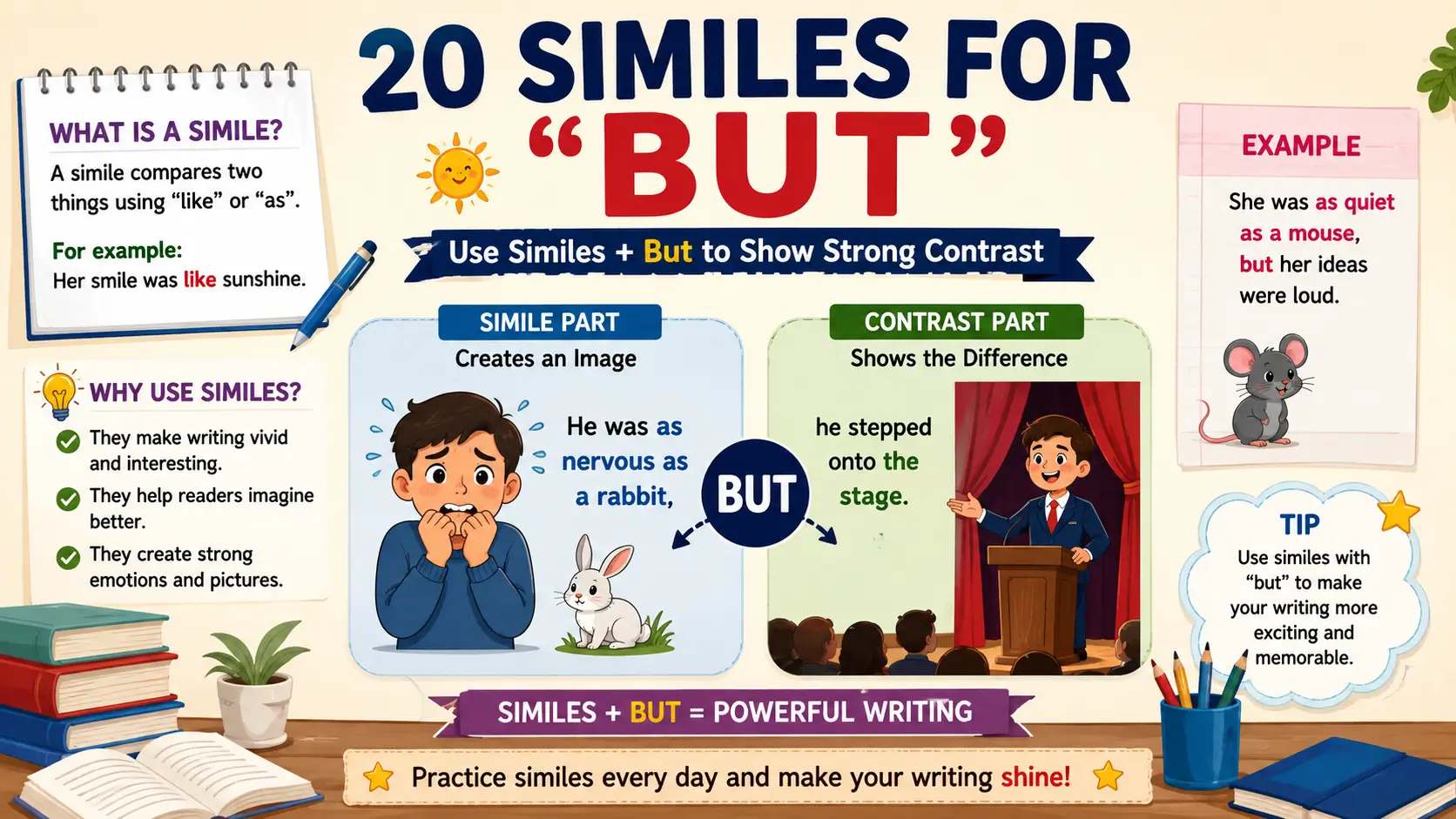
Have you ever wanted to make a sentence more interesting but got stuck on the word “but”? You’re not alone. The word but is used to show a contrast between two ideas. For example, “The road was long, but we kept walking.” It joins two thoughts that do not quite match.
Now, where do similes come in? A simile compares two different things using words such as like or as. For example, “Her smile was like sunshine.” Similes help readers picture an idea instead of simply being told about it.
When you combine simile sentences with “but,” you can create strong contrasts. For example, “He was as nervous as a rabbit, but he stepped onto the stage.” The simile shows fear, while but shows courage.
So, let’s explore some creative writing similes that use but naturally. You’ll also learn the meaning of similes, see examples of similes in context, and practice how to use similes in writing.
Quick note: There is no standard category called a “strohl simile.” If you saw that phrase online, it may be a typo or a misunderstanding of the word simile.
20 Similes for “But” in Creative Writing
Since but is a linking word rather than something that can literally be compared, these examples show how to use but with similes to create contrast.
1. “He was as quiet as a mouse, but his ideas were loud.”
Meaning: The person is physically quiet but has strong ideas.
What it conveys: This creates a contrast between quiet behavior and powerful thoughts.
Example sentences:
- She was as quiet as a mouse, but everyone listened when she spoke.
- He stayed as quiet as a mouse, but his writing spoke volumes.
2. “The task was as hard as climbing a mountain, but she finished it.”
Meaning: The task was very difficult, yet she succeeded.
What it conveys: The simile makes the difficulty easy to imagine.
Example sentences:
- Learning the new skill was as hard as climbing a mountain, but he did not quit.
- The project felt as hard as climbing a mountain, but we reached the end.
3. “He looked as cold as ice, but his heart was warm.”
Meaning: His appearance seemed cold, but he was kind inside.
What it conveys: It contrasts outward appearance with inner character.
Example sentences:
- He looked as cold as ice, but he helped everyone around him.
- Her face seemed as cold as ice, but her actions were kind.
4. “The night was as dark as coal, but the stars shone brightly.”
Meaning: The night was very dark, yet the stars were easy to see.
What it conveys: The contrast makes the scene more vivid.
Example sentences:
- The forest was as dark as coal, but the moon guided us.
- The sky was as dark as coal, but tiny stars appeared above us.
5. “She was as nervous as a deer, but she gave the speech.”
Meaning: She felt very nervous but still acted bravely.
What it conveys: It shows courage despite fear.
Example sentences:
- I was as nervous as a deer, but I walked onto the stage.
- She felt as nervous as a deer, but her voice stayed steady.
6. “The baby was as light as a feather, but his cry was powerful.”
Meaning: The baby was tiny and light, but his cry was strong.
What it conveys: It highlights an amusing contrast between size and sound.
Example sentences:
- The newborn was as light as a feather, but he could wake the whole house.
- She held him gently because he was as light as a feather, but his voice was strong.
7. “The road was as smooth as glass, but the journey was difficult.”
Meaning: The road itself was smooth, but traveling was still challenging.
What it conveys: It shows that an easy-looking situation can still have problems.
Example sentences:
- The road was as smooth as glass, but the storm made the trip hard.
- The path looked as smooth as glass, but we still struggled to reach the village.
8. “He was as busy as a bee, but he still helped me.”
Meaning: He was very busy but made time to help.
What it conveys: It emphasizes kindness and generosity.
Example sentences:
- Dad was as busy as a bee, but he helped me fix my bike.
- She was as busy as a bee, but she answered my question.
9. “The test was as easy as pie, but I made mistakes.”
Meaning: The test seemed very easy, yet mistakes were made.
What it conveys: It creates a humorous contrast.
Example sentences:
- The quiz was as easy as pie, but I still missed two questions.
- The puzzle looked as easy as pie, but I made several mistakes.
10. “The box was as heavy as a rock, but he carried it.”
Meaning: The box was very heavy, but he managed to carry it.
What it conveys: It highlights strength and determination.
Example sentences:
- The bag was as heavy as a rock, but she carried it upstairs.
- The box felt as heavy as a rock, but he refused to give up.
11. “She was as bright as the sun, but she stayed humble.”
Meaning: She was very talented or intelligent but did not act proud.
What it conveys: It praises both ability and modesty.
Example sentences:
- She was as bright as the sun, but she never made others feel small.
- Our teacher was as bright as the sun, but she always welcomed questions.
12. “The water was as cold as ice, but we jumped in.”
Meaning: The water was very cold, yet they entered it.
What it conveys: It shows boldness and excitement.
Example sentences:
- The lake was as cold as ice, but we went swimming anyway.
- The river felt as cold as ice, but the children laughed as they jumped in.
13. “He ran like the wind, but he arrived late.”
Meaning: He ran very fast but was still late.
What it conveys: The contrast adds humor.
Example sentences:
- He ran like the wind, but he missed the bus.
- She ran like the wind, but the race had already started.
14. “Her voice was as soft as a whisper, but her message was strong.”
Meaning: Her voice was quiet, but her words had power.
What it conveys: It shows that strength does not always require loudness.
Example sentences:
- Her voice was as soft as a whisper, but everyone heard her message.
- He spoke as softly as a whisper, but his words changed the room.
15. “The child was as playful as a puppy, but he knew when to be serious.”
Meaning: The child was playful but could also behave responsibly.
What it conveys: It shows a balanced personality.
Example sentences:
- Tom was as playful as a puppy, but he worked hard in class.
- She was as playful as a puppy, but she became serious during the meeting.
16. “The storm was as fierce as a lion, but the house stood strong.”
Meaning: The storm was powerful, but the house survived.
What it conveys: It creates a picture of strength against danger.
Example sentences:
- The storm was as fierce as a lion, but our little house remained standing.
- Winds roared as fiercely as a lion, but the trees held their ground.
17. “He was as stubborn as a mule, but he finally agreed.”
Meaning: He refused to change his mind but eventually accepted the idea.
What it conveys: It shows a funny change in attitude.
Example sentences:
- My brother was as stubborn as a mule, but he finally apologized.
- She was as stubborn as a mule, but she eventually saw my point.
18. “The room was as quiet as a library, but my mind was racing.”
Meaning: Everything around the person was quiet, but they were thinking quickly.
What it conveys: It contrasts external silence with internal activity.
Example sentences:
- The classroom was as quiet as a library, but my mind was racing.
- The house was as quiet as a library, but I could not sleep.
19. “The journey was like walking through fire, but we kept moving.”
Meaning: The journey was extremely difficult, but they continued.
What it conveys: It creates a powerful image of struggle and determination.
Example sentences:
- The final week was like walking through fire, but we finished the project.
- Starting over felt like walking through fire, but she stayed strong.
20. “He was as small as a button, but he was brave.”
Meaning: He was very small but had great courage.
What it conveys: It shows that physical size does not determine bravery.
Example sentences:
- The puppy was as small as a button, but it barked at the huge dog.
- The little boy was as small as a button, but he stood up for his friend.
How to Use “But” With Similes
Using but with a simile is simple.
A useful pattern is:
Subject + simile + but + contrasting idea.
For example:
“She was as tired as a bear after winter, but she kept working.”
The first part creates an image. The word but then introduces an unexpected or opposite idea.
You might say:
“He was as quiet as a mouse, but his ideas were powerful.”
This works because the two parts create tension. The reader expects someone quiet to stay in the background, but the second part changes that expectation.
In simple terms, similes create the picture, while “but” creates the contrast.
Practical Exercise: 10 Questions
Try these before checking the answers.
1. Complete the simile:
“She was as busy as a ________, but she still helped me.”
2. Identify the simile:
“The road was as smooth as glass, but the journey was difficult.”
3. Complete the sentence:
“He ran like the ________, but he arrived late.”
4. What contrast is shown?
“He looked as cold as ice, but his heart was warm.”
5. Choose the best word:
“The baby was as light as a ________, but his cry was powerful.”
- A. feather
- B. mountain
- C. rock
6. Is this a simile?
“She was very brave, but she was nervous.”
7. Complete the sentence:
“The water was as cold as ________, but we jumped in.”
8. Find the simile:
“The room was quiet, but my mind was racing.”
9. Create your own ending:
“The test was as easy as pie, but ________.”
10. Write your own sentence using but and a simile.
Answers and Explanations
1. Bee
“She was as busy as a bee, but she still helped me.”
Why: “As busy as a bee” is a common simile for someone who is very active.
2. “As smooth as glass”
It compares the road to glass to show that it was extremely smooth.
3. Wind
“He ran like the wind, but he arrived late.”
Why: “Like the wind” shows that someone ran very fast.
4. Appearance vs. personality
He looked cold or unfriendly, but his actions or feelings were warm and kind.
5. A. Feather
“As light as a feather” means something weighs very little.
6. No
It contains contrast through but, but it does not contain a simile.
7. Ice
“The water was as cold as ice, but we jumped in.”
Why: “As cold as ice” creates a strong image of very cold water.
8. There is no simile
The sentence contains contrast, but it does not compare two things using like or as.
9. Many answers are possible
For example: “The test was as easy as pie, but I still made three mistakes.”
10. Many answers are possible
For example: “He was as nervous as a rabbit, but he answered the question.”
Conclusion
Similes make ordinary writing more colorful, clear, and memorable. They help readers picture feelings, people, places, and actions. The word “but” is different. It is a conjunction used to connect ideas and show contrast.
When you combine but with similes, your writing can become even more interesting. You can show that someone is nervous but brave, tired but determined, or quiet but powerful.
The best way to learn is to practice. Start with a simple idea, add a comparison using like or as, and then use but to introduce a surprising contrast. Try creating your own simile sentences today. You may be surprised by how much stronger your creative writing becomes.

I’m Jude James, a passionate writer who loves making similes, metaphors, and idioms easy to understand. I enjoy helping readers explore creative language and express ideas with confidence.