Have you ever felt so nervous that your heart seemed to jump out of your chest? Maybe you had to speak in front of a crowd, faced a sudden problem, or heard some bad news. That feeling is panic, and similes can help you describe it in a vivid way.
A simile compares one thing to another using words such as “like” or “as.” Instead of simply saying, “She was panicking,” you might say, “She was shaking like a leaf in a storm.” Suddenly, the reader can picture the fear.
In simple terms, similes make emotions easier to see and feel. They add color, movement, and detail to your writing. Whether you are writing a story, poem, essay, or creative scene, the right simile can turn a plain sentence into something memorable.
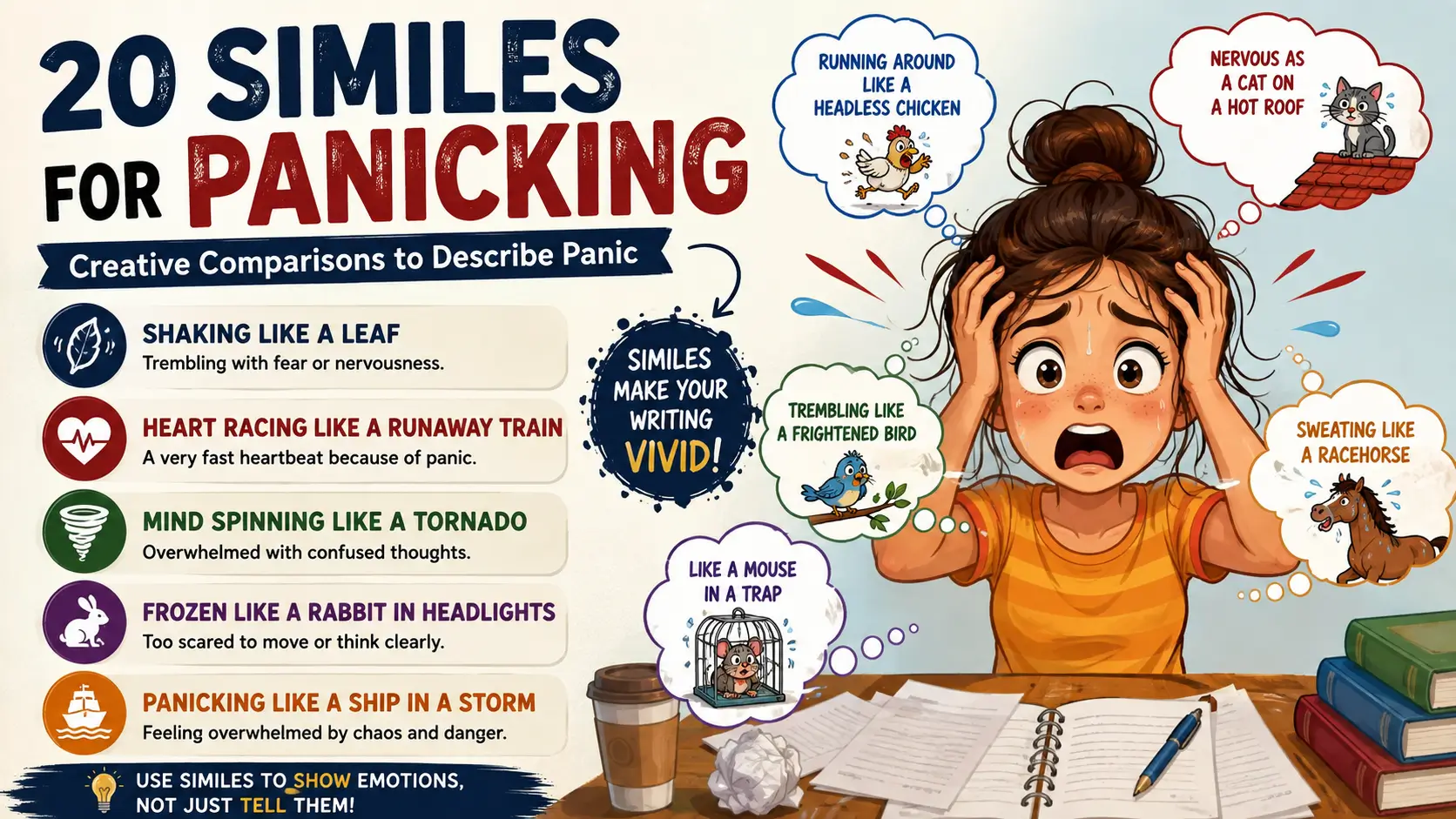
So, let’s explore 20 similes for panicking, along with their meanings and examples. You might even find a few ideas you can use in your own creative writing.
20 Similes for Panicking
1. Panicking like a cat in a room full of dogs
Simile: He was panicking like a cat in a room full of dogs.
Meaning: Feeling extremely frightened and unsafe.
What it conveys: This simile shows intense fear and the feeling of being trapped in danger.
Example sentences:
- She was panicking like a cat in a room full of dogs when she realized she was lost.
- He looked like a cat in a room full of dogs as the crowd moved toward him.
2. Shaking like a leaf
Simile: She was shaking like a leaf.
Meaning: Trembling because of fear or nervousness.
What it conveys: This is one of the most familiar examples of similes for fear and panic.
Example sentences:
- I was shaking like a leaf before opening the test results.
- He stood at the door, shaking like a leaf.
3. Running around like a headless chicken
Simile: Everyone was running around like headless chickens.
Meaning: Acting wildly without knowing what to do.
What it conveys: It describes panic mixed with confusion and poor decision-making.
Example sentences:
- When the alarm went off, everyone ran around like headless chickens.
- The team was running around like headless chickens after the computer crashed.
4. Panicking like a rabbit caught in headlights
Simile: He froze like a rabbit caught in headlights.
Meaning: Becoming extremely frightened and unable to react.
What it conveys: The comparison shows sudden fear that makes a person freeze.
Example sentences:
- She stood there like a rabbit caught in headlights when the teacher called her name.
- He looked like a rabbit caught in headlights after hearing the news.
5. Heart racing like a runaway train
Simile: Her heart was racing like a runaway train.
Meaning: Having a very fast heartbeat because of panic or fear.
What it conveys: It gives the reader a strong sense of speed and rising anxiety.
Example sentences:
- My heart was racing like a runaway train as I waited for the result.
- His heart raced like a runaway train when he heard footsteps behind him.
6. Nervous as a cat on a hot roof
Simile: He was as nervous as a cat on a hot roof.
Meaning: Extremely restless and uneasy.
What it conveys: The image suggests someone who cannot sit still because they are worried.
Example sentences:
- She was as nervous as a cat on a hot roof before her presentation.
- He looked as nervous as a cat on a hot roof while waiting for the phone call.
7. Panicking like a fish out of water
Simile: She was panicking like a fish out of water.
Meaning: Feeling helpless, confused, or completely out of place.
What it conveys: It shows someone struggling because they do not know how to handle the situation.
Example sentences:
- Without his notes, he was panicking like a fish out of water.
- I felt like a fish out of water when everyone started shouting.
8. Trembling like a frightened bird
Simile: He was trembling like a frightened bird.
Meaning: Shaking badly because of fear.
What it conveys: This gives panic a delicate but powerful image.
Example sentences:
- The child was trembling like a frightened bird during the storm.
- She stood trembling like a frightened bird after the sudden crash.
9. Panicking like a mouse in a trap
Simile: He was panicking like a mouse in a trap.
Meaning: Feeling trapped and desperate to escape.
What it conveys: The comparison emphasizes helplessness and urgency.
Example sentences:
- She was panicking like a mouse in a trap when she could not find the exit.
- He felt like a mouse in a trap as the room filled with smoke.
10. Breathing like a runner at the finish line
Simile: She was breathing like a runner at the finish line.
Meaning: Breathing quickly because of fear, stress, or excitement.
What it conveys: It shows the physical effects of panic.
Example sentences:
- He was breathing like a runner at the finish line after hearing the explosion.
- She breathed like a runner at the finish line as the deadline approached.
11. Mind spinning like a tornado
Simile: His mind was spinning like a tornado.
Meaning: Having many confused or frightening thoughts at once.
What it conveys: This is useful when you want to show mental panic rather than physical shaking.
Example sentences:
- My mind was spinning like a tornado after I lost my phone.
- Her thoughts spun like a tornado as she tried to solve the problem.
12. Panicking like a deer in headlights
Simile: He stood there panicking like a deer in headlights.
Meaning: Being shocked and unable to think or move properly.
What it conveys: It creates a clear picture of sudden, overwhelming fear.
Example sentences:
- I froze like a deer in headlights when everyone looked at me.
- She stared at the broken window like a deer in headlights.
13. Sweating like a racehorse
Simile: He was sweating like a racehorse.
Meaning: Sweating heavily because of stress, fear, or physical effort.
What it conveys: This focuses on a visible physical sign of panic.
Example sentences:
- He was sweating like a racehorse before walking onto the stage.
- She was sweating like a racehorse while waiting for the interview.
14. Panicking like a ship in a storm
Simile: She felt like a ship in a storm.
Meaning: Feeling overwhelmed by problems and uncertainty.
What it conveys: The storm represents confusion, danger, and a lack of control.
Example sentences:
- I felt like a ship in a storm when everything went wrong at once.
- He was like a ship in a storm, unsure which way to turn.
15. Thoughts racing like horses
Simile: Her thoughts were racing like horses.
Meaning: Thinking rapidly because of worry or fear.
What it conveys: It shows a mind that cannot slow down.
Example sentences:
- His thoughts raced like horses as he waited for the answer.
- My thoughts were racing like horses after I heard the strange noise.
16. Pale as a ghost
Simile: She became as pale as a ghost.
Meaning: Looking very pale because of shock or fear.
What it conveys: The simile shows that panic has affected the person’s appearance.
Example sentences:
- He turned as pale as a ghost when he saw the accident.
- She was as pale as a ghost after hearing the frightening news.
17. Panicking like a trapped animal
Simile: He was panicking like a trapped animal.
Meaning: Feeling desperate, frightened, and unable to escape.
What it conveys: It creates a strong sense of urgency and helplessness.
Example sentences:
- She struggled like a trapped animal when she could not find the door.
- He looked like a trapped animal as the crowd closed in.
18. Voice shaking like a broken bell
Simile: Her voice was shaking like a broken bell.
Meaning: Speaking unsteadily because of fear or nervousness.
What it conveys: This simile focuses on how panic changes someone’s speech.
Example sentences:
- His voice shook like a broken bell as he told the story.
- She tried to answer, but her voice trembled like a broken bell.
19. Panicking as if the world were ending
Simile: He was panicking as if the world were ending.
Meaning: Reacting with extreme fear to a difficult situation.
What it conveys: It shows that the person believes the problem is much bigger than it may really be.
Example sentences:
- She was panicking as if the world were ending because she was five minutes late.
- He acted as if the world were ending when his computer stopped working.
20. Nervous like a student before an exam
Simile: She was nervous like a student before an exam.
Meaning: Feeling worried about an upcoming event.
What it conveys: This is a simple, relatable comparison for everyday nervousness.
Example sentences:
- I felt nervous like a student before an exam as I waited outside the office.
- He was nervous like a student before an exam before giving his speech.
How to Use Similes for Panicking in Writing
Good creative writing similes do more than tell readers that someone is scared. They help readers experience the emotion.
Compare these two sentences:
Plain: She was panicking.
With a simile: Her heart was racing like a runaway train, and her thoughts spun like a tornado.
The second sentence gives us movement, sound, and emotion.
When learning how to use similes in writing, think about the part of panic you want to show:
- Physical fear: shaking like a leaf
- Fast heartbeat: racing like a runaway train
- Confused thoughts: spinning like a tornado
- Helplessness: like a trapped animal
- Sudden shock: like a deer in headlights
- Restlessness: like a cat on a hot roof
The best simile sentences match the emotion to an image that readers already understand.
Practical Exercise: 10 Questions
Try these questions before checking the answers.
1. Complete the simile:
She was shaking like a ______.
2. Which simile best shows confused and frantic behavior?
A. Calm as a lake
B. Running around like a headless chicken
C. Bright as the sun
D. Quiet as snow
3. Complete the sentence:
His heart was racing like a ______.
4. What does “like a deer in headlights” suggest?
A. Happiness
B. Relaxation
C. Sudden fear and shock
D. Confidence
5. Choose the best simile:
Her thoughts were ______.
A. spinning like a tornado
B. soft as cotton
C. shining like gold
D. sweet as honey
6. Rewrite this sentence using a simile:
He was extremely nervous.
7. What does “like a trapped animal” convey?
A. Freedom
B. Desperation and fear
C. Joy
D. Peace
8. Complete the sentence:
She was as pale as a ______.
9. Which simile best describes someone who cannot sit still because of worry?
A. As nervous as a cat on a hot roof
B. Cool as ice
C. Busy as a bee
D. Strong as an oak
10. Create your own simile for someone whose mind is overwhelmed by panic.
Answers and Explanations
1. Leaf.
“She was shaking like a leaf.” A leaf trembles easily in the wind, making it a clear image of fear.
2. B — Running around like a headless chicken.
This describes frantic actions without a clear plan.
3. Runaway train.
“His heart was racing like a runaway train.” The comparison suggests great speed and a lack of control.
4. C — Sudden fear and shock.
A deer caught in headlights may freeze because it is overwhelmed by danger.
5. A — Spinning like a tornado.
A tornado moves wildly, making it a useful image for chaotic thoughts.
6. Example:
“She was as nervous as a cat on a hot roof.”
This shows strong nervousness and restlessness.
7. B — Desperation and fear.
A trapped animal wants to escape but cannot easily find a way out.
8. Ghost.
“She was as pale as a ghost.” This suggests fear or shock has drained the color from her face.
9. A — As nervous as a cat on a hot roof.
This simile strongly suggests restlessness and anxiety.
10. Example answer:
“His thoughts raced like horses across an open field.”
There can be many correct answers. The goal is to create a clear comparison that shows panic.
Conclusion
Similes can turn a simple statement about panic into a vivid moment that readers can almost feel. Instead of saying someone is scared, you can show their shaking hands, racing heart, confused thoughts, or desperate actions through a strong comparison.
The meaning of similes becomes easier to understand when you connect an emotion to something familiar. Whether you choose “shaking like a leaf,” “like a deer in headlights,” or “like a ship in a storm,” each image adds a different shade of fear.
Now it is your turn. Try creating your own simile sentences for panic. Think about what the person sees, hears, feels, or does. Then compare that feeling to something vivid and familiar. With practice, your writing will become clearer, stronger, and more memorable.

I’m Evelyn Marie, an author passionate about similes, metaphors, and idioms. I enjoy explaining creative expressions simply, helping readers understand language and make their writing more engaging.