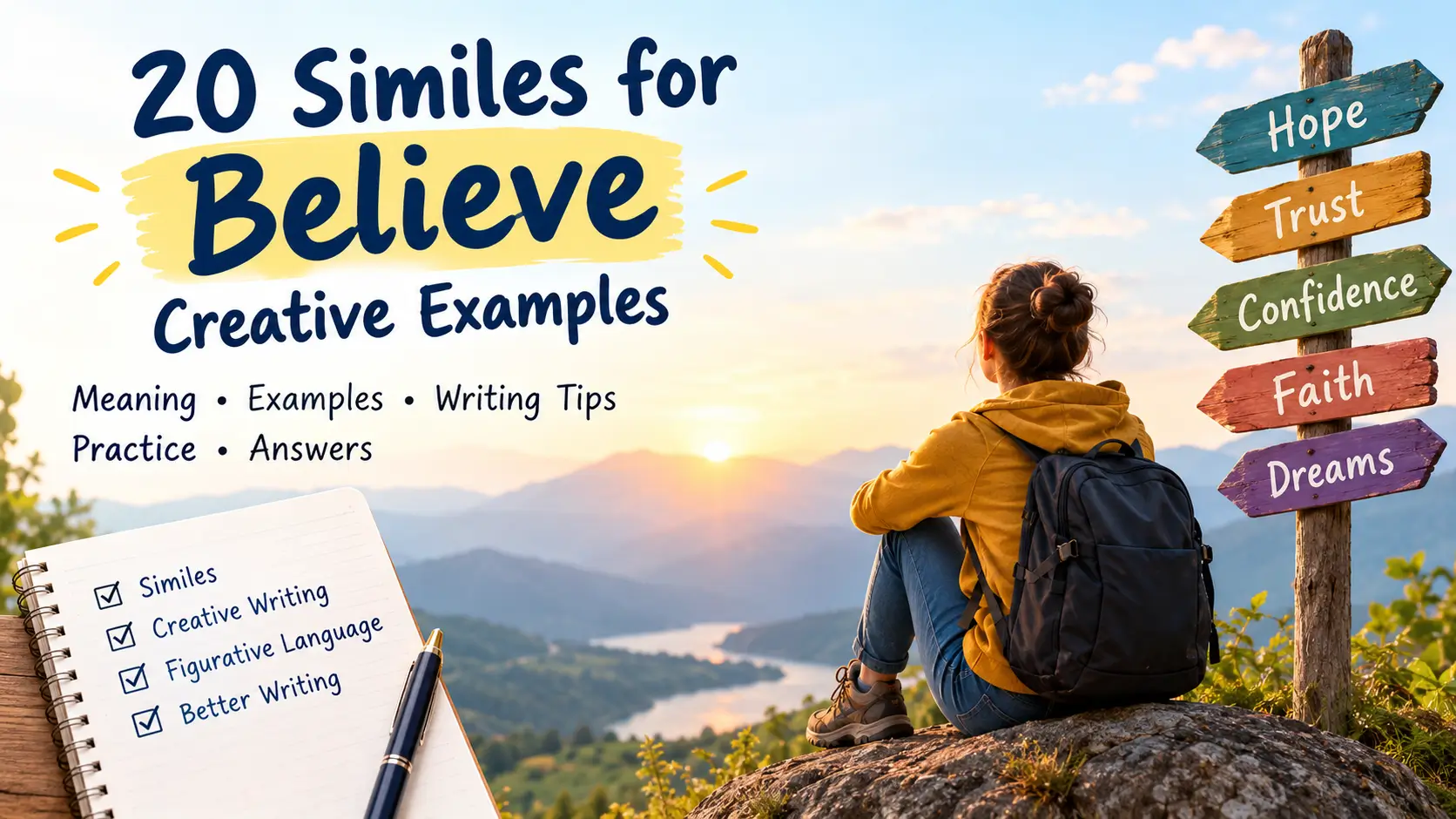
When you want to describe what it means to believe, a simple statement can sometimes feel too plain. Similes can make the idea clearer by comparing belief to something familiar, such as a strong bridge, a bright light, or a steady anchor. These comparisons help readers picture an invisible feeling or idea in a more vivid way. Whether you are writing a story, poem, school assignment, speech, or personal reflection, using similes for believe can make your words more expressive.
Belief can mean trusting someone, accepting that something is true, having faith in an idea, or trusting yourself. The right comparison depends on the kind of belief you want to show. In this article, you will find 20 natural and creative examples, along with simple meanings and simile sentences. You will also learn how to create your own similes, understand the difference between a simile and a metaphor, and practice identifying figurative language. Let’s explore how a small comparison can give the idea of belief a much stronger voice.
20 Similes for Believe
1. Believe Like a Rock-Solid Foundation
Meaning: To believe something like a rock-solid foundation means to trust it strongly and steadily.
What it conveys: This simile creates an image of belief that is firm and difficult to shake.
Example sentences:
- She believed in her team like a rock-solid foundation beneath a house.
- His belief in his dream was like a rock-solid foundation.
2. Believe Like a Child Believes in Magic
Meaning: This means believing with complete wonder, trust, and openness.
What it conveys: It suggests innocent and wholehearted belief without constant doubt.
Example sentences:
- He believed in the impossible like a child believes in magic.
- She trusted the old story like a child believes in magic.
3. Believe Like a Lighthouse in the Dark
Meaning: This describes belief that provides guidance during difficult times.
What it conveys: The comparison creates an image of hope and direction when things feel uncertain.
Example sentences:
- Her belief in a better future shone like a lighthouse in the dark.
- His faith in his goal was like a lighthouse in the dark.
4. Believe Like an Anchor Holds a Ship
Meaning: To believe like an anchor holds a ship means having a belief that keeps you steady.
What it conveys: It shows stability, strength, and confidence during uncertain moments.
Example sentences:
- She believed in herself like an anchor holds a ship.
- His confidence in the plan kept him steady like an anchor holds a ship.
5. Believe Like Sunlight Through Clouds
Meaning: This means having belief that brings hope even when life feels difficult.
What it conveys: It creates a warm image of hope appearing after a period of darkness.
Example sentences:
- Her belief in tomorrow was like sunlight through clouds.
- Hope entered his heart like sunlight through clouds.
6. Believe Like a Bridge Between Two Shores
Meaning: This describes belief as something that helps connect people, ideas, or possibilities.
What it conveys: The simile suggests trust can help someone move from doubt toward confidence.
Example sentences:
- Their shared belief was like a bridge between two shores.
- Trusting each other became like a bridge between two shores.
7. Believe Like a Seed Believes in Spring
Meaning: This means trusting that growth or better days will eventually come.
What it conveys: It creates an image of patience, hope, and quiet confidence.
Example sentences:
- She believed in her future like a seed believes in spring.
- He kept working toward his dream like a seed believes in spring.
8. Believe Like a Compass Points North
Meaning: To believe like a compass points north means having a strong inner sense of direction.
What it conveys: This simile shows belief as something that guides decisions.
Example sentences:
- He believed in his purpose like a compass points north.
- Her values guided her like a compass points north.
9. Believe Like a Mountain Stands Firm
Meaning: This means holding a belief strongly and refusing to be easily moved by doubt.
What it conveys: The image suggests strength, stability, and determination.
Example sentences:
- She believed in her cause like a mountain stands firm.
- His trust in his friend stood like a mountain in the storm.
10. Believe Like a Heart Trusts a Familiar Song
Meaning: This describes a natural and comforting kind of belief.
What it conveys: It suggests that some beliefs feel familiar, warm, and deeply personal.
Example sentences:
- She believed his words like a heart trusts a familiar song.
- He accepted the message like a heart trusts a familiar song.
11. Believe Like Rain Falls from the Sky
Meaning: This means believing naturally and without hesitation.
What it conveys: The comparison gives belief a sense of certainty and natural movement.
Example sentences:
- She believed in her friend like rain falls from the sky.
- His trust came as naturally as rain falls from the sky.
12. Believe Like a Candle Holds Its Flame
Meaning: This means keeping faith even when circumstances become difficult.
What it conveys: The image suggests a small but persistent source of hope.
Example sentences:
- He believed in his dream like a candle holds its flame.
- Her hope stayed alive like a candle holds its flame.
13. Believe Like a Runner Trusts the Road
Meaning: This means trusting the process while continuing forward.
What it conveys: It suggests courage, movement, and confidence despite uncertainty.
Example sentences:
- She believed in the journey like a runner trusts the road.
- He kept moving forward like a runner trusts the road beneath his feet.
14. Believe Like a Bird Trusts Its Wings
Meaning: This means trusting your own abilities enough to take a chance.
What it conveys: It creates an image of confidence, freedom, and self-belief.
Example sentences:
- She believed in herself like a bird trusts its wings.
- He faced the challenge like a bird trusts its wings.
15. Believe Like a Door Opens to Possibility
Meaning: This means belief can make someone more willing to see new opportunities.
What it conveys: The simile presents belief as an opening toward something new.
Example sentences:
- Her belief was like a door opening to possibility.
- Trusting himself felt like a door opening to possibility.
16. Believe Like a Fire Keeps Burning
Meaning: This means maintaining strong belief even when challenges appear.
What it conveys: It suggests energy, persistence, and determination.
Example sentences:
- His belief in his goal burned like a fire that would not go out.
- She held onto hope like a fire keeps burning through the night.
17. Believe Like a Friend Trusts a Promise
Meaning: This describes accepting someone’s words with confidence and trust.
What it conveys: The simile creates a personal image of loyalty and confidence.
Example sentences:
- She believed his promise like a friend trusts a promise.
- He accepted her words with the trust of a friend believing a promise.
18. Believe Like Stars Shine Beyond the Clouds
Meaning: This means continuing to believe even when the evidence or outcome is not immediately visible.
What it conveys: It creates an image of hope that remains present even when hidden.
Example sentences:
- He believed in better days like stars shine beyond the clouds.
- Her hope remained like stars shining beyond the clouds.
19. Believe Like a Sailor Trusts the Wind
Meaning: This means trusting something that helps you move toward a goal.
What it conveys: The comparison suggests faith, movement, and willingness to continue.
Example sentences:
- She believed in the journey like a sailor trusts the wind.
- He trusted his instincts like a sailor trusts the wind.
20. Believe Like Roots Hold a Tree
Meaning: This means having a deep and lasting belief that keeps you grounded.
What it conveys: The simile suggests that belief can provide stability and strength.
Example sentences:
- His belief in his family was like roots holding a tree.
- She held onto her values like roots hold a tree firmly in the earth.
How to Use Similes in Writing
Creating your own similes is easier when you follow a few simple steps.
Choose What You Want to Describe
First, decide what kind of belief you want to show.
For example:
- Believing in yourself
- Trusting a friend
- Having faith in a dream
- Believing something is true
- Holding onto hope
Find a Familiar Comparison
Think about something readers already understand.
For example, strong belief could be compared with:
- A mountain
- An anchor
- Deep roots
- A lighthouse
- A burning flame
Then connect the ideas.
Example:
“Her belief in herself was like deep roots holding a tree.”
Use “Like” or “As”
Similes often use words such as like and as to make the comparison clear.
For example:
- His belief was like an anchor.
- She was as trusting as a child with a favorite story.
Make the Comparison Clear
A good simile should help readers understand the feeling or idea. Avoid comparisons that are so unusual that the reader cannot see the connection.
Instead of:
“He believed like a purple clock.”
Try:
“He believed in his dream like a mountain stands firm.”
Match the Tone
Your comparison should fit your writing.
A serious story might use:
“Her belief was like an anchor in a storm.”
A playful story might use:
“He believed in the silly plan like a child believes in magic.”
Add Sensory Details
Sensory details can make creative writing similes stronger.
Instead of:
“She believed in him like a light.”
Try:
“She believed in him like a warm lamp glowing in a cold room.”
The second version gives the reader something to see and feel.
What Is a Simile?
A simile is a figure of speech that compares two different things using words such as like or as. Writers use similes to make ideas easier to picture and more interesting to read.
For example:
“His belief was like a strong bridge.”
The sentence does not mean his belief is literally a bridge. It compares belief with a bridge because both can provide support and connection.
Another example is:
“She trusted him like a child trusts a parent.”
This comparison helps readers understand how strong the trust is.
Similes are useful in stories, poems, essays, speeches, and descriptive writing because they turn abstract ideas into clear images.
The phrase “strohl simile” is not a standard literary term. If you came across that phrase while searching for simile examples, it may be a typo, a name, or wording intended to refer to another type of simile. The important point is to focus on the actual comparison and how it works.
Simile vs. Metaphor
Both similes and metaphors make comparisons, but they do it in different ways.
Simile: “The room smelled like rotten eggs.”
Metaphor: “The room was a rotten-egg factory.”
The simile uses like to make the comparison directly. The metaphor states the comparison more directly, without using like or as.
Here is another simple example:
- Simile: “Her belief was like a lighthouse.”
- Metaphor: “Her belief was a lighthouse.”
Both create a vivid picture, but the simile clearly signals that one thing is being compared with another.
Practical Exercise: 10 Questions
- Fill in the blank:
“She believed in herself like a bird trusts its ______.” - Identify the simile:
Which sentence contains a simile?
A. He trusted his friend.
B. Her belief was like an anchor.
C. She believed the story. - Multiple choice:
Which comparison best shows strong, steady belief?
A. Like a mountain standing firm
B. Like a falling leaf
C. Like a popping balloon - Fill in the blank:
“His hope was like sunlight through ______.” - Identify the comparison:
What two things are being compared in this sentence?
“Her belief was like a lighthouse in the dark.” - Multiple choice:
Which sentence is a simile?
A. His confidence was a mountain.
B. His confidence stood tall.
C. His confidence was like a mountain. - Create your own simile:
Complete this sentence with a creative comparison:
“I believe in my dreams like __________.” - Compare two sentences:
Which sentence gives a clearer picture? Explain why.
A. “She believed in him.”
B. “She believed in him like a friend trusts a promise.” - Create your own simile:
Write a simile showing that someone strongly believes in a friend. - Identify the figurative language:
Is this sentence a simile or a metaphor?
“His belief was a steady anchor during hard times.”
Answers and Explanations
- Answer: Wings.
Explanation: “Like a bird trusts its wings” shows confidence in one’s own ability. - Answer: B. Her belief was like an anchor.
Explanation: The word like connects belief with an anchor, making it a simile. - Answer: A. Like a mountain standing firm.
Explanation: A mountain suggests strength and stability, so it works well for strong belief. - Answer: Clouds.
Explanation: “Sunlight through clouds” suggests hope appearing during difficult times. - Answer: Belief and a lighthouse.
Explanation: The belief is compared with a lighthouse because both can provide guidance and hope. - Answer: C. His confidence was like a mountain.
Explanation: The word like clearly signals a comparison, making the sentence a simile. - Answer: Many answers are possible.
Explanation: A good answer should compare belief in dreams with something that suggests confidence, hope, or persistence. - Answer: B.
Explanation: Sentence B uses a simile to show how strong and dependable the belief is. - Answer: Answers will vary. For example: “She trusted her friend like a tree trusts its roots.”
Explanation: The comparison shows deep and dependable trust. - Answer: Metaphor.
Explanation: The sentence directly says belief was an anchor. It does not use “like” or “as,” so it is a metaphor.
Conclusion
Similes help turn simple ideas into vivid pictures. When you use similes for believe, you can show trust, hope, confidence, faith, and determination in ways that readers can easily understand. A belief can be compared with an anchor, lighthouse, mountain, flame, bridge, or even a bird trusting its wings. The best comparison depends on the feeling you want your reader to experience.
Remember that a strong simile does more than sound creative. It should make the meaning clearer. Start with the idea you want to describe, choose something familiar, and connect the two with “like” or “as.” With practice, you can create natural creative writing similes that make your stories, poems, and essays more memorable. Keep experimenting, and let your comparisons bring your writing to life.

I am Silas Michael, an enthusiastic writer passionate about similes, metaphors, and idioms. I enjoy explaining creative expressions through simple meanings and examples that help readers understand and improve their English.