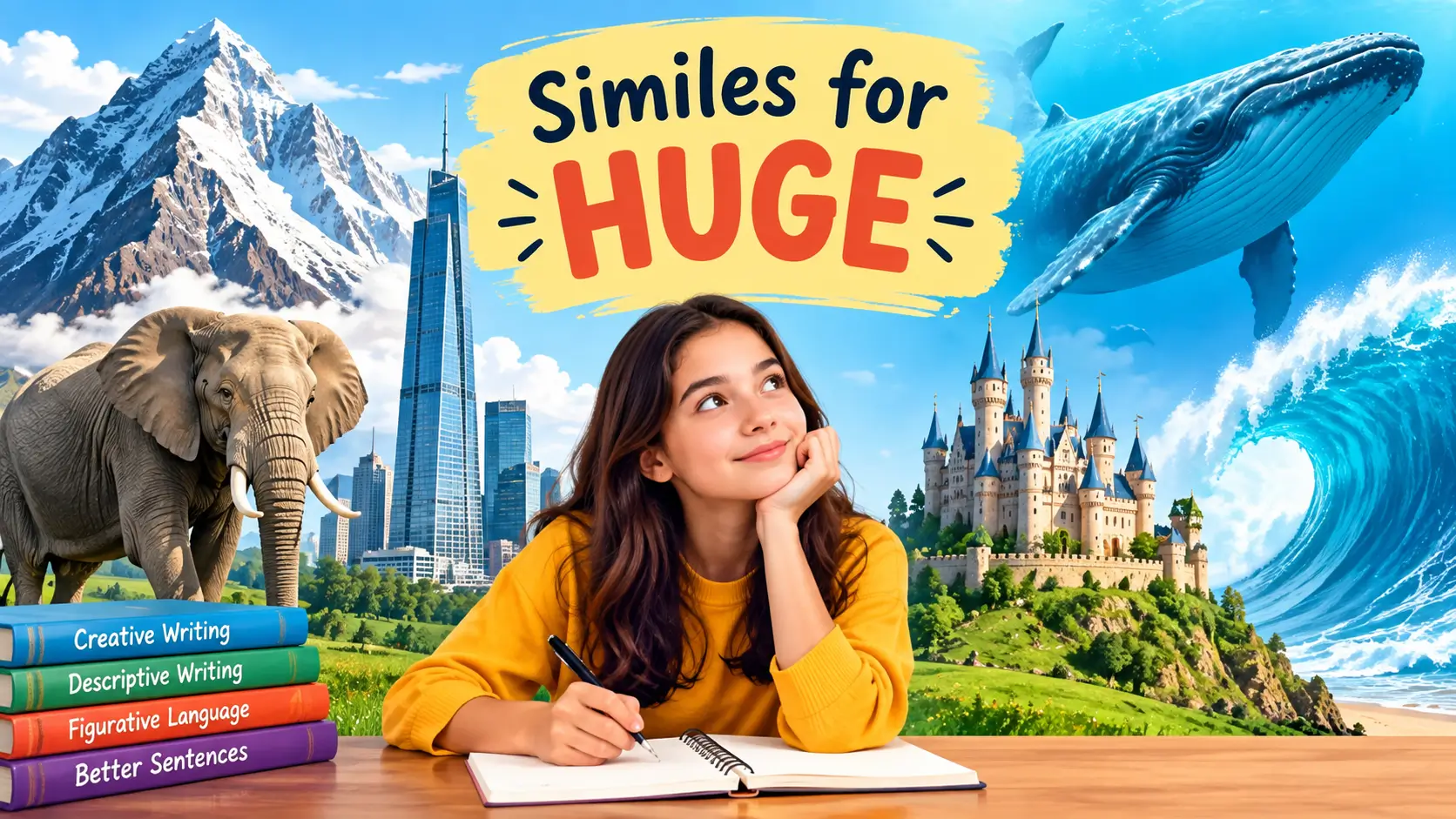
When you want to describe something as huge, simply saying “very big” can feel a little flat. A good simile gives your reader something familiar to picture. Instead of saying, “The building was huge,” you might say, “The building was as huge as a mountain.” Suddenly, the size feels much more real.
Similes are comparisons that often use words such as like or as. They are useful in stories, poems, essays, descriptive writing, and everyday conversation. The right comparison can make a giant object feel powerful, impressive, funny, mysterious, or even frightening.
In this article, you’ll find 20 similes for huge, each with a simple meaning, an explanation, and two natural example sentences. You’ll also learn how to create your own comparisons, understand the difference between a simile and a metaphor, and practice with ten questions.
Whether you are a student, beginner writer, or simply looking for creative writing examples, these similes can help you make your descriptions bigger, brighter, and more memorable.
20 Similes for Huge
1. As huge as a mountain
Meaning: Something is extremely large, like a mountain.
What it conveys: This comparison creates a strong image of enormous size and great height.
Example sentences:
- The new stadium looked as huge as a mountain from the highway.
- A pile of snow stood as huge as a mountain beside the road.
2. As huge as an elephant
Meaning: Something is extremely large and bulky.
What it conveys: It gives the reader an easy picture of something massive and heavy.
Example sentences:
- The old machine was as huge as an elephant.
- A strange shadow appeared on the wall, looking as huge as an elephant.
3. Like a giant ocean
Meaning: Something appears extremely large and seems to stretch endlessly.
What it conveys: This simile suggests vastness, openness, and a size that is difficult to measure.
Example sentences:
- The crowd spread across the field like a giant ocean.
- The desert looked like a giant ocean of golden sand.
4. As huge as a skyscraper
Meaning: Something is incredibly tall and large.
What it conveys: This comparison emphasizes height as well as impressive size.
Example sentences:
- The new tower was as huge as a skyscraper.
- A wall of ice rose as huge as a skyscraper in front of us.
5. Like a giant whale
Meaning: Something is extremely large and bulky.
What it conveys: The comparison creates an image of a massive object with an impressive presence.
Example sentences:
- The enormous submarine floated in the harbor like a giant whale.
- The old bus looked like a giant whale parked beside the tiny cars.
6. As huge as a castle
Meaning: Something is very large, spacious, and imposing.
What it conveys: This simile can suggest grandeur and a size that feels almost unreal.
Example sentences:
- Their new house was as huge as a castle.
- The hotel stood on the hill, as huge as a castle.
7. Like a mountain of gold
Meaning: There is an enormous amount of something valuable or precious.
What it conveys: It combines the idea of huge size with richness and abundance.
Example sentences:
- The treasure looked like a mountain of gold.
- The market was filled with jewelry piled up like a mountain of gold.
8. As huge as the sky
Meaning: Something seems extremely vast or almost limitless.
What it conveys: This comparison focuses on enormous width or space rather than physical weight.
Example sentences:
- The stadium screen looked as huge as the sky.
- Her dream seemed as huge as the sky.
9. Like a giant boulder
Meaning: Something is very large, solid, and heavy.
What it conveys: This simile makes the object seem difficult to move or lift.
Example sentences:
- The fallen rock sat in the middle of the road like a giant boulder.
- His backpack felt like a giant boulder after the long hike.
10. As huge as a dinosaur
Meaning: Something is exceptionally large.
What it conveys: The comparison adds a playful image of prehistoric size and strength.
Example sentences:
- The new construction vehicle was as huge as a dinosaur.
- That old crane looked as huge as a dinosaur against the small houses.
11. Like a giant mountain of clouds
Meaning: Something appears enormous, soft, and spread out.
What it conveys: This creates a dramatic image of something towering and expansive.
Example sentences:
- The storm clouds gathered like a giant mountain of clouds.
- The smoke rose into the sky like a giant mountain of clouds.
12. As huge as a whale shark
Meaning: Something is extraordinarily large.
What it conveys: This comparison highlights impressive size while keeping the image vivid and natural.
Example sentences:
- The creature in the aquarium looked as huge as a whale shark.
- The enormous fish seemed as huge as a whale shark beside the divers.
13. Like a giant wall
Meaning: Something is so large that it blocks or dominates the view.
What it conveys: It emphasizes height, width, and the feeling of something standing directly in front of you.
Example sentences:
- The wave rose like a giant wall before the boat.
- A huge cloud appeared like a giant wall across the horizon.
14. As huge as a football field
Meaning: Something covers an enormous amount of space.
What it conveys: This gives readers a familiar measurement they can easily imagine.
Example sentences:
- The warehouse was as huge as a football field.
- The parking lot was as huge as a football field.
15. Like a giant balloon
Meaning: Something is extremely large and rounded.
What it conveys: This simile works especially well for objects that are swollen, inflated, or circular.
Example sentences:
- The full moon looked like a giant balloon in the night sky.
- The enormous decoration floated above the crowd like a giant balloon.
16. As huge as a giant tree
Meaning: Something is extremely large and often tall.
What it conveys: It suggests strength, height, and a powerful natural presence.
Example sentences:
- The ancient statue was as huge as a giant tree.
- The old oak looked as huge as a giant tree beside the smaller plants.
17. Like an endless desert
Meaning: Something seems incredibly large and seems to continue without end.
What it conveys: This comparison emphasizes vastness rather than simply physical height.
Example sentences:
- The empty parking lot stretched before us like an endless desert.
- The classroom looked like an endless desert after everyone had left.
18. As huge as a cruise ship
Meaning: Something is remarkably large and imposing.
What it conveys: The comparison gives a strong sense of width, length, and massive physical presence.
Example sentences:
- The new building was as huge as a cruise ship.
- The enormous vehicle looked as huge as a cruise ship on the narrow road.
19. Like a giant monster
Meaning: Something looks extremely large, powerful, or intimidating.
What it conveys: This is useful when you want huge size to create excitement, fear, or drama.
Example sentences:
- The construction machine moved like a giant monster through the empty lot.
- The storm rolled toward the town like a giant monster.
20. As huge as the whole world
Meaning: Something feels unbelievably large or limitless.
What it conveys: This is an exaggerated, imaginative comparison that emphasizes an almost impossible amount of size.
Example sentences:
- To the little child, the playground looked as huge as the whole world.
- His excitement felt as huge as the whole world when he won the prize.
How to Use Similes in Writing
Creating your own similes is easier than it may seem. Start with the thing you want to describe, then ask yourself what familiar object has a similar quality.
For example:
- A huge crowd → “The crowd was like an endless ocean.”
- A huge house → “The house was as huge as a castle.”
- A huge wave → “The wave rose like a giant wall.”
- A huge dog → “The dog was as huge as a small horse.”
- A huge problem → “The problem grew like a mountain.”
Here is a simple process beginners can follow:
- Choose what you are describing.
Decide whether it is an object, person, place, feeling, or idea. - Identify the quality you want to emphasize.
Is it huge because it is tall, wide, heavy, powerful, or endless? - Find a familiar comparison.
Think about mountains, oceans, buildings, animals, storms, or other things people can easily picture. - Use “like” or “as.”
For example, “The truck was like a giant beast” or “The truck was as huge as a house.” - Make the image clear.
Your reader should quickly understand why the comparison works. - Match the tone.
A mountain may sound serious, while a dinosaur can make the description playful. - Add sensory details.
Instead of writing, “The building was huge,” try, “The huge building towered above us like a mountain, blocking the afternoon sun.”
Try to avoid using the same common comparison again and again. Fresh comparisons can make descriptive writing more interesting.
What Is a Simile?
A simile is a figure of speech that compares two different things to make a description clearer or more vivid.
Similes commonly use signal words such as:
- like
- as
- as … as
For example:
- “The building was like a mountain.”
- “The elephant was as huge as a truck.”
- “The crowd moved like an ocean.”
The objects being compared are not literally the same. The comparison simply helps the reader imagine a particular quality.
For example, if you write, “The castle was as huge as a mountain,” you do not mean the castle is actually a mountain. You mean its enormous size reminds you of a mountain.
What does “strohl simile” mean?
“Strohl simile” is not a standard literary term. If you have seen this phrase in a search query or informal writing resource, it may be a typo, a mistaken phrase, or a reference to something specific. In standard literary terminology, the correct term is simply simile.
Simile vs. Metaphor
A simile and a metaphor both make comparisons, but they do it differently.
Simile: uses words such as “like” or “as.”
The room smelled like rotten eggs.
Metaphor: directly says that one thing is another.
The room was a rotten-egg factory.
Here is another simple example:
- Simile: “The mountain was like a giant wall.”
- Metaphor: “The mountain was a giant wall.”
The simile makes the comparison openly. The metaphor makes it directly.
For beginners, a useful trick is to look for like or as. If the comparison uses one of these words, it is often a simile.
Practical Exercise: 10 Questions
- Fill in the blank:
“The enormous building was as huge as a ______.”
Choose a comparison that clearly suggests great size. - Identify the simile:
Which sentence contains a simile?
A. The stadium was enormous.
B. The stadium was like a mountain.
C. The stadium had many seats. - Fill in the blank:
“The crowd stretched across the field like ______.” - Multiple choice:
Which comparison best describes something that is both huge and intimidating?
A. like a tiny seed
B. like a giant monster
C. like a small feather
D. like a grain of rice - Identify the simile:
Is this a simile?
“The truck was as huge as a dinosaur.”
Answer yes or no. - Create your own simile:
Write a simile describing a huge house. - Compare the sentences:
Which sentence creates a stronger picture?
A. “The wave was huge.”
B. “The wave rose like a giant wall.” - Fill in the blank:
“The desert seemed as huge as ______.” - Create your own simile:
Describe a huge crowd using “like.” - Simile or metaphor?
Identify the figure of speech:
“The enormous ship was a floating mountain.”
Answers and Explanations
- Possible answer: “a mountain.”
“As huge as a mountain” works because mountains are familiar examples of enormous size. Other sensible comparisons can also be correct. - B. The stadium was like a mountain.
The word “like” connects the stadium to a mountain, making it a simile. - Possible answer: “an endless ocean.”
This comparison suggests that the crowd was extremely large and seemed to stretch a long way. - B. like a giant monster.
A giant monster suggests both enormous size and an intimidating presence. - Yes.
The phrase “as huge as” creates a direct comparison between the truck and a dinosaur. - Possible answer: “The house was as huge as a castle.”
A castle is a familiar image of a large, impressive building. Other creative answers are also acceptable. - B. “The wave rose like a giant wall.”
The second sentence gives the reader a clearer visual image. It shows not only size but also height and power. - Possible answer: “an endless ocean.”
This comparison emphasizes how wide and seemingly limitless the desert feels. - Possible answer: “The crowd moved like an endless ocean.”
The comparison helps the reader imagine a massive crowd spreading across a large area. - Metaphor.
The sentence directly calls the ship “a floating mountain.” It does not use “like” or “as,” so it is a metaphor rather than a simile.
Conclusion
Similes can turn a simple description into a picture your reader can almost see. Instead of saying something is merely “huge,” you can compare it to a mountain, castle, whale, skyscraper, ocean, or another familiar image. These comparisons give your writing more detail, emotion, and personality.
The 20 similes for huge in this guide can help you describe size in many different ways. Some create a serious feeling, while others are playful or dramatic. The key is to choose a comparison that fits your subject and your writing style.
As you practice, try creating your own simile sentences. Think about what makes something huge, then find a familiar image that captures that quality. With a little practice, your descriptive writing will become clearer, more vivid, and much more memorable.

I am Beau Thomas, the Administrator at SimilyHub. I enjoy making similes, metaphors, and idioms easy to understand through clear explanations, helpful examples, and engaging content for English learners and writers.