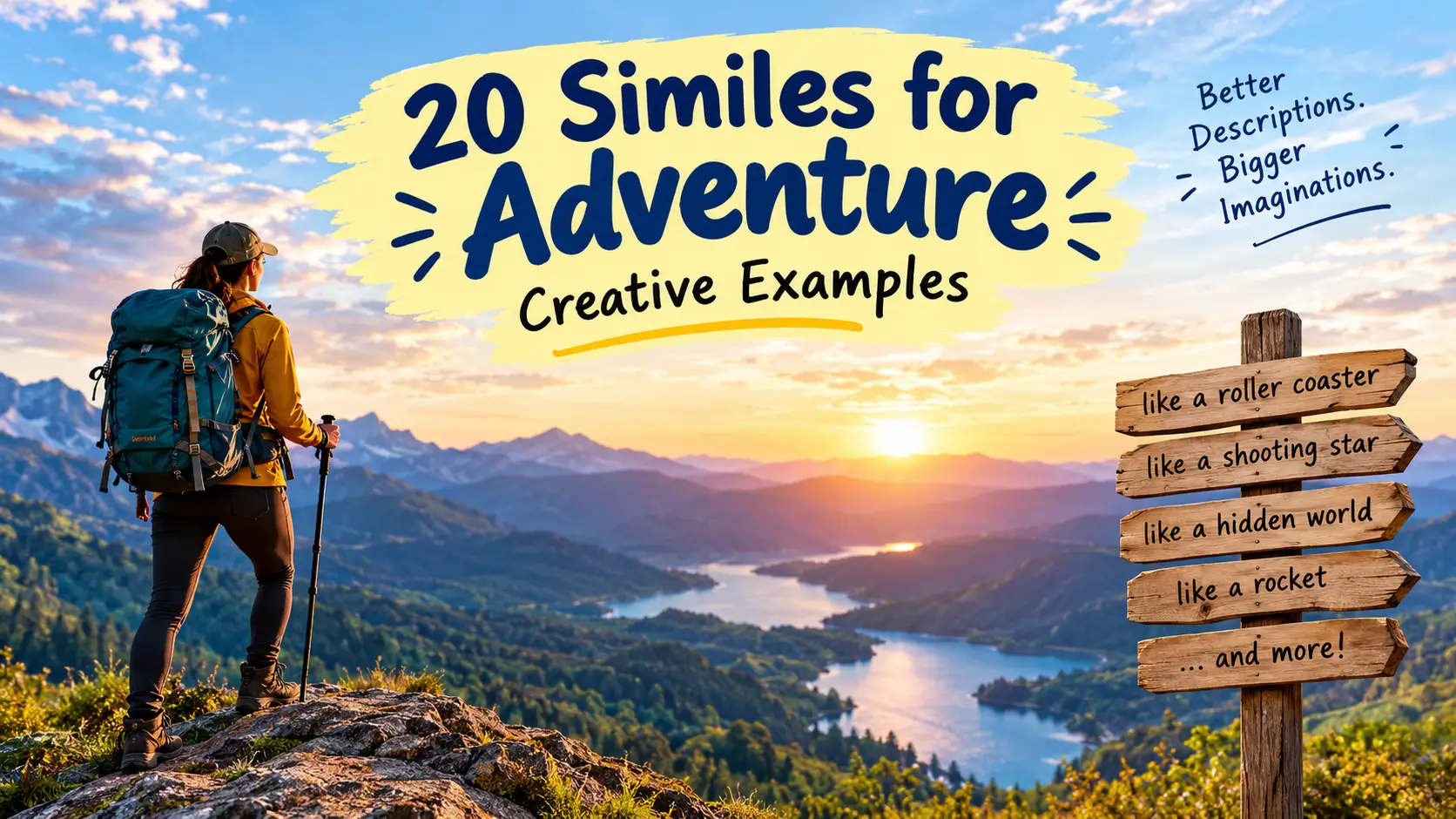
Adventure is all about excitement, discovery, and stepping into the unknown. Whether you are writing a story about a daring journey, a hiking trip, a treasure hunt, or an imaginary quest, similes can make your descriptions much more vivid. A simple comparison can help readers see, hear, and feel the adventure alongside your characters.
For example, saying “the journey was exciting” tells the reader how you feel, but “the journey was like riding a wild roller coaster” creates a stronger picture. That is the power of figurative language. Good similes turn ordinary descriptions into memorable creative writing examples.
In this guide, you will find 20 natural similes for adventure, along with their meanings and example sentences. You will also learn how to use similes in writing, understand the difference between similes and metaphors, and practice creating your own. Whether you are a beginner, student, teacher, or creative writer, these examples can give your descriptions a fresh spark.
20 Similes for Adventure
1. Like riding a wild roller coaster
Meaning: An adventure that is full of sudden excitement, surprises, and changes.
What it conveys: This simile creates a picture of an adventure that is thrilling but unpredictable.
Example sentences:
- Our mountain journey was like riding a wild roller coaster.
- Exploring the jungle felt like riding a wild roller coaster from start to finish.
2. Like stepping into a storybook
Meaning: An adventure that feels magical, unusual, or almost unreal.
What it conveys: It gives the reader a sense of wonder and imagination.
Example sentences:
- Walking through the ancient forest was like stepping into a storybook.
- The old castle made our adventure feel like stepping into a storybook.
3. Like sailing into the unknown
Meaning: Beginning a journey without knowing what will happen next.
What it conveys: This simile suggests mystery, courage, and discovery.
Example sentences:
- Starting our expedition was like sailing into the unknown.
- Leaving the familiar trail felt like sailing into the unknown.
4. Like a spark in the dark
Meaning: An adventure that suddenly brings excitement or energy.
What it conveys: The comparison suggests that adventure can brighten an ordinary moment.
Example sentences:
- The unexpected invitation was like a spark in the dark.
- Finding the hidden map felt like a spark in the dark.
5. Like chasing a shooting star
Meaning: Pursuing something exciting, rare, or difficult to reach.
What it conveys: It creates a dreamy image of hope, excitement, and bold ambition.
Example sentences:
- Searching for the lost treasure was like chasing a shooting star.
- His dream of exploring distant lands was like chasing a shooting star.
6. Like a firework bursting across the sky
Meaning: An adventure that is sudden, bright, energetic, and exciting.
What it conveys: This simile highlights a powerful burst of excitement.
Example sentences:
- The festival adventure was like a firework bursting across the sky.
- Our unexpected discovery felt like a firework bursting across the sky.
7. Like walking on the edge of a cloud
Meaning: An adventure that feels exciting, dreamy, and slightly unreal.
What it conveys: It gives the experience a light, magical quality.
Example sentences:
- Floating above the valley in a hot-air balloon felt like walking on the edge of a cloud.
- The beautiful mountain view made the whole trip feel like walking on the edge of a cloud.
8. Like opening a door to a new world
Meaning: An adventure that introduces someone to unfamiliar places or experiences.
What it conveys: This simile emphasizes discovery and new possibilities.
Example sentences:
- Exploring the old village was like opening a door to a new world.
- Learning to scuba dive felt like opening a door to a new world.
9. Like a compass pointing toward mystery
Meaning: A journey that leads toward something unknown and intriguing.
What it conveys: It suggests curiosity and the desire to discover what lies ahead.
Example sentences:
- The strange note was like a compass pointing toward mystery.
- Every clue felt like a compass pointing toward mystery.
10. Like a river rushing toward the sea
Meaning: An adventure that keeps moving forward with energy and purpose.
What it conveys: This creates an image of constant movement and momentum.
Example sentences:
- Our expedition moved forward like a river rushing toward the sea.
- Once the journey began, we traveled like a river rushing toward the sea.
11. Like a treasure map coming alive
Meaning: An adventure where clues and discoveries seem to become real.
What it conveys: This simile adds mystery and excitement to a journey.
Example sentences:
- Following the old clues was like watching a treasure map come alive.
- Each hidden mark made our adventure feel like a treasure map coming alive.
12. Like thunder before a storm
Meaning: An adventure that feels powerful and full of anticipation.
What it conveys: It suggests that something exciting or dramatic is about to happen.
Example sentences:
- The strange sounds in the cave were like thunder before a storm.
- The first clue felt like thunder before a storm.
13. Like a bird breaking free
Meaning: An adventure that brings a strong feeling of freedom.
What it conveys: This comparison focuses on independence, movement, and escape from routine.
Example sentences:
- Traveling alone made me feel like a bird breaking free.
- The long road trip felt like a bird breaking free from its cage.
14. Like climbing a staircase into the clouds
Meaning: An adventure that takes someone toward something difficult, beautiful, or unknown.
What it conveys: It creates an image of challenge mixed with wonder.
Example sentences:
- Climbing the enormous mountain was like climbing a staircase into the clouds.
- Every step toward the summit felt like climbing a staircase into the clouds.
15. Like a match lighting a campfire
Meaning: A small event that begins a larger and more exciting experience.
What it conveys: This simile shows how one small decision can start an adventure.
Example sentences:
- Finding the old key was like a match lighting a campfire.
- Her decision to join the expedition was like a match lighting a campfire.
16. Like racing the wind
Meaning: Moving quickly and freely while enjoying the excitement of the journey.
What it conveys: It creates a strong feeling of speed, freedom, and energy.
Example sentences:
- We rode our bicycles down the hill like racing the wind.
- The horses ran across the open field like they were racing the wind.
17. Like diving into a sea of surprises
Meaning: Entering an experience filled with unexpected events.
What it conveys: This simile emphasizes mystery, excitement, and unpredictability.
Example sentences:
- Our trip to the remote island was like diving into a sea of surprises.
- Every turn in the cave felt like diving into a sea of surprises.
18. Like a winding path through a mystery
Meaning: An adventure that unfolds slowly through clues and unexpected turns.
What it conveys: It gives the journey a mysterious and curious feeling.
Example sentences:
- The search for the missing artifact was like a winding path through a mystery.
- Our journey through the forest felt like a winding path through a mystery.
19. Like a rocket blasting into space
Meaning: An adventure that begins with enormous energy and excitement.
What it conveys: This comparison creates a strong image of speed, power, and enthusiasm.
Example sentences:
- The race began like a rocket blasting into space.
- Once we discovered the hidden passage, our adventure took off like a rocket blasting into space.
20. Like finding a secret world
Meaning: An adventure that reveals something hidden, beautiful, or unexpected.
What it conveys: This simile creates a sense of wonder and discovery.
Example sentences:
- Exploring the hidden valley was like finding a secret world.
- The underground cave looked like a secret world waiting to be discovered.
How to Use Similes in Writing
Creating your own similes becomes easier when you follow a few simple steps.
Choose what you want to describe
First, decide what you want your reader to picture. It could be a journey, a character, a place, or an emotion.
For example:
- The journey was exciting.
- The cave was dark.
- The explorer was nervous.
Find a familiar comparison
Think of something your reader already understands.
For example:
- The journey was like a roller coaster.
- The cave was as dark as midnight.
- The explorer was like a leaf shaking in the wind.
Use “like” or “as”
Most similes use signal words such as like and as.
Compare:
- The river was fast.
- The river moved like a racing horse.
The second sentence gives a clearer image.
Make the comparison clear
A good simile should help the reader understand something. Avoid a comparison that feels random.
Instead of:
The adventure was like a purple sandwich.
Try:
The adventure was like a stormy sea, full of sudden changes.
Avoid clichés when possible
Some comparisons are so common that they may not feel fresh. Try creating a comparison that fits your particular scene.
For example:
The forest was as quiet as a sleeping village.
This can feel more specific than simply saying:
The forest was very quiet.
Match the tone
A serious adventure needs different language from a funny adventure.
Serious:
The expedition was like walking into a storm.
Funny:
Packing for the expedition was like stuffing a whole house into one tiny backpack.
Add sensory details
Strong descriptive writing uses the senses.
Instead of:
The cave was scary.
Try:
The cave was like a cold mouth breathing against our faces.
The second example helps the reader imagine the cold air and eerie setting.
What Is a Simile?
A simile is a figure of speech that compares two different things using words such as like or as.
For example:
The explorer was as brave as a lion.
The explorer is not literally a lion. The comparison tells us that the explorer showed great courage.
Another example is:
The waves crashed like drums.
The waves are not drums, but their sound is being compared with the sound of drums.
Writers use similes because they make descriptions easier to picture. They can add emotion, humor, movement, sound, and color to creative writing.
In simple terms, a simile helps your reader see an idea instead of simply being told about it.
If you have seen the phrase “strohl simile,” it is worth noting that it is not a standard literary term. In most cases, someone using that phrase may simply be looking for information about similes or a particular comparison.
Simile vs. Metaphor
Both similes and metaphors compare things, but they do it in different ways.
Simile: Uses words such as like or as.
The room smelled like rotten eggs.
Metaphor: Says that one thing is another thing.
The room was a rotten-egg factory.
Here is another easy comparison:
- Simile: The runner was as fast as lightning.
- Metaphor: The runner was lightning.
For beginners, remember this simple rule: similes compare using “like” or “as,” while metaphors make a direct comparison.
Practical Exercise: 10 Questions
- Fill in the blank:
“The adventure was as exciting as ______.”
Create your own comparison. - Identify the simile:
Which sentence contains a simile?
A. The explorer entered the cave.
B. The explorer was nervous.
C. The explorer moved like a mouse through the cave. - Fill in the blank:
“The boat moved ______ a bird across the water.” - Multiple choice:
Which sentence is a simile?
A. The forest was a giant maze.
B. The forest was like a giant maze.
C. The forest became a maze. - Identify the comparison:
What two things are being compared in this sentence?
“Our journey was like a roller coaster.” - Create your own simile:
Complete this sentence with an original comparison:
“The hidden cave was as mysterious as ______.” - Compare two sentences:
Which sentence creates a stronger picture? Explain why.
A. The mountain was beautiful.
B. The mountain looked like a silver castle above the clouds. - Multiple choice:
Which word is commonly used to introduce a simile?
A. Because
B. Like
C. Although - Create your own simile:
Describe a fast-moving adventure using the pattern:
“The adventure moved like ______.” - Find the simile:
“We discovered a secret world beneath the old castle.”
Is this sentence a simile? If not, rewrite it as a simile.
Answers and Explanations
- Possible answer: “The adventure was as exciting as a rocket launch.”
Explanation: The comparison uses “as” to connect the adventure with something exciting. - Answer: C.
Explanation: “Moved like a mouse” compares the explorer’s movement with a mouse using the word “like.” - Answer: “like.”
Explanation: “The boat moved like a bird across the water” uses “like” to make a comparison. - Answer: B.
Explanation: “The forest was like a giant maze” is a simile because it uses “like.” - Answer: The journey is compared with a roller coaster.
Explanation: The comparison suggests that the journey had many exciting twists and surprises. - Possible answer: “The hidden cave was as mysterious as a locked treasure chest.”
Explanation: The sentence uses “as” to compare the cave with something mysterious. - Answer: B.
Explanation: The second sentence uses a simile and sensory imagery to give the reader a stronger mental picture. - Answer: B. Like.
Explanation: “Like” is one of the most common signal words used in similes. “As” is another. - Possible answer: “The adventure moved like a racing train.”
Explanation: The comparison creates a clear image of speed and constant movement. - Answer: No, the original sentence is not a simile.
Possible rewrite: “We discovered a secret world like a hidden jewel beneath the old castle.”
Explanation: The revised sentence makes a direct comparison using “like.”
Conclusion
Similes can turn a simple adventure into a scene that readers can almost see and feel. Instead of simply saying that a journey was exciting, you can compare it to a roller coaster, a shooting star, or a rocket blasting into space. These comparisons add color, movement, emotion, and personality to your writing.
The 20 similes for adventure in this guide can help you build stronger descriptions, but you do not have to copy them. Use them as inspiration and create comparisons that fit your own story. Think about what your character sees, hears, feels, and discovers. Then find something familiar that captures that experience.
With practice, writing creative simile sentences becomes easier. Start with one simple comparison, make it clear, and let your imagination take the journey from there.

I am Beau Thomas, the Administrator at SimilyHub. I enjoy making similes, metaphors, and idioms easy to understand through clear explanations, helpful examples, and engaging content for English learners and writers.