Have you ever made a silly mistake and thought, “Wow, that was not my brightest moment”? We all have! Sometimes, the best way to describe a foolish moment is with a funny simile.
A simile compares two different things using words such as “like” or “as.” For example, “He was as confused as a penguin in a desert.” The comparison makes the sentence more vivid, playful, and memorable.
When you use funny similes for stupidity, you can turn a simple idea into something readers can picture and enjoy. Instead of saying someone made a foolish choice, you might say, “He was thinking like a calculator with dead batteries.” The humor makes the writing more entertaining.
In simple terms, similes give your writing a creative twist. They can make stories, jokes, essays, conversations, and social posts more colorful.
You may have also seen the phrase “strohl simile.” It is not a standard literary term. If you meant “simile,” the meaning is simply a comparison using “like” or “as.”
Let’s explore some funny examples of similes and see how you can use them in your own writing.
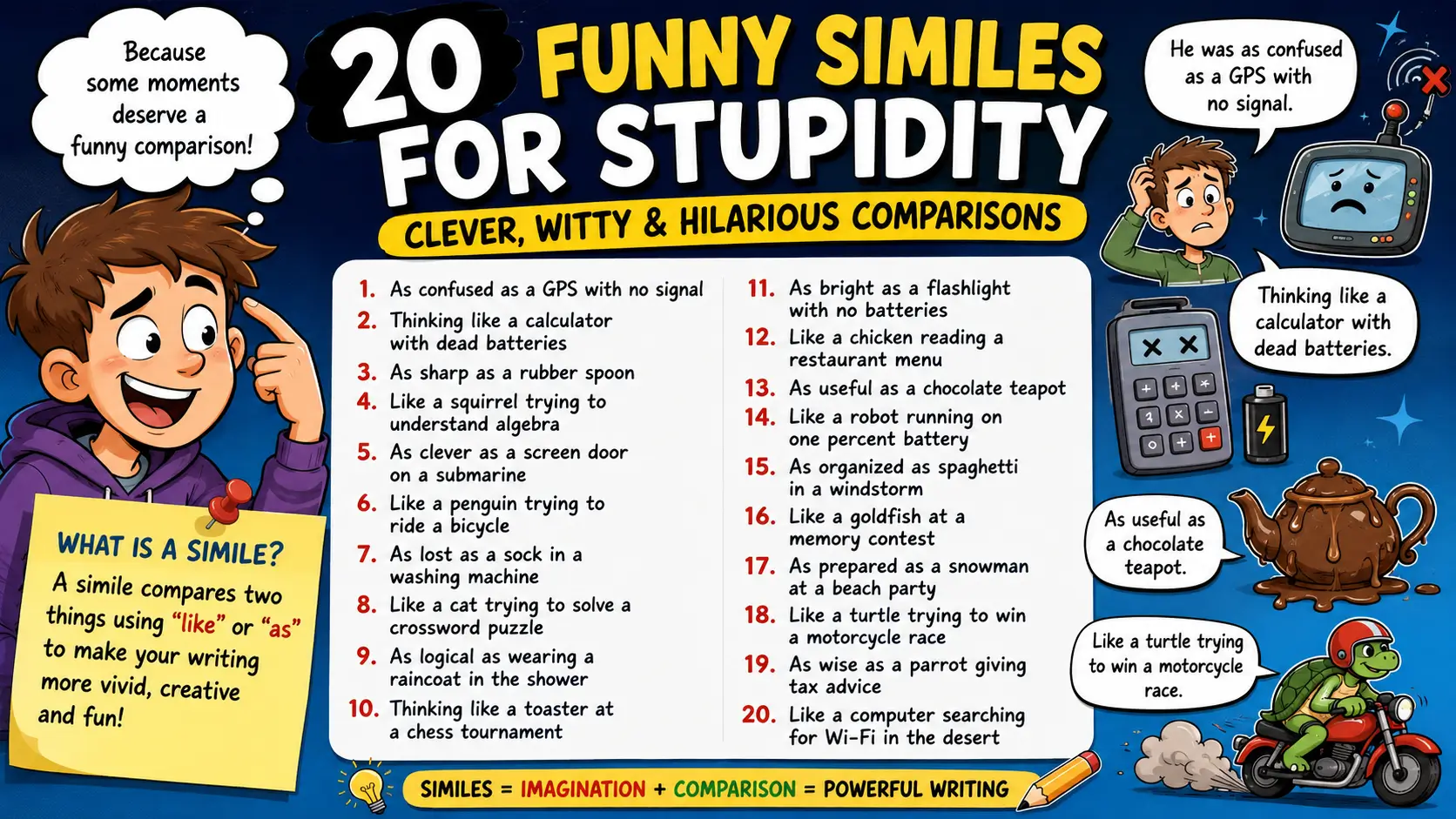
20 Funny Similes for Stupidity
Here are 20 playful examples of similes that describe foolish thinking or silly mistakes. They are meant for light humor rather than serious insults.
1. As confused as a GPS with no signal
Meaning: Someone has no idea what is happening or where to go.
What it conveys: This simile creates a funny picture of someone completely lost.
Example sentences:
- I was as confused as a GPS with no signal when the teacher changed the instructions.
- He looked as confused as a GPS with no signal after reading the complicated map.
2. Thinking like a calculator with dead batteries
Meaning: Someone is trying to think but getting nowhere.
What it conveys: It humorously suggests that the brain has stopped working.
Example sentences:
- After three hours of homework, I was thinking like a calculator with dead batteries.
- He was thinking like a calculator with dead batteries when asked to solve the problem.
3. As sharp as a rubber spoon
Meaning: Someone is not showing much cleverness.
What it conveys: The comparison is funny because a rubber spoon is not exactly a useful tool for sharpness.
Example sentences:
- I felt as sharp as a rubber spoon during that early-morning quiz.
- He was as sharp as a rubber spoon after staying awake all night.
4. Like a squirrel trying to understand algebra
Meaning: Someone is completely puzzled by something difficult.
What it conveys: It creates an amusing image of a creature facing a subject it cannot understand.
Example sentences:
- I looked like a squirrel trying to understand algebra during the math lecture.
- She was staring at the equation like a squirrel trying to understand algebra.
5. As clever as a screen door on a submarine
Meaning: Someone has made a very impractical decision.
What it conveys: The humor comes from imagining something completely unsuitable for its situation.
Example sentences:
- Bringing an umbrella to a swimming pool was as clever as a screen door on a submarine.
- His plan was as clever as a screen door on a submarine.
6. Like a penguin trying to ride a bicycle
Meaning: Someone is struggling with a task they clearly do not understand.
What it conveys: The unusual mental picture makes the sentence funny.
Example sentences:
- I was trying to fix the computer like a penguin trying to ride a bicycle.
- He assembled the furniture like a penguin trying to ride a bicycle.
7. As lost as a sock in a washing machine
Meaning: Someone is extremely confused.
What it conveys: It compares confusion with the chaotic journey of a sock inside a washing machine.
Example sentences:
- I was as lost as a sock in a washing machine during the meeting.
- Without the instructions, he was as lost as a sock in a washing machine.
8. Like a cat trying to solve a crossword puzzle
Meaning: Someone is attempting something without understanding it.
What it conveys: The impossible situation creates gentle humor.
Example sentences:
- I felt like a cat trying to solve a crossword puzzle during the exam.
- He approached the instructions like a cat trying to solve a crossword puzzle.
9. As logical as wearing a raincoat in the shower
Meaning: Something makes very little sense.
What it conveys: The simile points out an unnecessary or silly choice.
Example sentences:
- His idea was as logical as wearing a raincoat in the shower.
- Buying another umbrella was as logical as wearing a raincoat in the shower.
10. Thinking like a toaster at a chess tournament
Meaning: Someone is completely out of their depth.
What it conveys: The comparison suggests that the person has no useful idea about the situation.
Example sentences:
- I was thinking like a toaster at a chess tournament when they asked me about strategy.
- He looked like he was thinking like a toaster at a chess tournament.
11. As bright as a flashlight with no batteries
Meaning: Someone is not showing much understanding.
What it conveys: It uses a simple object to create a playful comparison.
Example sentences:
- I was as bright as a flashlight with no batteries before my first cup of coffee.
- He seemed as bright as a flashlight with no batteries during the quiz.
12. Like a chicken reading a restaurant menu
Meaning: Someone is completely confused about what to do.
What it conveys: The comparison creates an absurd and funny situation.
Example sentences:
- I stared at the computer screen like a chicken reading a restaurant menu.
- He looked like a chicken reading a restaurant menu when the software opened.
13. As useful as a chocolate teapot
Meaning: Someone or something is completely unsuitable for a task.
What it conveys: A chocolate teapot would melt when used, making the comparison humorous.
Example sentences:
- My plan was as useful as a chocolate teapot.
- His explanation was as useful as a chocolate teapot when we needed clear directions.
14. Like a robot running on one percent battery
Meaning: Someone is tired, slow, or struggling to think.
What it conveys: It gives a modern, relatable image of a brain that is barely functioning.
Example sentences:
- After studying all night, I was like a robot running on one percent battery.
- He answered questions like a robot running on one percent battery.
15. As organized as spaghetti in a windstorm
Meaning: Someone’s thoughts or plans are completely messy.
What it conveys: The strange image makes the lack of organization easy to imagine.
Example sentences:
- My thoughts were as organized as spaghetti in a windstorm.
- His study plan was as organized as spaghetti in a windstorm.
16. Like a goldfish at a memory contest
Meaning: Someone cannot remember important information.
What it conveys: The humor comes from the common image of goldfish having very short memories.
Example sentences:
- I felt like a goldfish at a memory contest during the history test.
- He was like a goldfish at a memory contest when we asked about yesterday’s meeting.
17. As prepared as a snowman at a beach party
Meaning: Someone is completely unprepared.
What it conveys: The comparison shows that the person is in the wrong situation without the right preparation.
Example sentences:
- I was as prepared as a snowman at a beach party for the surprise test.
- He arrived as prepared as a snowman at a beach party.
18. Like a turtle trying to win a motorcycle race
Meaning: Someone is badly suited to a task or challenge.
What it conveys: The comparison highlights an obvious mismatch.
Example sentences:
- I felt like a turtle trying to win a motorcycle race during the speed challenge.
- He approached the complicated project like a turtle trying to win a motorcycle race.
19. As wise as a parrot giving tax advice
Meaning: Someone is giving advice without knowing what they are talking about.
What it conveys: The absurd comparison makes the lack of knowledge humorous.
Example sentences:
- His financial advice was as wise as a parrot giving tax advice.
- I sounded as wise as a parrot giving tax advice when I tried to explain investing.
20. Like a computer searching for Wi-Fi in the desert
Meaning: Someone is desperately trying to find an answer but has no useful information.
What it conveys: It describes a frustrating lack of ideas in a funny way.
Example sentences:
- I was like a computer searching for Wi-Fi in the desert during the puzzle.
- He looked like a computer searching for Wi-Fi in the desert when the teacher asked the question.
How to Use Funny Similes in Your Writing
Funny similes work best when the comparison is clear, surprising, and easy to picture.
For example:
“He was confused.”
That sentence is clear, but it is plain.
Now try:
“He was as confused as a GPS with no signal.”
The second sentence gives the reader an image. That is the power of creative writing similes.
Here are three simple steps for creating your own:
Step 1: Choose the quality
Think about what you want to describe.
It could be:
- Confusion
- Foolishness
- Forgetfulness
- Laziness
- Poor planning
- Being unprepared
- Slow thinking
Step 2: Find something funny
Think of an object, animal, or situation that matches the quality.
For example:
Confused → GPS with no signal
Forgetful → goldfish at a memory contest
Unprepared → snowman at a beach party
Step 3: Connect them
Use like or as.
For example:
“I was as unprepared as a snowman at a beach party.”
That is a complete simile sentence.
Practical Exercise: 10 Questions
Ready to practice? Let’s see how well you can identify and create funny similes.
Questions
1. Which sentence contains a simile?
A. The boy was confused.
B. The boy was as confused as a GPS with no signal.
C. The boy looked confused.
2. Complete the simile:
“She was as lost as a ______.”
A. sock in a washing machine
B. happy birthday
C. blue notebook
3. What does “thinking like a calculator with dead batteries” suggest?
A. Someone is thinking very quickly.
B. Someone is struggling to think.
C. Someone is using a calculator.
4. Identify the simile:
A. My plan was useless.
B. My plan was as useful as a chocolate teapot.
C. My plan failed.
5. Complete the sentence:
“I was like a goldfish ______.”
A. at a memory contest
B. eating a sandwich
C. beside a pencil
6. Which word commonly helps create a simile?
A. Like
B. Because
C. But
7. What does “as prepared as a snowman at a beach party” mean?
A. Very prepared
B. Completely unprepared
C. Very cold
8. Create your own simile for someone who is very confused.
Use this pattern:
“They were as confused as ______.”
9. Which comparison is the funniest simile?
A. He was confused.
B. He was confused like a person.
C. He was like a toaster at a chess tournament.
10. Turn this plain sentence into a funny simile:
“She forgot everything.”
Answers and Explanations
1. B — “The boy was as confused as a GPS with no signal.”
It compares the boy’s confusion with a GPS that cannot find a signal.
2. A — “sock in a washing machine.”
The complete sentence is: “She was as lost as a sock in a washing machine.”
3. B — Someone is struggling to think.
A calculator with dead batteries cannot work, so the comparison suggests that someone’s thinking is not working well.
4. B — “My plan was as useful as a chocolate teapot.”
This is a simile because it compares the plan to a chocolate teapot using as.
5. A — “at a memory contest.”
The full simile is: “I was like a goldfish at a memory contest.”
6. A — Like.
“Like” and “as” are two common words used to form similes.
7. B — Completely unprepared.
A snowman would not be ready for a hot beach party, making this a funny comparison for poor preparation.
8. Example answer:
“They were as confused as a squirrel trying to understand algebra.”
Your answer can be different as long as it makes a clear comparison.
9. C — “He was like a toaster at a chess tournament.”
It creates a surprising and humorous picture.
10. Example answer:
“She forgot everything like a goldfish at a memory contest.”
Again, your own creative comparison can work too.
Why Similes Make Writing Better
The meaning of similes goes beyond simply comparing two things. A strong simile helps readers see, feel, or imagine an idea.
Compare these two sentences:
“Tom was very confused.”
and:
“Tom was as confused as a GPS with no signal.”
The second sentence is more colorful. You can picture Tom standing there with absolutely no idea what to do.
This is why writers use similes in stories, poems, speeches, jokes, and everyday conversations.
Funny similes are especially useful when you want to add personality without making your writing complicated.
You might say:
“My brain was like a computer searching for Wi-Fi in the desert.”
Instead of simply saying:
“I couldn’t think.”
The simile adds humor and personality to the sentence.
Conclusion
Funny similes are a simple way to make ordinary writing more creative and memorable. By comparing a person’s confusion, poor planning, forgetfulness, or silly mistake to something unexpected, you can make readers smile while clearly expressing your idea.
The best similes are easy to understand, vivid, and surprising. You do not need complicated vocabulary to create them. Start with a simple quality, choose a funny image, and connect the two with like or as.
For example, instead of saying, “I was confused,” you could say, “I was as confused as a GPS with no signal.”
Now it is your turn. Try creating your own funny simile today. The more you practice, the easier how to use similes in writing will become.

I am Beau Thomas, the Administrator at SimilyHub. I enjoy making similes, metaphors, and idioms easy to understand through clear explanations, helpful examples, and engaging content for English learners and writers.