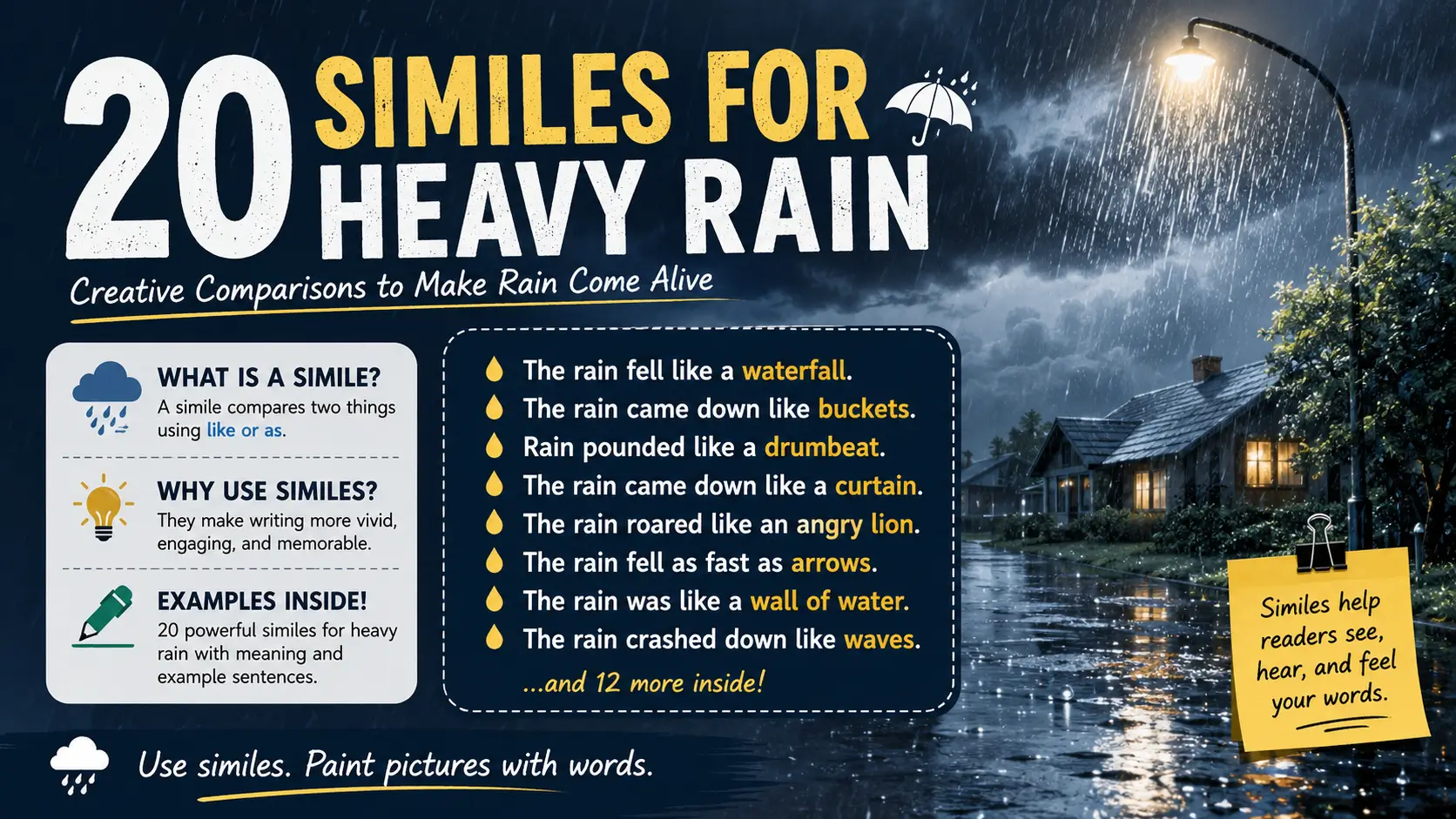
Have you ever watched heavy rain pour down so hard that it seemed to fill the whole world with sound? Sometimes, simply saying “It was raining heavily” does not show the reader what the moment feels like. That is where similes for heavy rain can help.
A simile compares two different things using words such as “like” or “as.” For example, you might say, “The rain fell like a waterfall.” You instantly get a stronger picture in your mind.
Similes make writing more colorful, clear, and memorable. They are useful in stories, poems, essays, and everyday creative writing. In simple terms, a good simile helps your reader see, hear, and feel what you are describing.
You may have also seen the phrase “strohl simile.” This is not a standard literary term. It may be a typo or a mistaken phrase for strong simile. Here, we will focus on strong, useful similes that describe heavy rain.
Let’s explore some creative examples of similes and see how to use them naturally.
20 Similes for Heavy Rain
1. The rain fell like a waterfall
Meaning: The rain was falling very heavily and continuously.
What it conveys: This simile creates an image of a huge amount of water rushing downward.
Example sentences:
- The rain fell like a waterfall outside our window.
- By evening, the rain was pouring like a waterfall from the dark sky.
2. The rain came down like buckets
Meaning: Rain was falling in a very large amount.
What it conveys: It makes the rainfall sound sudden, powerful, and overwhelming.
Example sentences:
- It was raining like buckets when we left school.
- The rain came down like buckets, flooding the streets within minutes.
3. The rain pounded like a drumbeat
Meaning: The rain made a loud, steady sound as it hit surfaces.
What it conveys: This simile focuses on the strong noise of heavy rain.
Example sentences:
- Rain pounded like a drumbeat against the roof.
- All night, the rain sounded like a drumbeat on the windows.
4. The rain fell like silver ropes
Meaning: Heavy rain appeared as long, shining streams.
What it conveys: This gives the rain a bright and visual quality.
Example sentences:
- Silver rain fell like ropes from the cloudy sky.
- Under the streetlights, the rain looked like silver ropes.
5. The rain poured like a broken dam
Meaning: The rain was extremely heavy and seemed impossible to stop.
What it conveys: It suggests force, speed, and a huge amount of water.
Example sentences:
- The rain poured like a broken dam across the village.
- Water rushed down the road as the rain poured like a broken dam.
6. The rain hit the roof like thousands of tiny stones
Meaning: The raindrops struck the roof with great force.
What it conveys: This simile emphasizes the sharp sound and strength of the rain.
Example sentences:
- Rain hit the metal roof like thousands of tiny stones.
- We could barely hear each other as the rain struck the roof like tiny stones.
7. The rain came down like a curtain
Meaning: The heavy rain formed a thick sheet that blocked the view.
What it conveys: It helps readers picture how difficult it was to see through the rain.
Example sentences:
- The rain came down like a curtain around the house.
- A curtain of rain covered the road ahead.
8. The rain roared like an angry lion
Meaning: The rain was loud and powerful.
What it conveys: This gives the storm a wild and frightening feeling.
Example sentences:
- Outside, the heavy rain roared like an angry lion.
- The storm roared like an angry lion throughout the night.
9. The rain fell as fast as arrows
Meaning: The raindrops seemed to fall quickly and forcefully.
What it conveys: This creates a sense of speed and intensity.
Example sentences:
- The rain fell as fast as arrows from the gray sky.
- Drops struck the ground as fast as arrows.
10. The rain was like a wall of water
Meaning: The rainfall was so thick that it seemed solid.
What it conveys: It shows how hard it was to see or move through the rain.
Example sentences:
- Outside the door stood a wall of water.
- The rain was like a wall of water between us and the road.
11. The rain crashed down like waves
Meaning: The rain came down with great force.
What it conveys: This comparison makes the storm feel powerful and energetic.
Example sentences:
- Rain crashed down like waves against the windows.
- The storm sent sheets of rain crashing down like waves.
12. The rain fell like beads from a giant necklace
Meaning: The raindrops looked like many shining beads falling together.
What it conveys: This creates a more beautiful and imaginative image of heavy rain.
Example sentences:
- The rain fell like beads from a giant necklace.
- Under the morning light, the drops looked like beads falling from the sky.
13. The rain drummed like a marching band
Meaning: The rain made a loud, rhythmic sound.
What it conveys: This simile focuses on the steady rhythm of rainfall.
Example sentences:
- The rain drummed like a marching band on the rooftop.
- All afternoon, rain drummed like a marching band above us.
14. The rain rushed down like a stampede
Meaning: The rain seemed wild, fast, and uncontrollable.
What it conveys: This gives the storm a dramatic sense of movement.
Example sentences:
- Rain rushed down like a stampede from the dark clouds.
- The streets filled quickly as the rain came like a stampede.
15. The rain fell like a thousand needles
Meaning: The raindrops felt sharp and forceful.
What it conveys: This simile is useful when heavy rain hurts or stings the skin.
Example sentences:
- The cold rain hit my face like a thousand needles.
- Outside, the rain felt like a thousand needles against my cheeks.
16. The rain was as heavy as a waterfall
Meaning: The rain was extremely strong and plentiful.
What it conveys: The comparison helps readers understand just how intense the rainfall was.
Example sentences:
- The rain was as heavy as a waterfall.
- By midnight, the rain was as heavy as a waterfall outside our home.
17. The rain hammered the streets like a blacksmith
Meaning: The rain hit the streets with repeated force.
What it conveys: It gives the storm a strong, noisy, almost physical presence.
Example sentences:
- The rain hammered the streets like a blacksmith working on hot metal.
- All evening, the storm hammered the pavement like a busy blacksmith.
18. The rain fell like a thousand threads
Meaning: The rain looked like countless thin lines falling from the clouds.
What it conveys: This creates a delicate visual image while still showing heavy rainfall.
Example sentences:
- Rain fell like a thousand threads from the dark clouds.
- From the window, the storm looked like a thousand threads of water.
19. The rain swept across the town like a giant broom
Meaning: The rain moved across the area with great force.
What it conveys: It suggests that the storm seemed to wash over everything in its path.
Example sentences:
- Heavy rain swept across the town like a giant broom.
- The storm moved through the valley like a giant broom.
20. The rain fell as hard as rocks
Meaning: The rain felt extremely forceful.
What it conveys: This simile shows how powerful and uncomfortable the rainfall could be.
Example sentences:
- The rain fell as hard as rocks against the old roof.
- We ran for shelter as the rain fell as hard as rocks.
Practical Exercise: Test Your Simile Skills
Now it is your turn. Try these questions before looking at the answers.
Questions
1. Complete the simile:
The rain fell like a __________.
2. Which sentence uses a simile?
A. The rain was heavy.
B. The rain fell like a waterfall.
C. The rain flooded the road.
3. Complete the sentence:
The rain pounded on the roof like a __________.
4. What does “The rain was like a wall of water” mean?
5. Choose the best word:
The rain roared like an angry ________.
A. lion
B. flower
C. feather
6. Create your own simile for very loud rain.
7. Which simile shows that rain is moving very quickly?
A. The rain fell like arrows.
B. The rain was like soft cotton.
C. The rain looked like glass.
8. Complete the simile:
The rain came down like __________.
9. What feeling does “The rain fell like a thousand needles” create?
10. Write one simile describing rain hitting a window.
Answers and Explanations
1. The rain fell like a waterfall.
This shows that a huge amount of rain was falling heavily.
2. B. The rain fell like a waterfall.
The word “like” connects the rain to a waterfall, making it a simile.
3. The rain pounded on the roof like a drumbeat.
This compares the sound of rain to a steady drumbeat.
4. It means the rain was so heavy and thick that it seemed like a solid wall.
This helps readers imagine how difficult it was to see through the storm.
5. A. lion.
“Roared like an angry lion” creates a strong image of loud, powerful rain.
6. Example answer:
“The rain sounded like a marching band.”
Your answer can be different as long as it makes a clear comparison.
7. A. The rain fell like arrows.
Arrows suggest speed and force, so this simile makes the rainfall feel fast and powerful.
8. Example answer:
“The rain came down like buckets.”
You can create many other comparisons, such as “like a waterfall.”
9. It creates a feeling of pain, sharpness, or discomfort.
The word “needles” makes the raindrops seem cold and sharp.
10. Example answer:
“The rain tapped the window like tiny fingers.”
This creates a clear and easy-to-picture image.
How to Create Your Own Similes for Heavy Rain
Creating a simile does not have to be difficult. Start by asking yourself one simple question:
“What does this rain remind me of?”
Think about what you can see, hear, feel, or imagine.
For example:
- If the rain is loud, compare it to drums.
- If it is fast, compare it to arrows.
- If it is thick, compare it to a wall.
- If it is powerful, compare it to a waterfall.
- If it feels painful, compare it to needles.
You might say:
“Rain fell like drums from the sky.”
A more natural version would be:
“Rain hammered the roof like a drumbeat.”
The second sentence gives the reader a clearer picture.
When learning how to use similes in writing, remember that the best comparison does not need to be complicated. A simple, fresh image can be more powerful than a fancy one.
Why Similes Make Rain Descriptions Better
Compare these two sentences:
“It was raining heavily.”
Now try:
“Rain hammered the roof like a marching band.”
The first sentence gives information. The second creates an experience.
That is the real power of creative writing similes. They help readers imagine the scene instead of simply receiving information.
Good similes can add:
- Sound
- Movement
- Emotion
- Color
- Mood
- Sensory detail
- Personality
This is why examples of similes are useful when you are learning creative writing. Once you understand the pattern, you can create your own simile sentences for almost anything.
Conclusion
Similes can turn an ordinary description of heavy rain into something vivid and memorable. Instead of simply saying that rain is heavy, you can compare it to a waterfall, drumbeat, wall of water, or even a thousand needles.
The key is to choose a comparison that matches what you want your reader to feel. In simple terms, a strong simile should make your description easier to picture.
As you practice, do not worry about making every comparison perfect. Start with what you see, hear, and feel. Then ask yourself what those details remind you of.
So, the next time heavy rain rolls across your window, grab a notebook and write your own simile. You might discover that even a storm can become a source of creative inspiration.

I am Beau Thomas, the Administrator at SimilyHub. I enjoy making similes, metaphors, and idioms easy to understand through clear explanations, helpful examples, and engaging content for English learners and writers.