Arguments can be loud, tense, confusing, or even playful. The right simile can help readers picture exactly what an argument feels like. Instead of simply saying, “They were arguing loudly,” you can compare the argument to something familiar, such as a storm, a roaring engine, or a bouncing ball. These comparisons make your writing more vivid and interesting.
In this guide, you’ll find 20 similes for arguing that you can use in stories, essays, poems, and everyday descriptions. Each example includes a simple meaning, what the comparison conveys, and two natural simile sentences. You’ll also learn how to create your own comparisons and recognize similes in writing.
These examples of similes are beginner-friendly and useful for creative writing similes, descriptive writing, and other forms of figurative language. Whether you are describing two friends having a disagreement or a heated debate between characters, these simile sentences can help you show the action instead of simply telling readers about it.
20 Similes for Arguing
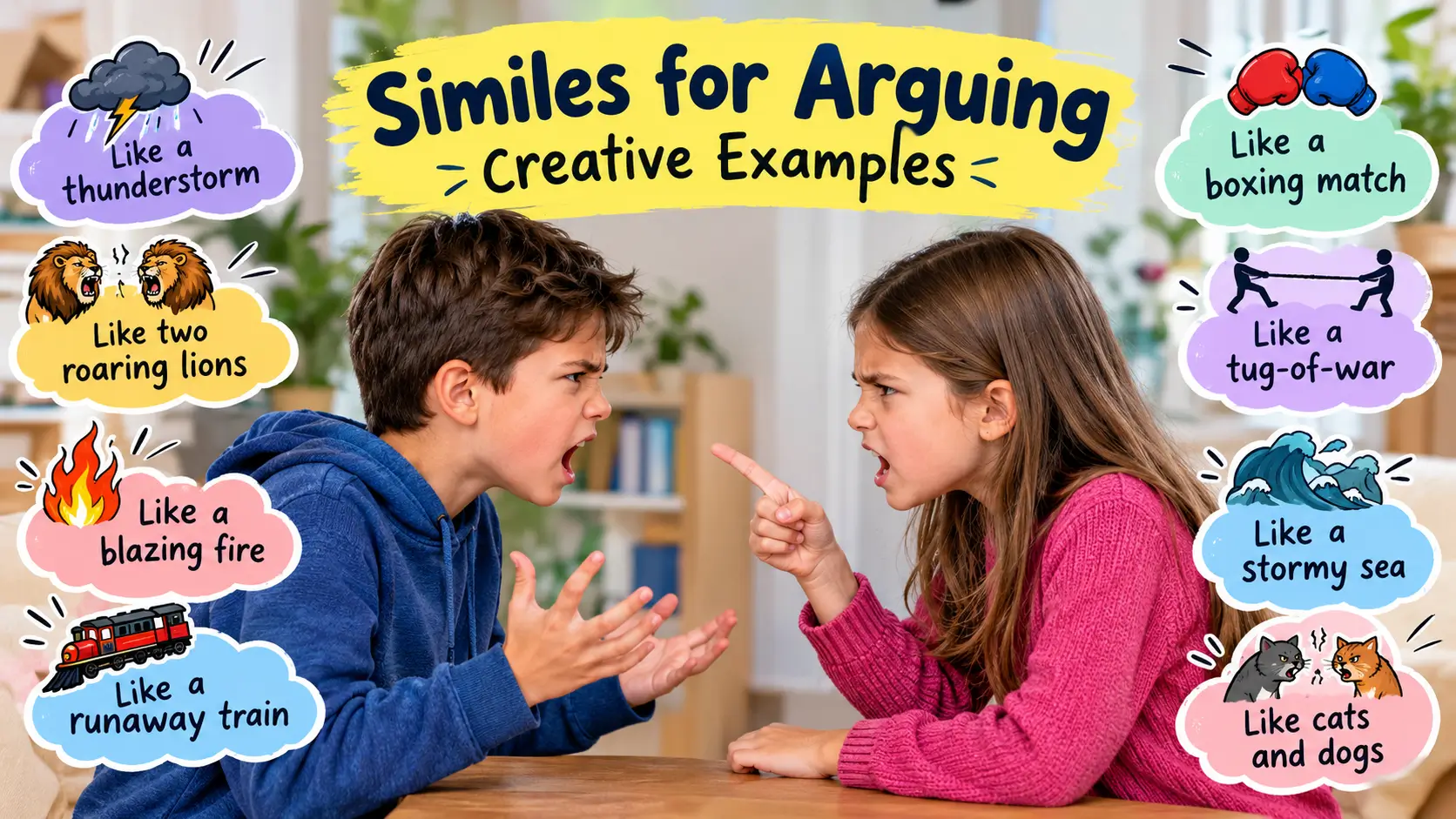
1. Like a thunderstorm
Meaning: The argument is loud, powerful, and full of strong emotions.
What it conveys: This comparison creates an image of noise, tension, and sudden bursts of anger.
Example sentences:
- Their argument was like a thunderstorm, shaking the whole house.
- The meeting became like a thunderstorm when everyone started shouting.
2. Like two roaring lions
Meaning: Two people are arguing fiercely and refusing to back down.
What it conveys: It suggests strength, anger, and a fierce struggle.
Example sentences:
- The brothers argued like two roaring lions over the broken toy.
- They faced each other like two roaring lions during the debate.
3. Like fireworks exploding
Meaning: The argument suddenly becomes loud and energetic.
What it conveys: This creates a picture of quick words, strong reactions, and emotional bursts.
Example sentences:
- Their disagreement turned into an argument like fireworks exploding.
- Questions and angry replies flew like fireworks exploding in the night.
4. Like a blazing fire
Meaning: The argument grows hotter and more intense.
What it conveys: It shows rising anger and emotions that are difficult to control.
Example sentences:
- Their argument grew like a blazing fire.
- Every new accusation made the discussion burn like a blazing fire.
5. Like a boxing match
Meaning: Two people are strongly challenging each other with words.
What it conveys: It suggests competition, pressure, quick responses, and determination.
Example sentences:
- Their debate felt like a boxing match.
- The two students exchanged arguments like a boxing match in the classroom.
6. Like a tug-of-war
Meaning: Both sides are trying hard to prove that they are right.
What it conveys: It shows a struggle in which neither person wants to give in.
Example sentences:
- Their argument was like a tug-of-war, with neither side giving up.
- The discussion became like a tug-of-war between two strong opinions.
7. Like a boiling kettle
Meaning: Someone is becoming increasingly angry and may soon lose control.
What it conveys: It creates an image of anger building under pressure.
Example sentences:
- Dad looked like a boiling kettle as the argument continued.
- She was like a boiling kettle, ready to burst after hearing the accusation.
8. Like a stormy sea
Meaning: The argument is confused, emotional, and difficult to control.
What it conveys: This comparison gives the argument a restless and turbulent feeling.
Example sentences:
- Their conversation became like a stormy sea.
- His thoughts were tossed around like a stormy sea during the argument.
9. Like sparks from a fire
Meaning: Small disagreements quickly create more conflict.
What it conveys: It suggests that one angry comment can start a much bigger argument.
Example sentences:
- Their short remarks flew like sparks from a fire.
- Every complaint sent sparks like a fire through the conversation.
10. Like cats and dogs
Meaning: Two people are constantly arguing or disagreeing.
What it conveys: This familiar comparison suggests frequent conflict and clashing personalities.
Example sentences:
- The two brothers fight like cats and dogs.
- Our neighbors argue like cats and dogs almost every evening.
11. Like a cracked bell
Meaning: The argument is loud, harsh, and unpleasant to hear.
What it conveys: It focuses on the sharp and irritating sound of angry voices.
Example sentences:
- His voice rang through the room like a cracked bell.
- Their shouting sounded like a cracked bell echoing down the hallway.
12. Like a runaway train
Meaning: The argument keeps getting stronger and becomes difficult to stop.
What it conveys: It shows that the conflict has gained momentum and is moving out of control.
Example sentences:
- Their argument became like a runaway train.
- Once the accusations began, the discussion moved like a runaway train.
13. Like a thunderclap
Meaning: The argument or angry response is sudden and powerful.
What it conveys: It creates a sense of shock, loudness, and unexpected emotion.
Example sentences:
- Her angry reply came like a thunderclap.
- The sudden argument hit the quiet room like a thunderclap.
14. Like a barking dog
Meaning: Someone is speaking loudly and angrily without calmly discussing the problem.
What it conveys: It gives the argument a noisy, impatient, and aggressive feeling.
Example sentences:
- He kept arguing like a barking dog.
- She answered every question like a barking dog guarding its yard.
15. Like a cracked dam
Meaning: Strong emotions have been held inside and suddenly begin to come out.
What it conveys: It suggests that anger has been building for a long time.
Example sentences:
- Their argument burst open like a cracked dam.
- Years of frustration came out like water through a cracked dam.
16. Like two trains colliding
Meaning: Two people with strong opposing views clash suddenly and intensely.
What it conveys: It creates an image of a powerful and dramatic confrontation.
Example sentences:
- Their opinions crashed together like two trains colliding.
- The debate felt like two trains colliding at full speed.
17. Like a drumbeat
Meaning: The same complaint or point is repeated again and again.
What it conveys: It suggests a steady, repetitive argument that does not seem to stop.
Example sentences:
- His complaints continued like a drumbeat.
- She repeated the same point like a drumbeat throughout the meeting.
18. Like a storm trapped in a room
Meaning: The argument fills a small space with intense emotion and tension.
What it conveys: It makes the disagreement feel overwhelming and impossible to ignore.
Example sentences:
- Their argument was like a storm trapped in a room.
- Anger filled the kitchen like a storm trapped in a room.
19. Like arrows flying
Meaning: Words are being exchanged quickly and sharply.
What it conveys: This comparison suggests that hurtful comments are being aimed at one another.
Example sentences:
- Their insults flew like arrows.
- During the argument, sharp words passed between them like arrows flying through the air.
20. Like a battle of words
Meaning: Two people are using strong arguments to challenge each other.
What it conveys: It presents the disagreement as a serious verbal struggle.
Example sentences:
- Their discussion became like a battle of words.
- The debate was like a battle of words, but both sides stayed respectful.
How to Use Similes in Writing
Learning how to use similes in writing can make simple sentences much more vivid. A good simile connects an idea to something readers already understand.
Start with a familiar image. For example, if a person is very angry, think about things that feel hot, loud, or powerful. You might compare the anger to a blazing fire or a thunderstorm.
Use like or as to make the comparison clear.
For example:
- The argument was like a thunderstorm.
- Her voice was as sharp as a needle.
- Their words flew like arrows.
Sensory details can make your creative writing similes stronger. Think about what readers might hear, see, feel, or imagine.
Also consider your tone. A serious story might use a comparison such as “like two trains colliding.” A humorous story might use something lighter, such as “like cats and dogs.”
The best similes are clear, natural, and connected to the idea you want to describe.
What Is a Simile?
A simile is a type of figurative language that compares two different things using words such as like or as.
For example:
- The baby slept like a log.
- Her smile was as bright as the sun.
- The children ran like wild horses.
A simile does not mean that two things are literally the same. Instead, it highlights a shared quality.
When we say, “Their argument was like a thunderstorm,” we do not mean that the argument was actually weather. We mean it was loud, powerful, and full of emotional energy.
Similes help writers create strong mental pictures. They are useful in stories, poems, essays, speeches, and descriptive writing.
Simile vs. Metaphor
Both similes and metaphors compare different things, but they do it in different ways.
A simile uses words such as like or as:
- The argument was like a storm.
- Her voice was as loud as thunder.
A metaphor makes a direct comparison without using like or as:
- The argument was a storm.
- Her voice was thunder.
The two forms can create similar images, but the structure is different.
A simple way to remember the difference is:
Simile = comparison using like or as.
Metaphor = direct comparison.
Both are useful forms of figurative language, and both can make descriptive writing more powerful.
Practical Exercise: 10 Questions
1. Fill in the blank:
Their argument was ___ a thunderstorm.
2. Identify the simile:
Which sentence contains a simile?
A. The room was silent.
B. Their argument was like a storm.
C. They stopped talking.
D. She left the room.
3. Multiple choice:
Which simile best describes an argument that keeps growing stronger?
A. Like a sleeping cat
B. Like a runaway train
C. Like a quiet lake
D. Like a soft pillow
4. Identify the comparison:
In the sentence “Their words flew like arrows,” what two things are being compared?
5. Fill in the blank:
The brothers argued ___ two roaring lions.
6. Create a simile:
Write a simile describing a very loud argument.
7. Create a simile:
Write a simile describing an argument that is difficult to stop.
8. Multiple choice:
Which sentence is a simile?
A. Their argument was a fire.
B. Their argument burned.
C. Their argument was like a blazing fire.
D. Their argument ended quickly.
9. Compare:
Change this metaphor into a simile: “The debate was a boxing match.”
10. Create your own:
Write one original simile for two people who strongly disagree but remain respectful.
Answers and Explanations
1. Like
“Their argument was like a thunderstorm” is a simile because it uses like to compare the argument with a thunderstorm.
2. B — Their argument was like a storm.
The word like signals the comparison.
3. B — Like a runaway train
A runaway train suggests something that has gained momentum and is difficult to stop.
4. Their words and arrows
The sentence compares words to arrows because the words are sharp, quick, or hurtful.
5. Like
“The brothers argued like two roaring lions” compares their behavior with fierce lions.
6. Example answer: “Their argument was like thunder booming through the house.”
This works because thunder gives the reader a strong image of loud sound.
7. Example answer: “Their argument was like a runaway train.”
A runaway train suggests that the argument continues without slowing down.
8. C — Their argument was like a blazing fire.
This is a simile because it uses like.
9. “The debate was like a boxing match.”
Adding like changes the direct metaphor into a simile.
10. Example answer: “Their debate was like a careful game of chess.”
This comparison suggests that both people are thinking carefully and responding to each other without becoming hostile.
Conclusion
Similes can turn ordinary descriptions into vivid and memorable writing. When you describe an argument as being like a thunderstorm, a tug-of-war, or a runaway train, readers can picture the emotion more clearly. These 20 similes for arguing give you useful ideas for stories, poems, essays, and descriptive writing.
When creating your own similes, think about the main feeling you want to show. Then choose a familiar object, action, sound, or scene that shares that quality. Use like or as to connect the two ideas. Keep your comparison clear and natural.
With practice, you can use similes to make your writing stronger, more colorful, and more engaging. Try creating a few new similes of your own and see how much more powerful your descriptions become.

I am Silas Michael, an enthusiastic writer passionate about similes, metaphors, and idioms. I enjoy explaining creative expressions through simple meanings and examples that help readers understand and improve their English.