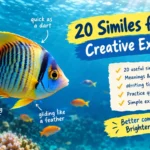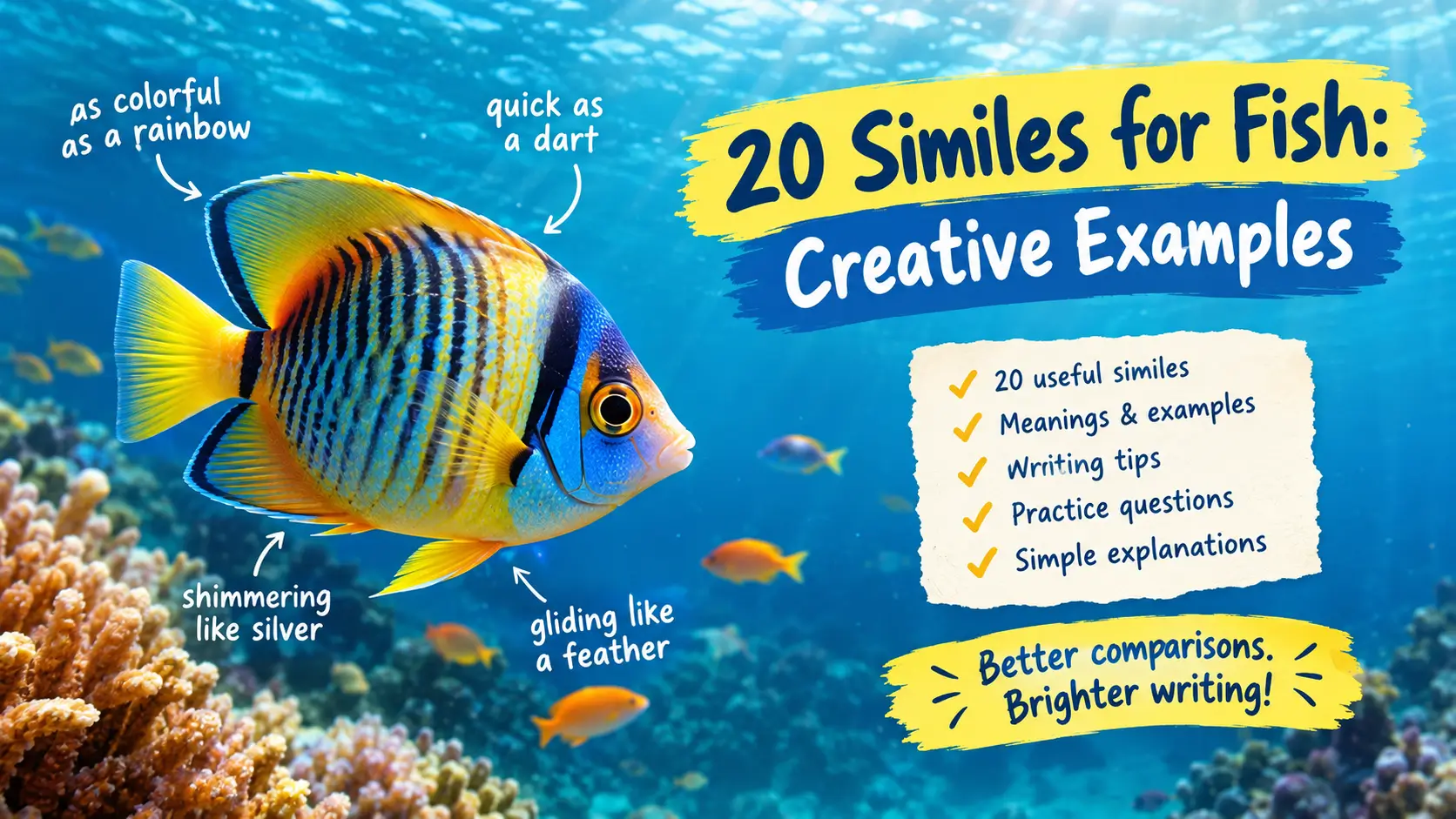
Fish are fascinating creatures, and they can make your writing more vivid when you compare them with familiar things. A good simile helps readers picture movement, color, size, speed, or behavior in a simple way. For example, you might describe a fish as “quick as a dart” to show how fast it swims or “shimmering like silver” to highlight its bright scales. These comparisons make ordinary descriptions more lively and memorable.
In this guide, you will find 20 creative similes for fish that work well in stories, poems, school assignments, and descriptive writing. Each example includes a simple meaning, what it conveys, and two natural simile sentences. You will also learn how similes work, how they differ from metaphors, and how to create your own. At the end, there is a short exercise to help you practice. Whether you are a beginner or simply looking for fresh creative writing similes, these examples can help you describe fish in more colorful and interesting ways.
20 Similes for Fish
1. As slippery as a fish
Meaning: Something is very difficult to hold, catch, or control.
What it conveys: This simile emphasizes slipperiness and the way a fish can quickly escape from your hands.
Example sentences:
- The little fish was as slippery as a fish when Maya tried to move it into the tank.
- The wet rope felt as slippery as a fish in his hands.
2. As quick as a dart
Meaning: A fish moves extremely fast through the water.
What it conveys: The comparison creates a strong image of sudden, rapid movement.
Example sentences:
- The tiny fish was as quick as a dart when it noticed the approaching net.
- A silver fish shot across the pond as quick as a dart.
3. Shimmering like silver
Meaning: A fish looks bright and shiny, especially when light reflects from its scales.
What it conveys: It creates a sparkling image of a fish moving through clear water.
Example sentences:
- The fish swam beneath the surface, shimmering like silver.
- In the morning sunlight, the trout looked like it was shimmering like silver.
4. Swimming like a graceful dancer
Meaning: A fish moves smoothly and elegantly through the water.
What it conveys: This comparison highlights gentle, flowing movement.
Example sentences:
- The colorful fish moved through the aquarium like a graceful dancer.
- Its fins waved as it swam like a graceful dancer across the tank.
5. As colorful as a rainbow
Meaning: A fish has many bright or beautiful colors.
What it conveys: This simile emphasizes a vivid mixture of colors.
Example sentences:
- The tropical fish was as colorful as a rainbow.
- We watched a fish as colorful as a rainbow glide between the coral.
6. Darting like an arrow
Meaning: A fish moves quickly and suddenly in one direction.
What it conveys: The comparison makes the fish seem fast, sharp, and energetic.
Example sentences:
- The minnows were darting like arrows when the boat came near.
- One fish went darting like an arrow toward the rocks.
7. As quiet as a shadow
Meaning: A fish moves almost silently.
What it conveys: It gives the impression of peaceful, nearly invisible movement.
Example sentences:
- The fish drifted through the dark water as quiet as a shadow.
- It moved around the aquarium as quiet as a shadow.
8. Gliding like a feather
Meaning: A fish moves smoothly and gently through the water.
What it conveys: This simile creates a soft image of effortless movement.
Example sentences:
- The angelfish was gliding like a feather through the tank.
- Beneath the calm surface, the fish moved like a feather floating on air.
9. As hungry as a wolf
Meaning: A fish is extremely eager to eat.
What it conveys: The comparison emphasizes strong hunger and excitement around food.
Example sentences:
- The pond fish were as hungry as wolves when we sprinkled food into the water.
- After a long day, the large fish seemed as hungry as a wolf.
10. Flopping like a fish out of water
Meaning: Someone or something is moving awkwardly or struggling in an unfamiliar situation.
What it conveys: It creates a funny image of confused, uncontrolled movement.
Example sentences:
- Without his usual tools, the mechanic was flopping around like a fish out of water.
- I felt like a fish out of water, moving awkwardly through the unfamiliar room.
11. As smooth as a fish
Meaning: Something has a very smooth surface or texture.
What it conveys: This simile focuses on the sleek, smooth feel associated with a fish.
Example sentences:
- The wet stone felt as smooth as a fish beneath her fingers.
- The polished surface was as smooth as a fish.
12. Swimming like a torpedo
Meaning: A fish moves very quickly and directly through the water.
What it conveys: The comparison suggests speed, power, and focused movement.
Example sentences:
- The large fish came swimming like a torpedo toward the bait.
- Suddenly, the tuna began swimming like a torpedo through the open sea.
13. As bright as a jewel
Meaning: A fish has strikingly bright and beautiful colors.
What it conveys: This comparison makes the fish seem precious, colorful, and eye-catching.
Example sentences:
- The tiny tropical fish was as bright as a jewel.
- Each fish looked as bright as a jewel beneath the aquarium lights.
14. Drifting like a leaf
Meaning: A fish moves slowly and gently through the water.
What it conveys: The simile creates a calm and peaceful image.
Example sentences:
- The small fish was drifting like a leaf in the quiet pond.
- It drifted like a leaf beneath the surface as the water slowly moved.
15. As silver as a coin
Meaning: A fish has shiny, silver-colored scales.
What it conveys: The comparison makes the fish’s appearance easy to visualize.
Example sentences:
- The fish was as silver as a coin under the bright sunlight.
- We spotted a fish as silver as a coin near the riverbank.
16. Slipping through the water like a ribbon
Meaning: A fish moves smoothly and flexibly through the water.
What it conveys: It highlights graceful movement and the way a fish bends as it swims.
Example sentences:
- The eel moved through the water like a ribbon.
- The long fish was slipping through the water like a ribbon.
17. As still as a statue
Meaning: A fish is completely motionless.
What it conveys: This simile emphasizes a moment when the fish stops moving.
Example sentences:
- The fish remained as still as a statue beneath the rock.
- For several seconds, the goldfish was as still as a statue.
18. Flashing like a spark
Meaning: A fish appears suddenly as it moves quickly through the water.
What it conveys: The comparison creates an image of brief, bright, energetic movement.
Example sentences:
- A small fish went flashing like a spark across the pond.
- Silver scales were flashing like sparks as the fish turned.
19. As tiny as a grain of rice
Meaning: A fish is extremely small.
What it conveys: This simile helps readers imagine the very small size of a young or tiny fish.
Example sentences:
- The newly hatched fish was as tiny as a grain of rice.
- We could barely see the fish because it was as tiny as a grain of rice.
20. Swimming together like a school of dancers
Meaning: A group of fish moves together in an organized, flowing way.
What it conveys: The comparison highlights teamwork, rhythm, and graceful group movement.
Example sentences:
- The colorful fish moved together like a school of dancers.
- Below the boat, hundreds of fish turned together like a school of dancers.
How to Use Similes in Writing
Creating your own similes becomes easier when you follow a few simple steps.
Choose what you want to describe
Start with the exact feature you want readers to notice. With a fish, you might describe its:
- Speed
- Color
- Size
- Shape
- Movement
- Texture
- Behavior
For example, instead of simply saying, “The fish was fast,” think about what else is fast.
Find a familiar comparison
Choose something readers already understand. A dart, arrow, feather, leaf, or jewel can give readers a clear mental picture.
For example:
- The fish was as fast as an arrow.
- The fish moved like a drifting leaf.
- Its scales shone like tiny jewels.
Use “like” or “as”
Similes often use like or as to make a comparison.
For example:
- The fish moved like a ribbon.
- The fish was as bright as a jewel.
Make the comparison clear
A good simile should help the reader see something more clearly. Avoid comparisons that have no obvious connection.
Instead of writing, “The fish was like a chair,” choose a comparison that describes a real feature, such as:
The fish was as silver as a coin.
Avoid clichés when possible
Common similes can be useful, especially for beginners, but original comparisons can make your writing more interesting.
For example, instead of:
The fish was fast like lightning.
You could write:
The fish shot through the water like a silver arrow.
Match the simile to your tone
A children’s story may use playful comparisons, while a nature poem may need something calm and beautiful.
Playful:
The hungry fish snapped at the food like a tiny shark.
Peaceful:
The fish drifted through the pond like a leaf on a quiet stream.
Add sensory details
Strong descriptive writing often combines a simile with details about sight, sound, touch, or movement.
For example:
The fish flashed like a silver spark beneath the blue water.
The words silver, spark, and blue water give the reader a stronger picture.
What Is a Simile?
A simile is a figure of speech that compares two different things using words such as like or as. The comparison helps readers understand an idea by connecting it to something familiar.
For example:
- The fish moved like an arrow.
- Its scales were as bright as jewels.
- The tiny fish was like a floating leaf.
In each sentence, the comparison gives the reader a clearer mental image.
Similes are useful because they make writing more vivid. Instead of simply saying, “The fish moved quickly,” you could say, “The fish moved like a dart.” The second sentence gives the reader a stronger sense of speed.
The phrase “strohl simile” is not a standard literary term. If you see that wording in a search, it may be a typo or an unusual way of referring to a simile. The basic meaning of a simile remains the same: a comparison between unlike things, usually using like or as.
Simile vs. Metaphor
Similes and metaphors both compare things, but they do it in different ways.
A simile makes a direct comparison using words such as like or as.
Simile: The room smelled like rotten eggs.
A metaphor describes one thing as if it actually were another thing.
Metaphor: The room was a rotten-egg factory.
Here is another simple example:
Simile: The fish moved like an arrow.
Metaphor: The fish was an arrow through the water.
The simile says the two things are similar. The metaphor makes a stronger, direct comparison.
Practical Exercise: 10 Questions
- Fill in the blank: The fish moved as quickly as a ________.
- Identify the simile: Which sentence contains a simile?
A. The fish swims in the pond.
B. The fish is as bright as a jewel.
C. The fish has blue scales. - Fill in the blank: The fish drifted through the water like a ________.
- Multiple choice: Which comparison best describes a shiny silver fish?
A. As silver as a coin
B. As loud as a drum
C. As tall as a tree - Identify the simile: Is this a simile? “The fish was a silver arrow.” Explain your answer.
- Create your own: Write a simile that describes a fish swimming quickly.
- Compare the sentences: Which sentence creates a stronger image?
A. The fish was colorful.
B. The fish was as colorful as a rainbow.
Explain why. - Multiple choice: Which word is commonly used to introduce a simile?
A. Because
B. Like
C. Therefore - Create your own: Write a simile describing the size of a very small fish.
- Compare two sentences: What is the difference between these sentences?
A. The fish moved like a ribbon.
B. The fish was a ribbon.
Identify which one is a simile and explain why.
Answers and Explanations
- Answer: A dart or arrow.
Explanation: Both comparisons suggest very fast movement. A simile connects the fish’s speed to something that moves quickly. - Answer: B. The fish is as bright as a jewel.
Explanation: The sentence uses “as” to compare the fish’s brightness with a jewel. - Answer: A leaf or feather.
Explanation: Both can suggest slow, gentle movement. The exact answer can vary because creative similes can have more than one reasonable comparison. - Answer: A. As silver as a coin.
Explanation: A coin can provide a familiar image of a shiny silver surface. - Answer: No, it is a metaphor.
Explanation: It directly says the fish is an arrow instead of using “like” or “as.” - Answer: One possible answer is: “The fish darted through the water like an arrow.”
Explanation: The comparison with an arrow shows quick, direct movement. Other original answers can also be correct. - Answer: B. The fish was as colorful as a rainbow.
Explanation: The simile gives readers a familiar image of many bright colors, making the description more vivid. - Answer: B. Like.
Explanation: “Like” is one of the most common signal words used in similes. “As” is another. - Answer: One possible answer is: “The fish was as tiny as a grain of rice.”
Explanation: A grain of rice is familiar and small, so the comparison helps readers picture the fish’s size. - Answer: A is a simile, while B is a metaphor.
Explanation: Sentence A uses “like” to compare the fish with a ribbon. Sentence B directly says the fish was a ribbon.
Conclusion
Similes can turn a simple description into a clear and memorable picture. Instead of saying that a fish is fast, shiny, colorful, or graceful, you can compare it with something readers already know. That is why similes for fish can be useful in stories, poems, classroom assignments, and descriptive writing.
The key is to choose comparisons that fit the feature you want to describe. Think about the fish’s movement, color, size, or behavior, then find a familiar image that matches it. Use words such as like and as to make the comparison clear.
Now try creating a few of your own. With practice, your simile sentences can become more vivid, playful, and creative. A simple comparison can make an ordinary sentence swim to life!

I’m Evelyn Marie, an author passionate about similes, metaphors, and idioms. I enjoy explaining creative expressions simply, helping readers understand language and make their writing more engaging.