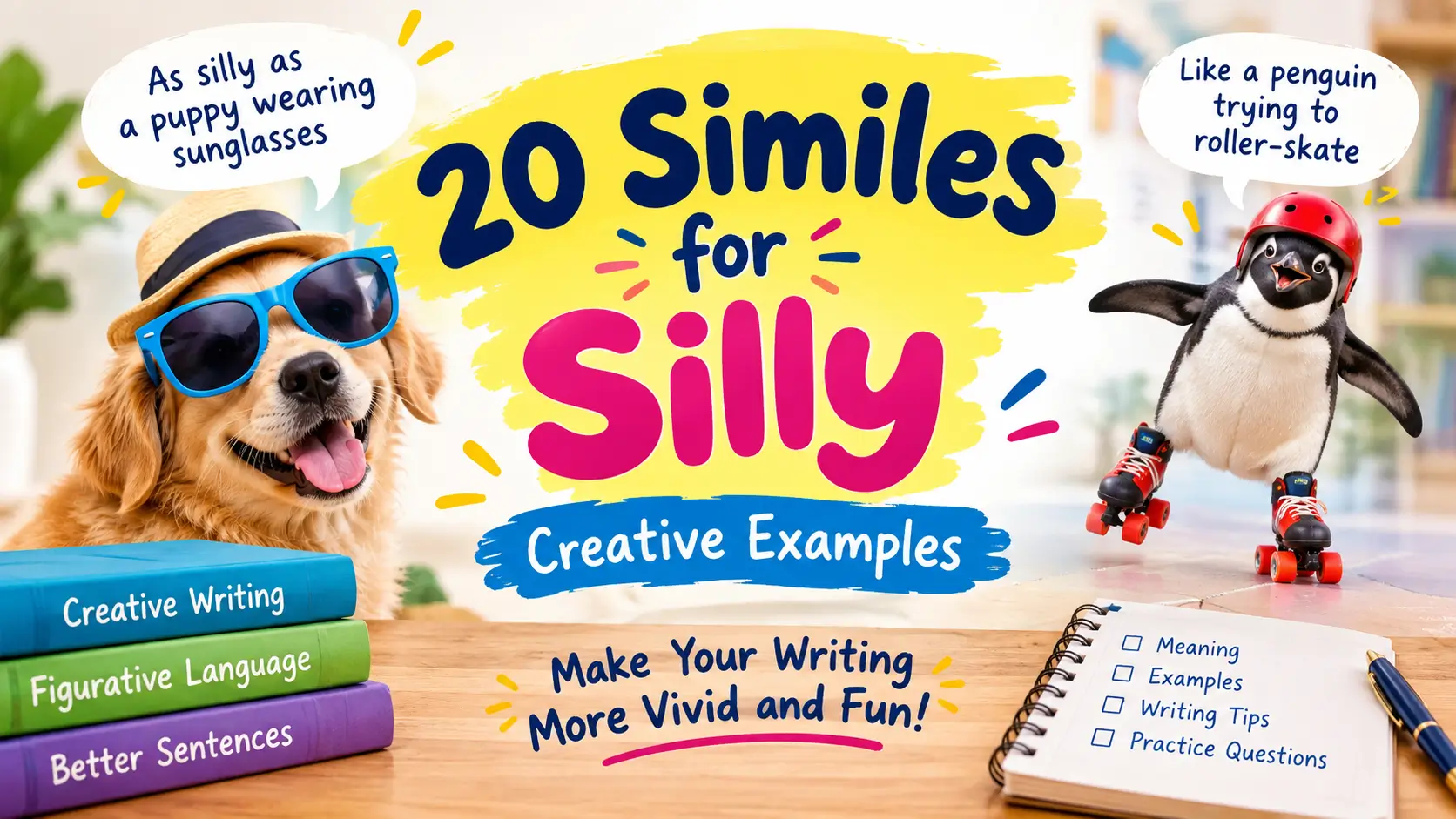
Have you ever seen someone do something so goofy that “silly” just doesn’t seem strong enough? A good simile can make that moment much more fun and vivid. Similes compare one thing to another using words such as “like” or “as,” helping readers picture exactly what you mean. Instead of simply saying, “He looked silly,” you might say, “He looked as silly as a penguin wearing roller skates.” Suddenly, the sentence creates a clear and funny image.
In this article, you’ll find 20 creative and natural similes for silly. Some are playful, some are exaggerated, and others are useful for everyday descriptive writing. Each example includes a simple meaning, what it conveys, and two sentences showing how to use it. You’ll also learn how similes work, how they differ from metaphors, and how to create your own. Finally, you can test your understanding with ten practical questions. Whether you are a student, teacher, or beginner writer, these examples can help make your creative writing more colorful and entertaining.
20 Similes for Silly
1. As silly as a clown at a library
Meaning: This describes someone behaving in a very goofy or inappropriate way for a quiet or serious place.
What it conveys: It creates a funny picture of someone who does not seem to fit the situation.
Example sentences:
- Jake was as silly as a clown at a library when he started dancing between the bookshelves.
- She acted as silly as a clown at a library during the serious meeting.
2. As silly as a goose
Meaning: This describes someone who is acting foolish, playful, or amusing.
What it conveys: It gives the idea of harmless, cheerful silliness rather than serious foolishness.
Example sentences:
- You are as silly as a goose when you make those funny faces.
- My little brother was as silly as a goose all afternoon.
3. Like a cat chasing its own tail
Meaning: This describes someone behaving in a confused, pointless, or amusing way.
What it conveys: It creates an image of someone moving around without knowing what they are doing.
Example sentences:
- Tom ran around the room like a cat chasing its own tail.
- I felt like a cat chasing its own tail while trying to find my lost pencil.
4. As silly as a banana in a hat
Meaning: This describes something that looks unusually funny or ridiculous.
What it conveys: The strange image makes the comparison playful and humorous.
Example sentences:
- He looked as silly as a banana in a hat during the costume contest.
- With those oversized glasses, she was as silly as a banana in a hat.
5. Like a duck in a dance class
Meaning: This describes someone who looks awkward or funny while trying to do something unfamiliar.
What it conveys: It suggests clumsy movements mixed with harmless humor.
Example sentences:
- I moved like a duck in a dance class when I tried salsa for the first time.
- He looked like a duck in a dance class while copying the complicated steps.
6. As silly as a puppy wearing sunglasses
Meaning: This describes something extremely cute, funny, and playful.
What it conveys: It creates a cheerful image of something that looks amusing rather than serious.
Example sentences:
- The little boy looked as silly as a puppy wearing sunglasses.
- She smiled for the camera, looking as silly as a puppy wearing sunglasses.
7. Like a fish riding a bicycle
Meaning: This describes someone attempting something in a very strange or awkward way.
What it conveys: The impossible image makes the situation seem absurd and funny.
Example sentences:
- Without any practice, I felt like a fish riding a bicycle on the dance floor.
- He tried to fix the computer like a fish riding a bicycle.
8. As silly as a frog in a fancy suit
Meaning: This describes someone who looks funny because their appearance does not match the situation.
What it conveys: It creates a playful contrast between something ordinary and something formal.
Example sentences:
- Dad looked as silly as a frog in a fancy suit at the children’s party.
- Wearing a tuxedo to the beach made him look as silly as a frog in a fancy suit.
9. Like a squirrel with too much coffee
Meaning: This describes someone who is extremely energetic, restless, or unable to sit still.
What it conveys: It creates a lively and humorous picture of frantic movement.
Example sentences:
- After the exciting news, Mia was running around like a squirrel with too much coffee.
- The children were jumping and laughing like squirrels with too much coffee.
10. As silly as a chicken wearing boots
Meaning: This describes something that looks funny, unusual, or out of place.
What it conveys: The unexpected image gives the sentence a playful tone.
Example sentences:
- He marched around the garden as silly as a chicken wearing boots.
- Those tiny shoes made the puppy look as silly as a chicken wearing boots.
11. Like a penguin trying to roller-skate
Meaning: This describes someone who is awkward and uncoordinated while attempting something difficult.
What it conveys: It creates a humorous picture of clumsy movement.
Example sentences:
- I moved like a penguin trying to roller-skate during my first skating lesson.
- He looked like a penguin trying to roller-skate as he struggled to balance.
12. As silly as a goat in a playground
Meaning: This describes someone behaving in a playful and unusual way.
What it conveys: It suggests energetic, carefree, and slightly ridiculous behavior.
Example sentences:
- The children were as silly as goats in a playground after school.
- My cousin became as silly as a goat in a playground when the music started.
13. Like a robot with a broken instruction manual
Meaning: This describes someone acting awkwardly because they do not know what to do.
What it conveys: It gives the impression of confused, unnatural, and funny behavior.
Example sentences:
- I stood there like a robot with a broken instruction manual when everyone started dancing.
- He looked like a robot with a broken instruction manual while trying to follow the exercise routine.
14. As silly as a squirrel wearing a backpack
Meaning: This describes something amusing, unusual, or unexpectedly funny.
What it conveys: The unusual picture makes the description playful and memorable.
Example sentences:
- The tiny dog looked as silly as a squirrel wearing a backpack.
- With his enormous schoolbag, he looked as silly as a squirrel wearing a backpack.
15. Like a rooster giving a speech
Meaning: This describes someone speaking or behaving in a dramatic and amusing way.
What it conveys: It suggests exaggerated confidence and funny seriousness.
Example sentences:
- He stood on the chair like a rooster giving a speech.
- My little sister announced dinner like a rooster giving a speech.
16. As silly as a sock on a sandwich
Meaning: This describes something that is completely out of place or makes no sense.
What it conveys: The strange comparison creates an absurd and humorous image.
Example sentences:
- His bright winter hat looked as silly as a sock on a sandwich at the beach.
- Wearing formal shoes with pajamas was as silly as a sock on a sandwich.
17. Like a kangaroo trying to whisper
Meaning: This describes someone attempting to behave quietly or calmly but looking funny while doing it.
What it conveys: It suggests an amusing mismatch between the person and the behavior.
Example sentences:
- He tried to sneak across the room like a kangaroo trying to whisper.
- The excited child moved like a kangaroo trying to whisper during the ceremony.
18. As silly as a parrot with a tiny hat
Meaning: This describes someone or something that looks especially funny and unusual.
What it conveys: It creates a bright, playful image that works well in humorous writing.
Example sentences:
- The magician looked as silly as a parrot with a tiny hat.
- She posed for the photograph as silly as a parrot with a tiny hat.
19. Like a comedian who forgot the joke
Meaning: This describes someone who is awkward, confused, or unsure of what to do.
What it conveys: It creates a funny image of someone caught in an embarrassing moment.
Example sentences:
- I stood there like a comedian who forgot the joke when everyone looked at me.
- He looked like a comedian who forgot the joke after losing his place in the speech.
20. As silly as a monkey in a business meeting
Meaning: This describes someone behaving playfully or foolishly in a serious situation.
What it conveys: It highlights the contrast between silly behavior and a formal setting.
Example sentences:
- The children were as silly as monkeys in a business meeting during the quiet ceremony.
- He acted as silly as a monkey in a business meeting when he started making funny faces.
How to Use Similes in Writing
Creating your own similes is easier than it may seem. Start with the thing you want to describe, then think of something familiar that shares a noticeable quality.
Choose what you want to describe
First, identify the person, object, action, or feeling.
For example:
- A silly child
- A silly joke
- A silly mistake
- A silly expression
Find a familiar comparison
Think about animals, objects, people, or situations that create a strong image.
For example:
- A silly child → a puppy chasing its tail
- A silly expression → a clown’s surprised face
- A silly mistake → putting shoes on the wrong feet
Use “like” or “as”
Similes often use like or as.
For example:
- “He danced like a chicken.”
- “She was as silly as a cartoon character.”
Make the comparison clear
A good simile should help the reader understand the quality you are describing.
Instead of:
He was like a thing.
Try:
He was as silly as a puppy chasing its own tail.
The second example gives the reader a clear mental picture.
Avoid clichés when possible
Common similes can be useful, but fresh comparisons can make your writing stand out.
Instead of:
He was as busy as a bee.
You might write:
He was as busy as a squirrel hiding food before winter.
Match the simile to your tone
A funny story can use an exaggerated comparison. A school essay may need something simpler and clearer.
For example:
The boy moved like a confused penguin.
This works well in playful descriptive writing.
Add sensory details
Strong similes can appeal to sight, sound, movement, or even smell.
For example:
Her laugh sounded like a squeaky toy.
Or:
He bounced around the room like a rubber ball.
These creative writing examples help readers experience the scene instead of simply being told about it.
What Is a Simile?
A simile is a figure of speech that compares two different things to make an idea clearer, stronger, or more interesting.
Similes commonly use words such as like and as.
For example:
The baby laughed like a tiny bell.
The baby is not actually a bell. The comparison helps the reader imagine the bright, cheerful sound.
Another example is:
He was as quiet as a mouse.
The person is compared with a mouse to show that he made very little noise.
A third example is:
Her eyes sparkled like stars.
The comparison helps the reader picture bright, shining eyes.
Similes are part of figurative language. Writers use them to add detail, emotion, humor, and personality to their sentences. They are especially useful in descriptive writing because they help readers form pictures in their minds.
The phrase “strohl simile” is not a standard literary term. If you encounter that phrase in a search, it may be a typo, a specific phrase used in a particular context, or a mistaken reference to similes in general. A standard simile is simply a comparison between two different things, usually using words such as “like” or “as.”
Simile vs. Metaphor
Similes and metaphors both make comparisons, but they do it differently.
A simile directly signals the comparison with words such as “like” or “as.”
Simile: The room smelled like rotten eggs.
A metaphor makes the comparison directly without “like” or “as.”
Metaphor: The room was a rotten-egg factory.
Here is an easy way to remember it:
- Simile: says one thing is like another.
- Metaphor: says one thing is another.
Both can make creative writing more vivid. The best choice depends on the effect you want.
Practical Exercise: 10 Questions
Test yourself with these questions. Try answering them before looking at the explanations.
- Fill in the blank:
“The little boy was as silly as a ______.”
Create your own comparison. - Identify the simile:
Which sentence contains a simile?
A. The dog ran across the yard.
B. The dog ran like a rocket.
C. The dog was tired. - Fill in the blank:
“She danced like a ______.”
Choose something that would create a funny image. - Multiple choice:
Which is a simile?
A. His smile was sunshine.
B. His smile was bright.
C. His smile was like sunshine. - Identify the comparison:
In the sentence “He moved like a confused penguin,” what two things are being compared? - Create your own simile:
Write a simile describing someone who is very silly. - Compare two sentences:
Which sentence creates a stronger mental picture?
A. “The child was silly.”
B. “The child was as silly as a monkey in a business meeting.”
Explain why. - Multiple choice:
Which word commonly signals a simile?
A. Because
B. Like
C. Therefore - Create your own simile:
Write a simile describing a silly mistake. - Identify the figurative language:
Is this sentence a simile or a metaphor?
“The classroom was a circus.”
Answers and Explanations
- Possible answer: “The little boy was as silly as a puppy chasing its tail.”
Explanation: This works because a puppy chasing its tail creates a playful and funny image. Many answers are possible. - Correct answer: B. The dog ran like a rocket.
Explanation: The word “like” connects the dog with a rocket, making this a simile. - Possible answer: “She danced like a chicken.”
Explanation: A chicken can suggest funny, awkward movements, making it a natural playful comparison. - Correct answer: C. His smile was like sunshine.
Explanation: The word “like” directly compares the smile with sunshine, so it is a simile. - Answer: The sentence compares the person’s movement with the movement of a confused penguin.
Explanation: The comparison uses “like” to show that the person moved in an awkward or funny way. - Possible answer: “He was as silly as a squirrel wearing a backpack.”
Explanation: This comparison creates an unusual and humorous picture. Your answer can be different as long as it clearly compares two things. - Correct answer: B. “The child was as silly as a monkey in a business meeting.”
Explanation: Sentence B gives the reader a specific mental picture. Sentence A simply tells the reader that the child was silly. - Correct answer: B. Like.
Explanation: “Like” is one of the most common signal words used to create a simile. “As” is another common choice. - Possible answer: “My mistake was like putting a winter coat on a fish.”
Explanation: The comparison makes the mistake seem strange and ridiculous. Any clear, creative comparison can work. - Correct answer: Metaphor.
Explanation: The sentence says the classroom “was” a circus rather than saying it was “like” a circus. That makes it a metaphor.
Conclusion
Similes make ordinary sentences more vivid, memorable, and fun. Instead of simply saying that someone is silly, you can compare their behavior to something readers can easily picture. A playful comparison such as “as silly as a puppy wearing sunglasses” immediately creates an image and adds personality to your writing.
The 20 similes for silly in this guide show how comparisons can describe funny behavior, awkward movements, unusual appearances, and playful situations. You also learned what similes are, how they differ from metaphors, and how to build your own comparisons.
When writing, start with the quality you want to describe. Then look for a familiar image that shares that quality. Keep experimenting, and do not be afraid to create unusual comparisons. A fresh simile can turn a simple sentence into something readers remember.

I’m Jude James, a passionate writer who loves making similes, metaphors, and idioms easy to understand. I enjoy helping readers explore creative language and express ideas with confidence.