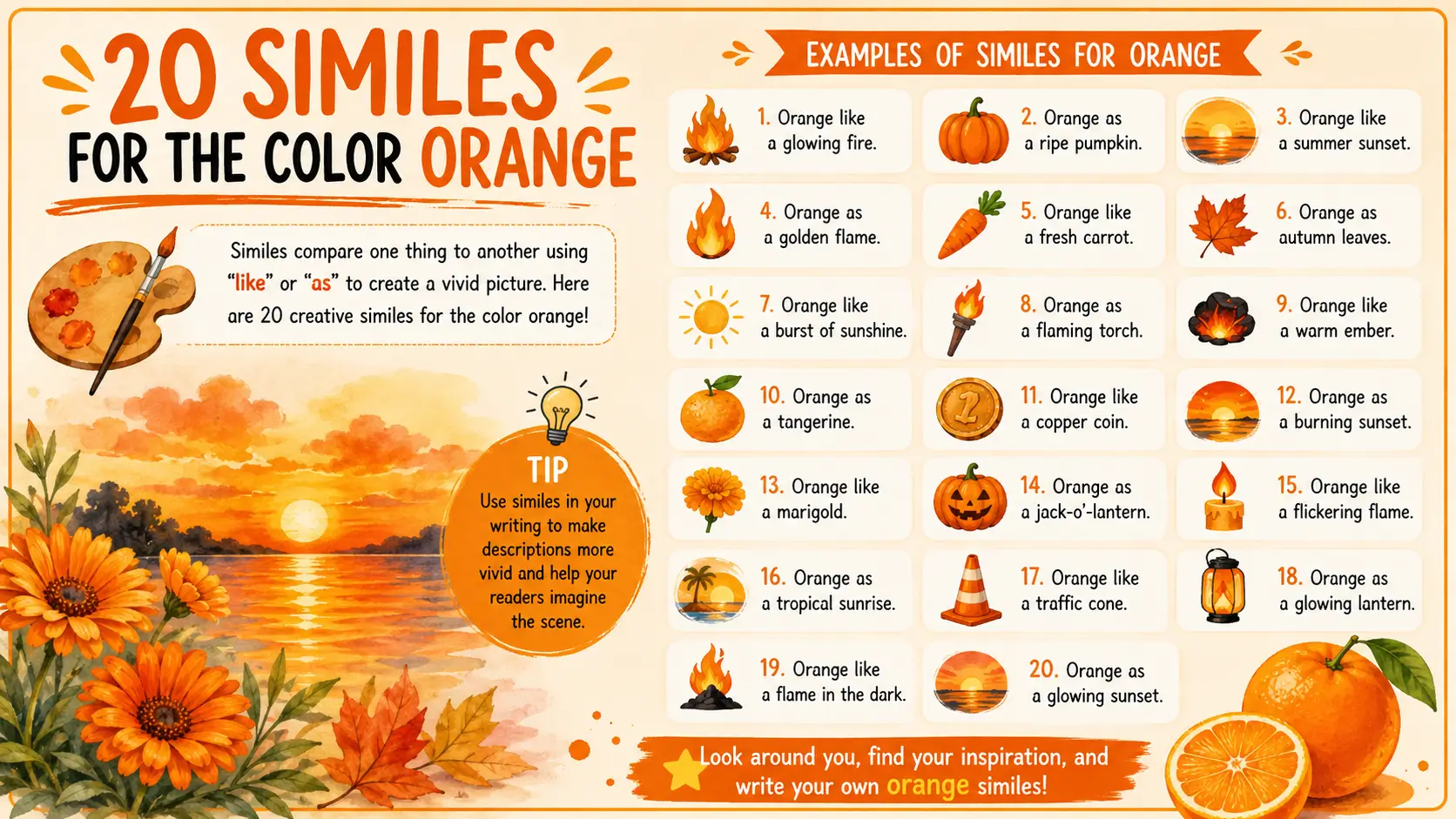
Have you ever looked at a bright orange sunset and thought, “How can I describe that?” Simply saying “the sunset was orange” tells the reader the color, but it does not help them see it. This is where similes can make your writing come alive.
A simile compares one thing to another using words such as like or as. For example, you might say, “The sunset was like a glowing fire.” The sunset is not really fire, but the comparison helps the reader picture its warm, bright orange color.
When you use similes for the color orange, you can describe much more than color. You can show warmth, energy, beauty, brightness, heat, or even autumn feelings. In simple terms, a good simile gives your reader a picture in their mind.
Let’s explore some creative examples of similes for orange. You will also see the meaning behind each one and learn how to use similes in writing. By the end, you will have plenty of ideas for creating your own colorful simile sentences.
1. Orange Like a Glowing Fire
Simile: The sky was orange like a glowing fire.
Meaning: This compares the orange color to the bright glow of a fire.
What it conveys: It creates a feeling of warmth, brightness, and heat. This simile works especially well for sunsets, flames, or glowing lights.
Example sentences:
- The sunset spread across the sky like a glowing fire.
- Her orange scarf shone like a glowing fire in the winter sunlight.
2. Orange as a Ripe Pumpkin
Simile: The pumpkin was orange as a ripe pumpkin.
Meaning: This comparison connects a strong orange color with a fully grown pumpkin.
What it conveys: It suggests a rich, natural, warm orange. It is useful when describing autumn scenes, vegetables, decorations, or clothing.
Example sentences:
- The leaves were orange as a ripe pumpkin.
- His bright hat was as orange as a ripe pumpkin.
3. Orange Like a Summer Sunset
Simile: The clouds were orange like a summer sunset.
Meaning: The orange color is compared with the warm colors seen in the evening sky.
What it conveys: This simile creates a peaceful, beautiful, and dreamy image.
Example sentences:
- The clouds looked like a summer sunset after the rain.
- Her painting was filled with colors like a summer sunset.
4. Orange as a Golden Flame
Simile: The candle burned orange as a golden flame.
Meaning: This compares orange with the glowing color of a bright flame.
What it conveys: It suggests warmth, movement, and glowing light.
Example sentences:
- The campfire flickered like a golden flame in the darkness.
- The lamp gave the room an orange glow like a golden flame.
5. Orange Like a Fresh Carrot
Simile: The carrot was orange like a fresh carrot.
Meaning: This comparison uses the familiar color of a fresh carrot.
What it conveys: It gives the reader a simple, clear picture of a bright natural orange.
Example sentences:
- The bird had feathers orange like a fresh carrot.
- The little flower was as bright as a fresh carrot.
6. Orange as the Autumn Leaves
Simile: The trees were orange as the autumn leaves.
Meaning: This compares an orange object or scene with colorful leaves in fall.
What it conveys: It brings feelings of autumn, change, cool weather, and nature.
Example sentences:
- The park looked orange as the autumn leaves.
- Her sweater was as orange as autumn leaves.
7. Orange Like a Burst of Sunshine
Simile: The flower was orange like a burst of sunshine.
Meaning: The orange color is compared with a sudden burst of bright sunlight.
What it conveys: This simile suggests happiness, energy, brightness, and cheer.
Example sentences:
- The orange flowers opened like a burst of sunshine.
- Her bright dress stood out like a burst of sunshine.
8. Orange as a Flaming Torch
Simile: The torch was orange as a flaming torch.
Meaning: This comparison connects orange with the bright color of a burning torch.
What it conveys: It creates a strong image of fire, light, and energy.
Example sentences:
- The clouds glowed like a flaming torch at sunset.
- The orange flag waved like a flaming torch above the crowd.
9. Orange Like a Warm Ember
Simile: The stone glowed orange like a warm ember.
Meaning: An ember is a small piece of glowing wood or coal left after a fire. Its warm orange color makes it a useful comparison.
What it conveys: This simile suggests a softer, darker, glowing orange.
Example sentences:
- The last light of the sunset glowed like a warm ember.
- The lantern shone like a warm ember in the dark room.
10. Orange as a Tangerine
Simile: The ball was as orange as a tangerine.
Meaning: The bright orange color is compared with the skin of a ripe tangerine.
What it conveys: It gives the reader a simple and familiar picture of vivid orange.
Example sentences:
- The small kite was as orange as a tangerine.
- Her shoes were bright, like a ripe tangerine.
11. Orange Like a Copper Coin
Simile: The old coin was orange like copper.
Meaning: Copper often has a warm reddish-orange color.
What it conveys: This comparison works well for objects with a darker, earthy, or metallic orange shade.
Example sentences:
- The autumn leaves shimmered like copper coins.
- The old roof looked orange like polished copper in the sunlight.
12. Orange as a Burning Sunset
Simile: The horizon was as orange as a burning sunset.
Meaning: This compares an orange color with the intense glow of the evening sky.
What it conveys: It creates a dramatic and powerful image.
Example sentences:
- The mountains stood beneath a sky as orange as a burning sunset.
- The sea reflected light like a burning sunset.
13. Orange Like a Marigold
Simile: The garden was orange like a field of marigolds.
Meaning: Marigolds often have bright orange flowers, making them a natural comparison.
What it conveys: This simile creates an image of beauty, nature, and cheerful color.
Example sentences:
- The flower bed was like a field of orange marigolds.
- Her painting was bright as a marigold in the morning sun.
14. Orange as a Jack-o’-Lantern
Simile: The pumpkin glowed as orange as a jack-o’-lantern.
Meaning: This comparison uses the familiar bright orange color of a carved Halloween pumpkin.
What it conveys: It can create a playful, festive, or spooky feeling.
Example sentences:
- The decorations were as orange as jack-o’-lanterns.
- His bright face appeared like a glowing jack-o’-lantern in the candlelight.
15. Orange Like a Flickering Flame
Simile: The leaves danced orange like a flickering flame.
Meaning: This compares the changing orange colors and movement of leaves with a moving flame.
What it conveys: It gives the scene energy and movement.
Example sentences:
- The autumn trees moved like flickering flames in the wind.
- Orange reflections danced on the wall like flickering flames.
16. Orange as a Tropical Sunrise
Simile: The morning sky was as orange as a tropical sunrise.
Meaning: The comparison connects orange with the warm colors of a sunrise in a tropical setting.
What it conveys: It suggests beauty, warmth, peace, and a fresh beginning.
Example sentences:
- The horizon was as orange as a tropical sunrise.
- The clouds glowed like a tropical sunrise over the ocean.
17. Orange Like a Bright Traffic Cone
Simile: The cone was orange like a bright traffic cone.
Meaning: This uses the strong orange color of a traffic cone as a clear comparison.
What it conveys: It suggests a very bright, bold, and noticeable orange.
Example sentences:
- His jacket was as bright as a traffic cone.
- The warning sign stood out like a bright orange traffic cone.
18. Orange as a Glowing Lantern
Simile: The light was orange as a glowing lantern.
Meaning: This compares the color with the warm orange light produced by a lantern.
What it conveys: It creates a cozy, gentle, and warm feeling.
Example sentences:
- The room looked peaceful like a glowing orange lantern.
- The moonlight mixed with the warm lights like glowing lanterns along a path.
19. Orange Like a Flame in the Dark
Simile: Her dress stood out like a flame in the dark.
Meaning: The bright orange dress is compared with a flame that can easily be seen against darkness.
What it conveys: This shows strong contrast and draws attention to the orange color.
Example sentences:
- The orange flower stood out like a flame in the dark.
- His bright shirt appeared like a flame against the black wall.
20. Orange as a Glowing Sunset
Simile: The sky was as orange as a glowing sunset.
Meaning: This compares a strong orange shade with the warm glow of the setting sun.
What it conveys: It gives the reader a peaceful, beautiful, and vivid picture.
Example sentences:
- The clouds were as orange as a glowing sunset.
- The lake reflected the sky like a glowing orange sunset.
How to Use Orange Similes in Writing
Knowing examples is helpful, but the real skill comes from knowing how to use similes in writing.
Start by looking at the orange object you want to describe. Then ask yourself:
What does this orange thing remind me of?
It might remind you of:
- Fire
- A pumpkin
- A sunset
- Autumn leaves
- A carrot
- A tangerine
- A flame
- A lantern
- A marigold
- A sunrise
Next, connect your two ideas with like or as.
For example:
Basic sentence:
The leaves were orange.
Creative simile:
The leaves were orange like tiny flames dancing in the wind.
The second sentence gives the reader a much stronger mental picture.
You might say that similes turn ordinary descriptions into small pictures. That is why creative writing similes are so useful in poems, stories, essays, and descriptive writing.
Practical Exercise: Test Your Simile Skills
Try these 10 questions before checking the answers.
Questions
1. Complete the simile:
The sunset was orange like ________.
a) a glowing fire
b) a blue ocean
c) fresh snow
2. Which sentence uses a simile?
a) The pumpkin was orange.
b) The pumpkin was orange like a glowing lantern.
c) The pumpkin grew in the garden.
3. Complete the sentence:
The autumn leaves were as orange as ________.
a) ripe pumpkins
b) dark clouds
c) green grass
4. What does this simile suggest?
The sky glowed like a warm ember.
a) The sky was cold and dark.
b) The sky had a soft, warm orange glow.
c) The sky was completely green.
5. Write a simile for an orange flower using like.
6. Which comparison creates the brightest orange image?
a) orange like a shadow
b) orange like a traffic cone
c) orange like gray stone
7. Complete the simile:
The orange clouds looked like ________.
a) flickering flames
b) pieces of ice
c) drops of rain
8. What is the main purpose of a simile?
a) To make writing more vivid
b) To make every sentence longer
c) To remove descriptions
9. Turn this plain sentence into a simile:
The pumpkin was orange.
10. Create your own simile for an orange sunset.
Answers and Explanations
1. Answer: a) a glowing fire
A glowing fire has a warm, bright orange color. The comparison helps readers picture the sunset more clearly.
2. Answer: b) The pumpkin was orange like a glowing lantern.
This is a simile because it compares the pumpkin to something else using like.
3. Answer: a) ripe pumpkins
Ripe pumpkins are a familiar example of a warm orange color. The comparison makes the color easy to imagine.
4. Answer: b) The sky had a soft, warm orange glow.
A warm ember gives off a gentle orange-red light. The simile creates a calm and glowing image.
5. Example answer:
The orange flower was bright like a tiny burst of sunshine.
There can be many correct answers. The important thing is that the comparison creates a clear picture.
6. Answer: b) orange like a traffic cone
Traffic cones are designed to be highly visible, so they are a good comparison for a strong, bright orange.
7. Answer: a) flickering flames
Flames can be orange and move in the wind. This comparison adds both color and movement to the sentence.
8. Answer: a) To make writing more vivid
Similes help readers imagine what something looks, feels, sounds, or even tastes like.
9. Example answer:
The pumpkin was as orange as a glowing jack-o’-lantern.
The comparison gives the reader a stronger image than simply saying the pumpkin was orange.
10. Example answer:
The sunset was like a giant orange flame spreading across the sky.
Your answer can be different. A strong simile should create a clear and interesting picture.
Why Similes Make Writing Better
A simile can take a simple idea and give it life.
Compare these two sentences:
The sky was orange.
The sky was orange like a giant fire glowing above the hills.
Both sentences tell us about the color. However, the second sentence gives us more to imagine. We can almost see the bright sky and feel its warmth.
This is the real meaning of similes in creative writing: they help readers connect an unfamiliar image with something they already know.
Similes are also useful because they can create different moods.
For example:
- Orange like a warm ember can feel calm.
- Orange like a roaring fire can feel powerful.
- Orange like a marigold can feel cheerful.
- Orange like autumn leaves can feel peaceful.
- Orange like a traffic cone can feel bold and bright.
So, the best simile is not always the brightest one. Choose a comparison that matches the feeling you want your reader to experience.
Tips for Creating Your Own Orange Similes
Here are a few simple tips to help you create original similes.
1. Look around you
Find orange objects in everyday life. You may notice fruit, flowers, clothes, signs, toys, sunsets, leaves, or lights.
2. Think about the shade
Orange is not always the same. It can be:
- Bright orange
- Dark orange
- Pale orange
- Golden orange
- Red-orange
- Peach-orange
- Burnt orange
Choose a comparison that matches the exact shade.
3. Think about the feeling
Ask yourself what the color makes you feel.
Does it feel:
- Warm?
- Happy?
- Exciting?
- Peaceful?
- Energetic?
- Spooky?
- Cozy?
Your answer can guide your simile.
4. Use sensory details
Do not only describe how something looks. Think about heat, movement, sound, or mood.
For example:
The orange leaves glowed like tiny fires in the cool wind.
Now the reader can imagine both color and movement.
5. Avoid forced comparisons
A simile should make sense to the reader. If the comparison feels random, choose another one.
Good writing does not need complicated words. A simple, clear comparison can be much more powerful.
Conclusion
Similes make ordinary descriptions more colorful, vivid, and memorable. When you describe orange as like a glowing fire, as bright as a tangerine, or like autumn leaves, your reader gets more than a color. They get an image.
The best simile sentences connect something familiar with something you want your reader to imagine. That is why similes are useful in poems, stories, school writing, and everyday creative work.
Now it is your turn. Look around and find something orange. Think about what it reminds you of, then build a sentence with like or as. Do not worry about making it perfect. Try a few ideas, have fun, and let your imagination choose the comparison.

I am Beau Thomas, the Administrator at SimilyHub. I enjoy making similes, metaphors, and idioms easy to understand through clear explanations, helpful examples, and engaging content for English learners and writers.