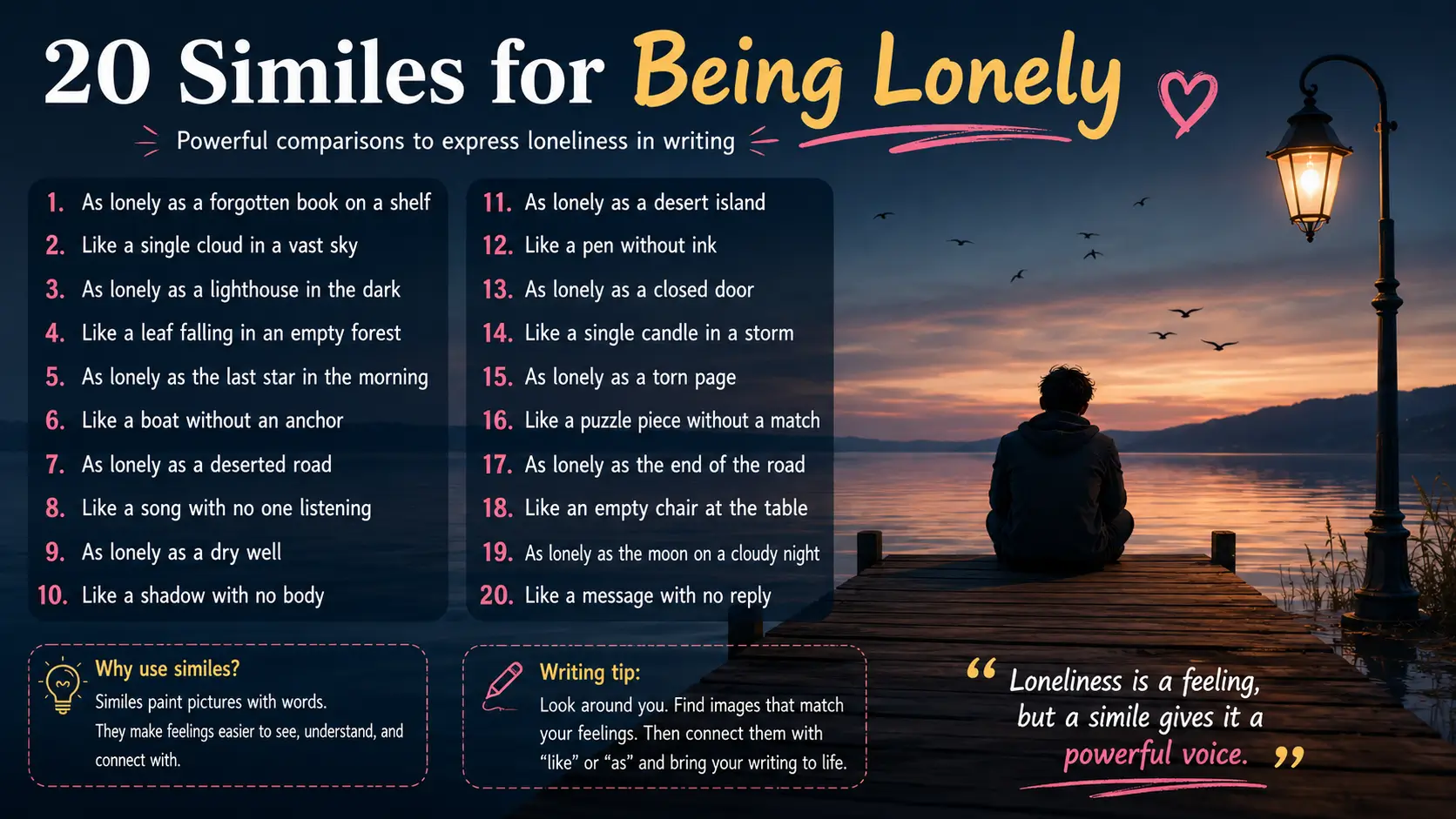
Have you ever felt lonely even when other people were around? Sometimes, the feeling is hard to explain. You know what you feel, but the right words seem far away. This is where similes can help.
A simile compares one thing to another using words such as “like” or “as.” For example, you might say, “She felt as lonely as a single star in a dark sky.” You are not really a star. The comparison helps the reader picture the feeling.
Similes make writing more vivid, emotional, and easy to understand. They turn an invisible feeling into a picture we can see in our minds. In simple terms, a good simile helps readers feel what your character feels.
If you are looking for similes for being lonely, you are in the right place. Let’s explore 20 creative examples, their meanings, and simple simile sentences you can use in stories, poems, essays, and everyday writing.
A quick note: “Strohl simile” is not a standard literary term. If you saw that phrase somewhere, it may be a typo or a mistaken reference to a regular simile.
20 Similes for Being Lonely
1. As lonely as a forgotten book on a shelf
Meaning: Very lonely and ignored.
What it conveys: This simile creates the image of something left behind while everyone else moves on.
Example sentences:
- She felt as lonely as a forgotten book on a dusty shelf.
- After everyone left, he sat quietly, as lonely as a forgotten book.
2. Like a single cloud in a vast sky
Meaning: Feeling completely alone in a large world.
What it conveys: A small cloud floating across a huge sky suggests isolation and distance.
Example sentences:
- He felt like a single cloud in a vast sky.
- Among the busy crowd, she was like a single cloud drifting alone.
3. As lonely as a lighthouse in the dark
Meaning: Feeling isolated while standing apart from others.
What it conveys: A lighthouse stands alone, even though its light helps other people.
Example sentences:
- He stood by the window, as lonely as a lighthouse in the dark.
- She felt as lonely as a lighthouse watching the empty sea.
4. Like a leaf falling in an empty forest
Meaning: Feeling lost and unheard.
What it conveys: The falling leaf suggests someone whose presence seems unnoticed.
Example sentences:
- He felt like a leaf falling in an empty forest.
- Her quiet voice disappeared like a leaf falling in an empty forest.
5. As lonely as the last star in the morning
Meaning: Being the final one left behind.
What it conveys: The last visible star before daylight suggests fading away while everything changes.
Example sentences:
- She felt as lonely as the last star in the morning.
- He sat by himself, as lonely as the last star before sunrise.
6. Like a boat without an anchor
Meaning: Feeling without support, direction, or connection.
What it conveys: A boat without an anchor can drift away, giving the feeling of being lost.
Example sentences:
- After his friends moved away, he felt like a boat without an anchor.
- She drifted through the week like a boat without an anchor.
7. As lonely as a deserted road
Meaning: Empty, quiet, and isolated.
What it conveys: A deserted road gives the reader a strong picture of silence and emptiness.
Example sentences:
- His room felt as lonely as a deserted road.
- At midnight, the old street looked as lonely as a deserted road.
8. Like a song with no one listening
Meaning: Feeling unheard or unnoticed.
What it conveys: A song needs listeners, so this comparison suggests that someone’s thoughts or feelings are going unheard.
Example sentences:
- She felt like a song with no one listening.
- His dreams seemed like a song playing to an empty room.
9. As lonely as a dry well
Meaning: Feeling empty and without comfort.
What it conveys: A dry well has nothing to give, making it a strong image for emotional emptiness.
Example sentences:
- His heart felt as lonely as a dry well.
- After the goodbye, she felt as empty as a dry well.
10. Like a shadow with no body
Meaning: Feeling invisible or unnoticed.
What it conveys: A shadow normally belongs to someone or something. A shadow with no body suggests loneliness and a lack of identity or connection.
Example sentences:
- He walked through the crowd like a shadow with no body.
- She felt like a shadow with no body in the noisy classroom.
11. As lonely as a desert island
Meaning: Completely isolated from others.
What it conveys: A desert island is far from people, making it a simple and powerful image of loneliness.
Example sentences:
- He felt as lonely as a desert island.
- Even in the crowded city, she sometimes felt as lonely as a desert island.
12. Like a pen without ink
Meaning: Feeling unable to express yourself.
What it conveys: A pen without ink cannot write, just as a lonely person may struggle to share their feelings.
Example sentences:
- Without anyone to talk to, he felt like a pen without ink.
- Her ideas stayed inside her like a pen without ink.
13. As lonely as a closed door
Meaning: Feeling shut out from others.
What it conveys: A closed door can represent separation, distance, and blocked connection.
Example sentences:
- He felt as lonely as a closed door.
- After the argument, she stood there as lonely as a closed door.
14. Like a single candle in a storm
Meaning: Feeling alone and vulnerable.
What it conveys: A small candle struggling against a storm creates an image of someone trying to stay strong while alone.
Example sentences:
- She stood alone like a single candle in a storm.
- He felt like a single candle trying to survive the darkness.
15. As lonely as a torn page
Meaning: Feeling incomplete or separated.
What it conveys: A torn page suggests something removed from the whole, making it useful for describing emotional separation.
Example sentences:
- She felt as lonely as a torn page from an old book.
- After leaving home, he felt like a torn page.
16. Like a puzzle piece without a match
Meaning: Feeling out of place or unable to connect.
What it conveys: A puzzle piece needs other pieces to form a picture. Without a match, it remains separate.
Example sentences:
- At the new school, he felt like a puzzle piece without a match.
- She felt like a puzzle piece that belonged nowhere.
17. As lonely as the end of the road
Meaning: Feeling alone at the end of a journey.
What it conveys: The end of a road can suggest finality, distance, and having no one beside you.
Example sentences:
- He felt as lonely as the end of the road.
- At that moment, her life seemed as lonely as an empty road’s end.
18. Like an empty chair at the table
Meaning: Feeling someone’s absence or feeling that someone is missing.
What it conveys: An empty chair can remind us of a person who is no longer there.
Example sentences:
- He stared at the empty chair like someone waiting for a friend.
- The empty chair at the table felt like a symbol of her loneliness.
19. As lonely as the moon on a cloudy night
Meaning: Feeling hidden, distant, and alone.
What it conveys: The moon is far away, and clouds can hide its light. This creates a gentle, emotional image.
Example sentences:
- She felt as lonely as the moon on a cloudy night.
- His smile faded, leaving him as lonely as a hidden moon.
20. Like a message with no reply
Meaning: Feeling ignored or longing for connection.
What it conveys: Sending a message and receiving no response is a familiar experience that can make loneliness easy to understand.
Example sentences:
- He waited like a message with no reply.
- Her heart felt like a message sent into silence.
How to Use Similes for Loneliness in Writing
A simile works best when it fits the emotion and situation. You do not need to use a complicated comparison. A simple image can be stronger.
For example, instead of writing:
He was very lonely.
You might write:
He felt like a single cloud drifting across a huge sky.
The second sentence gives the reader something to picture.
When using creative writing similes, think about what loneliness looks, sounds, or feels like.
Ask yourself:
- Does loneliness feel empty?
- Does it feel quiet?
- Does it feel like being forgotten?
- Does it feel like being far away?
- Does it feel like missing someone?
Then find an object, place, or experience that creates the same feeling.
That is one of the easiest ways to learn how to use similes in writing.
Practical Exercise: Test Your Understanding
Complete each sentence with the best simile from the list above.
Questions
- He felt ________ in the crowded city.
- She stood alone, ________ in the dark.
- After everyone left, he felt like ________.
- Her voice seemed like ________.
- Without her friends, she felt ________.
- He wandered through life like ________.
- She felt like ________ when nobody understood her.
- His heart was as empty as ________.
- At the new school, he felt like ________.
- She waited for a reply like ________.
Answers and Explanations
1. Like a single cloud in a vast sky
Explanation: The cloud is surrounded by a huge empty space, making it a good image of isolation.
2. Like a single candle in a storm
Explanation: A candle standing alone in a storm suggests vulnerability and struggle.
3. A forgotten book on a shelf
Explanation: A forgotten book represents someone who feels ignored or left behind.
4. A song with no one listening
Explanation: This comparison shows that her words or feelings are not being heard.
5. As lonely as a desert island
Explanation: A desert island is separated from other people, making it a clear image of loneliness.
6. A boat without an anchor
Explanation: A boat without an anchor can drift without support or direction.
7. Like a pen without ink
Explanation: A pen without ink cannot express anything, just as she may struggle to express herself.
8. A dry well
Explanation: A dry well suggests emptiness and a lack of comfort or emotional support.
9. A puzzle piece without a match
Explanation: This shows that the person feels out of place and unable to connect.
10. Like a message with no reply
Explanation: Waiting for an unanswered message creates a familiar feeling of distance and longing.
Why Similes Make Lonely Feelings Stronger
Loneliness is an emotion, so readers cannot see it directly. Similes give that emotion a shape.
Compare these two sentences:
Plain:
Maria was lonely.
With a simile:
Maria felt like an empty chair at a table.
The second sentence gives us an image. We can picture the chair. We can imagine the missing person. We can feel the silence around it.
That is the real power of similes.
Good examples of similes do not simply decorate writing. They help readers understand an emotion quickly. They can also make characters more realistic and memorable.
You might say that a simile gives an invisible feeling a visible face.
How to Create Your Own Similes for Being Lonely
Creating your own simile is easier than it sounds.
Start with the feeling:
“I feel lonely.”
Now ask:
“What else feels lonely?”
Maybe you think of:
- An empty playground
- A house with no lights
- A single bird
- An abandoned train station
- A lost balloon
- An empty seat
- A fading photograph
- A quiet street at midnight
Now connect the image to the feeling using like or as.
For example:
Lonely + empty playground
He felt like an empty playground after sunset.
Or:
Lonely + single bird
She was like a single bird flying across the winter sky.
This simple method can help you create original simile sentences for poems, stories, journals, and other creative writing.
Conclusion
Similes help us turn difficult feelings into clear pictures. When you write about loneliness, a simple comparison can make your words much more powerful. Instead of only telling readers that a character feels lonely, you can show that feeling through an empty chair, a distant moon, a forgotten book, or a message with no reply.
In simple terms, similes help readers see and feel emotions.
The best similes do not need fancy words. They need a strong image that matches the feeling. So, take these examples as inspiration, then try creating your own. Look around you and ask, “What does loneliness remind me of?” Your answer might become your next great simile.
Keep writing, keep exploring, and let your comparisons make your feelings come alive.

I am Beau Thomas, the Administrator at SimilyHub. I enjoy making similes, metaphors, and idioms easy to understand through clear explanations, helpful examples, and engaging content for English learners and writers.