Have you ever said, “She is as busy as a bee”? That is a simile. A simile compares two different things using words such as like or as. It helps readers picture an idea in a simple and fun way.
For example, saying “The boy ran” tells us what happened. But “The boy ran like a cheetah” gives us a much clearer picture. We can imagine speed, energy, and excitement.
Similes are useful in stories, poems, classroom work, and everyday speech. They make writing more colorful and help readers connect with your ideas.
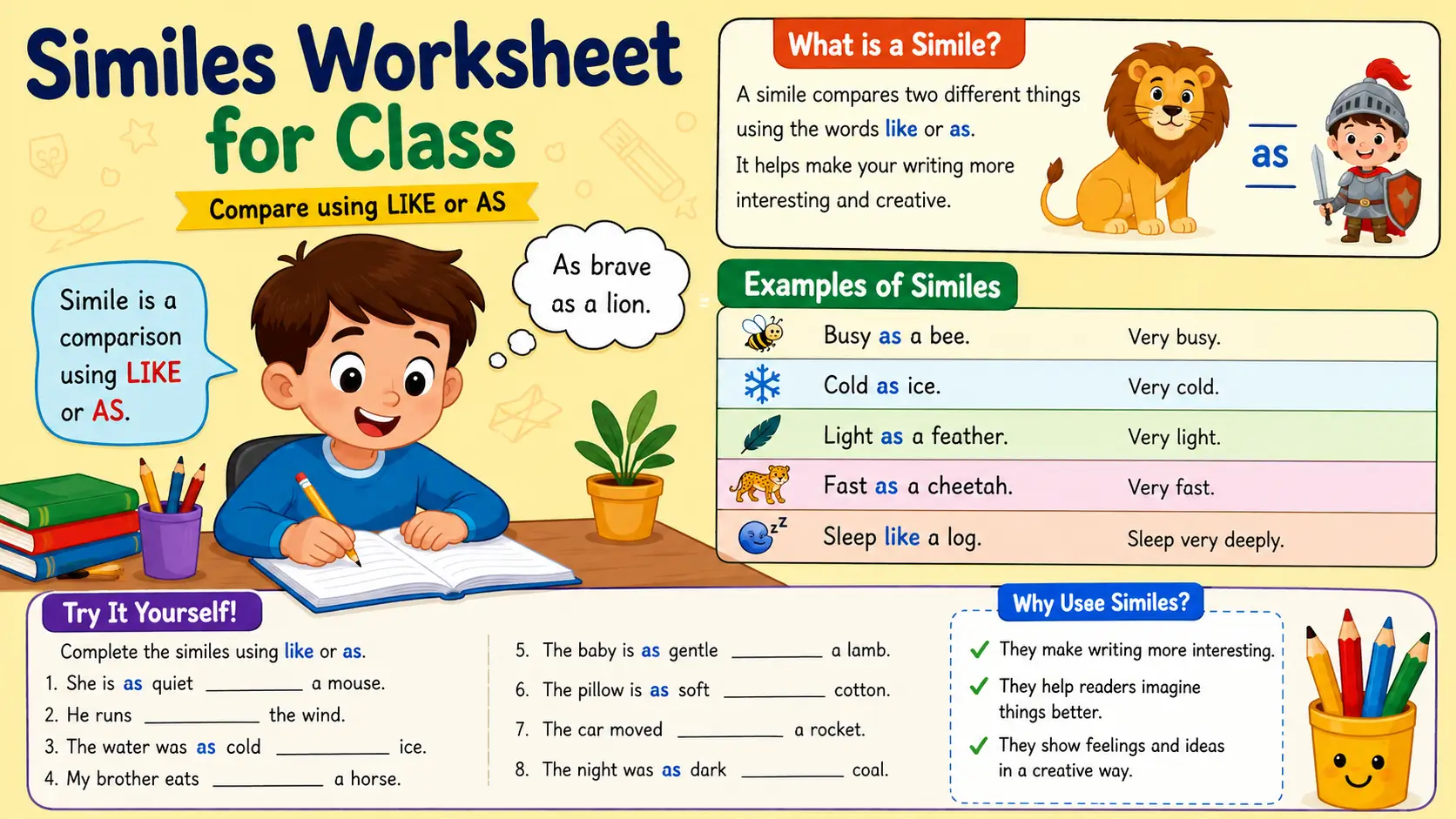
If you are looking for a similes worksheet for class, this guide gives you plenty to practice. You will find examples of similes, meanings, simile sentences, and simple exercises with answers.
One quick note: “strohl simile” is not a standard literary term. If you saw that phrase in a worksheet or lesson, it may be a spelling mistake or a reference used by a particular teacher. In simple terms, a simile is a comparison using like or as.
Let’s explore some easy examples.
What Is a Simile?
A simile is a figure of speech that compares two unlike things using like or as.
Simple formula
Thing + like/as + comparison
For example:
- The baby slept like a log.
- Her smile was as bright as the sun.
- The classroom was as quiet as a library.
The comparison does not mean the two things are actually the same. It helps describe a quality they share.
Here are 20 easy examples of similes. Each one includes its meaning and two example sentences.
1. As busy as a bee
Simile: “My teacher is as busy as a bee.”
Meaning: Very busy and active.
What it conveys: This simile shows that someone has many things to do.
Example sentences:
- Mom was as busy as a bee before the party.
- Our teacher was as busy as a bee preparing the class activity.
2. As brave as a lion
Simile: “The firefighter was as brave as a lion.”
Meaning: Very brave and fearless.
What it conveys: It creates an image of someone who faces danger with courage.
Example sentences:
- Sara was as brave as a lion during the competition.
- The young hero stood as brave as a lion.
3. Runs like the wind
Simile: “Ali runs like the wind.”
Meaning: Ali runs very fast.
What it conveys: It gives the reader a strong picture of great speed.
Example sentences:
- The athlete ran like the wind toward the finish line.
- My brother runs like the wind when he plays football.
4. As cold as ice
Simile: “The water was as cold as ice.”
Meaning: Very cold.
What it conveys: It makes the reader imagine an extremely cold feeling.
Example sentences:
- The mountain stream was as cold as ice.
- My hands felt as cold as ice after playing outside.
5. As bright as the sun
Simile: “Her smile was as bright as the sun.”
Meaning: Very cheerful or shining.
What it conveys: It creates a warm and happy image.
Example sentences:
- The child’s face was as bright as the sun.
- His smile was as bright as the sun after winning the prize.
6. Sleeps like a log
Simile: “My little brother sleeps like a log.”
Meaning: Sleeps very deeply.
What it conveys: It suggests that the person does not wake easily.
Example sentences:
- Dad slept like a log after a long day.
- The baby slept like a log all night.
7. As light as a feather
Simile: “The box was as light as a feather.”
Meaning: Very light in weight.
What it conveys: It helps the reader imagine something that is easy to lift.
Example sentences:
- The paper was as light as a feather.
- The little bag felt as light as a feather.
8. As fast as a cheetah
Simile: “The runner was as fast as a cheetah.”
Meaning: Extremely fast.
What it conveys: It gives a clear image of speed.
Example sentences:
- The boy was as fast as a cheetah during the race.
- She moved as fast as a cheetah across the field.
9. As quiet as a mouse
Simile: “The students were as quiet as mice.”
Meaning: Very quiet.
What it conveys: It shows that there is little or no noise.
Example sentences:
- Everyone became as quiet as a mouse when the principal entered.
- The children sat as quiet as mice during the story.
10. Eats like a horse
Simile: “My brother eats like a horse.”
Meaning: Eats a lot of food.
What it conveys: It adds a playful way to describe a person’s large appetite.
Example sentences:
- After football practice, Omar ate like a horse.
- My hungry cousin eats like a horse.
11. As gentle as a lamb
Simile: “The little girl was as gentle as a lamb.”
Meaning: Very gentle and kind.
What it conveys: It creates an image of someone who treats others softly.
Example sentences:
- The nurse was as gentle as a lamb with the child.
- He was as gentle as a lamb while holding the kitten.
12. Shines like a star
Simile: “The dancer shines like a star.”
Meaning: Stands out or performs wonderfully.
What it conveys: It suggests talent, beauty, or success.
Example sentences:
- Maya shines like a star on stage.
- The young singer shone like a star during the show.
13. As red as a rose
Simile: “The flower was as red as a rose.”
Meaning: Deep or bright red.
What it conveys: It gives the reader a clear picture of the color.
Example sentences:
- Her dress was as red as a rose.
- The sunset looked as red as a rose.
14. As busy as an ant
Simile: “The workers were as busy as ants.”
Meaning: Very active and hardworking.
What it conveys: It compares people’s activity to the constant work of ants.
Example sentences:
- The students were as busy as ants before the school fair.
- Everyone was as busy as ants cleaning the classroom.
15. Laughs like a hyena
Simile: “He laughs like a hyena.”
Meaning: Laughs loudly or in a distinctive way.
What it conveys: It creates a funny and vivid image of someone’s laugh.
Example sentences:
- My friend laughs like a hyena when he hears a funny joke.
- The children laughed like hyenas during the game.
16. As soft as cotton
Simile: “The pillow was as soft as cotton.”
Meaning: Very soft and comfortable.
What it conveys: It helps readers imagine a pleasant texture.
Example sentences:
- The blanket felt as soft as cotton.
- The puppy’s fur was as soft as cotton.
17. As busy as a squirrel
Simile: “The squirrel was as busy as a bee.”
Meaning: Very active and always moving.
What it conveys: It creates an image of quick and constant activity.
Example sentences:
- The children were as busy as squirrels collecting leaves.
- She was as busy as a squirrel getting ready for the event.
18. As clear as glass
Simile: “The lake was as clear as glass.”
Meaning: Very clear and easy to see through.
What it conveys: It helps the reader imagine a clean, transparent surface.
Example sentences:
- The water was as clear as glass.
- We could see the stones because the stream was as clear as glass.
19. As slippery as a fish
Simile: “The wet ball was as slippery as a fish.”
Meaning: Very difficult to hold.
What it conveys: It gives a playful image of something sliding out of your hands.
Example sentences:
- The soap was as slippery as a fish.
- The wet football felt as slippery as a fish.
20. As hungry as a wolf
Simile: “I was as hungry as a wolf after school.”
Meaning: Very hungry.
What it conveys: It shows strong hunger in a fun and memorable way.
Example sentences:
- After the long hike, we were as hungry as wolves.
- The children were as hungry as wolves after playing outside.
Practical Simile Exercise: 10 Questions
Now it is your turn. Try these questions before checking the answers.
Question 1: Identify the simile
Which sentence contains a simile?
A. The dog barked loudly.
B. The dog was as fast as a rocket.
C. The dog ran home.
Question 2: Complete the simile
The classroom was as quiet as a ________.
A. mouse
B. drum
C. train
Question 3: Identify the comparison
What two things are compared in this sentence?
“Her smile was as bright as the sun.”
Question 4: Complete the sentence
The boy ran ________ the wind.
A. like
B. under
C. beside
Question 5: What does it mean?
What does “as light as a feather” mean?
A. Very heavy
B. Very light
C. Very noisy
Question 6: Find the simile
Which sentence uses a simile?
A. The moon was beautiful.
B. The moon looked like a silver ball.
C. The moon appeared tonight.
Question 7: Create your own simile
Complete this sentence:
“The baby was as peaceful as __________.”
Question 8: What does it convey?
What does “He eats like a horse” suggest?
A. He eats very little.
B. He eats very slowly.
C. He eats a lot.
Question 9: Identify the comparison word
Which word makes this sentence a simile?
“The flowers danced like little children.”
Question 10: Create a simile sentence
Write a simile about something that is very cold.
Answers and Explanations
1. Answer: B
“The dog was as fast as a rocket.” uses as to make a comparison. It tells us the dog was very fast.
2. Answer: A — mouse
The common simile is “as quiet as a mouse.” It means very quiet.
3. Answer: Her smile and the sun
The sentence compares the brightness of her smile to the sun.
4. Answer: A — like
The correct sentence is: “The boy ran like the wind.”
5. Answer: B — Very light
“As light as a feather” means something weighs very little.
6. Answer: B
“The moon looked like a silver ball.” compares the moon with a silver ball using like.
7. Possible answer: a sleeping kitten
“The baby was as peaceful as a sleeping kitten.” This suggests the baby was calm and quiet.
Your answer can be different as long as it makes a clear comparison using like or as.
8. Answer: C — He eats a lot.
“Eats like a horse” is a playful way to describe someone with a big appetite.
9. Answer: “like”
The word like connects the flowers with little children and creates the comparison.
10. Possible answer
“The water was as cold as ice.”
Other answers can work too, such as “The wind felt like a freezer.” The important thing is to create a clear comparison.
How to Use Similes in Writing
Using similes is easy when you start with a simple idea.
First, think about what you want to describe. Maybe it is a person, place, sound, feeling, color, or object.
Next, think about something that has a similar quality.
For example:
Idea: The classroom is quiet.
Comparison: A library is quiet.
Simile: The classroom was as quiet as a library.
You might say:
“The rain sounded like tiny drums.”
This is more interesting than simply saying, “It was raining.”
When writing your own creative writing similes, ask yourself:
- What does this thing look like?
- What does it sound like?
- How does it feel?
- What is it similar to?
- Can I use like or as to make the comparison?
The best similes are clear, natural, and easy for readers to understand.
Simile vs. Metaphor
Similes and metaphors both make comparisons, but they work differently.
Simile:
“The boy is as brave as a lion.”
Metaphor:
“The boy is a lion.”
The simile uses as to make the comparison clear. The metaphor says one thing is another.
For beginners, looking for like and as is a useful way to spot many similes.
Why Similes Matter in Class
Similes can make classroom writing more exciting. They help students move beyond simple descriptions and create pictures with words.
Instead of:
“The sun was bright.”
A student might write:
“The sun was as bright as a giant lamp.”
Instead of:
“The puppy was soft.”
A student might write:
“The puppy was as soft as cotton.”
These small changes can make a big difference. They encourage students to notice the world around them and find creative connections.
A good similes worksheet for class can also help students practice reading, vocabulary, descriptive writing, and creative thinking at the same time.
Conclusion
Similes are simple but powerful tools for better writing. They compare one thing with another using words such as like and as. This makes descriptions easier to picture and more fun to read.
Whether you are writing a poem, story, paragraph, or classroom assignment, similes can help your ideas stand out. The key is to choose comparisons that make sense and clearly show the quality you want to describe.
Now that you have explored these examples of similes and completed the exercises, try creating a few of your own. Look around you and ask, “What does this remind me of?” You might be surprised by the creative comparisons you discover.
Keep practicing, and soon writing simile sentences will feel natural.

I am Beau Thomas, the Administrator at SimilyHub. I enjoy making similes, metaphors, and idioms easy to understand through clear explanations, helpful examples, and engaging content for English learners and writers.