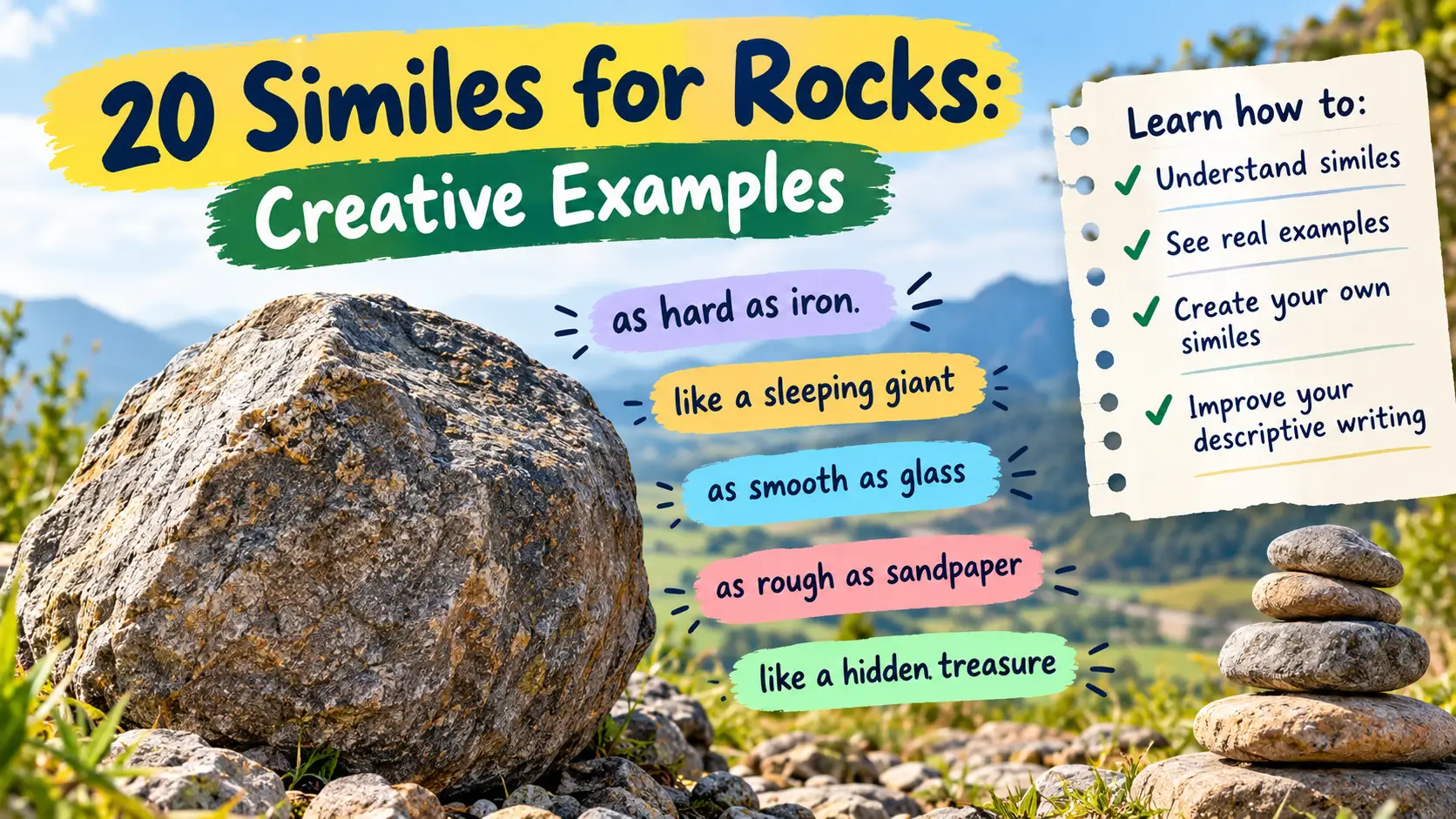
Rocks may seem simple, but they can create strong images in creative writing. They can be rough, smooth, heavy, sharp, cold, solid, or ancient. The right comparison can help readers picture a rock clearly and understand what it represents. For example, saying “the rock was hard as iron” gives a stronger image than simply saying “the rock was hard.” These similes for rocks can make stories, poems, school assignments, and descriptive writing more interesting.
A simile compares two different things using words such as like or as. When you compare a rock to something familiar, readers can quickly imagine its size, shape, texture, or strength. In this guide, you will find 20 creative examples of similes, along with simple meanings and natural simile sentences. You will also learn how to use similes in writing, tell a simile from a metaphor, and practice creating your own comparisons. Whether you are a beginner or simply looking for fresh creative writing similes, these examples can help you make your writing more vivid.
20 Similes for Rocks
1. As hard as iron
Meaning: The rock is extremely hard and difficult to break.
What it conveys: This creates an image of great strength and toughness.
Example sentences:
- The old rock was as hard as iron beneath our feet.
- We could not crack the rock because it was as hard as iron.
2. Like a sleeping giant
Meaning: The rock is large, powerful-looking, and still.
What it conveys: This comparison makes the rock seem enormous and mysterious.
Example sentences:
- The huge boulder rested on the hillside like a sleeping giant.
- From a distance, the mountain rock looked like a sleeping giant.
3. As smooth as glass
Meaning: The rock has a very smooth surface.
What it conveys: It creates an image of a polished, slippery, or carefully worn rock.
Example sentences:
- The river stone was as smooth as glass.
- She held a small rock that felt as smooth as glass.
4. Like a piece of the earth’s armor
Meaning: The rock looks strong and protective.
What it conveys: This comparison gives the rock a powerful and protective quality.
Example sentences:
- The giant boulder stood like a piece of the earth’s armor.
- The dark rocks covered the hillside like pieces of the earth’s armor.
5. As cold as ice
Meaning: The rock feels extremely cold.
What it conveys: Readers can almost feel the chilly surface.
Example sentences:
- The stone was as cold as ice when I picked it up.
- His wet hand touched a rock as cold as ice.
6. Like a giant brick
Meaning: The rock is large, solid, and heavy.
What it conveys: This makes the rock seem bulky and difficult to move.
Example sentences:
- The fallen stone was like a giant brick in the middle of the path.
- We tried to lift the rock, but it was like a giant brick.
7. As rough as sandpaper
Meaning: The rock has a coarse and uneven surface.
What it conveys: This comparison helps readers imagine its scratchy texture.
Example sentences:
- The cave wall felt as rough as sandpaper.
- I touched the rock, and its surface was as rough as sandpaper.
8. Like a hidden treasure
Meaning: The rock is unusual, beautiful, or valuable to the person who finds it.
What it conveys: It creates a sense of excitement and discovery.
Example sentences:
- The colorful stone in the stream looked like a hidden treasure.
- To the child, the shiny rock was like a hidden treasure.
9. As heavy as a boulder
Meaning: Something feels extremely heavy, like a large rock.
What it conveys: This comparison emphasizes great weight.
Example sentences:
- The old stone was as heavy as a boulder.
- The muddy rock felt as heavy as a boulder in my hands.
10. Like a frozen loaf of bread
Meaning: The rock has a solid, rounded, or block-like shape.
What it conveys: This playful comparison can make descriptive writing more fun.
Example sentences:
- The oddly shaped rock looked like a frozen loaf of bread.
- A pale stone sat beside the trail like a frozen loaf of bread.
11. As ancient as a dinosaur
Meaning: The rock seems extremely old.
What it conveys: This gives the rock a sense of age, history, and mystery.
Example sentences:
- The massive stone looked as ancient as a dinosaur.
- We wondered how long the rock had existed because it seemed as ancient as a dinosaur.
12. Like a giant’s tooth
Meaning: The rock is large, pale, and oddly shaped.
What it conveys: This comparison creates a strange and memorable picture.
Example sentences:
- A white stone stuck out of the ground like a giant’s tooth.
- The jagged rock looked like a giant’s tooth rising from the earth.
13. As sharp as a knife
Meaning: The rock has a very pointed or cutting edge.
What it conveys: It warns readers that the rock may be dangerous to touch.
Example sentences:
- The broken stone was as sharp as a knife.
- Be careful with that rock because its edge is as sharp as a knife.
14. Like a silent guard
Meaning: The rock stands quietly in one place as if it is watching over something.
What it conveys: This gives the rock a protective and watchful personality.
Example sentences:
- The tall stone stood like a silent guard beside the entrance.
- A large rock remained like a silent guard near the forest path.
15. As dark as charcoal
Meaning: The rock is very dark in color.
What it conveys: This creates a strong visual image of a black or deep-gray stone.
Example sentences:
- The volcanic rock was as dark as charcoal.
- A stone as dark as charcoal rested near the campfire.
16. Like a polished marble
Meaning: The rock is smooth, shiny, and attractive.
What it conveys: This comparison suggests beauty and a carefully finished surface.
Example sentences:
- The wet stone gleamed like polished marble.
- Under the sunlight, the rock looked like polished marble.
17. As steady as a mountain
Meaning: Something is very stable and unlikely to move.
What it conveys: This comparison suggests strength, calmness, and reliability.
Example sentences:
- The huge rock remained as steady as a mountain during the storm.
- He stood beside the stone as steady as a mountain.
18. Like a tiny planet
Meaning: A small, round rock resembles a miniature world.
What it conveys: This gives an ordinary stone a sense of wonder and imagination.
Example sentences:
- The round pebble looked like a tiny planet in her palm.
- Its swirling colors made the little rock look like a tiny planet.
19. As solid as concrete
Meaning: The rock is extremely firm and strong.
What it conveys: This emphasizes durability and strength.
Example sentences:
- The ground beneath the cliff was as solid as concrete.
- The stone felt as solid as concrete when I kicked it.
20. Like a forgotten piece of history
Meaning: The rock seems old and connected to the distant past.
What it conveys: This creates a mysterious feeling and encourages readers to imagine its story.
Example sentences:
- The ancient stone looked like a forgotten piece of history.
- I picked up the weathered rock, wondering if it was like a forgotten piece of history.
How to Use Similes in Writing
Similes work best when they help readers see, feel, or understand something more clearly. You do not need complicated comparisons. Simple ideas can be powerful.
Start with the quality you want to describe. Is the rock hard, rough, smooth, cold, heavy, dark, or old? Then think of something familiar that has the same quality.
For example:
- Hard → “The rock was hard as iron.”
- Smooth → “The pebble was smooth as glass.”
- Rough → “The stone felt like sandpaper.”
- Old → “The rock seemed as ancient as a dinosaur.”
Use like or as to connect your two ideas. Sensory details can make your comparisons stronger. Think about what the rock looks, feels, sounds, or even seems like.
Also consider your tone. A serious story might use “like a silent guard,” while a playful story could use “like a frozen loaf of bread.”
Good similes should add meaning rather than simply decorate a sentence. Choose a comparison that fits the scene and helps your reader picture it.
What Is a Simile?
A simile is a type of figurative language that compares two different things using words such as like or as.
For example:
- The rock was as hard as iron.
- The pebble was like a tiny planet.
- The cave wall felt as rough as sandpaper.
The things being compared are different, but they share a quality. A rock is not actually iron, a planet, or sandpaper. The comparisons simply help readers understand what the rock is like.
Similes are useful in stories, poems, essays, and descriptive writing because they create clearer mental pictures. Instead of saying “The rock was rough,” you can say, “The rock was as rough as sandpaper.” The second sentence gives readers a stronger sensory image.
Simile vs. Metaphor
A simile makes a comparison using words such as like or as.
A metaphor makes a direct comparison without using those words.
For example:
- Simile: The rock was as hard as iron.
- Metaphor: The rock was iron.
Another example:
- Simile: The boulder stood like a giant.
- Metaphor: The boulder was a giant.
Both forms of figurative language can make writing more vivid. The main difference is how the comparison is made. Similes clearly signal the comparison, while metaphors state the comparison more directly.
Practical Exercise: 10 Questions
1. Fill in the blank:
The river stone was as smooth as ________.
2. Identify the simile:
Which sentence contains a simile?
A. The rock was huge.
B. The rock was like a sleeping giant.
C. The rock rested beside the tree.
D. The rock was gray.
3. Multiple choice:
Which comparison best describes a very rough rock?
A. As smooth as glass
B. Like a tiny planet
C. As rough as sandpaper
D. Like a silent guard
4. Identify the comparison word:
In the sentence “The stone was as cold as ice,” which word helps form the simile?
5. Create a simile:
Write a simile describing a very heavy rock.
6. Fill in the blank:
The dark stone was as dark as ________.
7. Simile or metaphor?
“The boulder was a sleeping giant.” Is this a simile or a metaphor?
8. Create a simile:
Write a simile describing a small, colorful pebble.
9. Multiple choice:
Which sentence uses a simile correctly?
A. The rock is a mountain.
B. The rock like mountain.
C. The rock was like a mountain.
D. The rock mountain was heavy.
10. Compare and create:
Think of something that is very old. Write a simile comparing an old rock to that thing.
Answers and Explanations
1. Answer: Glass.
Explanation: “As smooth as glass” compares the smooth surface of a stone with glass.
2. Answer: B. The rock was like a sleeping giant.
Explanation: It uses “like” to compare the rock with a sleeping giant.
3. Answer: C. As rough as sandpaper.
Explanation: Sandpaper has a rough texture, so it is a useful comparison.
4. Answer: As.
Explanation: “As” helps create the comparison “as cold as ice.”
5. Answer: Answers will vary.
Example: The rock was as heavy as a truck.
Explanation: The comparison emphasizes the rock’s great weight.
6. Answer: Charcoal.
Explanation: “As dark as charcoal” creates a clear image of a very dark rock.
7. Answer: Metaphor.
Explanation: The sentence directly says the boulder was a sleeping giant without using “like” or “as.”
8. Answer: Answers will vary.
Example: The pebble looked like a tiny rainbow.
Explanation: The comparison highlights the pebble’s bright colors.
9. Answer: C. The rock was like a mountain.
Explanation: It uses “like” to make a clear comparison.
10. Answer: Answers will vary.
Example: The rock was as ancient as a dinosaur.
Explanation: The comparison emphasizes how extremely old the rock seems.
Conclusion
Using similes for rocks can turn simple descriptions into vivid pictures. Instead of saying a rock is hard, rough, cold, heavy, or old, you can compare it with something readers already know. Phrases such as “as hard as iron,” “as rough as sandpaper,” and “like a silent guard” make your writing more colorful and memorable.
The best similes are clear, natural, and connected to the quality you want to describe. When practicing how to use similes in writing, start with familiar objects and sensory details. Ask yourself what the rock looks, feels, or seems like. Then build a comparison with like or as. With practice, you can create your own examples of similes and use them confidently in stories, poems, schoolwork, and descriptive writing.

I am Beau Thomas, the Administrator at SimilyHub. I enjoy making similes, metaphors, and idioms easy to understand through clear explanations, helpful examples, and engaging content for English learners and writers.