Have you ever read a sentence that made you stop and picture the scene in your mind? That is often the magic of figurative language. Similes and metaphors for creative writing can turn plain words into bright, memorable images.
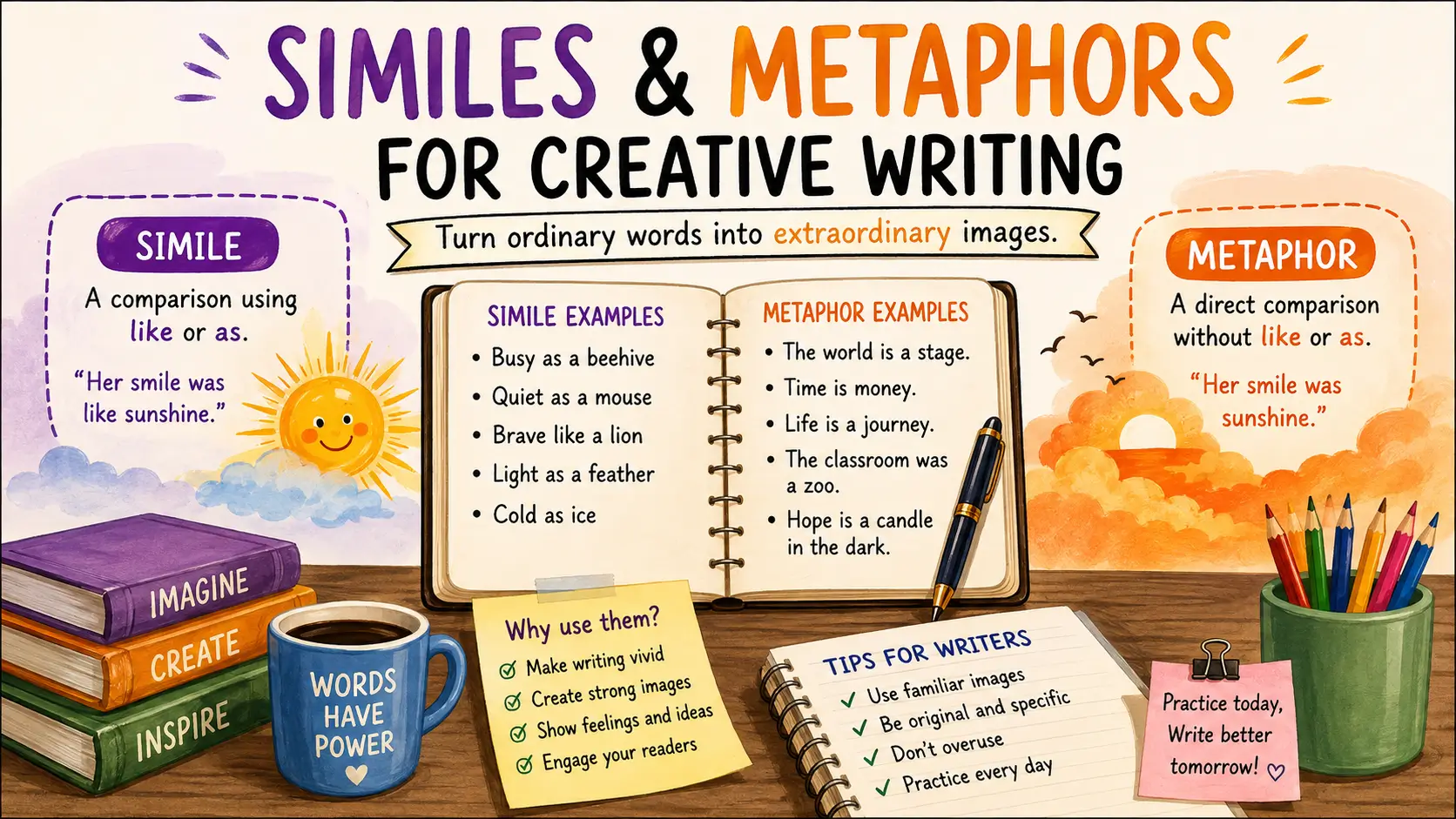
A simile compares two different things using words such as “like” or “as.” For example, “Her smile was like sunshine” helps us imagine a warm, happy smile. A metaphor makes a comparison without using “like” or “as.” For example, “Her smile was sunshine” gives the same idea in a stronger, more direct way.
In simple terms, both devices help readers see, feel, and experience your writing instead of simply reading it.
You might say that similes and metaphors are tools in a writer’s toolbox. They can make stories, poems, essays, and descriptions more colorful.
One quick note: “strohl simile” is not a standard literary term. If you came across that phrase, it may be a typo or a reference to a strong simile. A strong simile is simply a clear, fresh comparison that adds meaning to your writing.
Let’s explore some useful examples.
What Is a Simile?
A simile is a figure of speech that compares two unlike things using “like” or “as.”
For example:
The baby slept like a tiny angel.
The baby is not literally an angel. The comparison helps us imagine the baby’s peaceful appearance.
What Is a Metaphor?
A metaphor also compares two unlike things, but it does so directly.
For example:
The classroom was a zoo.
The classroom is not actually a zoo. The metaphor tells us that it was noisy, busy, or difficult to control.
Simile vs. Metaphor
| Simile | Metaphor |
|---|---|
| Uses “like” or “as” | Makes a direct comparison |
| “His voice was like thunder.” | “His voice was thunder.” |
| Often feels clear and descriptive | Often feels bold and imaginative |
Both can make your creative writing stronger.
20 Creative Writing Similes and Metaphors
1. “Her smile was like sunshine.”
Meaning: Her smile was warm, bright, and cheerful.
What it conveys: This simile creates a happy image and suggests that her smile makes others feel good.
Example sentences:
- Her smile was like sunshine on a cold morning.
- When she entered the room, her smile was like sunshine after rain.
Metaphor: Her smile was sunshine.
2. “He ran like a deer.”
Meaning: He ran very quickly and lightly.
What it conveys: The comparison helps readers picture fast, graceful movement.
Example sentences:
- He ran like a deer across the open field.
- When the dog barked, the boy ran like a deer.
Metaphor: He was a deer racing across the field.
3. “The moon was like a silver coin.”
Meaning: The moon looked round, bright, and silver.
What it conveys: This gives a simple visual image of the moon at night.
Example sentences:
- The moon was like a silver coin floating in the dark sky.
- Above the quiet village, the moon looked like a silver coin.
Metaphor: The moon was a silver coin in the sky.
4. “Her voice was as soft as a whisper.”
Meaning: Her voice was very quiet and gentle.
What it conveys: The simile creates a peaceful and delicate feeling.
Example sentences:
- Her voice was as soft as a whisper.
- She spoke as softly as a whisper so nobody would wake the baby.
Metaphor: Her voice was a whisper.
5. “The wind howled like a hungry wolf.”
Meaning: The wind made a loud, wild sound.
What it conveys: This comparison makes the weather feel powerful and slightly frightening.
Example sentences:
- The wind howled like a hungry wolf outside the window.
- All night, the wind howled like a hungry wolf.
Metaphor: The wind was a hungry wolf.
6. “His heart was like a locked door.”
Meaning: He was unwilling to share his feelings.
What it conveys: The comparison suggests emotional distance or sadness.
Example sentences:
- After the argument, his heart was like a locked door.
- Her kindness slowly opened his heart, which had been like a locked door.
Metaphor: His heart was a locked door.
7. “The classroom was as busy as a beehive.”
Meaning: The classroom was full of activity and noise.
What it conveys: Readers can imagine students moving, talking, and working.
Example sentences:
- Before the test, the classroom was as busy as a beehive.
- At lunchtime, the school hallway was as busy as a beehive.
Metaphor: The classroom was a beehive.
8. “The snow fell like feathers.”
Meaning: The snow fell gently and softly.
What it conveys: This simile creates a calm, peaceful winter scene.
Example sentences:
- The snow fell like feathers from the gray sky.
- Outside my window, snowflakes drifted down like feathers.
Metaphor: The snow was a blanket of feathers.
9. “His anger was like a volcano.”
Meaning: His anger was powerful and ready to explode.
What it conveys: The comparison shows strong emotion that may suddenly burst out.
Example sentences:
- His anger was like a volcano waiting to erupt.
- I could tell his anger was like a volcano beneath the surface.
Metaphor: His anger was a volcano.
10. “The old house stood like a tired soldier.”
Meaning: The house looked worn, damaged, and aged.
What it conveys: The simile gives the house a human quality and creates a sense of history.
Example sentences:
- The old house stood like a tired soldier at the end of the road.
- Covered in dust, the building stood like a tired soldier.
Metaphor: The old house was a tired soldier.
11. “Her laughter was like bells.”
Meaning: Her laughter sounded bright, clear, and pleasant.
What it conveys: This creates an enjoyable sound image.
Example sentences:
- Her laughter was like bells ringing through the garden.
- We heard her laughter, light and clear like bells.
Metaphor: Her laughter was a set of bright bells.
12. “The river moved like a silver snake.”
Meaning: The river moved in a long, winding path.
What it conveys: The comparison helps readers picture the river twisting through the land.
Example sentences:
- The river moved like a silver snake through the valley.
- Under the moonlight, the river curled like a silver snake.
Metaphor: The river was a silver snake.
13. “He was as quiet as a mouse.”
Meaning: He was extremely quiet.
What it conveys: This is a familiar simile that makes silence easy to understand.
Example sentences:
- During the movie, he was as quiet as a mouse.
- The little boy became as quiet as a mouse when the teacher entered.
Metaphor: He was a quiet little mouse.
14. “The city was like a giant machine.”
Meaning: The city was constantly moving and working.
What it conveys: This comparison shows busy streets, people, traffic, and activity.
Example sentences:
- At sunrise, the city was like a giant machine coming to life.
- During rush hour, the city moved like a giant machine.
Metaphor: The city was a giant machine.
15. “Her words were as sharp as knives.”
Meaning: Her words were painful or hurtful.
What it conveys: The comparison shows how deeply someone’s words affected another person.
Example sentences:
- Her words were as sharp as knives.
- Even though he smiled, her words felt as sharp as knives.
Metaphor: Her words were knives.
16. “The stars sparkled like diamonds.”
Meaning: The stars looked bright and beautiful.
What it conveys: This creates a vivid picture of a clear night sky.
Example sentences:
- The stars sparkled like diamonds above the quiet lake.
- On the darkest night, the stars shone like diamonds.
Metaphor: The stars were diamonds scattered across the sky.
17. “Time flies like a bird.”
Meaning: Time seems to pass very quickly.
What it conveys: This simile is useful when writing about childhood, memories, holidays, or important moments.
Example sentences:
- Time flies like a bird when you are having fun.
- As I watched my children grow, time seemed to fly like a bird.
Metaphor: Time is a bird racing across the sky.
18. “The forest was as dark as night.”
Meaning: The forest was extremely dark.
What it conveys: This comparison creates a mysterious or frightening mood.
Example sentences:
- The forest was as dark as night, even though it was afternoon.
- We stepped into a forest as dark as night.
Metaphor: The forest was a sea of night.
19. “Hope is like a small candle.”
Meaning: Hope can provide light during difficult times.
What it conveys: The comparison shows that even a small amount of hope can make darkness easier to face.
Example sentences:
- Hope is like a small candle in a dark room.
- Even during hard times, hope can shine like a small candle.
Metaphor: Hope is a candle in the darkness.
20. “Her imagination was a wild garden.”
Meaning: Her imagination was full of ideas, colors, and unexpected possibilities.
What it conveys: This metaphor shows creativity as something alive, rich, and constantly growing.
Example sentences:
- Her imagination was a wild garden filled with strange and beautiful ideas.
- For the young writer, imagination was a wild garden where stories grew.
Simile: Her imagination was like a wild garden.
How to Use Similes and Metaphors in Creative Writing
Knowing examples of similes is helpful, but knowing how to use similes in writing is even more useful.
Here are a few simple tips.
1. Start with the feeling
Ask yourself what you want the reader to feel.
Do you want the scene to feel:
- Happy?
- Scary?
- Peaceful?
- Lonely?
- Exciting?
- Mysterious?
Then choose a comparison that creates that feeling.
2. Use familiar images
Simple comparisons can be powerful.
For example:
The baby was as peaceful as a sleeping kitten.
Readers quickly understand the image.
3. Avoid forced comparisons
Not every sentence needs a simile or metaphor. Too many comparisons can make writing feel crowded.
Use figurative language when it adds something useful.
4. Try unexpected comparisons
Fresh comparisons can make your writing memorable.
Instead of:
The classroom was noisy.
Try:
The classroom buzzed like a beehive.
The second sentence gives readers a stronger picture.
5. Mix similes and metaphors
You do not have to choose only one.
For example:
The storm was a giant beast. Its wind roared like an angry lion.
The metaphor creates the main image, while the simile adds detail.
Practical Exercise: 10 Questions
Try these questions before looking at the answers.
Question 1
Complete the simile:
The baby slept as peacefully as a ______.
Question 2
Which sentence contains a simile?
A. The classroom was a zoo.
B. The classroom was like a zoo.
C. The classroom became a zoo.
Question 3
Complete the sentence:
The stars were like ______ in the night sky.
Question 4
Is this a simile or metaphor?
Her eyes were two bright stars.
Question 5
Is this a simile or metaphor?
He fought like a lion.
Question 6
Turn this plain sentence into a simile:
The rain was heavy.
Question 7
Turn this simile into a metaphor:
The boy was as fast as a cheetah.
Question 8
What does this simile mean?
Her voice was like a gentle breeze.
Question 9
Create a simile for someone who is very quiet.
He was as quiet as ______.
Question 10
Turn this metaphor into a simile:
The moon was a silver coin.
Answers and Explanations
Answer 1
Possible answer: “The baby slept as peacefully as a kitten.”
The comparison helps readers imagine a calm and gentle baby.
Answer 2
Answer: B. “The classroom was like a zoo.”
The word “like” signals the comparison.
Answer 3
Possible answer: “The stars were like diamonds in the night sky.”
The comparison shows that the stars were bright and sparkling.
Answer 4
Answer: Metaphor.
“Her eyes were two bright stars” makes a direct comparison without using “like” or “as.”
Answer 5
Answer: Simile.
“He fought like a lion” uses the word “like.”
Answer 6
Possible answer:
The rain fell like a waterfall.
This gives readers a stronger image of heavy rain.
Answer 7
Possible answer:
The boy was as fast as a cheetah.
A metaphor could also be:
The boy was a cheetah on the track.
Answer 8
It means her voice was soft, calm, and pleasant, similar to the gentle movement of a breeze.
Answer 9
Possible answer:
He was as quiet as a mouse.
Other answers can work if the comparison clearly shows silence.
Answer 10
Answer:
The moon was like a silver coin.
The original sentence is a metaphor. Adding “like” turns it into a simile.
Why Similes and Metaphors Matter
Good creative writing does more than give information. It helps readers experience an idea.
Compare these two sentences:
The sunset was beautiful.
and:
The sunset was like a golden fire spreading across the sky.
The second sentence gives readers something to picture.
That is the real power of figurative language.
Similes can make descriptions clearer. Metaphors can make ideas stronger. Together, they help writers create mood, emotion, personality, and memorable images.
When you read stories, poems, advertisements, or songs, look for these comparisons. Ask yourself why the writer chose that particular image. Then try creating your own.
Conclusion
Similes and metaphors are simple tools, but they can make creative writing much more powerful. A simile uses words such as “like” or “as” to compare two things, while a metaphor makes the comparison directly.
The best examples of similes do more than decorate a sentence. They help readers see an image, understand a feeling, or experience a moment.
So, when you write your next story, poem, or description, pause and ask: “What does this remind me of?” That question can lead to a great comparison.
Start small. Write one simile today, then turn it into a metaphor. With practice, your writing will become more vivid, creative, and memorable.

I’m Jude James, a passionate writer who loves making similes, metaphors, and idioms easy to understand. I enjoy helping readers explore creative language and express ideas with confidence.