Negative feelings can be hard to explain. Sometimes, simple words are not enough to show anger, sadness, fear, or a gloomy mood. That is where similes can help. They let you compare a feeling, person, or situation to something readers already know.
For example, you might say, “His mood was as dark as a storm cloud.” This simile helps readers picture someone who feels upset or unhappy. It paints a clear image without using a long explanation.
If you are looking for similes for negative, you are in the right place. These expressions can help you describe bad moods, harmful behavior, difficult moments, and unpleasant experiences in a more vivid way. They are useful for school assignments, poems, short stories, essays, and everyday writing.
In this guide, we will explore 20 negative similes, explain their meanings, and show how to use them in natural sentences. You will also find simple examples and a short exercise to test your skills.
By the end, you will have plenty of ideas to make your writing clearer, stronger, and more expressive.
What Is a Negative Simile?
A negative simile is a comparison that describes something unpleasant, harmful, sad, angry, or undesirable. Like other similes, it often uses the words “like” or “as.”
For example:
- “The room was as cold as ice.”
- “His words cut like a knife.”
- “Her mood was like a dark cloud.”
Each sentence compares one thing to another to help the reader understand its feeling or effect.
In simple terms, negative similes help you show a bad feeling instead of just naming it. Rather than saying someone is mean, you might compare their words to sharp thorns. This makes the description more powerful and easier to imagine.
20 Similes for Negative With Meanings and Examples
Here are 20 creative writing similes you can use to describe negative emotions, attitudes, and situations.
1. As Dark as a Storm Cloud
Meaning: Very gloomy, sad, or full of anger.
This simile creates an image of dark skies before a storm. It works well when describing a person’s mood or a difficult situation.
Examples:
- His mood was as dark as a storm cloud after the argument.
- The news left her face as dark as a storm cloud.
2. Like a Knife Through the Heart
Meaning: Extremely painful or upsetting.
This simile describes words or events that cause deep emotional pain. It helps readers feel how much something hurts.
Examples:
- Her cruel comment felt like a knife through the heart.
- Hearing the bad news was like a knife through the heart.
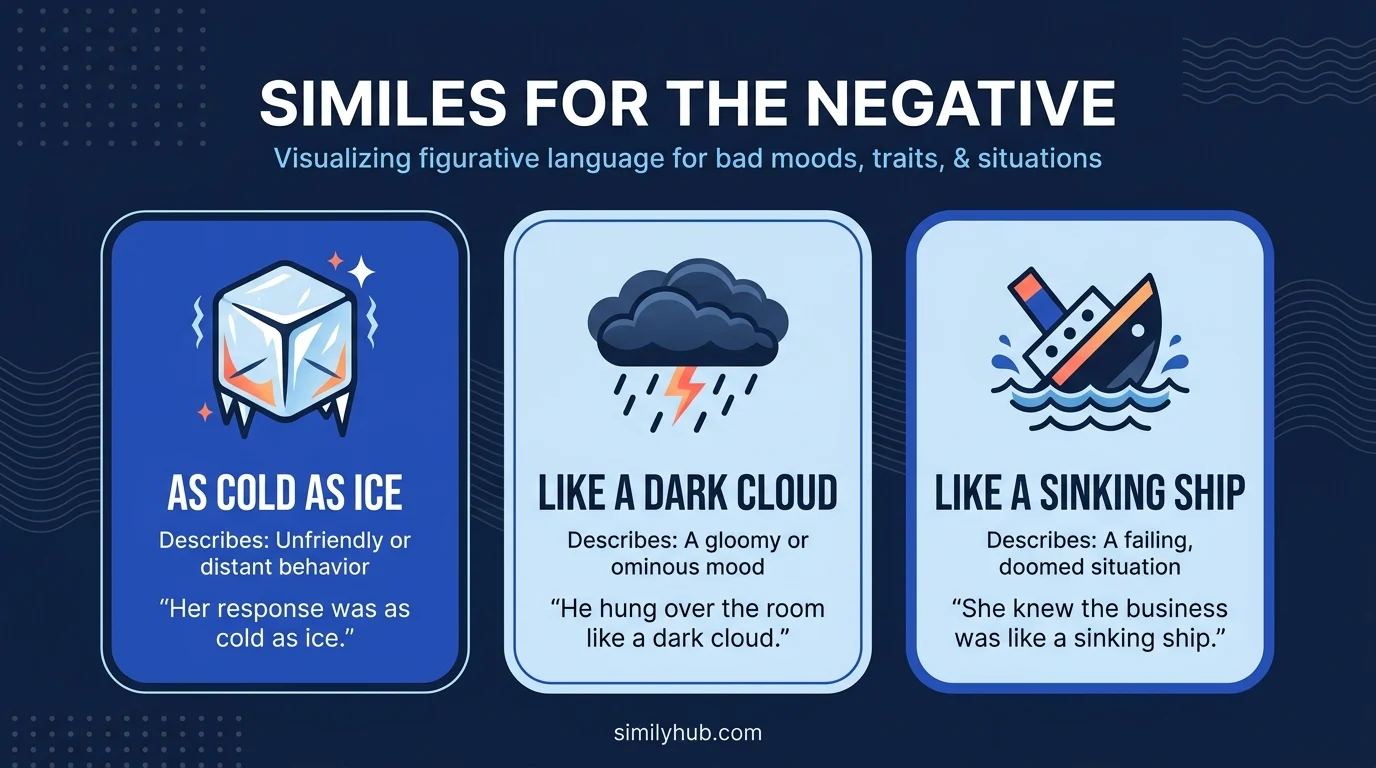
3. As Cold as Ice
Meaning: Unkind, unfriendly, or without warmth.
This is a common simile for someone who shows little care or emotion toward others.
Examples:
- His response was as cold as ice when I asked for help.
- She looked as cold as ice after our disagreement.
4. Like a Broken Record
Meaning: Repeating the same negative thing again and again.
This simile is useful when someone keeps complaining or repeating an irritating message.
Examples:
- He sounded like a broken record as he complained about his job.
- My brother was like a broken record, blaming everyone for his mistake.
5. As Bitter as Vinegar
Meaning: Full of resentment, anger, or unpleasant feelings.
This comparison uses a sharp, sour taste to describe a person’s words or attitude.
Examples:
- Her reply was as bitter as vinegar after the fight.
- He spoke with a tone as bitter as vinegar.
6. Like a Dark Shadow
Meaning: Something troubling that follows a person or makes life feel sad.
This simile can describe guilt, fear, worry, or a painful memory that refuses to go away.
Examples:
- His past mistakes followed him like a dark shadow.
- Fear hung over the village like a dark shadow.
7. As Sharp as a Thorn
Meaning: Harsh, hurtful, or painful.
Just as a thorn can prick the skin, cruel words can hurt someone’s feelings.
Examples:
- Her words were as sharp as a thorn.
- He gave me an answer as sharp as a thorn when I asked a simple question.
8. Like a Heavy Stone
Meaning: A burden that causes worry, sadness, or stress.
This simile helps readers imagine how a problem can weigh on someone’s mind.
Examples:
- The secret sat in his heart like a heavy stone.
- Her guilt felt like a heavy stone she could not put down.
9. As Restless as a Caged Animal
Meaning: Unable to relax because of worry, anger, or frustration.
This comparison shows someone who feels trapped and cannot find peace.
Examples:
- He paced the room, as restless as a caged animal.
- Before the difficult meeting, she felt as restless as a caged animal.
10. Like a House of Cards
Meaning: Weak or unstable and likely to fall apart.
This simile describes plans, relationships, or situations that can fail easily.
Examples:
- Their friendship fell apart like a house of cards.
- His plan was like a house of cards, ready to collapse at the first problem.
11. As Sour as a Lemon
Meaning: Unpleasant, unfriendly, or full of dissatisfaction.
This simile uses a sour taste to describe a person’s mood or reaction.
Examples:
- He gave me an expression as sour as a lemon.
- Her attitude was as sour as a lemon after losing the game.
12. Like Walking on Broken Glass
Meaning: A painful or difficult experience that requires great care.
This comparison works well for tense relationships and uncomfortable situations.
Examples:
- Talking to his angry boss felt like walking on broken glass.
- Their marriage had become like walking on broken glass.
13. As Slow as a Snail
Meaning: Moving or progressing very slowly.
Although this simile is not always negative, it can show frustration when something takes too long.
Examples:
- The service was as slow as a snail at the busy restaurant.
- Progress on our project was as slow as a snail.
14. Like a Leaking Bucket
Meaning: Unable to hold or keep something properly, such as money, energy, or information.
This simile can describe wasteful habits or a problem that keeps getting worse.
Examples:
- His savings disappeared like water from a leaking bucket.
- My energy felt like a leaking bucket after a sleepless night.
15. As Weak as a Paper Wall
Meaning: Lacking strength, support, or protection.
This simile suggests that something looks like a barrier but cannot withstand much pressure.
Examples:
- Their defense was as weak as a paper wall.
- His excuse was as weak as a paper wall when the truth came out.
16. Like a Ticking Time Bomb
Meaning: A tense situation that could suddenly become dangerous or explode into conflict.
This expression is useful when describing hidden anger or growing problems.
Examples:
- The argument left the room feeling like a ticking time bomb.
- His bottled-up anger was like a ticking time bomb.
17. As Empty as a Desert
Meaning: Feeling lonely, hollow, or without hope.
This simile uses a vast, empty landscape to express emotional emptiness.
Examples:
- After her best friend moved away, her days felt as empty as a desert.
- The abandoned house was as empty as a desert.
18. Like a Ship Without a Sail
Meaning: Lost, directionless, or unable to move forward.
This comparison describes a person who has no clear plan or feels unsure about what to do.
Examples:
- After losing his job, he felt like a ship without a sail.
- Without a clear goal, the team moved like a ship without a sail.
19. As Noisy as a Thunderstorm
Meaning: Extremely loud, chaotic, or disruptive.
This simile can describe an argument, a crowded room, or a stressful environment.
Examples:
- The classroom was as noisy as a thunderstorm.
- Their argument became as noisy as a thunderstorm in the middle of the night.
20. Like a Candle in the Wind
Meaning: Weak, fragile, or easily affected by difficult conditions.
This simile creates an image of something struggling to survive in a harsh environment.
Examples:
- His confidence was like a candle in the wind after repeated failures.
- Their fragile peace flickered like a candle in the wind.
How to Use Negative Similes in Writing
Negative similes can make your writing more vivid, but the key is to choose a comparison that fits the situation.
Here are four simple tips:
- Match the feeling. Use “as cold as ice” for an unfriendly attitude and “like a knife through the heart” for deep emotional pain.
- Use clear images. Choose familiar objects, animals, or natural events that readers can picture.
- Avoid overusing them. One strong simile can have more impact than several comparisons in the same paragraph.
- Show the feeling in context. Instead of writing only “He was angry,” try “His anger rumbled like thunder beneath a quiet voice.”
For example, you might write: “Mia entered the room with a face as dark as a storm cloud. Her words were as sharp as thorns, and the silence afterward felt like a heavy stone.”
These simile sentences help readers picture the mood and understand how the characters feel.
Practical Exercise: Test Your Simile Skills
Try these 10 questions before checking the answers.
Questions
- Complete the simile: His mood was as dark as a ______.
- What does “as cold as ice” mean?
- Complete the sentence: Her cruel words felt like a knife through the ______.
- Which simile describes someone who repeats the same complaint?
- What does “like a house of cards” suggest?
- Complete the simile: He paced the room, as restless as a caged ______.
- Which simile describes a painful and uncomfortable situation?
- What does “like a ticking time bomb” mean?
- Complete the sentence: After losing his direction, he felt like a ship without a ______.
- Write your own negative simile about sadness using the word “like.”
Answers and Explanations
- Storm cloud. This suggests a gloomy, angry, or unhappy mood.
- Unfriendly or unkind. It describes someone who shows little warmth or care.
- Heart. This comparison describes deep emotional pain.
- Like a broken record. It describes someone who keeps repeating the same thing.
- Weak or unstable. It suggests that something could easily fall apart.
- Animal. A caged animal may seem trapped and unable to relax.
- Like walking on broken glass. It describes a situation that feels painful or difficult to handle.
- A tense situation that could suddenly become dangerous or erupt into conflict.
- Sail. It suggests that the person feels lost or lacks direction.
- Example answer: “My sadness followed me like a dark shadow.” This compares sadness to something that stays close and is hard to escape.
Your answer to question 10 can be different. The goal is to create a clear comparison that helps readers imagine the feeling.
Conclusion
Negative similes help you describe difficult feelings, unpleasant situations, and harmful behavior in a more creative way. Instead of simply telling readers that someone is sad, angry, or upset, you can use comparisons that help them picture and feel the moment.
From “as cold as ice” to “like a ticking time bomb,” each simile offers a different way to express a negative mood or experience. The best choice depends on what you want your reader to understand.
When learning how to use similes in writing, start with simple comparisons from everyday life. Think about weather, animals, objects, and familiar experiences. Then connect them to the feeling you want to describe.
Try writing three original negative similes today. Use them in a short story, poem, or paragraph, and see how they change your writing. With practice, your descriptions will become clearer, stronger, and more memorable.

I am Beau Thomas, the Administrator at SimilyHub. I enjoy making similes, metaphors, and idioms easy to understand through clear explanations, helpful examples, and engaging content for English learners and writers.